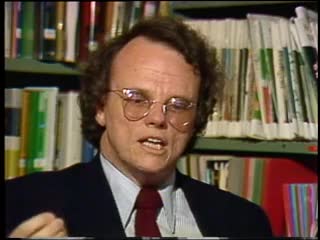
Description: South Boston High School exterior. Background comments of pedestrians talking to camera operator and reporter. Pam Bullard interviews headmaster Jerome Wynegar on what programs his school will offer, including core curriculum and vocational education. Wynegar says racial problems have been aggravated by outside agitators. He adds that the school is enrolled to capacity, and cannot accommodate students who wish to return after dropping out. He says that the school should make sure to listen to the suggestions of the students, and those students who dropped out, to try to improve the school. He commends the faculty. Additional comments from Wynegar as they shoot cutaways. Shots of graffiti painted on pavement, which reads “Stop Forced Busing.” Several takes of reporter voice over and standup.
Collection: Ten O'Clock News
Date Created: 08/17/1976
Description: Interview with headmaster Jerome Wynegar about changes at South Boston High School in last two years in four areas: administration, discipline, curriculum review, community relations. He sees improvement in students' ability to learn with fewer disruptions than in first years of busing. He discusses the school's attempt to prepare students for their futures. He says more research is needed into educational methods for a changing world; experiential learning should be emphasized over traditional lectures. He endorses alternative programs because attendance is encouraged. reel 1 of 2
Collection: Ten O'Clock News
Date Created: 06/01/1978
Description: Interview with headmaster Jerome Wynegar. Says there are more opportunities at South Boston High School than at any other school in the city. He is very sanguine about the integration of the student body, and the array in curriculum from basic skills to electives to vocational education. Compliments the administrative involvement of Joseph McDonough (community district superintendent). Says Boston School Department is notoriously bad in paying bills. reel 2 of 2
Collection: Ten O'Clock News
Date Created: 06/01/1978
Description: Democratic presidential candidate Jerry Brown visits his Rhode Island campaign headquarters. Hopes to capture the uncommitted delegates. Says "I'm not Santa Claus."
Collection: Ten O'Clock News
Date Created: 05/18/1976
Description: JERRY WILLIAMS ON AIR AT WRKO, DAVID BRUDNOY INTERVIEW. STUDIO. TALK SHOW.
Collection: Ten O'Clock News
Date Created: 10/19/1984
Description: WRKO host Jerry Williams talks on his show with atheist activist Madalyn Murray O'Hair via phone. “On Air” sign in radio studio. Audio engineer at console.
Collection: Ten O'Clock News
Date Created: 03/07/1984
Description: Jerry Williams' ballot question to repeal seat belt law wins voter approval.
Collection: Ten O'Clock News
Date Created: 11/05/1986
Description: Jess Cain celebrates 30th anniversary at WHDH radio. Testimony from fans and colleagues. Eddie Andelman, Larry Glick, Curt Gowdy, Jack Hynes.
Collection: Ten O'Clock News
Date Created: 12/03/1987
Description: Christy George reports that Jesse Jackson came to Boston to support the strike by employees of New England Telephone. Jackson addresses the strikers at City Hall Plaza. Management and employees cannot agree on who should pay for workers' health benefits. Interview with New England Telephone spokesman Peter Cronin, who says that the union agreed to share health care costs in 1986. George reports that employees accuse management of staging a "take-back." Jan Pierce of Communication Workers of America attends the rally on City Hall Plaza. Pierce rips up a phone bill and urges the workers not to pay their bills until the strike is over. The union is asking customers to stall payment on their phone bills until the strike is over. National unions are backing the Nynex strikers. Striking workers demonstrate outside of the New England Telephone building. The strikers urge a woman not to pay her phone bill.
1:00:14: Visual: Footage of Jesse Jackson (leader, Rainbow Coalition) addressing the striking employees of Nynex at City Hall Plaza. Jackson wears a baseball cap and a denim jacket. Jackson says that working people must take back America. Shots of striking workers waving signs and applauding for Jackson. Christy George reports that Jackson came to Boston to support the strike by employees of New England Telephone. V: Footage of Jackson saying that the workers need a health plan, not a "stale plan." The crowd applauds for Jackson and repeats his chants. Shots of the striking workers. Shots of hundreds of people assembled on City Hall Plaza. George reports that the telephone company and the workers do not agree on who should pay for the workers' health benefits. George reports that Nynex maintains that the union agreed to share the rising cost of health benefits. V: Footage of Peter Cronin (Spokesman, New England Telephone) saying that the union agreed in 1986 to share costs if the price of health benefits reached a certain level in 1988. Cronin says that the cost of health benefits has reached the level at which employees are expected to share costs or to take a deductible. George reports that employees say that Nynex is involved in a "take-back." George notes that the union says that it is fighting for all unions. George adds that today's rally included striking employees from Eastern Airlines and the United Mine Workers. V: Shots of striking workers at City Hall Plaza. Shots of uniformed pilots standing at the front of the rally. George reports that Jackson preached solidarity; that Jackson called on the workers to fight against the anti-labor policies of Ronald Reagan (former US president) and George Bush (US President). V: Footage of Jackson addressing the striking workers. Jackson encourages the workers to vote. He urges them to vote for important issues like wages, health care, education, and justice. Shot of a sign reading, "I won't pay my phone bill until the Nynex strike is over." George reports that the rally kicked off a new strategy by the union. V: Footage of Jan Pierce (Vice-President, Communication Workers of America) addressing the rally. Pierce rips up a phone bill and tosses the pieces into the air. Pierce urges the workers not to pay their phone bills until the strike is over. The workers cheer. Footage of Cronin saying that a customer should pay his or her bill if a service is provided. Cronin says that Nynex customers are reasonable; that Nynex customers will pay their bills. George reports that the union is actually asking customers to stall payments or to pay the minimum amount to keep their phone connected. V: Shot of a Boston Police cruiser. The cruiser has a sign supporting the strike on its window. Footage of strikers outside of the New England Telephone building on Franklin Street. Police officers are posted at the entrance to the building. Striking workers tell a female customer not to pay her phone bill. The workers tell the woman that her phone will not be disconnected because there are no workers to disconnect the phones. The woman walks away without paying her bill. The workers applaud. George stands in front of the New England Telephone building. George reports that labor unions have been losing ground in the US; that national unions are putting a lot of effort into the Nynex strike. George notes that the AFL-CIO is behind the strategy of asking customers to delay payment of their phone bills. George adds that the AFL-CIO represents a lot of people. V: Shots of the striking workers in front of the Nynex building. The workers chant, "Don't pay your bills." Shots of individual workers; of the exterior of the New England Telephone building. George reports that the AFL-CIO is throwing its weight behind this strike; that a win for labor would reverse a series of defeats. George notes that all unions will lose ground if the telephone company wins this strike. V: Shots of the striking workers.
Collection: Ten O'Clock News
Date Created: 08/15/1989
Description: David Boeri reports that Jesse Jackson will travel to Iraq to interview Saddam Hussein for the Jesse Jackson Show. Previously, Jackson has met with both the Iraqi ambassador and Prince Turki bin Abdul Aziz of Saudi Arabia, the brother of King Faad. Prince Aziz considers Jackson's trip to be a diplomatic mission to cool hostilities between Iraq and the United States. Boeri's report includes footage of Prince Aziz and his entourage. Interview with Mustafa Aziz, an advisor to Prince Aziz, who says that Jackson is well regarded in the Middle East. Boeri notes that George Bush does not support Jackson's trip. Jackson traveled to Syria in 1984 to secure the release of US Navy pilot Robert Goodman, Jr.. Footage from a press conference with Goodman and Jackson and footage of Ronald Reagan, who didn't like Jackson's 1984 trip. Many suspect Jackson of using guise of a journalist carry out a diplomatic mission to Iraq. Boeri's report features footage from the Jesse Jackson Show.
1:00:07: Visual: Footage of Jesse Jackson (African American political leader) from the Jesse Jackson Show on October 5, 1989. Jackson talks about his goal of discussing a broad range of ideas and viewpoints on his show. David Boeri reports that Jackson has found controversial ideas to discuss on his show. Boeri reports that Saddam Hussein (leader of Iraq) will be a guest star on Jackson's show; that Jackson's producers hope to be in Baghdad by the weekend. Boeri notes that Jackson's show will be syndicated. V: Shot of Hussein speaking on a telephone; of Hussein exiting a vehicle and being greeted by a few soldiers. Shot of an Iraqi military soldier in a bunker; of Iraqi military soldiers standing at attention. Footage of Jackson in Syria in January of 1984. Jackson sits beside Lieutenant Robert Goodman, Jr. (US Navy pilot) at a press conference. Jackson expresses gratitude for religious leaders and people who prayed and fasted for Goodman's release. Boeri reports that Jackson visited Syria in 1984; that Jackson went on a mission to free a US Navy pilot shot down by the Syrians. V: Footage of Jackson greeting an official in January of 1984. Footage of Goodman at the press conference with Jackson. Goodman says that he is happy to be going home; that Jackson is respected in the Middle East. Boeri reports that George Bush (US President) has not commented publicly on Jackson's trip to Iraq. Boeri reports that Ronald Reagan (former US President) did not appreciate Jackson's efforts in Syria in 1984; that Reagan did not return Jackson's pre-trip phone calls. V: Shot of Reagan speaking at a press conference during his presidency. Boeri reports that permission for Jackson's upcoming trip to Iraq was granted after a meeting with the Iraqi ambassador. Boeri reports that Jackson has been involved in a round of meetings; that Jackson recently traveled to Boston to meet Prince Turki bin Abdul Aziz of Saudi Arabia (brother of King Faad of Saudi Arabia). V: Shot of Jackson speaking. Footage of Prince Aziz and his entourage entering a luncheon room. Aziz greets US officials and members of the press, including Boeri. Boeri reports that Prince Aziz is fifth in the line of succession to the Saudi throne; that Aziz is a former deputy defense minister; that Aziz has been staying at the Charles Hotel in Cambridge. Boeri notes that Dr. Mustafa Aziz (advisor to Prince Aziz) believes that Jackson's upcoming trip to Iraq may be the last chance for a peaceful solution. V: Footage of Dr. Mustafa Aziz being interviewed by Boeri. Mustafa Aziz says that Jackson is seen in the Middle East as an honest politician and a civil rights champion. Boeri reports that Prince Aziz considers Jackson's trip to be a diplomatic mission instead of a journalistic mission. Boeri notes that Prince Aziz considers violent hostilities to be imminent. V: Footage of Mustafa Aziz being interviewed by Boeri. Mustafa Aziz says that the situation is tense and explosive. Boeri stands in front of the Charles Street Hotel. Boeri reports that the Bush administration told Jackson that they do not want him to go to Iraq; that the Bush administration said that they would not stop Jackson; that the Bush administration wished Jackson good luck. Boeri reports that Jackson's producers see the trip as an opportunity for Jackson to prove himself as a world-class journalist with international connections. Boeri notes that many suspect Jackson of taking cover as a journalist while on diplomatic mission to Baghdad. Boeri reports that Prince Aziz has installed a satellite on the roof of the Charles Hotel; that Prince Aziz will be watching Jackson's broadcast from Baghdad.
Collection: Ten O'Clock News
Date Created: 08/23/1990