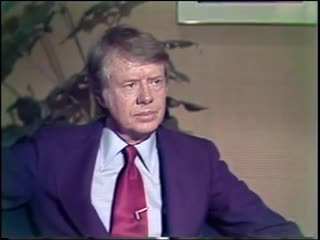
Description: John Hashimoto reports that Jesse Jackson visited Madison Park High School to talk to students. Hashimoto's report includes footage of Jackson's address to students in the school gymnasium. The students cheer enthusiastically as he approaches the podium. Jackson tells students that they must live with the consequences of their actions. He tells them that they can become whatever they want to be. He reprimands one student for talking during his speech. Jackson urges students to register to vote. He directs those who are not registered to a voter registration table in the gymnasium. Hashimoto reports on speculation that Jackson will run for the presidency in 1992. Hashimoto notes that Jackson could be elected senator if Washington DC becomes a state. Hashimoto reports that Jackson also spoke at the University of Massachusetts Boston. Hashimoto notes that Jackson addressed national and political issues in his address at UMass. Hashimoto's report features footage of Jackson's address at UMass. Hashimoto reports that Jackson is working to keep himself visible. Hashimoto calls Jackson a "perennial candidate" for elected office. The edited news story is followed by b-roll footage of Jackson and his entourage arriving at the high school, and the opening of the assembly including color guard and the end of the national anthem. Additional footage of Jackson's address. Byron Rishing, Bruce Bolling, and Charles Yancey sit behind Jackson during assembly. This edition of the Ten O'Clock News also included the following item: Francis "Mickey" Roache speaks to high school students on police stop-and-search policy
1:00:04: Visual: Footage of Jesse Jackson (African American political leader) holding up a child as the media photographs him. Jackson greets supporters and students at Madison Park High School in Roxbury. Shots of students in the audience. John Hashimoto reports that Jackson visited Madison Park High School to talk to students about reality, hope, and self-determination. V: Footage of Jackson addressing the students. Jackson asks students to stand if they know someone their age who is in jail because of drugs. Shots of students standing up in the audience. Footage of Jackson pointing to a student in the audience. Jackson tells the student that he will escort the student out of the auditorium if the student does not stop talking. Jackson tells the student to respect the student assembly. Footage of Jackson telling the students that they can be whatever they want to be. Jackson says that if Dan Quayle (US Vice-President) can be vice president, then the students can be whatever they want to be. The students applaud. Shots of students in the audience. Footage of Jackson telling the students that they must live with the consequences of their actions. Shots of the students rising to their feet to applaud for Jackson. Hashimoto reports that Jackson ended his talk by urging the students to vote. V: Footage of Jackson addressing the students. Jackson asks the students who are eligible to vote but who are not registered to come down to the voter registration table. Shots of students walking toward the table; of students registering to vote at the table. Hashimoto reports that many are wondering if Jackson will run for president in 1992. V: Footage of Jackson addressing the students. Jackson says that he will not talk about 1992. Jackson says that his priorities are to organize workers and to register voters. Shots of students lined up to register to vote. Hashimoto reports that Jackson sounds like a candidate; that Jackson is one of the backers of a bill to make Washington DC a state unto itself. Hashimoto notes that Washington DC would need 2 senators if it became a state; that Jackson could be a candidate for one of those two positions. V: Footage of Jackson, his entourage, and his supporters walking outside of a school building. Bruce Bolling (Boston City Council) walks with Jackson. Shot of Jackson entering a gymnasium at University of Massachusetts in Boston to the roaring applause of students. Jackson shakes hands with students near the podium. Shots of the audience as they applaud. Hashimoto reports that Jackson spoke at UMass Boston today; that he addressed national and political issues. V: Footage of Jackson speaking at UMass Boston. Jackson talks about the need to rebuild small towns in the US. Shots of Jackson addressing the audience at UMass Boston. Hashimoto reports that Jackson is working to keep himself visible. Hashimoto notes that Jackson's dominance as the nation's most visible African American leader is threatened by moderate politicians like Douglas Wilder (Governor of Virginia). V: Shot of Wilder exiting a voting booth. Hashimoto reports that Jackson will host his own television talk show in the fall. V: Shots of Jackson addressing the audience at UMass Boston. Footage of Jackson saying that it is time for mass action, mass education, mass demonstration; that it is time for the US to do the right thing. Hashimoto stands in the gymnasium at UMass Boston. Hashimoto reports that Jackson acts like a winner despite losing the Democratic nomination in 1988. Hashimoto says that many wonder if Jackson will ever become an elected official instead of a "galvanizing symbol." Hashimoto notes that Jackson is a perennial candidate for office, but has never won.
Collection: Ten O'Clock News
Date Created: 05/08/1990
Description: Sam Fleming reports that Jesse Jackson is campaigning in New Hampshire. Some consider Jackson to be the frontrunner for the Democratic nomination, but many political observers doubt Jackson's chances of winning the nomination. Jackson addresses supporters at a campaign rally, including about his support for the gay and lesbian community. Interviews with enthusiastic Jackson supporters in New Hampshire. Jackson tells reporters that his race is not as important as his credentials. He addresses another rally on the need for national affordable health care. Interview with Joe Grandmaison the Chairman of the New Hampshire Democratic Party, who says that it would not be wise to underestimate Jackson and his campaign. This edition of the Ten O'Clock News also included the following item: Ray Flynn, Michael Dukakis, and Bruce Bolling discuss linkage between Chinatown development and Parcel 18 in Roxbury
1:00:54: Visual: Footage of Jesse Jackson (Democratic candidate for US President) getting his picture taken in front of the fall foliage in New Hampshire. Jackson walks into a rustic building. Sam Fleming reports that Jackson is trying to secure voter support in New Hampshire; that Jackson is considered to be the frontrunner for the Democratic nomination. V: Shots of Jackson shaking hands with New Hampshire voters. Shot of Jackson addressing the crowd. The crowd applauds. Fleming reports that many political observers doubt Jackson's chances of winning the nomination; that Jackson is not paying attention to the "conventional wisdom" of the political observers. V: Footage of Jackson addressing the crowd. Shots of members of the crowd. Jackson talks about speaking at last weekend's rally for gays and lesbians in Washingon D.C. Jackson says that the voices of gays and lesbians deserve to be heard. Fleming notes that Jackson is reaching out to the dispossesed. V: Footage of Jackson talking about his efforts to build a diverse coalition of supporters. Jackson says that his leadership will put the nation on a course for jobs, peace, and justice. The crowd applauds. Shots of individual audience members. Footage of an older white female voter saying that Jackson is "energizing"; of a white female voter saying that she hopes that Jackson has a chance at the nomination. Footage of an older white male voter saying that some critics are trying to create a negative image of Jackson; that Jackson is "electable." Footage of Jackson speaking to reporters. A reporter asks Jackson if an African American can win the Democratic nomination. Jackson says that the issue of his race should be left to "God"; that the issue of his credentials should be left up to the voters. Fleming notes that Jackson has been questioned about the state of his marriage. V: Footage of Jackson telling reporters that he will not speculate about rumors; that he is fighting to win the nomination. Fleming reports that Jackson opened his campaign office in Manchester, N.H. V: Footage of a crowd gathered in front of Jackson's campaign office. Shot of a white female voter holding a hand-made Jackson campaign sign. The crowd begins to chant, "We want Jesse." Jackson shakes hands with voters outside of the office. Shots of an older white man; of a young African American boy in the crowd. Jackson addresses the crowd. Jackson talks about the need for a national health care system. Jackson says that he will provide "bold leadership." Fleming notes that Jackson did well with white Democratic voters in New Hampshire in 1984. Fleming reports that one Jackson campaign supporter said that the Jackson campaign lacked an organized structure; that fundraising so far has been minimal. Fleming adds that some voters see Jackson as a candidate supported mainly by African Americans. V: Shots of Jackson addressing a crowd; of individual members of the crowd. Footage of Joe Grandmaison (Chairman, New Hampshire Democratic Party) saying that no one underestimates the strength of Jackson and his message. Footage of Jackson addressing the crowd about the need to save jobs, schools, farms, and the environment, and to "give peace a chance." The crowd chants along with Jackson and applauds for him. Shot of an elderly woman at the Jackson campaign rally.
Collection: Ten O'Clock News
Date Created: 10/12/1987
Description: A Ten O'Clock News special features an interview with Jesse Jackson (Democratic candidate for US President). Christopher Lydon (WGBH), Dennis Farney (Wall Street Journal), and Ken Bode (NBC News) interview Jackson. Lydon notes that the goal of the interview is to discover how Jackson's character would shape his presidency. Jackson jokes about the psychoanalytic nature of the interview. Jackson talks about growing up in a segregated society and participating in the civil rights movement. He answers questions about his childhood. He talks about his campaign and the support he has received so far. Jackson talks about the challenges faced by young African Americans, and says that young African Americans must work twice as hard as whites in order to succeed. Jackson says that some conservative African Americans may not support his candidacy; he adds that people of all races are finding common ground in his candidacy. Jackson reviews the accomplishments of his political organization and talks about his experiences in shaping political policy during the 1960s and the 1970s. He names the politicians whom he admires. He talks about his relationship to the Democratic Party leadership and about his efforts to open up the Democratic Party to minority voters. Jackson says that he would like to establish better relations between the African American community and the Jewish community. He names the people to whom he turns for advice. Jackson says that he regrets the splintering of the civil rights movement in the 1970s. He talks about the Rainbow Coalition as a means to reunite those groups. Tape 1 of 2.
1:00:37: Visual: WGBH logo. Christopher Lydon introduces an "extended conversation" with Jesse Jackson (candidate for US President). Lydon notes that the half hour show was planned in cooperation with the John F. Kennedy School of Government at Harvard University. Lydon adds that the goal of the interview is to discover how Jackson's character would shape his presidency. Lydon introduces in-studio guests Dennis Farney (Wall Street Journal) and Ken Bode (NBC News). Lydon reviews biographical facts about Jackson including date of birth, education, and his career in the civil rights movement. Lydon asks Jackson which actor he would choose to portray Jesse Jackson in a movie about his life, and what Jackson would tell the actor about his character. Jackson jokes about the psychoanalytic nature of this interview. Jackson talks about growing up in a segregated society. Jackson says that he is sensitive to the needs of the poor and the disenfranchised; that he participated in the civil rights movement and has seen great changes. Jackson says that he has not grown bitter about US society because he has seen such great changes. 1:04:28: V: Farney asks Jackson about his childhood and whether he felt rejected by his father. Jackson talks about feeling a sense of rejection as a child; that he was called a "bastard." Jackson says that his athletic and academic success were his way of fighting back against those who rejected him or laughed at him. Jackson says that he has grown accustomed to adversity and to the "double standard" which exists in society. Bode asks Jackson if the US is ready for an African American president. Bode mentions that Bill Lucy (African American union leader) has said that the US is not ready. Jackson notes that he has been received warmly in New Hampshire. Jackson says that no one will know if the US is ready for an African American president until the nation is given the chance to elect one. Jackson says that an African American candidate may get support from women, Hispanics and American Indians; that many groups in society can identify with his candidacy. Jackson mentions the Rainbow Coalition. Jackson notes that he is running second or third out of eight candidates in New Hampshire. Lydon asks Jackson about his success in life and about his belief in self-reliance. Jackson says that the "triangle" of family, church, and school allowed him to grow up with a sense of confidence; that he was insulated from some of the ill effects of segregation. Jackson mentions the closeness of his family to a particular white family, despite living in a segregated society. 1:11:19: V: Lydon asks Jackson how to foster good support networks for young African Americans growing up today. Jackson says that young African Americans need to work harder than whites to succeed; that their hard work will pay off in the end; that those who work hard to succeed develop an inner strength and character. Bode notes that the Alabama Democratic Conference endorsed Walter Mondale's candidacy for US President. Bode adds that Jackson's political organization said that their endorsement of Mondale was the equivalent of "putting another bullet into the body of Martin Luther King." Jackson denies characterizing the endorsement in that manner. Jackson talks about the reluctance of the African American community to upset the status quo. Jackson says that some of the resistance to the civil rights movement came from conservative African Americans. Bode asks Jackson what percentage of the vote he expects to receive in the Alabama primary. Jackson says that he will not speculate on percentages. Jackson talks about the endorsements and support he has received. Jackson says that he has received support from white voters in the south; that whites, African Americans, and other minorities are finding common ground in his candidacy. 1:15:38: V: Farney asks why Jackson sometimes refers to himself as a "prophet" instead of a "politician." Jackson explains that his role is prophetic in that he tries to change the structure of society. Farney notes that Jackson has been criticized for a lack of administrative experience. Jackson reviews the accomplishments of his political organization. Jackson notes the limited budget under which his campaign operates. Farney asks about Jackson's political legacy. Jackson says that his candidacy has forced the Democratic Party to open up; that his candidacy has forced both political parties to understand the importance of minority voters. Lydon asks about Jackson's spiritual life. Jackson says that he tries to seek common ground between people of different religions; that certain values are held in common by all religions. Jackson says that he is committed to the poor, the elderly and the young. Lydon asks Jackson why Ralph Abernathy (African American leader) said that Jackson could be his president but not his pastor. Jackson says that he does not know why Abernathy said that. Bode comments that Jackson has not held political office, but that he has had a lot of contact with politicians. Jackson notes that he was the first African American delegate to the Democratic Party in 1962. Jackson reviews his leadership experience and his role in shaping public policy in the 1960s and 1970s. 1:20:55: V: Bode asks Jackson which politicians he admires, aside from Martin Luther King. Jackson talks about Hubert Humphrey (US Senator), Ron Dellums (US Representative), and Adam Powell (US Representative). Bode notes that Jackson has criticized Tip O'Neill (Speaker, US House of Representatives) and Lane Kirkland (President, AFL-CIO). Bode asks how Jackson will deal with the Democratic leadership. Jackson says that he will conduct business with these leaders on the basis of "mutual respect." Jackson says that the Democratic Party needs a more articulate spokesman than O'Neill; that he respects O'Neill. Jackson notes that the labor movement needs to commit itself to providing equal access to jobs for African Americans, Hispanics, and women. Lydon asks Jackson about how his candidacy is viewed by American Jews. Jackson says that he would like to establish better relations between African American and Jewish leaders. Jackson says that he regrets the conflicts between African Americans and Jews in the past; that he supports the right of Israel to exist; that he also supports the rights of Palestinians. Jackson talks about his view of the Middle Eastern conflict. Farney notes that Jimmy Carter (former US President) was elected as an "outsider." Farney asks if Jackson would be more successful than Carter in operating in politics as an "outsider." Jackson says that Carter remained on the "outside" as president; that Carter did not use the power of the presidency to its full extent. Jackson says that he disagrees with the critics who call the Carter administration a "failure." Jackson criticizes the foreign policy of Ronald Reagan (US President). 1:26:29: V: Bode asks Jackson about his advisors. Jackson says that he consults with his wife and his children. Jackson names a list of people with whom he consults including Dellums, Marion Barry (mayor of Washington D.C.), Walter Fauntroy (US Congressman), Edward Bennett Williams (attorney), Dr. Al Pitcher (University of Chicago), and Dr. Jack Mendelsohn (minister). Lydon asks Jackson to disclose any major failures or flaws in his character. Jackson says that he does not dwell on his failures, but that he has learned a lot from them. Jackson says that he regrets how the civil rights movement broke up in the 1970s; that he is trying to bring back together the groups involved in the civil rights movement through his coalition. Jackson says that he is concerned with the conflict between African Americans and American Jews. Jackson talks about the importance of communication in resolving conflict. Lydon thanks Jackson, Farney and Bode. End credits roll.
Collection: Ten O'Clock News
Date Created: 02/03/1984
Description: David Boeri reports that Jesse Jackson spoke at the Massachusetts State House about the importance of access to higher education. Boeri notes that some students cannot afford higher education because of the increasing costs of higher education and federal cuts in student aid. Many supporters turned out to listen to Jackson. Jackson talks to the audience about the importance of education. Jackson addresses the media after his speech.
1:00:10: Visual: Footage of Kevin Sheehan (State Student Association of Massachusetts) talking about college students who must work forty hours per week on top of taking classes. Footage of Mike Ferrigno (State Student Association of Massachusetts) addressing a crowd at the State House about the debt incurred by many students in college. David Boeri reports that many low- and middle-income college students are incurring heavy debt in colleges; that some students can not afford to go to college. V: Shot of students walking on a campus. Boeri reports that speakers at a State House rally attacked federal cuts in federal aid to students. Boeri notes that the cuts come at a time when tuition and the cost of living are increasing; that grants are less easy to obtain. V: Shot of speakers and the audience inside the State House. Footage of Jesse Jackson (African American political leader) speaking about the importance of access to education. Boeri reports that Jackson said that universities have let the enrollment numbers fall for African American, minority, and low-income students. V: Shots of the members of the audience, including Mel King (community activist), Bill Owens (former state senator) and Shirley Owens Hicks (state representative). Footage of Jackson urging students to protest cuts in student aid. Jackson condemns the priorities of Ronald Reagan (US President). Jackson says that Reagan is "embarking on a trillion dollar misadventure in space." Jackson tells students that they need to stay sober, fight the Star Wars program and to "vote with Red Sox fever." The audience applauds as members rise to their feet. Footage of Jackson speaking to the media after his speech. Jackson uses the parable of Jesus Christ to illustrate society's obligation to cater to the needs of the poor and needy. Jackson says that many children are "locked out and living in the manger." Bruce Bolling (Boston City Council) is visible behind Jackson. Boeri reports that the State Student Association has registered over 5,000 new student voters; that the students will vote for more affordable education in November.
Collection: Ten O'Clock News
Date Created: 10/17/1986
Description: During informal conversation prior to an interview with Christopher Lydon, Dennis Farney (Wall Street Journal) and Ken Bode (NBC News), Jesse Jackson uses expletives to describe how his parents disciplined him as a child.
1:00:00: Visual: Jesse Jackson (US presidential candidate) sits in the WGBH studio with Christopher Lydon, Dennis Farney (Wall Street Journal) and Ken Bode (NBC News) before an interview. A crew member adjusts Jackson's lapel microphone. The four men joke lightheartedly about the interview. Lydon tells a story about another reporter's 1972 interview with George McGovern (Democratic nominee for US president). Lydon says that McGovern was asked if his father beat him as a child. Jackson uses slang and expletives to describe how his parents disciplined him as a child. Visual: Video cuts out. Audio of Lydon asking Jackson about his favorite ministers in the Boston area. Jackson mentions Reverend Charles Stith. Video returns. Lydon runs his hands through his hair and prepares for the interview.
Collection: Ten O'Clock News
Date Created: 02/03/1984
Description: 4 days of testimony in Jesse Waters / George Vest dope & graft trial.
Collection: Ten O'Clock News
Date Created: 09/23/1986
Description: Alexandra Marks reports on the Jeter family's business. These entrepreneurs started Jet-A-Way trash disposal and recycling business in Boston in 1967. Interview with Jesse Jeter on the lack of media attention on successful African American people and other minority businesses. He also talks about the racism he experiences in some of his business relationships. Interview with Ed and Darlene Jeter on the hard work they put into their business. They also discuss the help that affirmative action has given their company. Footage from the NAACP's Leadership Development Training Conference. Interview with entrepreneur William Singleton, president of Quest, who talks about the lack of financing for minority companies. Following the edited story is additional b-roll footage of the Jet-A-Way company at work. Recycling yard, dumpsters, heavy machinery.
1:00:07: Visual: Shots of machinery sorting trash at a Jet-A-Way sorting facility. Alexandra Marks reports that Jet-A-Way owns a state-of-the-art trash-sorting plant; that Jet-A-Way is a multi-million dollar Boston company; that Jet-A-Way recycles trash, industrial waste, and construction debris. V: Footage of Jesse Jeter (marketing director, Jet-A-Way) being interviewed at the facility. Jeter says that they recycle materials from projects as far away as South Korea and Japan. Marks reports that Jeter's parents started Jet-A-Way in 1967; that Jet-A-Way is one of the fastest-growing minority firms in the US. V: Shots of bales of paper being moved around a warehouse; of Jeter watching standing in the warehouse as a white worker maneuvers a piece of equipment. Shot of a Jet-A-Way truck. Footage of Jeter being interviewed by Marks. Jeter says that people are not familiar with successful African American entrepreneurs; that the media concentrate on crime, drug and poverty in the African American community. Marks reports that Jeter says that people make prejudicial assumptions about many minority businesses. V: Footage of Jeter being interviewed by Marks. Jeter says that people will second-guess the decisions of a minority firm. Jeter says that prospective clients will ask to see the client lists of minority firms; that prospective clients doubt the legitimacy of minority firms. Jeter says that his firm services MIT (Massachusetts Institute of Technology, the John Hancock Company, and the Town of Newton. Footage of Ed Jeter (Jet-A-Way) and Darlene Jeter (Jet-A-Way) being interviewed. Ed Jeter says that the company has succeeded through hard work. Marks reports that Darlene and Ed Jeter have seen the company through several economic downturns; that they are good businesspeople. V: Footage of Ed Jeter being interviewed. Ed Jeter says that the company benefitted from minority quotas that were in place when the business began. Footage of Darlene Jeter being interviewed. Darlene Jeter says that Jet-A-Way formed good business relationships with their early clients; that they have served some clients for over twenty years. Marks reports that business success was the theme of a last week's NAACP Leadership Development Training Conference. Marks reports that prominent African American women modeled business fashion; that young entrepreneurs worked the crowd at the luncheon. V: Footage from the NAACP Leadership Development Training Conference. Shot of an African American man singing and playing the piano at the luncheon. Shot of an African American woman modeling a dress on a catwalk. The audience at the luncheon applauds. Shot of a second African American woman modeling an outfit. Shot of William Singleton (President, Quest Publishing Company) talking about his company to two conference attendees. Footage of Singleton being interviewed at the conference. Singleton says that most people do not see the activity of African American entrepreneurs; that African American entrepreneurs are underfinanced and working hard. Marks reports that Singleton's company publishes the magazine "Black History Is No Mystery." Marks notes that Singleton believes that the lack of financing for African American entrepreneurs is due to ignorance. V: Shot of Singleton talking to conference attendees at a table. Footage of Singleton being interviewed at the conference. Singleton says that financers do not understand how the African American community works; that people are starting to understand. Marks reports that there are challenges for African-American businesses. V: Shots of workers sorting trash and debris on an assembly line. Jesse Jeter surveys the operation in the facility. Footage of Jesse Jeter being interviewed. Jesse Jeter says that racism exists in Boston and in the US. Jesse Jeter says that racism affects contracts, business relationships, and personal relationships. Shots of machinery moving trash in the Jet-A-Way facility; of Jeter directing operations in the facility.
Collection: Ten O'Clock News
Date Created: 03/29/1991
Description: Elderly Jews who emigrated from Eastern Europe discuss the possible reunification of Germany in the wake of opening the Berlin Wall.
Collection: Ten O'Clock News
Date Created: 11/17/1989
Description: Two fledgling state legislature candidates are defined by their position on taxes: Jim Marzilli (pro), Democrat for representative; Charlie Shannon (anti), Republican for senate.
Collection: Ten O'Clock News
Date Created: 05/03/1990
Description: Jim Nuzzo announces his Republican candidacy for Congress. Frank comments on Ethics Committee investigation. Alexander Tennant.
Collection: Ten O'Clock News
Date Created: 05/22/1990