« Previous | 4,921 - 4,930 of 7,330 | Next »
Description:
Christopher Lydon reports on the demise of the elevated tracks along the MBTA orange line. The elevated train stations were designed by Alexander Wadsworth Longfellow (nephew of Henry Wadsworth Longfellow) and were once considered the architectural pride of the city's mass transit system. Interview with Margaret Floyd of Tufts University and State Rep. Byron Rushing about the elevated line. Floyd discusses the architecture of the stations. Rushing talks about the architectural and historical significance of the elevated line, and its importance to the community. Interviews with people on the street who give their opinions on the elevated line. Following the edited story is additional b-roll of the elevated line and orange line trains.
1:00:00: Visual: Shot of Dover Station on the elevated tracks of the orange line of the MBTA. Shots of Dover, Northampton, Dudley, and Eggleston Stations on the elevated orange line. Shots of the elevated tracks. Christopher Lydon reports that the elevated tracks of the orange line run through Roxbury and the South End; that trains will not longer pass through the stations after this evening. V: Shots of a tunnel leading to one of the orange line stations. Graffiti covers the walls. Shots of the decrepit exteriors of stations along the elevated tracks of the orange line. Lydon says that the elevated stations were once the "architectural pride" of the city's mass transportation; that the stations were designed by Alexander Wadsworth Longfellow (architect and nephew of Henry Wadsworth Longfellow) for a turn-of-the-century competition. V: Shots of architectural drawings and plans of the elevated stations. Footage of Margaret Floyd (Tufts University) talking about the modular design of the elevated stations of the orange line. Floyd talks about the ornate ironwork and other details which do not appear in contemporary architecture. Shots of the elevated stations; of the iron railings of a walkway leading to a station. Footage of Byron Rushing (State Representative from Roxbury) saying that he is surprised that historic preservationists have not protested the demolition of the elevated stations. Rushing says that the orange line was the first elevated line in the country to be designed for electric trains. Shot of a person looking from one of the windows of an elevated station. Shots of an orange line train traveling along the elevated tracks. Lydon reports that Dudley Square is dominated by the elevated train station. V: Shots of the elevated tracks in Dudley Square from below. Footage of Rushing saying that the physical structure of the elevated tracks has been an important characteristic of the neighborhood for a long time. Rushing adds that people talk about Dudley Station in unflattering terms. Footage of a white man saying that Dudley station is "unsightly"; that the station is falling apart and is beyond repair. Footage of Rushing saying that there is a place for "funkiness"; that the tracks cannot be put back up once they are torn down. Rushing adds that one can never predict what will happen to the neighborhood when the tracks are taken down. Footage of an African American man saying that Dudley station only needs some renovation and a paint job; of a young African American man saying that he would like the area around Dudley station renovated to resemble Lafayette Place when the tracks are taken down. Footage of a young African American boy saying that the area should be turned into "everything." Shots of Dudley Station. Footage of Rushing saying that the city should pave the road where the tracks once were; that a bike path should be constructed along the route of the tracks. Byron talks about being able to ride from Franklin Park to downtown Boston. Rushing calls the elevated tracks a "fantastic piece of sculpture." Rushing says that the tracks are "the Eiffel Tower on its side." Shots of the train tracks from a moving train; of the tracks from beneath. Rushing talks about how the elevated tracks connect several neighborhoods; that the elevated tracks do not belong to any one community. Rushing speculates that an artist in the future will be commissioned to come up with a way to connect the neighborhoods, while making an artistic statement at the same time. Rushing says that the artist will come up with a design similar to the elevated tracks. Rushing says that he does not know why the city is so eager to dismantle the tracks. Shot of an orange line train moving down the tracks.
Collection:
Ten O'Clock News
Date Created:
04/30/1987
Description:
James O'Leary, MBTA director, explains how T can improve the Washington Street bus service which replaced the El.
Collection:
Ten O'Clock News
Date Created:
08/14/1987
Description:
Orange Then Blue jazz band, composed of New England Conservatory alumni and named after a Mingus tune, rehearse and talk about their attitude toward performing the music, both standards and originals. Bruce Barth, Matt Darriau, Adam Kolker, Dave Mann, George Schuller, Roy Okutani, Pat Hollenbeck.
Collection:
Ten O'Clock News
Date Created:
03/15/1985
Description:
Orange line Egleston station. POV riding up escalator to outdoor platform with few passengers waiting. Empty train pulls up, people board. POV riding along track, looking inbound to Boston and down onto track bed. Train interior. Characteristic screeching and locomotion clunking sounds. Train passes through Dudley station. Map sign of MBTA subway system.
Collection:
Ten O'Clock News
Date Created:
10/04/1977
Description:
Physicist creates sculptures ("orbs") from light spikes, i.e. electric field in a contained atmosphere, which change with human contact.
Collection:
Ten O'Clock News
Date Created:
10/06/1987
Description:
Bishop Roberto Gonzalez is ordained at Holy Cross Cathedral as first Hispanic auxiliary bishop in Boston archdiocese, and youngest.
Collection:
Ten O'Clock News
Date Created:
10/03/1988
Description:
Interview with residents at Orient Heights housing project about prejudice among residents, and outside groups, including white supremacy groups, coming in causing trouble. Two white boys say “the white kids don't want to live with the blacks or the spics [sic].” Interview with woman from Lawyers Committee for Civil Rights about unresponsiveness of city officials to racial violence, following fire bombing of Guatemalan family by 200 whites. Interview with man from an advocacy group on the history of similar racially motivated attacks in East Boston and the lack of response from the community and officials. He mentions that violence in housing projects, specifically, is not given enough attention by the police. He also describes lawsuits brought by minorities who have been discriminated against. Exteriors of Orient Heights project, many windows boarded up. Black and white kids play. Mural of JFK and Big Bird.
Collection:
Ten O'Clock News
Date Created:
07/27/1978
Description:
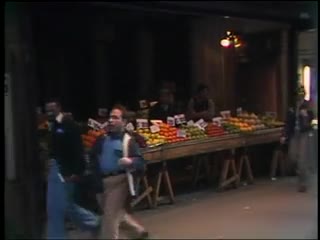
Orpheum Theatre marquee: “Opera Company of Boston, Damnation of Faust.” Produce for sale on sidewalk below. White bas relief entrance on Hamilton Place. Signs for Meatloaf concert. Ticket window with posters for Cecil Taylor and Artist's Ball. Poster for gala benefit for restoration of Modern Theatre.
Collection:
Ten O'Clock News
Date Created:
03/30/1978
Description:
Bruins vs St. Louis Blues. Bobby Orr scores winning goal in sudden death overtime to gain Stanley Cup. Replay of the goal. Team celebrating. Blues and Bruins congratulating each other after game. Some dropout at the end of the tape.
Collection:
Ten O'Clock News
Date Created:
05/15/1970