Description: Deborah Wang reports that the city of Boston's minority set-aside program is facing a court challenge. This program allows minority-owned businesses to break into their industries by inviting them to participate in municipal projects. Interview with Robert McCoy pf McCoy Landscaping, who says that his business could not have survived without the program. The Consortium of Minority Business Enterprises has been formed to protect set-aside laws in Massachusetts. Interview with Walter Williams of the Contractors' Association of Boston, about the set-aside programs. The Consortium gave a hostile reception to Sen. John Kerry at a recent meeting, where he says that public opinion is not in favor of set-aside programs. Wang notes that Consortium members seem to be united in support of set-aside programs. This edition of the Ten O'Clock News also included the following item: Press conference to celebrate the positive findings of a study on the state's Healthy Start Program
1:00:08: Visual: Footage of construction workers digging holes for the construction of a new park in Roxbury. Deborah Wang reports that the new Roxbury park is a $400,000 project which has been funded by the city of Boston. Wang reports that the work is being done by McCoy Landscapers; that McCoy Landscapers may not have had an opportunity to do the job five years ago. V: Footage of Robert McCoy (McCoy Landscaping) being interviewed by Wang at the park site. McCoy says that the minority set-aside program has allowed him to build his business; that he could not have survived without the program. Wang reports that McCoy says that minority firms often have a hard time getting their bids accepted by contractors. V: Shots of construction workers digging holes at the Roxbury park site. Footage of McCoy saying that most contractors want to work with firms with which they are familiar. McCoy says that the minority set-aside program has allowed his company to break into the business. Wang reports that the minority set-aside program has been threatened by a Supreme Court decision; that Boston's set-aside program is facing a court challenge. Wang reports that minority business owners say that their businesses will be devastated if the program is shut down. V: Shot of workers digging and measuring holes at the Roxbury site. Footage of a meeting held by the Consortium of Minority Business Enterprises. Shot of a banner for the Contractors' Association of Boston, which hangs on a wall of the meeting room. Shots of the media and audience members at the meeting. Wang reports that the Consortium of Minority Business Enterprises has been formed to protect set-aside laws in Massachusetts. V: Footage of Walter Williams (Contractors' Association of Boston) being interviewed by Wang. Williams says that minority-owned businesses will be fighting with white-owned businesses for opportunities. Wang reports that members of the Consortium of Minority Business Enterprises gave a hostile reception to John Kerry (US Senator). Wang notes that Kerry has been a long-time supporter of set-aside programs. Wang reports that Kerry told the Consortium that public opinion is against them. V: Footage of Kerry at the Consortium meeting. Kerry says that Irish immigrants, Italian immigrants, and immigrants of other nationalities struggled to succeed without affirmative action programs when they arrived in the US. A Consortium member tells Kerry that he does not care if the Consortium offends other groups. Kerry tells the Consortium that he is trying to describe the feelings of other groups toward affirmative action programs; that the Consortium needs to decide whether or not to take these feelings into account. Kerry says that there will be trouble if the Consortium does not care about the feelings of other groups. Shots of Consortium members attending the meeting, including Deval Patrick (attorney). Wang reports that the Consortium needs to decide whether it will compromise; that members took a hard line at today's meeting. V: Footage of McCoy being interviewed by Wang at the Roxbury park site. saying that the Consortium will probably offend some groups with its actions; that the civil rights movement offended some people. McCoy says that the Consortium will not change its position.
Collection: Ten O'Clock News
Date Created: 05/15/1989
Description: Marcus Jones reports that a group of minority developers will work with Mayor Ray Flynn and the Boston Redevelopment Authority (BRA) to develop a multi-million dollar complex including office, retail, and residential space in downtown Boston. The complex will replace a downtown parking garage. Jones reports that Flynn's "parcel to parcel linkage program" will link downtown development to development in minority neighborhoods. Jones adds that this project will be linked to a parcel of land in Roxbury. Flynn and the developers, called the Columbia Plaza Associates, hold a press conference to announce plans for the development. Interviews with President of City Council Bruce Bolling and Davis Woo of the Chinese Investment Group about the need for development in minority neighborhoods. Interview with Stephen Coyle, the BRA Commissioner, about opportunities for minority involvement in development. This edition of the Ten O'Clock News also included the following items: Community leaders talk about the significance of the African Meeting House and Renovation of the African Meeting House
1:00:30: Visual: Shots of downtown Boston; of construction in downtown Boston. Marcus Jones reports that $7 billion has been invested in construction in dowtown Boston over the past nine years. V: Shot of Ray Flynn (Mayor of Boston) and a group of minority developers. Jones reports that a group of minority developers are working with Flynn through his "parcel to parcel linkage program"; that the developers will work with the Flynn administraton on a multi-million dollar development which will replace a downtown parking garage. V: Shot of the downtown parking garage. Footage of Flynn saying that a united partnership has been created with members of the Asian, African American, and Hispanic communities. Jones reports that the developers have called themselves the Columbia Plaza Associates; that the developers have raised $2.5 million of their $5.7 million goal. V: Shot of an African American developer standing among the group. Jones notes that the developers represent an important part of Flynn's plan to link downtown development to development in minority neighborhoods such as Chinatown and Roxbury. V: Footage of Bruce Bolling (President, Boston City Council) saying that "those who have been factored out will now be factored in." Footage of Davis Woo (Chinese Investment Group) saying that the developers will work toward buiding new housing in Chinatown; that there is not enough housing in Chinatown. Jones reports that city officials expect to see a development with office, retail, and housing space built to replace the parking garage; that the project is valued at $400 million; that $100 million is earmarked for the minority developers who have won the right to co-develop the project. V: Shot of the parking garage; of a relief of the seal of the city of Boston set into the wall of the garage. Footage of Stephen Coyle (Commissioner, Boston Redevelopment Authority) saying that the minority developers have the "inside track" to develop the project; that this project marks the beginning of a "new era" in the city. Jones reports that up to $15 million spent to purchase the land from the city will be spent by the minority developers to create jobs and to build offices, stores and housing on a 5-acre parcel of land near the Ruggles MBTA Station in Roxbury. V: Overhead shot of the parcel of land in Roxbury. Footage of Coyle saying that the Boston economy will remain strong for the next decade; that teams of minority developers will be able to take advantage of new economic opportunities. Footage of Bolling saying that the work of minority developers will ensure future minority participation in the city. Jones reports that city officials will designate a formal development team for the linkage project in the winter; that construction is slated to start in the spring of 1988. V: Shot of the parking garage.
Collection: Ten O'Clock News
Date Created: 09/19/1986
Description: Christy George reports that Ernie Branch teaches karate to urban kids. Interview with Branch, who talks about the value of karate. Branch says that hard work, dedication, and concentration are all important in karate. Branch holds a class with a group of kids. Interviews with the children in Branch's class about why they like karate and about what they would like to be when they grow up. Interviews with parents Haroldine Haley and Michael Langelow about the benefits of the karate classes. Branch's karate classes are funded by the Massachusetts Housing Finance Agency (MHFA).
0:59:58: Visual: Footage of minority youth in a karate class. Shots of individual youth as they perform their exercises. Shot of Ernie Branch (karate instructor). Christy George reports that Branch is a volunteer; that Branch is also a father and a former marine. V: Footage of Branch counting out loud as the youth do their exercises. Shots of individual youth in the class. Branch circulates among the class members. Footage of Branch being interviewed. Branch says that young kids have not yet decided if they want to be "good guys" or "bad guys." Branch says that the "good guys" do not offer any incentives; that the "bad guys" do offer incentives. Branch says that kids must learn that short term greed does not pay off in the end. Branch says that he tries to teach kids that hard work, dedication, and concentration will pay off. Branch says that kids need to learn how to think. George reports that Branch teaches karate to kids; that karate is a form of self-defense; that karate teaches confidence, structure, and self-respect. V: Branch instructs the members of the class to sit down. They sit down. Shots of individual members of the class. A young African American boy performs exercises in front of the class. Footage of Branch being interviewed. Branch says that major sports like basketball and football do not appeal to all kids. Branch says that some kids who fail in other sports find success in karate. Branch says that there is no failure in karate; that kids can progress at their own rate of speed; that kids receive individual attention. Footage of the members of the class being interviewed by George. George asks what karate teaches them about not fighting. King Branch (age eleven) says that karate has taught him that people will make trouble for you if you make trouble for them. King Branch says that he does not want to be the one who starts a fight; that he might be the one who gets beat up. Footage of Nathaniel Pomales (age eleven) says that it is important to remember hand blocks so that others cannot hit you. George remarks that karate requires a lot of concentration. Pomales says that he keeps it all in his head. Footage of Camille Langelow (age nine) saying that she has learned discipline and how to stand up for herself. Footage of James Haley (age nine) saying that karate has taught him to avoid bad behavior; that he usually has bad behavior. Footage of Andrew Cherry (age ten) saying that karate has taught him to avoid fights; that karate has taught him to ignore what others say about him. George reports that two of the children in Branch's class have special needs; that they are overactive and have trouble concentrating. George notes that these students have no problem in Branch's class. V: Shot of Branch instructing the members of the class as they do their exercises. Footage of Haroldine Haley (mother of James Haley) sitting with James Haley. Haroldine Haley says that she used to have trouble getting James Haley to do his homework. Haroldine Haley says that she told James Haley that he could not go to karate if his homework is not finished. Haroldine Haley says that James Haley always has his homework done before karate now. George reports that Haroldine Haley and Michael Langelow (father of Camille Langelow) think that parents need to be more involved with their children. Footage of Michael Langelow sitting with Camille Langelow. Michael Langelow says that kids are being destroyed by drugs, gangs, and violence. Michael Langelow says that parents need to be responsible for their children. Shots of two members of the class performing exercises in front of the others. George reports that Branch's karate classes are funded by the Massachusetts Housing Finance Agency (MHFA); that the MHFA finances low-interest mortgages for low-income housing. George reports that the MHFA has found that the best way to protect its real estate is to protect the tenants. George notes that the MHFA conducts classes and counseling in areas including substance abuse, single parenting, suicide prevention, and karate. V: Shot of Branch demonstrating hand movements for the class. Footage of Pomales saying that he wants to be a scientist and an astronaut when he grows up; of Cherry saying that he would like to be a basketball player. Footage of a young girl in the class saying that she would like to be a doctor. Footage of Camille Langelow saying that she would like to be a runner or another kind of athlete. Footage of King Branch saying that he would like to be a US Marine sergeant. Shots of the students in karate class. George says that not all kids have someone who cares about them. V: Footage of Ernie Branch being interviewed. Branch says that he cares about youth because they represent the future. Shots of the students performing exercises in unison. Branch corrects one of the girls in class.
Collection: Ten O'Clock News
Date Created: 07/26/1990
Description: Mitchell Rabkin, president of Beth Israel Hospital, objects to cost containment provision in proposal to extend health coverage to uninsured.
Collection: Ten O'Clock News
Date Created: 09/03/1987
Description: David Boeri reports on the Bank of Boston's new mortgage program for low- and moderate-income city residents. President of Bank of Boston Ira Stepanian and Robert Mahoney announcing the new program to the media at a press conference at a Roxbury branch of the Bank of Boston. Boeri reviews the terms of the program. He notes that many houses in the area are not eligible for the program because their sale prices are too high. Interview with Roxbury resident Diana Strother, who says that many residents do not make enough money to take advantage of the program. Interview with Leon Wilson from the Bank of Boston about the terms of mortgages under the program. Boeri notes that the units in the Fort Hill condominium complex are too expensive to qualify for the Bank of Boston program. Interview with Boston resident Alvin Wilkins and realtor Eve Moss about housing prices in the area. Interview with Bruce Marks from the Hotel and Restaurant Workers Union. Marks calls the Bank of Boston program a "public relations scam" if it does not truly help low-income residents with followup steps.
1:00:03: Visual: Footage of Ira Stepanian (President, Bank of Boston) speaking to the media at a Roxbury branch of the Bank of Boston. Stepanian says that the Bank of Boston would like to help to solve some of the city's problems. Shots of media and audience members listening to Stepanian. David Boeri reports that Stepanian talked about the Bank of Boston's new mortgage program for city residents. Boeri notes that the new program is called First Step With Rate Advantage. Boeri describes the terms of the mortgages offered under the program. Boeri reports that the first year's rate is 8.65%; that the maximum purchase price cannot exceed $140,000 for a single unit; that the maximum purchase price cannot exceed $185,000 for a two-family home; that the maximum purchase price cannot exceed $225,000 for a three-family home. Boeri notes that individuals making $35,000 or less are eligible for the program; that families making $45,000 or less are eligible. V: On-screen text details the terms of the mortgages offered under the program. Footage of Robert Mahoney (Bank of Boston) addressing the audience at the Roxbury branch of the bank. Mahoney says that the program serves the needs of a certain segment of the population. Shots of African American women in the audience. Boeri notes that some Roxbury residents say that the program is out of reach for them. V: Footage of Diana Strother (Roxbury resident) saying that Roxbury residents pay the highest rents in the city; that the average income in Roxbury is $15,000. Strothers says that most Roxbury residents do not make enough to take advantage of the program. Footage of Leon Wilson (Bank of Boston) being interviewed by Boeri. Boeri notes that it is difficult to find a house for $140,000 in this neighborhood. Boeri asks about monthly mortgage payment on a $140,000 house. Wilson says that residents would pay $1,100 per month if they made a downpayment of $14,000. Boeri reports that it is hard to find houses which meet the eligibility requirements of the program. V: Shot of a condominium complex in Fort Hill with units for sale. Shot of Boeri talking to a small group of people on the front porch of one of the Fort Hill condominium buildings. Boeri notes that condominium units in a Fort Hill development are selling between $149,000 and $165,000. Boeri notes that the condominiums do not meet the eligibility requirements of the Bank of Boston program; that the condominiums are not affordable for many residents. V: Shot of homes on a residential street. Footage of Alvin Wilkins (Boston resident) being interviewed by Boeri. Boeri asks Wilkins if it is possible to find homes for $140,000 in the area. Wilkins says that homes selling at $140,000 need a lot of repair. Wilkins says that it is impossible to find a home which is ready to move in to at that price. Footage of Eve Moss (realtor) saying that the average mortgage payment for one of the Fort Hill condominiums is $1,200. Moss says that it is difficult to make those mortgage payments on a salary of $45,000 or less. Footage of Wilson saying that the Bank of Boston is trying to provide an opportunity for some people to own a home. Footage of Bruce Marks (Hotel and Restaurant Workers Union) says that the Bank of Boston is pulling a public relations scam if they are trying to bill the program as an example of a low- and moderate-income home ownership program. Marks says that he would like to see a program which is truly aimed at low- and moderate-income people. Footage of Mahoney addressing the audience at a Roxbury branch of Bank of Boston. Boeri reports that many hope the program's next step will be a bigger one.
Collection: Ten O'Clock News
Date Created: 05/10/1989
Description: This tape includes a short piece documenting a celebration at the Grand Concourse in South Station. Students and city officials celebrate the unveiling of a mural created by Sidewalk Sam and Boston elementary-school students. The mural is made up of personal drawings by students and it celebrates ethnic diversity and racial harmony in Boston. A choir of students performs in South Station. A city official congratulates the students. Sidewalk Sam leads students in a cheer. This tape includes additional footage of the celebration at South Station. Ray Flynn looks on as a student choir performs. Additional footage includes shots of the mural
1:00:30: Visual: Shot of a man conducting a children's choir. The children begin to sing. Shot of a sign reading, "Boston youth celebrate ethnic diversity and harmony." Shots of students in the choir. Footage of a city official speaking from a podium. The official says that the children are promoting racial harmony and peace. Footage of students singing in the choir. Shots of a large mural created by elementary-school students in the Boston Public School System. Shots of students waving at the camera. Shots of a section of the mural, hanging in the Grand Concourse of South Station in Boston. Shots of students in the choir. Shot of Robert Guillemin (artist), also known as "Sidewalk Sam" leading the students in a cheer. Shots of the mural; of the individual drawings making up the mural.
Collection: Ten O'Clock News
Date Created: 05/15/1990
Description: 2 programs in Boston public schools, Compact Ventures and Sports Pact, encourage students to remain in school and motivate them to achieve. Classrooms. Joan Benoit.
Collection: Ten O'Clock News
Date Created: 02/02/1988
Description: Muddy River in the Emerald Necklace is severely polluted by sewage where it meets Route 9, but source of discharge is unknown.
Collection: Ten O'Clock News
Date Created: 07/21/1987
Description: Legislators ponder new taxes to reduce the budget deficit. Some say spending cuts must occur first. Door to Speaker's office. Reps. Cerasoli, Flaherty, Havern, Mara, Businger, Woodward.
Collection: Ten O'Clock News
Date Created: 10/30/1989
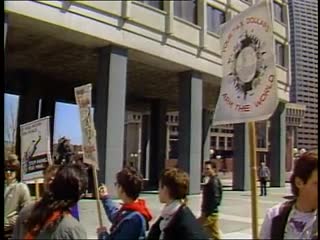
Description: Protesters at Government Center demonstrate against bombing of Libya, although the march was originally planned against contra aid. Another protest takes place nearby opposing federal taxes for military funding.
Collection: Ten O'Clock News
Date Created: 04/15/1986