Description: Rudolph Pierce, Mickey Roache and others hold forum with students at Humphrey Center on "stop and search" tactics by Boston police. Rebecca Rollins reports that Boston lawyers and police officials participated in a forum with students at Madison Park High School. Rollins notes that the topic of the forum was gang activity and the Boston Police Department's stop-and-search procedures. Rollins notes that students and community members have complained about unreasonable stop-and-search procedures by police offiicers. Rollins' report includes footage from the forum. Panelists include Rudolph Pierce (Boston Bar Association), Joan Stanley (Colette Manoil Law Offices) and Francis "Mickey" Roache (Police Commissioner, City of Boston). Pierce says that police have the right to stop a person if there is reasonable suspicion of guilt. Dennis Jean (senior, Madison Park High School) talks about his experiences with police officers who have stopped him. Candido Brown (junior, Madison Park High School) asks why police should be able to search him if he is innocent. Roache tells students that the police department is obliged to protect the rights of citizens. Rollins reports that the forum will help to improve communication between youth and police. Rollins' report includes footage of police officers arresting an African American man. This tape includes additional footage of the forum at Madison Park High School.
1:00:10: Visual: Footage of Rudolph Pierce (Boston Bar Association) speaking at a Madison Park High School. Pierce talks about gang members in Boston. Footage of Joan Stanley (Colette Manoil Law Offices) speaking at the press conference. Stanley says that neighborhood residents are fed up with the activities of some gang members. Rebecca Rollins reports that Boston lawyers and police officials talked about gang activity with students at Madison Park High School. Rollins notes that the lawyers and police officials read fictional scenarios about confrontations between gangs and police. Rollins reports that lawyers and police officials met with students to discuss their differences over the Boston Police Department's stop-and search procedures. V: Shots of the students in the audience at Madison Park High School; of an African American female student addressing the panel of lawyers and police officials. Shot of Francis "Mickey" Roache (Police Commissioner, City of Boston) addressing the students. Footage of a white police officer arresting an African American man. The police officer puts handcuffs on the man, who stands next to a red sports car. Footage of Pierce addressing the students. Pierce says that a police officer has the right to stop and frisk someone if they have reasonable suspicions about the person. Pierce says that the "reasonable suspicion" must be based on facts. Footage of Dennis Jean (senior, Madison Park High School) saying that he and his friends would be stopped and searched almost every day by police. Pierce says that police officers once forced him to drop his pants in public. Pierce says that police officers force people to remove their sneakers; that his friends have had their money stolen by police officers. Pierce says that police officers harass people when they stop to search them. Footage of Roache addressing the students. Roache says that the police often want to act on information that they receive. Roache says that police officers are obliged to protect the rights of citizens. Shots of students in the audience; of the lawyers and police officials at the front of the room. Rollins reports that Roache told students that he investigates every complaint about the improper treatment of citizens at the hands of police officers. Rollins notes that students and police officials cannot agree on what constitutes "improper treatment." V: Shot of two white police officers searching a young African American male on the street. Shot of the lawyers and police officials on the panel at Madison Park High School. Footage of Candido Brown (junior, Madison Park High School) addressing the panel. Brown asks the panel why police officers should be allowed to bother him when he is not doing anything. The students applaud. Shot of a white official addressing the students. Rollins reports that the forum may not resolve the stop-and-search controversy; that the forum will improve communication between youth and police. V: Shots of students at the forum. Footage of Jean saying that the police should be investigating "gang territory." Jean says that police know where the gangs are and what the gangs wear. Jean says that he is not wearing any gang insignia.
Collection: Ten O'Clock News
Date Created: 05/08/1990
Description: Meg Vaillancourt reports that the city of Boston is experimenting with a parcel-to-parcel linkage program to promote development in both the downtown area and in the outlying neighborhoods of the city. A new development project has linked a development in Chinatown to the development of Parcel 18 near the Ruggles MBTA station in Roxbury; the developers had to agree to develop both parcels of land. Vaillancourt reviews the details of the proposed development in each neighborhood. Interview with Stephen Coyle of the Boston Redevelopment Authority about the linkage project. Coyle says that the city is linking desirable downtown sites to sites in other neighborhoods in an attempt to bring jobs and services to the neighborhoods. Mayor Ray Flynn, Governor Michael Dukakis, and City Councilor Bruce Bolling at a press conference in Roxbury talk about the benefits of the linkage project. The Columbia Plaza Associates are a group of minority developers who will most likely develop the sites in Chinatown and Roxbury. Vaillancourt reviews the city's criteria for the development project. The project may bring more jobs and better housing to the Roxbury neighborhood. Following the edited story is b-roll of the area near the Ruggles MBTA station. This edition of the Ten O'Clock News also included the following item: Jesse Jackson campaigns for president in New Hampshire
1:00:06: Visual: Footage of Stephen Coyle (Boston Redevelopment Authority) saying that public land is being used to create "community equity." Shots of a street in Chinatown.<br /><br />Meg Vaillancourt reports that a new development project will affect two communities; that a parking garage and another lot on Essex Street will be developed into office space, retail space, a hotel, and moderate-income housing. Vaillancourt adds that land near the Ruggles MBTA station in Roxbury will be developed into a commercial center with two office buildings, a cultural center, and mixed-income housing for over 150 families. <br /><br />: V: Shots of a parking garage in Chinatown; of the area near the Ruggles Street MBTA station in Roxbury.<br /><br />Vaillancourt notes that developers who wanted the land in Chinatown had to agree to develop the land in Roxbury. <br /><br />: V: Shot of shoppers on a street in Chinatown; of African American commuters entering the Ruggles MBTA station. Shot of a sign reading, "Parcel-to-parcel linkage program project #1. Kingston-Bedford/Parcel 18."<br /><br />Vaillancourt reports that the parcel-to-parcel linkage program is the first program of its kind in the nation. <br /><br />V: Footage of Coyle saying that the downtown sites are desirable to developers; that the city is linking downtown sites with sites in other neighborhoods; that the city would like to bring the service economy into other neighborhoods. Coyle says that Roxbury can benefit from a service economy, especially with the new MBTA orange line trains. Footage of Ray Flynn (Mayor of Boston) addressing a crowd seated outside of the Ruggles MBTA station. Flynn talks about the necessity of good jobs, affordable housing, and neighborhood revitalization. The crowd applauds. The crowd is mostly African American. Shots of an older African American woman in the crowd.<br /><br />Vaillancourt reports that the $400 million project will provide benefits to both communities; that the projects will create more than 2,000 jobs in construction; that the projects will provide more than 8,000 permanent jobs when complete. <br /><br />V: Shots of construction workers working on building sites. Footage of Michael Dukakis (Governor of Massachusetts) saying that these projects will prove to students that there are opportunities for them if they stay in school to be trained. Shot of the audience members. Footage of Bruce Bolling (President, Boston City Council) says that the projects are about the "economic mainstreaming" of those who had been factored out of the process. Shots of an African American woman and her child in the audience; of an African American man at the podium.<br /><br />Vaillancourt reports that Roxbury and Chinatown residents met with the Columbia Plaza Associates; that Columbia Plaza Associates are the minority developers of the projects. Vaillancourt notes that the Columbia group must satisfy five criteria before being officially designated as the developer of the projects. Vaillancourt reports that the group must expand minority and community participation in the project beyond 30%; that the group must develop a plan with clear community benefits; that the plan must get maximum benefit from the $6.6 million in linkage funds; that the project plans must be sensitive in scale and design; that the group must find private investors who promote community ownership and who will insure the projects. <br /><br />V: Shot of the Boston skyline from area near the Ruggles MBTA station. Text on screen lists the city's criteria for development. Footage of Coyle being interviewed by Vaillancourt. Coyle says that the plan requires that the land be put to use for the community. Shot of an African American woman holding her child.<br /><br />Vaillancourt stands in front of the Ruggles MBTA station. Vaillancourt reports that Roxbury community activists blocked a 1970 plan to extend an interstate highway; that the plan would have destroyed several area neighborhoods; that the activists argued for more jobs, more housing and better transportation. Vaillancourt notes that the project looks like it will fulfill the wishes of those community activists.:
Collection: Ten O'Clock News
Date Created: 10/12/1987
Description: Marcus Jones reports that the Boston Redevelopment Authority (BRA) is considering a parcel of land in Roxbury for the new headquarters of the Massachusetts Water Resources Authority (MWRA). The development of Parcel 18 near the Ruggles MBTA station is seen as a cornerstone to the area's economic revitalization. Interview with Anthony Williams, Assistant Director of the BRA about the proposed development. Williams shows Jones maps of the area and plans for the development. Williams talks about the benefits of constructing the MWRA headquarters in Roxbury. Jones reports that the land was cleared in the 1960s and has lain vacant ever since. Interview with State Rep. Byron Rushing about the proposed project. Rushing says that the community must benefit from any development of the land. Following the edited story is additional footage of the area around Parcel 18 and footage from Jones' interviews with Williams and Rushing.
1:00:05: Visual: Shots of Parcel 18 in front of the Ruggles MBTA station in Roxury; of the entrance to the Ruggles MBTA station. Marcus Jones reports that Parcel 18 is one of six locations being considered as the site for the new headquarters of the Massachusetts Water Resources Authority (MWRA). Jones reports that developers and city officials see construction of MWRA headquarters as a cornerstone to the area's economic revitalization. V: Shots of Anthony Williams (Assistant Director, Boston Redevelopment Authority) showing Jones a map of the area. Shot of a map of proposed development in the area. Jones reports that the land has been vacant for more than twenty years. V: Shots of traffic passing by Parcel 18 and the Ruggles MBTA station. Footage of Williams being interviewed by Jones. Williams says that development takes time; that the community must be involved in the development process. Williams says that construction of the MWRA headquarters would allow development to proceed at a quicker rate. Shot through a fence of Parcel 18, Ruggles MBTA station and the Boston skyline. Jones reports that Roxbury has the highest unemployment rate of any neighborhood in Boston; that Roxbury has seen none of the benefits of development in downtown Boston. V: Shot of Jones and Williams looking at a map. Shots of the map. Footage of Williams saying that Parcel 18 is in close proximity to the downtown area. Williams says that the Roxbury neigborhood is centrally located with good access to public transportation. Williams notes that museums and universities are convenient to the site. Williams says that development will proceed quickly when people realize the potential of the site. Footage of Byron Rushing (State Representative) says that there is always risk involved in the development of a site. Rushing says that he wants the Boston Redevelopment Authority (BRA) to promise that the land will be put to beneficial use even if this development fails. Shot of Parcel 18. Jones reports that the site was cleared in the 1960s to make room for the construction of Interstate 95; that the community blocked construction of the highway. Jones reports that the community wants the development to bring jobs and affordable housing to the community. V: Footage of Rushing saying that any benefits from the development of the site must go to the local community. Shots of Parcel 18.
Collection: Ten O'Clock News
Date Created: 03/23/1989
Description: Hope Kelly reports on the annual reenactment on Patriot's Day of the ride of American Revolutionary leader William Dawes. Kelly notes that Dawes's ride is overshadowed by that of Paul Revere (American revolutionary leader). Dawes began his ride to Lexington in 1775 from the site of the First Church of Roxbury. Tom Plant (Roxbury historian) organizes the annual reenactment at the First Church of Roxbury. Plant and others in colonial costume participate in the reenactment. Interview iwth Plant and Butch Redding (Roxbury resident) about the reenactment and the rich history of the Roxbury neighborhood. Kelly reports that many historians overlook the sacrifices made by black soldiers during the American Revolution.
0:59:28: Visual: Shot of a man in colonial costume leading a horse to the front steps of the First Church of Roxbury. Shots of the weathervane and steeple of the church; of the steeple of the church. Hope Kelly reports that there has been a church located on the site of the First Church of Roxbury for 350 years; that William Dawes (American revolutionary leader) began his ride to Lexington in 1775 from the site of the First Church of Roxbury. Kelly notes that Paul Revere (American revolutionary leader) did not make his ride alone. V: Footage of Tom Plant (Roxbury historian) dressed in colonial costume. He speaks to a small crowd in front of the First Church of Roxbury. Plant says that many people forget that Dawes rode one of the most historic rides in American history. Plant says that Roxbury residents are thankful that Roxbury is a part of that history. Shots of a small crowd listening to Plant. Kelly reports that Plant is the president of the congregation of the First Church of Roxbury; that he is president of the Historical Society of Roxbury Highlands. Kelly says that Plant is the organizing force behind the annual re-enactment in Roxbury. V: Shots of Plant speaking; of men on horseback in colonial costume. Kelly reports that Plant sent William Dawes off on his ride with a blessing at the re-enactment. V: Footage of Plant giving a blessing. Shots of the man playing Dawes in the re-enactment; of the audience applauding. Footage of Plant being interviewed by Kelly. Kelly asks Plant what he was thinking about during the re-enactment. Plant says that he is often transported back to colonial times when he walks the streets of Roxbury. Plant says that he felt like he was transported back during the re-enactment. Shots of "Dawes" and another man on horseback riding away from the church on horseback. Footage of the audience singing as the men ride away. The audience includes Byron Rushing (state representative) and Butch Redding (Roxbury resident). Redding is dressed in colonial dress. Kelly reports that a small crowd was present to celebrate a neglected part of history. V: Footage of Butch Redding (Roxbury resident) being interviewed. Redding says that Roxbury is rich in both white American history and African American history. Shot of the crowd outside of the church. Kelly reports that many African American soldiers fought in the American Revolution; that they were treated with ambivalence by the American army. Kelly notes that the exclusion of people of color was the norm in the eighteenth century; that many forget the sacrifices made by soldiers of color in the American Revolution. V: Shots of Plant addressing a small audience from the pulpit of the First Church of Roxbury; of audience members. Footage of Plant addressing the audience about the role of African Americans in history.
Collection: Ten O'Clock News
Date Created: 04/15/1991
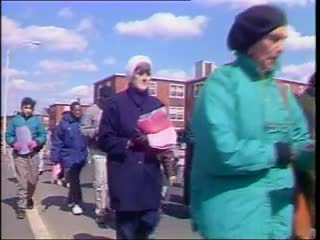
Description: Roxbury residents and clergy march past sites of shootings, singing hymns and carrying cross to commemorate victims of violence.
Collection: Ten O'Clock News
Date Created: 04/13/1990
Description: Resident of Garrison Trotter section of Roxbury is unhappy that nearby vacant house owned by city may become group home for mentally ill. City official says no class can be excluded by local objection.
Collection: Ten O'Clock News
Date Created: 03/11/1991
Description: Marcus Jones reports that the Massachusetts State Legislature has passed a bill designating the city of Quincy as the location for the new headquarters of the Massachusetts Water Resources Authority (MWRA). Parcel 18 in Roxbury had been chosen as the initial site for the headquarters. Speaker of the House George Keverian and House leadership in the chambers of the House of Representatives. Mayor Ray Flynn , City Councilor Bruce Bolling, and Parcel 18 supporters at a press conference outside of the Massachusetts State House. Flynn and Bolling express their support for Parcel 18. Flynn says that the legislature's decision has undermined public confidence in the government. Governor Michael Dukakis has vetoed the bill designating Quincy as the MWRA site at a press conference. Interview with Reverend Tony Bethel of the Parcel 18 Task Force, who says that he and his supporters will continue to fight for economic justice for Roxbury. Footage of the building in Quincy proposed to house the MWRA.
1:00:12: V: Footage of Bruce Bolling (Boston City Council) at a press conference outside of the Massachusetts State House. Bolling says that state legislators need to stand with the supporters of Parcel 18; that the supporters of Parcel 18 are on the "correct side." Shots of a crowd of Parcel 18 supporters gathered outside of the State House for the press conference. The supporters hold signs reading, "Parcel-to-parcel linkage" and "Roxbury equals economic opportunity." Marcus Jones reports that the Massachusetts state legislature has passed a bill which designates the city of Quincy as the location for the new headquarters of the Massachusetts Water Resources Authority (MWRA). Jones notes that the bill overrules the MWRA's initial decision to build their headquarters on Parcel 18 in Roxbury. V: Footage of George Keverian (Speaker of the Massachusetts House of Representatives) and the House leadership at the front of the chambers of the Massachusetts House of Representatives. Shots of the exterior of the Ruggles MBTA station in Roxbury; of the Boston skyline from Parcel 18 in Roxbury. Jones reports that Quincy legislators pushed for the MWRA to settle in an aging industrial building near the site of a sludge facility. V: Shots of officials climbing the stairs of an industrial building in Quincy; of the interior of the building. Shots of the sludge facility in Quincy. Jones notes that Parcel 18 supporters say that the battle is not yet over. V: Shots of demonstrators at the press conference outside of the State House. Shot of a sign reading, "Keep the MWRA in Roxbury." Footage of Ray Flynn (Mayor of Boston) saying that the legislature's decision jeopardizes the citizens' confidence government. Flynn says that the legislature has not shown a commitment to "straightforward, honest government." Shot of Michael Dukakis (Governor of Massachusetts) signing a piece of paper at a press conference. Members of the media photograph him. Jones reports that Dukakis vetoed the legislature's MWRA bill yesterday; that the legislature will vote next week on Dukakis's veto. Jones reports that Parcel 18 supporters will lobby for the Roxbury site over the next week. V: Shot of the press conference outside of the State House. Shots of demonstrators and audience members at the press conference. A demonstrator holds up a sign reading, "Fairness equals a vote for Roxbury." Footage of Bolling saying that Quincy was not chosen to be the initial site because Quincy did not have the best proposal.The crowd applauds for Bolling. Footage of the Reverend Tony Bethel (Parcel 18 Task Force) being interviewed by Jones outside of the State House. Bethel says that he and his supporters will continue to fight for economic justice for the Roxbury area, even if Dukakis' veto is overruled. Jones reports that Parcel 18 supporters have vowed to continue the fight to bring the MWRA to Roxbury.
Collection: Ten O'Clock News
Date Created: 07/11/1989
Description: HIGHEST BOSTON RAPE STATISTICS IN AREA B ROXBURY
Collection: Ten O'Clock News
Date Created: 04/16/1987
Description: Hope Kelly reports that the Boston Bank of Commerce is sponsoring the Home Ownership Loan Pool, to encourage homeownership loans for residents in minority neighborhoods. The neighborhoods of Roxbury, Dorchester, and Mattapan have received little investment money in the past. Kelly's report includes footage from a press conference with Ronald Homer (President, Boston Bank of Commerce) and community leaders. Bruce Bolling (Boston City Council) speaks out in support of the new program. Homer talks about the Home Ownership Loan Pool. Homer says that concessionary-rate lending does not serve the long-term interests of the community. Kelly reviews the details of Homer's proposal. Kelly notes that housing is scarce in Roxbury while vacant lots are plentiful. Kelly interviews Gus Newport (Dudley Street Neighborhood Initiative). Newport says that disinvestment has been a problem in the greater Roxbury neighborhood. Kelly, Newport and Gertrude Fidalgo (community worker) take a walk in the Dudley Street neighborhood. Fidalgo says that development of vacant lots will create safer conditions in the area. Kelly notes that new housing developments are planned for the area. Kelly's report includes footage of workers at the Dudley Street Neighborhood Initiative building.
1:00:09: Visual: Shots of vacant lots in the Roxbury neighborhood of Boston. Hope Kelly reports that vacant lots in Roxbury are only 1.5 miles from downtown Boston. V: Footage of Gus Newport (Executive Director, Dudley Street Initiative) being interviewed near a vacant lot by Kelly. Kelly notes that these lots would have been developed years ago if they were in a different part of the city. Newport agrees with Kelly. Newport says that no bank financing was available to developers interested in the Roxbury neighborhood. Footage of Bruce Bolling (Boston City Council) speaking at a press conference. Bolling says that there has been "a process of disinvestment" in the Roxbury community for over thirty years. Bolling says that the members of the community must determine the direction of the community's growth. Shots of the attendees of the press conference, including Juanita Wade (Boston School Committee), Charles Yancey (Boston City Council), Gail Snowden (Bank of Boston), Don Muhammad (Roxbury community leader) and Newport. Shot of Mel King (community activist) listening at the entrance to the room. Kelly reports that the neighborhoods of Roxbury, Dorchester, and Mattapan have not received much investment money in the past; that a new bank program will provide financing in those neighborhoods. V: Footage from the press conference. Bolling sits at a table with Ronald Homer (President, Boston Bank of Commerce) and two others. African American community leaders stand behind them. Homer talks about a proposal which encourages banks to commit a portion of their loan portfolios to serve the greater Roxbury area. Kelly reports that the Boston Bank of Commerce is the only bank in Massachusetts that is owned and operated by African Americans. Kelly reports that the Boston Bank of Commerce is sponsoring the Home Ownership Loan Pool. Kelly reports that the loan pool encourages banks to set aside $250 million in loans for minority neighborhoods; that $25 million of the loans are to be set aside for first-time home buyers at below-market mortgage rates. Kelly reports that $100 million of the loans are to be set aside for the renovation or purchase of existing housing stock; that $500,000 be set aside for a home ownership and financing resource center. V: Shot of the exterior of the Boston Bank of Commerce. On-screem text and visuals detail the specifics of the Home Ownership Loan Pool. Footage of Homer at the press conference. Homer says that the Boston Bank of Commerce has taken a stand in the past against concessionary-rate lending. Homer says that concessionary-rate lending is not a useful way to serve the community in the long-term. Shots of attendees at the press conference including Newport, Juanita Wade (Boston School Committee) and Charles Yancey (Boston City Council). Kelly reports that Homer and others believe that concessionary-rate lending may be a good short-term solution. Kelly reports that Newport agrees with Homer. Kelly notes that Newport is the former mayor of Berkeley, California. V: Shot of the exterior of the Dudley Street Neighborhood Initiative building. Shot of Newport standing inside the building. Shots of staff members doing office work at the Dudley Street Neighborhood Initiative. Kelly reports that the Dudley Street Neighborhood Initiative was founded in 1984; that the Initiative has eminent domain power and zoning authority over 1.5 square miles of Roxbury land. Kelly notes that housing is scarce in Roxbury; that vacant lots are plentiful in the area. V: Shot of a map of Roxbury in the Dudley Street Neighborhood Initiative office. Footage of Newport and Kelly standing in front of a map of Roxbury. Newport points out the vacant lots in the area. Newport says that the Roxbury area has the most vacant land of any neighborhood in the city. Shots of Kelly, Newport and Gertrude Fidalgo (community worker) on a snowy street in Roxbury. They pass by a vacant lot. Kelly reports that 364 units of housing are planned for Roxbury; that most of those units will be affordable. V: Footage of Newport saying that disinvestment has been a major problem in the area. Kelly says that the banks are responsible for the initial disinvestment in the neighborhood. V: Footage of Newport saying that it is hard to believe that these conditions exist so close to downtown Boston. Footage of Fidalgo saying that she would not want to walk through this area because there are no streetlights or houses. Fidalgo says that more housing will create safer conditions in the neighborhood. Shots of a vacant lot and the surrounding area.
Collection: Ten O'Clock News
Date Created: 12/28/1989
Description: Marcus Jones interviews Eugene Rivers of the African Peoples Pentecostal Church about his community work in the greater Roxbury neighborhood. Jones notes that Rivers is an outspoken critic of the religious establishment. He adds that Rivers spends a lot of time counseling troubled youth and acting as a legal advocate for them. Rivers talks about his work with neighborhood youth. Rivers says that many troubled teenagers come from disadvantaged socioeconomic backgrounds. Rivers talks about the need for churches to do more to reach out to young people. Rivers says that churches must provide alternatives for young people. Rivers talks about violence in the community and about his commitment to young people in the neighborhood. Jones notes that violence is a problem in the neighborhood. He adds that Rivers is committed to fighting the problem. Jones' report is accompanied by footage of Rivers talking to young people on the street and footage of Rivers' church van, damaged from gunfire.
1:00:06: Visual: Footage of Eugene Rivers (Pastor, African Peoples Pentecostal Church) talking to two young African American men in front of a courthouse. Marcus Jones reports that Rivers is not a social worker; that Rivers spends a lot of time counseling troubled youth. Jones reports that Rivers is the pastor of the African Peoples Pentecostal Church; that Rivers' church holds its meetings at the Freedom House in Roxbury. V: Footage of Rivers being interviewed by Jones. Jones asks how much of Rivers' time is taken up by troubled youth. Rivers says that his wife thinks that he spends too much time. Jones asks Rivers how often he is in the courthouse. Rivers says that he is in the courthouse three or four days per week. Rivers says that a large number of teenagers end up getting into trouble for legitimate reasons; that many these teenagers get into trouble stemming from their socio-economic backgrounds. Rivers says that he tries to make himself available to help these people. Shot of Rivers walking on a sidewalk with a young African American man. Jones reports that Rivers is an outspoken critic of the religious establishment. Jones reports that Rivers believes that religious leaders have failed the young people of Roxbury, Dorchester, and Mattapan. Jones notes that Rivers believes that religious organizations need to provide alternatives to drugs, gangs, and violence. V: Shot of a group of African American teenage boys standing in front of a house. Another group of African American teenage boys rides by on bicycles. Footage of Rivers being interviewed by Jones. Rivers says that churches are the premier institutions in the African American community. Rivers says that churches, including his own, are not doing enough to reach out to young people. Rivers says that the absence of the churches on the street is more conspicuous than the presence of drugs. Shot of Rivers walking on the street with another African American man. Rivers stops an African American teenage boy. Rivers starts talking to the boy. Footage of Rivers being interviewed by Jones. Rivers says that many young men are involved in illegal activities because no other form of activity was available to them. Rivers says that many young drug dealers never had adult role models; that many young drug dealers never had access to any kind of significant alternative. Shot of Rivers walking down the courthouse steps with another man. Jones reports that Rivers speaks from experience when he talks about role models. Jones reports that Rivers was a gang member and drug dealer in Philadelphia before he enrolled at Harvard University. Jones notes that Rivers is trying to make a difference on the streets of a neighborhood where gang violence is commonplace. V: Shot of bullet holes in the windshield of Rivers's van. Footage of Rivers counting the bullet holes on his van. Rivers points out the damage done to his van. Close-up shot of a bullet hole on the side of the van. Jones reports that gang members fired dozens of bullets into the home of Rivers's next-door nieghbor last month. Jones reports that many of the bullets hit Rivers's church van; that two bullets pierced the wall of his home. V: Shot of Rivers and Jones outside of Rivers's home. Shot of a bullet hole in the window of a home. Shots of the broken windows of the church van; of broken glass inside of the van. Shot of a bullet hole in the wall of Rivers's home. Footage of Rivers being interviewed by Jones outside of his home. Jones comments that Rivers's neighbors have moved out of their home. Rivers says that he feels a commitment toward the community; that he wants to make something happen here. Shot of Rivers and Jones framed by the broken window of the van. Jones reports that Rivers, his family and his congregation want to make the African American community aware of its responsibility to change things. Jones reports that Rivers wants the community to work at making improvements instead of blaming outsiders. V: Footage of Rivers being interviewed by Jones. Rivers says that kids will participate in legitimate acitivities if those activities are provided. Jones asks who will provide the activities. Rivers says that African American churches need to come up with alternatives for youth; that the churches should close shop if they fail to provide alternatives. Rivers says that African American churches should become employers, educators, advocates; that the churches should be in the courts and in the jails. Rivers says that the churches have failed to understand the meaning of the gospel if they fail to take up this challenge.
Collection: Ten O'Clock News
Date Created: 08/15/1990