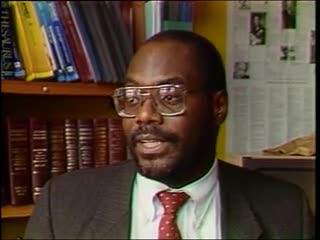
Description: Jan von Mehren reports that Rev. Graylan Hagler of the Church of the United Community has been critical of the Boston Police Department's stop-and-search policy in Roxbury. Hagler has proposed that graduates of the police academy spend 18 months working as coaches and counselors in the community. Interview with Hagler, who says that police officers and the community would benefit from a stronger relationship. He adds that the police must take a more innovative approach to fighting crime in the area. He also says that police officers and young people need to form a partnership. Von Mehren notes that critics do not believe that Hagler's plan is feasible.
1:00:07: Visual: Footage of the Reverend Graylan Ellis-Hagler (Church of the United Community) walking on a street in Roxbury with two African American men. Shots of the exterior of the Church of the United Community; of a sign for the Church of the United Community. Jan von Mehren reports that Ellis-Hagler spends a lot of time on the Roxbury streets. Von Mehren notes that Ellis-Hagler moved his church into a building where drug addicts were regularly shooting up. Von Mehren reports that the church is one of the most active community centers in Roxbury. V: Shots of men standing outside of the church. Two men exchange a hug as a greeting. Shots of a Boston Police Department cruiser on the street outside of the church. Shots of Ellis-Hagler and a group of people entering the church. Von Mehren reports that Hagler has been critical of the Boston Police Department's stop-and-search policy in Roxbury. V: Footage of Ellis-Hagler being interviewed by von Mehren. Ellis-Hagler says that people feel less safe on the street than they did five years ago. Ellis-Hagler says that the police need to try out some new tactics in fighting crime. Ellis-Hagler talks about a proposal he submitted to the Boston Police Department. Hagler says that he has recommended that first-year police officers not be put on the street immediately. Ellis-Hagler says that first-year police officers should have an "intern" relationship with the community. Shots of Boston police officers making drug arrests on the street; of African American kids playing basketball on an outdoor court; of the snowy parking lot of a housing development. Von Mehren reports that Ellis-Hagler wants graduates of the police academy to spend 18 months working as coaches and counselors in the community. V: Footage of Ellis-Hagler saying that most police officers are concerned about the community. Ellis-Hagler says that many police officers realize that an more innovative approach is necessary. Shots of a group of police officers on the street; of a police officer sitting on a motorcycle; of police officers at police headquarters. Von Mehren reports that the police commissioner has not responded to Ellis-Hagler's plan. Von Mehren notes that many citizens are calling for more police protection; that some may not like Ellis-Hagler's idea of employing police officers as coaches and counselors. Von Mehren reports that Ellis-Hagler believes that his plan will result in more effective police officers. V: Shots of Ellis-Hagler talking with a group of African American men at his church. Shots of the individual men in the group. Shot of a group of men standing outside of the church. Ellis-Hagler exits the church and embraces one of the men. Audio of Ellis-Hagler saying that the police depend on cooperation from the community to solve crime. Footage of Ellis-Hagler saying that young people are a good source of information for police officers; that young people know where and when drug activity takes place. Ellis-Hagler says that the police officers should form a partnership with young people; that both sides would benefit from the relationship. Von Mehren stands in the meeting hall of the Church of the United Community. Von Mehren reports that Ellis-Hagler will hold a community summit next Monday; that Ellis-Hagler will discuss his police partnership proposal. Von Mehren says that Ellis-Hagler is pushing the proposal; that some do not believe the plan is feasible.
Collection: Ten O'Clock News
Date Created: 12/15/1989
Description: Roxbury Community College suffers from budget cut, enrollment drop, and chiefly a crisis of confidence in president Walter Howard. Students rally to save the school. Campus, photo of Howard.
Collection: Ten O'Clock News
Date Created: 05/15/1991
Description: Carmen Fields reports that the infant mortality rate in Boston's African American community is three times the rate in white communities. Fields interviews Jeanne Taylor, PhD (Roxbury Comprehensive Health Center) and David Dolin (Executive Vice President, Beth Israel Hospital)) about the partnership between the two facilities and the rising infant mortality rate in Boston. Dolin says that the high infant mortality rate is a social problem involving health, education, housing, employment, and crime. He adds that advances must be made in all of those areas in order to combat the high infant mortality rate in Boston. Taylor talks about the role of community health centers and the benefits of relationships between community health centers and large hospitals. Taylor says that the infant mortality rate is only one indicator of distress in the African American community. Fields reports that the concept of linkage is being applied to health care through the partnerships between the large and small medical facilities. Fields's report includes footage of infants being cared for in the nursery of a health facility.
1:00:15: Visual: Footage of Jeanne Taylor, PhD (Roxbury Comprehensive Health Center) being interviewed by Carmen Fields. Taylor says that Roxbury Comprehensive Health Center has always been an independently licensed health center; that the health center is federally funded. Taylor says that Roxbury Comprehensive Health Center does not have a relationship with the city or the state. Taylor says that the health center has had informal relationships with hospitals in the past. Taylor says that hospitals provide a wealth of resources to health centers; that hospitals can provide specialists to health centers; that hospital residents can come to work in health centers. Fields reports that the infant mortality rate in Boston's African American community is three times the rate in white communities. Fields notes that the gap grew in 1989 and in 1990. Fields notes that the African American community is called a "death zone." V: Shots of an African American infant hooked up to breathing equipment; of a health care worker monitoring medical equipment in a hospital nursery; of a monitor on the medical equipment. Shot of the health care worker tending to an infant; of the infant hooked up to equipment. Footage of David Dolin (Executive Vice President, Beth Israel Hospital) being interviewed by Fields. Dolin suggests that there is no one to blame for the high infant mortality rate; that you cannot place blame on any one segment of the health care community. Dolin says that the problem may not be a health problem; that the problem is a social problem involving health, education, housing, the police department, and the mayor's staff. Fields reports that the concept of linkage is being applied to health care and the infant mortality rate. V: Footage of Taylor being interviewed by Fields. Taylor says that many hospitals have had limited interest in partnering with health care centers in the past; that many hospitals and health care centers had relationships of mistrust. Taylor says that the mistrust stems from the African American community. Taylor says that the health care profession has performed questionable research on African Americans; that African Americans have not been included in medical research in the past. Taylor says that hospitals are usually interested in partnering with health care centers for research purposes. Taylor says that the relationship of mistrust between hospitals and health care centers has changed. Footage of Dolin being interviewed by Fields. Dolin says that funding is coming from health care centers and hospitals; that there is little funding from the government. Dolin says that health care centers and hospitals are underfunded; that some areas get neglected. Dolin says that many factors affect maternal and infant health; that increased funds from hospitals and health care centers can be undermined by these other factors. Footage of Taylor being interviewed by Fields. Fields asks Taylor to explain linkage as it applies to community health centers. Taylor says that linkage promotes relationships between large medical facilities and smaller health care centers with limited resources. Taylor says that the health care centers can gain access to hospital amenities. Taylor says that health care centers can take advantage of hospital residents and hospital purchasing discounts for equipment and supplies. Taylor says that health care center physicians can admit patients to the partnering hospital; that the health care physicians can be on the faculty of these hospitals. Taylor says that physicians at health care centers need extra benefits because they do not make high salaries. Footage of Dolin being interviewed by Fields. Dolin says that hospitals have a responsibility to the local community. Dolin says that the best way to deliver care to the community is through the health care center. Dolin says that the hospitals need to provide their expertise and resources to aid the health care centers. Dolin says that he sees no disadvantages to the relationships between hospitals and health care centers. Footage of Taylor being interviewed by Fields. Fields asks what will happen if linkage is not adopted. Taylor says that costs will rise; that there will be a double standard in health care across the nation. Footage of Dolin being interviewed by Fields. Dolin says that the high infant mortality rate and other problems will not be solved if linkage is not adopted. Dolin says that there are other factors; that problems in the areas of crime, drugs, housing, and education must also be solved. Footage of Taylor being interviewed by Fields. Taylor says that the infant mortality rate in the African American community is only one indicator of the distress in that community. Taylor says that the major hospitals in Boston did not realize that the infant mortality rate was a problem until a major newspaper printed a story about it. Taylor says that the African American community has been neglected; that the neglect must stop.
Collection: Ten O'Clock News
Date Created: 01/28/1991
Description: Leslie Harris, an attorney with Roxbury Defenders Committee, describes his work seeking justice for those accused, sometimes unfairly, by police in the street drug war. Lawyers in conference room.
Collection: Ten O'Clock News
Date Created: 09/04/1990
Description: Public defender Leslie Harris spends typical day in Roxbury District Court in administrative runaround and ushering client through bail hearing. Judge Julian Houston. Sound of door slamming.
Collection: Ten O'Clock News
Date Created: 09/05/1990
Description: Public defender Leslie Harris talks about confusion of getting cases through Roxbury District Court. This includes delays; missing defendants, witnesses and victims; making deals with prosecutors. Courtroom.
Collection: Ten O'Clock News
Date Created: 09/06/1990
Description: Touching reactions from friends and classmates of 11 year old Charles Copney, killed on a Saturday evening on Highland Avenue, Roxbury, in a shooting that also killed a teenager.
Collection: Ten O'Clock News
Date Created: 04/22/1991
Description: Carolyn Sawyer reports that a group of unemployed laborers are picketing the construction site of the new Post Office in Dudley Square in Roxbury. The picketers are demanding that fifty percent of the laborers on the site be residents of the Roxbury community. Press conference held by the picketers at the site. Rev. Graylan Hagler from the Church of the United Community says that the men will not go away with "crumbs." Picketers Ivan Singleton, James Gun, and Ron Nelson also speak out at the press conference. Interview with Stephen Coyle of the Boston Redevelopment Authority, who is trying to mediate the dispute. Coyle says that the community is legitimately concerned about the high rate of unemployment among residents. He adds that he expects similar protests during upcoming construction projects. Sawyer reviews the agreement concerning minority participation in the construction project.
1:00:37: Visual: Footage of Graylan Ellis-Hagler (Church of the United Community) speaking at a press conference held at the construction site of the new Post Office in Dudley Square. A group of African American men stand behind Ellis-Hagler. Ellis-Hagler says that he and the men will not go away with "crumbs." Ellis-Hagler says that if his men do not work, then nobody works. Shots of the Post Office construction site in Dudley Square. Carolyn Sawyer reports that no one has worked at the Post Office construction site since last Friday. Sawyer reports that picketers have refused to be moved. V: Footage of Ivan Singleton (unemployed laborer) speaking at the press conference. Singleton says that he lives in the community; that laborers on the construction site are coming in from outside of the community. Singleton says that he wants to work on the site. Footage of James Gun (unemployed laborer) speaking at the press conference. Gun says that unemployed laborers in the community are not working on any of the construction jobs in the community. Shot of the Post Office construction site. Sawyer reports that the workers want the fifty percent of the laborers on the site to be residents of the Roxbury community. Sawyer notes that federal law requires minority participation to be ten percent. Sawyer reports that the Post Office has agreed to hire 30% of the work force from the community. V: Shot of a Post Office building in the city. Footage of Stephen Coyle (Boston Redevelopment Authority) being interviewed in his office. Coyle says that the Post Office has satisfied the law and made an agreement with the community. Coyle says that the community is not satisfied. Coyle says that the Post Office and the community appear to be on a collision course. Sawyer reports that Coyle is charged with keeping the project on schedule; that the project is due to be completed next August. Sawyer notes that Coyle met separately today with Suffolk Construction (general contractor of the construction site), with Post Office officials and with Roxbury residents. V: Footage of Coyle being interviewed by Sawyer. Coyle says that the community has legitimate concerns; that unemployment rates are high. Sawyer reports that he expects more of these kinds of disputes in the future. V: Footage of Coyle being interviewed by Sawyer. Coyle says that there will be more tension surrounding upcoming construction projects; that there are not enough jobs and contracts for everyone. Coyle says that he hopes the public sector will engage in more capital projects in the future; that an increase in capital projects would ease the tension. Sawyer reports that government budgets are tight; that more capital projects appear unlikely. V: Shots of the Post Office construction site; of an African American man at the press conference. Footage of Ron Nelson (unemployed carpenter) at the press conference. Nelson says that laborers are coming in from outside to take food from the mouths of community residents. Nelson says that money from the construction is not circulating in the community. Nelson says that the unemployed laborers will continue to picket until they are allowed to work.
Collection: Ten O'Clock News
Date Created: 12/21/1990
Description: Meg Vaillancourt reports on the street violence that resulted in the accidental shooting of Darlene Tiffany Moore (eleven-year-old Roxbury resident). Vaillancourt interviews Maleka Few (Roxbury resident, age twelve) and Jessica Moore (Roxbury resident, age 10). The girls are afraid of the violence that resulted in Tiffany Moore's death. Vaillancourt reports that Roxbury residents went to City Hall to ask for more police protection in the neighborhood. Vaillancourt's report includes footage of Roxbury community leaders at a press conference. Amanda Houston (Roxbury resident), Bruce Bolling (Boston City Council), and Louis Elisa (Roxbury resident) talk about the need for more police on the streets. Vaillancourt reports the Ray Flynn (Mayor of Boston) has put more police on the streets and has pledged a full investigation of Moore's shooting. Vaillancourt's report includes footage of William Celester (Deputy Superintendent, Boston Police Department) and Flynn at a press conference. Vaillancourt reports that Roxbury is experiencing its worst violence in twenty years. She notes that city and state officials gathered at a press conference to discuss the problem. Vaillancourt's report includes footage of the press conference in Roxbury with Francis "Mickey" Roache (Police Commissioner, City of Boston), Royal Bolling, Sr. (former State Senator), and John Kerry (US Senator). Roache blames drug traffic for the violence. Kerry criticizes the ineffectual drug policy and social programs of the Reagan administration. Vaillancourt's report includes footage of police officers stopping African American men on the streets of Roxbury.
1:00:26: Visual: Footage of Maleka Few (Roxbury resident, age 12) saying that she thinks it might happen to her next. Shot of a Boston Herald newspaper article with a headline reading, "Police vow to capture girl's killers." A photo of Darlene Tiffany Moore (Roxbury resident, age 11) accompanies the article. Meg Vaillancourt reports that Moore was sitting outside on Humboldt Avenue in Roxbury when she was killed by a stray bullet; that Moore was the unintentional victim of a war between two rival gangs. V: Shot of a Humboldt Avenue in Roxbury. Footage of Few saying that the gang members were not shooting at Moore; that Moore was in the wrong place at the wrong time. Few says that she does not want to go out to the store with her mother anymore. Footage of Jessica Moore (Roxbury resident, age 10) saying that she used to sit in the same place on Humboldt Street. Shots of African American girls standing on a street in Roxbury. Vaillancourt reports that Roxbury parents went to City Hall today to ask for more police protection. V: Footage of Amanda Houston (Roxbury resident) saying that she is a "gutsy lady;" that she is starting to feel frightened. Footage of Bruce Bolling (Boston City Council) speaking to the press. Bolling says that there is open warfare going on in the city. Shot of media camera crews. Footage of Louis Elisa (Roxbury resident) saying that Roxbury residents pay their taxes; that Roxbury citizens are demanding equal protection under the law. Vaillancourt reports that forty extra police officers are patrolling Humboldt Avenue; that Ray Flynn (Mayor of Boston) has pledged a full investigation of the shooting. V: Shot of two police officers patrolling a street. Footage of William Celester (Deputy Superintendent, Boston Police Department) speaking to the press. Flynn stands beside him. Celester says that the community has been providing information about the shooting to police; that the police are investigating suspects. Footage of two white police officers stopping an African American man to search him. Vaillancourt reports that Roxbury is experiencing its worst violence in twenty years. V: Footage of Francis "Mickey" Roache (Police Commissioner, City of Boston) speaking at press conference in Roxbury. John Kerry (US Senator) and Royal Bolling Sr. (State Senator) are among the crowd standing with Roache. Roache says that drugs equal violence. Shots of the press at the press conference. Vaillancourt notes that Kerry visited Roxbury today to talk to residents about the drug problem. V: Footage of Kerry saying that the government cannot ask kids in Roxbury to say no to drugs if the Reagan administration cannot say no to General Manuel Noriega (leader of Panama). Kerry says that the drug policy of the Reagan administration is hypocritical and ineffective; that the administration's policy is contributing to the drug problem. Vaillancourt reports that Roxbury residents are calling for drastic measures to fight violence; that some curfews, night-court sessions, and the National Guard have all been suggested. V: Footage of Kerry saying that the presence of the National Guard will not solve the drug problem; that overcrowded prisons, an inadequate school system, and a lack of treatment centers are all contributing to the drug problem. Shot of two white police officers talking to an African American teenage boy on a street in Roxbury. Vaillancourt reports that Roxbury residents want increased aid on all levels. Vaillancourt notes that residents are worried that the situation will not improve after Moore's killer is found. V: Shot of a cameraman filming a man in a business suit on the street; of Humboldt Avenue in Roxbury.
Collection: Ten O'Clock News
Date Created: 08/22/1988
Description: On Good Friday, parishioners and clergy march through Roxbury past sites of violence in a pilgrimage of hope for the community. Stations of the cross.
Collection: Ten O'Clock News
Date Created: 03/29/1991