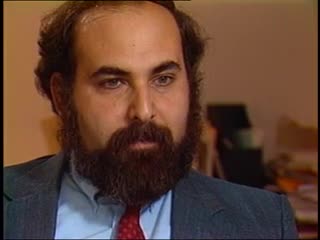
Description: Five likely Republican gubernatorial candidates assemble: Paul Cellucci, Steven Pierce, William Weld, Paul Cronin, Guy Carbone.
Collection: Ten O'Clock News
Date Created: 09/05/1989
Description: Republican legislative leaders David Locke and Steven Pierce propose budget cuts in many areas to eliminate deficit. Keverian bangs gavel at speaker's rostrum.
Collection: Ten O'Clock News
Date Created: 09/15/1989
Description: Mayor of Lawrence Kevin Sullivan explains making an example of drug criminals receiving welfare. Public defender says that only fraction of individuals arrested have been involved with drug trade. Police Lieutenant Baker in charge of mayor's war on drugs cites small portion of drug-related card seizures. Discussion of ethics on revoking cards after "serious felony" instead of drug activity. Public defender accuses Sullivan of taking advantage of vulnerable citizens. Baker and Kelly discuss typical arrest file with welfare card seizure.
Collection: Ten O'Clock News
Date Created: 08/16/1989
Description: House delays debate on taxes because leaders must revise proposal to improve chance of passage. McGee, Keverian,Brett,Pierce,Galvin,Hynes,Havern. Shouts f/ floor of "Mr. Speaker." Dukakis attests to confusion.
Collection: Ten O'Clock News
Date Created: 11/30/1989
Description: Under court order, Registry of Motor Vehicles can no longer provide information from drivers' licenses. This creates dilemma for police who require details to make positive identifications. RMV officers.
Collection: Ten O'Clock News
Date Created: 01/19/1989
Description: Harvard study indicates federal efforts in drug war are misdirected; more money should be spent at local and state levels. Marijuana being cut in field, smoking joint.
Collection: Ten O'Clock News
Date Created: 08/21/1989
Description: Retrospective of the developing budget crisis through clips of Dukakis in action over the last fiscal year. Keverian bangs gavel.
Collection: Ten O'Clock News
Date Created: 07/13/1989
Description: Charleston, South Carolina police chief Reuben Greenberg explains his tactics for lowering the crime rate in his city, including "flying squad" of officers who run after criminals.
Collection: Ten O'Clock News
Date Created: 04/04/1989
Description: Christy George reports that the Reverend Allan Boesak, an anti-apartheid activist, received an award at Harvard University. He gives a speech at the university in which he urges western countries to place economic sanctions on the South African government. He criticizes Ronald Reagan and other western leaders for supporting the South African government. Boesak, at a press conference after the awards ceremony, praises Dukakis for imposing sanction and and urges George Bush to impose sanctions on South Africa. Boesak talks about the effectiveness of sanctions. George's report includes footage of Bush talking about South Africa and footage of apartheid South Africa. Following the edited story is additional footage of Boesak's press conference at Harvard.
1:00:00: Visual: Footage of Dr. Allan Boesak (anti-apartheid activist) preaching at Memorial Church at Harvard University. Boesak says that the lives of many South African blacks could have been saved if Ronald Reagan (US President) and other Western leaders had divested from South Africa in 1985. Footage of South African police brutally arresting South African blacks. Christy George reports that Boesak is one of the few South African church leaders who would dare to blame Reagan for the deaths of South African children. V: Footage of Boesak at Harvard. Boesak accuses Reagan, Margaret Thatcher (Prime Minister of Great Britain), and Helmut Kohl (Chancellor of Germany) of supporting the South African government. Boesak says that these leaders refused to impose sanctions on the apartheid government. George reports that Boesak is outspoken; that Boesak received an award from Harvard University today; that Boesak chided Harvard for investing in South Africa. V: Shots of Memorial Church at Harvard University; of Boesak receiving an award from a Harvard official. George notes that Boesak praised Michael Dukakis (Governor of Massachusetts) for imposing sanctions against South Africa; that Boesak begged George Bush (US President-elect) to do the same. V: Footage of Bush on October 25, 1988. Bush says that the South African government is racist; that the US needs to stay engaged; that the US needs to use its "moral influence" to change the South African government. Footage of Boesak at a press conference at Harvard University. Boesak says that he hopes Bush will follow the example of Massachusetts; that the US should divest from South Africa. Boesak says that he wishes Dukakis had been elected president. Boesak says that Bush has talked about his commitment to civil rights; that Bush needs to act on his commitment. Footage of South African blacks running from police on January 10, 1988. George reports that Boesak says that the South African government is redoubling its efforts to enforce apartheid laws. V: Footage of Boesak saying that he his tired of lame excuses from western governments. Boesak says that western leaders are lying when they talk about their concern for South African blacks. Boesak talks about the US government's commitment to sanctions against Cuba, Libya, Argentina and Nicaragua. George reports that Boesak says that sanctions are effective; that war has become too expensive for the South African government. George reports that Boesak points to the end of wars in Namibia and Angola as proof of the effectiveness of sanctions. V: Footage of Africans celebrating in the streets; of Africans marching in the street; of African soldiers watching a plane taxi on a runway. Footage of Boesak at a press conference. Boesak talks about sanctions. Boesak says that the South African government should be cut off from oil and from access to the international money market. Boesak says that no South African blacks would be hurt if air links to and from South African were cut off. Boesak says that he and Desmond Tutu (South African anti-apartheid leader) are the only two South African blacks who fly anywhere.
Collection: Ten O'Clock News
Date Created: 01/17/1989
Description: Jan von Mehren reports that Rev. Graylan Hagler of the Church of the United Community has been critical of the Boston Police Department's stop-and-search policy in Roxbury. Hagler has proposed that graduates of the police academy spend 18 months working as coaches and counselors in the community. Interview with Hagler, who says that police officers and the community would benefit from a stronger relationship. He adds that the police must take a more innovative approach to fighting crime in the area. He also says that police officers and young people need to form a partnership. Von Mehren notes that critics do not believe that Hagler's plan is feasible.
1:00:07: Visual: Footage of the Reverend Graylan Ellis-Hagler (Church of the United Community) walking on a street in Roxbury with two African American men. Shots of the exterior of the Church of the United Community; of a sign for the Church of the United Community. Jan von Mehren reports that Ellis-Hagler spends a lot of time on the Roxbury streets. Von Mehren notes that Ellis-Hagler moved his church into a building where drug addicts were regularly shooting up. Von Mehren reports that the church is one of the most active community centers in Roxbury. V: Shots of men standing outside of the church. Two men exchange a hug as a greeting. Shots of a Boston Police Department cruiser on the street outside of the church. Shots of Ellis-Hagler and a group of people entering the church. Von Mehren reports that Hagler has been critical of the Boston Police Department's stop-and-search policy in Roxbury. V: Footage of Ellis-Hagler being interviewed by von Mehren. Ellis-Hagler says that people feel less safe on the street than they did five years ago. Ellis-Hagler says that the police need to try out some new tactics in fighting crime. Ellis-Hagler talks about a proposal he submitted to the Boston Police Department. Hagler says that he has recommended that first-year police officers not be put on the street immediately. Ellis-Hagler says that first-year police officers should have an "intern" relationship with the community. Shots of Boston police officers making drug arrests on the street; of African American kids playing basketball on an outdoor court; of the snowy parking lot of a housing development. Von Mehren reports that Ellis-Hagler wants graduates of the police academy to spend 18 months working as coaches and counselors in the community. V: Footage of Ellis-Hagler saying that most police officers are concerned about the community. Ellis-Hagler says that many police officers realize that an more innovative approach is necessary. Shots of a group of police officers on the street; of a police officer sitting on a motorcycle; of police officers at police headquarters. Von Mehren reports that the police commissioner has not responded to Ellis-Hagler's plan. Von Mehren notes that many citizens are calling for more police protection; that some may not like Ellis-Hagler's idea of employing police officers as coaches and counselors. Von Mehren reports that Ellis-Hagler believes that his plan will result in more effective police officers. V: Shots of Ellis-Hagler talking with a group of African American men at his church. Shots of the individual men in the group. Shot of a group of men standing outside of the church. Ellis-Hagler exits the church and embraces one of the men. Audio of Ellis-Hagler saying that the police depend on cooperation from the community to solve crime. Footage of Ellis-Hagler saying that young people are a good source of information for police officers; that young people know where and when drug activity takes place. Ellis-Hagler says that the police officers should form a partnership with young people; that both sides would benefit from the relationship. Von Mehren stands in the meeting hall of the Church of the United Community. Von Mehren reports that Ellis-Hagler will hold a community summit next Monday; that Ellis-Hagler will discuss his police partnership proposal. Von Mehren says that Ellis-Hagler is pushing the proposal; that some do not believe the plan is feasible.
Collection: Ten O'Clock News
Date Created: 12/15/1989