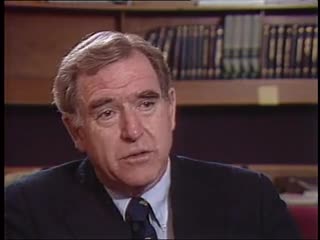
Description: Interview with Dr. Arnold Relman, editor of New England Journal of Medicine, on reform of health care system. Patients in hospital corridor. X-rays, sphygmomanometer (blood pressure gauge).
Collection: Ten O'Clock News
Date Created: 07/17/1990
Description: Upon return from Iraq, where he surveyed and documented war devastation, Dr. Jonathan Fine of Physicians for Human Rights describes dire need for food, medicine, water, electricity. Injured children.
Collection: Ten O'Clock News
Date Created: 04/19/1991
Description: Carmen Fields interviews Dr. Kenneth Clark (psychologist). Fields reports that Clark and his Mamie Phipps Clark (psychologist) performed studies using dolls to gauge ego and self-esteem in young African American children. Fields notes that the Clarks' research influenced the Supreme Court's 1953 landmark decision on school desegregation. Clark talks about his research, saying that African American children rejected the brown dolls because they had internalized society's negative stereotypes of African Americans. Clark discusses the use of the study by NAACP lawyers in the 1953 school desegregation case. Clark talks about the importance of school desegregation and the need for white and African American children to grow up with self-respect and respect for others. He says that children must be taught to act humanely toward others. Fields' report includes footage from the 1959 film Imitation of Life and footage from Eyes on the Prize. Fields' report also includes footage of school desegregation in South Boston and shots of dolls. Sound cuts out at the very end of the video.
1:00:10: Visual: Shot of a display of dolls and toys. Carmen Fields reports that Dr. Kenneth Clark (psychologist) and the late Mamie Phipps Clark (psychologist) used dolls in a 1939 psychological experiment; that the Clarks used dolls to gauge ego and self esteem in young African American children. Fields notes that the results of the experiments shocked the nation. V: Shots of Kenneth Clark being interviewed by Fields. Shots of a white doll; of an African American doll. Footage of Clark talking about how African American children internalize society's negative stereotypes of African Americans. Clark says that two out of three African American children rejected the brown dolls. Footage from the 1959 film, Imitation of Life. Footage of Clark saying that the children were forced to identify with the brown dolls they had rejected. Fields reports that the Supreme Court's 1953 decision on school desegregation was influenced by the Clarks' research. V: Shot of the exterior of the Supreme Court Building in Washington D.C. Footage of Clark saying that NAACP lawyers were interested in the study; that NAACP found parallels between the results of the study and the effects of segregated schools on African American chiildren. Fields reports that school desegregation has been accomplished in both southern and northern cities. V: Black and white footage from Eyes On the Prize. Shots of an African American girl being accompanied into a school; of the National Guard running in formation; of African American students entering a school; of an African American female student in a classroom; of an African American man walking with two white men. Shots of school buses pulling up to the front of South Boston High School in 1974; of South Boston residents jeering at the buses. Shots of police officers lined up on a streeet outside of a Charlestown Housing Project. Fields notes that Clark blames low self-esteem for many of today's educational problems including high drop-out rates and violence. V: Footage of Clark being interviewed by Fields. Clark says that society's problems cannot be solved by laws and court cases; that churches have not influenced people to act more humanely toward others. Clark says that children must be educated to act in a humane manner. Fields asks Clark how he responds to people who believe that desegregation did not work. Clark says that desegregation has never really been tried; that schools are still organized along racial lines. Clark says that schools are not set up to teach children to respect others. Fields asks if the doll study is still relevant today. Clark says that both white African American children need help in developing positive self-images in today's society. Shots of students in an integrated classroom; of white students in the classroom. Footage of Clark saying that racism is indicative of a lack of self-respect. Clark says that dolls can be used to communicate a sense of humanity and decency. Shots of white and African American dolls. Footage of Clark saying that some African American children in his doll study had good role models; that those children did not reject the brown dolls. Clark says that children can be taught to respect themselves and others.
Collection: Ten O'Clock News
Date Created: 10/18/1988
Description: Dr. Margot O'Toole defends her exposure of fraudulent data in published research of Nobel winners. Photos of David Baltimore, Tereza Imanishi-Kari. Whitehead Institute at MIT.
Collection: Ten O'Clock News
Date Created: 03/27/1991
Description: Dr. Walter Drew of Institute for Self Active Education promotes use of industrial surplus for elementary students to create fanciful objects. Children glue and decorate plastic and foam parts.
Collection: Ten O'Clock News
Date Created: 05/21/1991
Description: Story on the Drop-a-Dime Program started by Roxbury residents Georgette Watson and Rev. Bruce Wall. Pedestrians on the streets of Roxbury and Roxbury neighborhood in the evening. Watson points out a drug dealer and a building out of which the drug trade operates. Interview with Watson about the drug problem in the city and the effectiveness of the Drop-a-Dime Program. She talks about the role of neighborhood youth in the drug trade. Representatives from the Drop-a-Dime Program were not included in the mayor's newly formed council on drug abuse. Mayor Ray Flynn holds press conference announcing the formation of the council. Ben Thompson, Chairman of the council, says that the council intends to work with anti-crime and drug prevention groups across the city. William Weld, US Attorney for Massachusetts, and Derek Sanderson, former player for the Boston Bruins, stand with the other members of the council at the press conference. Interview with Bruce Wall about how community groups have not been included on the council. He adds that members of community groups understand how the drug trade functions in their neighborhoods. Flynn will go to the Boston City Council to obtain funding to combat drug abuse in the city.
1:00:05: Visual: Shots through the windshield of a traveling car of Boston streets; of Washington Street; of youth gathered in front of a building. Audio of Georgette Watson (Roxbury community leader) talking about drug trafficking in her neighborhood. Watson points out a well-known drug dealer as he walks across the street. Watson talks about the role of neighborhood youth in the drug trade. Meg Vaillancourt reports that Watson is familiar with the drug trade in her neighborhood; that Watson and Reverend Bruce Wall (Roxbury community leader) started the Drop-a-Dime program. Vaillancourt reports that the Drop-a-Dime program encourages residents to phone in tips and information about the drug trade to police; that South Boston and Roxbury police have found the tips to be mostly accurate. V: Shots of Watson and Wall; of a tape recorder. Footage of a hand pressing the play button on the tape recorder. Audiocassette is heard playing in the background of the report. Shots from a traveling car of Washington Street in the evening. Vaillancourt reports that Watson wants to expand Drop-a-Dime program into a city-wide service; that representatives from the program were not included in the mayor's council on drug abuse. V: Footage of Watson saying that Drop-a-Dime deserves more support from the mayor and the city. Vaillancourt reports that the Ray Flynn (Mayor of the City of Boston) held a press conference today to announce his new drug abuse council; that Flynn did not answer questions regarding the absence of Drop-a-Dime representatives from the council. V: Shots of Flynn and his council at a press conference. Footage of Ben Thompson (Chairman of the Council), saying that the council intends to be "inclusive"; that the council intends to work with other anti-crime and drug prevention groups across the city. Footage of Wall saying that community groups need to be included on the mayor's council; that community groups understand how the drug trade functions on the streets of the city. Shots of members of the drug abuse council, including William Weld (US Attorney for Massachusetts) and Derek Sanderson (former player for the Boston Bruins). Footage of Flynn explaining that Sanderson will be paid by the city of Boston; that the rest of the committee is made up of volunteers. Shots of the council preparing to leave the press conference. Vaillancourt notes that the council is made up of local and state officials. Vaillancourt notes that the council will prepare a report on how the city can combat drug abuse; that Flynn will take the report to the Boston City Council in order to obtain funding; that it will be difficult for Flynn to obtain extra funds because of the economic crisis faced by the city.
Collection: Ten O'Clock News
Date Created: 12/07/1984
Description: Drop-a-Dime is in danger of shutting down for lack of funds. Founder Georgette Watson is emotional about possible demise of the drug tip hotline. Pay phone, answering machine.
Collection: Ten O'Clock News
Date Created: 06/14/1989
Description: After abundant rain, local drought restrictions are lifted. Gushing drain pipe. Flooded basement and yard. Pumping equipment.
Collection: Ten O'Clock News
Date Created: 08/14/1989
Description: Aflatoxin fungus which thrives in drought conditions is known to cause liver cancer. Corn fields, corn meal. MIT scientist in lab.
Collection: Ten O'Clock News
Date Created: 03/02/1989
Description: David Boeri reports on drug traffic in the Franklin Development Project. William Sommers, the Boston Inspectional Services Commissioner tours a condemned building on Homestead Street. Interviews with Sommers and Pat Farreta about the problems in the building. Ferrata talks about drug dealers who sell drugs from their apartments. Boeri talks to a tenant, who refuses to comment on the drug traffic in the building. Boeri reports on a plan for increased police presence in the community to combat drug and footage of police making a drug arrest. Interview with Roxbury community leader Don Muhammad about how to solve the drug problem in the community. Following the edited story is b-roll of the Roxbury neighborhood around the Franklin Development Project. Also, additional footage from the tour of condemned buildings with Commissioner Sommers and Pat Ferrata. This edition of the Ten O'Clock News also included the following item: Ray Flynn proposes to increase the number of Boston residents working in Boston jobs
1:00:08: Visual: Footage William Sommers (Inspectional Services Commissioner, Boston) touring a condemned building on 157 Homestead Street in Roxbury. Shots of a rotted stairway; of a the structural beams showing through a wall. Footage of Sommers pointing to a rotted ceiling in an apartment. Shots of Sommers standing in the stairwell of the building. David Boeri reports that Sommers condemned the building at 157 Homestead Street on the previous day; that the tenants will be relocated while the building is repaired. V: Footage of Sommers saying that he has written up thousands of housing violations for the Franklin Development Project. Footage of African American tenants moving furniture from the decrepit building. Boeri reports that Sommers blames the US Department of Housing and Urban Development (HUD) for neglecting this building and others. V: Shot of a cockroach crawling along a dirty wall. Shots of African American tenants in the lobby of the building. The lobby walls are covered with graffiti. Footage of Sommers saying that there needs to be continuous support for urban housing; that he does not want to repair this building only to see it fall apart again. Boeri stands in front of the building on Homestead Street. Boeri reports that the city will have to fight the drug pushers in the building. V: Footage of Pat Farreta (Housing Inspector) saying that drug buyers will smash down the front doors of buildings in order to reach the apartment of a drug dealer. Shot of a door covered in graffiti. Shots of an African American man removing cabinet doors from the building on Homestead Street. Boeri reports that tenants of these buildings are terrorized by drug dealers. V: Footage of Ferreta saying that tenants report that drugs are being dealt through a hole in the door of one of the apartments. Shot of Boeri, Sommers and Ferreta standing together. Ferreta says that drugs will be dealt in the building that evening if he does have the building secured. Boeri reports that Mrs. Walker (tenant) will be moved to a hotel or shelter while her apartment is fixed. V: Footage of Mrs. Walker looking away from the camera. She says that she does not want to talk about it. Boeri stands in front of the building on Homestead Street. Boeri reports that tenants are afraid of reprisals if they talk about the drug problem; that tenants have told him off-camera that drug dealing occurs day and night in the building. V: Footage of a handcuffed woman getting into a police cruiser. A white police officer closes the cruiser door. Shots of police officers standing on the sidewalks in Roxbury. Boeri reports that the court-appointed trustee for the Franklin Development Project used $300,000 of federal money to hire Boston Police officers to remove drug dealers. Boeri notes that Boston Police officers will be continually present on the streets of Roxbury for 30 days. V: Shot from a moving vehicle of police officers standing on a sidewalk. Boeri reports that community activists disagree about whether the police presence is a good thing. V: Shot of Boeri walking on a street with Don Muhammad (Roxbury community leader}. Footage of Muhammad saying that the community needs leadership more than it needs police; that absentee landlords and irresponsible tenants are part of the problem. Muhammad says that residents would drive out the drug pushers if they owned the buildings. Muhammad urges the courts to punish drug dealers to the full extent of the law. Muhammad compares a drug pusher to "someone who is driving an automobile at 150 mph in a 30 mph zone when children are crossing the street."
Collection: Ten O'Clock News
Date Created: 07/24/1986