Description: Boston City Council sympathizes with striking Virginia coal miners by voting to close city's accounts with Shawmut Bank, whose vice chair is a Pittston trustee. David Scondras.
Collection: Ten O'Clock News
Date Created: 07/26/1989
Description: Developer Harold Brown purchases Beach Street garage. Chinatown restaurant owners laud him for providing affordable parking near their businesses.
Collection: Ten O'Clock News
Date Created: 12/15/1988
Description: Alexandra Marks reports on the Jeter family's business. These entrepreneurs started Jet-A-Way trash disposal and recycling business in Boston in 1967. Interview with Jesse Jeter on the lack of media attention on successful African American people and other minority businesses. He also talks about the racism he experiences in some of his business relationships. Interview with Ed and Darlene Jeter on the hard work they put into their business. They also discuss the help that affirmative action has given their company. Footage from the NAACP's Leadership Development Training Conference. Interview with entrepreneur William Singleton, president of Quest, who talks about the lack of financing for minority companies. Following the edited story is additional b-roll footage of the Jet-A-Way company at work. Recycling yard, dumpsters, heavy machinery.
1:00:07: Visual: Shots of machinery sorting trash at a Jet-A-Way sorting facility. Alexandra Marks reports that Jet-A-Way owns a state-of-the-art trash-sorting plant; that Jet-A-Way is a multi-million dollar Boston company; that Jet-A-Way recycles trash, industrial waste, and construction debris. V: Footage of Jesse Jeter (marketing director, Jet-A-Way) being interviewed at the facility. Jeter says that they recycle materials from projects as far away as South Korea and Japan. Marks reports that Jeter's parents started Jet-A-Way in 1967; that Jet-A-Way is one of the fastest-growing minority firms in the US. V: Shots of bales of paper being moved around a warehouse; of Jeter watching standing in the warehouse as a white worker maneuvers a piece of equipment. Shot of a Jet-A-Way truck. Footage of Jeter being interviewed by Marks. Jeter says that people are not familiar with successful African American entrepreneurs; that the media concentrate on crime, drug and poverty in the African American community. Marks reports that Jeter says that people make prejudicial assumptions about many minority businesses. V: Footage of Jeter being interviewed by Marks. Jeter says that people will second-guess the decisions of a minority firm. Jeter says that prospective clients will ask to see the client lists of minority firms; that prospective clients doubt the legitimacy of minority firms. Jeter says that his firm services MIT (Massachusetts Institute of Technology, the John Hancock Company, and the Town of Newton. Footage of Ed Jeter (Jet-A-Way) and Darlene Jeter (Jet-A-Way) being interviewed. Ed Jeter says that the company has succeeded through hard work. Marks reports that Darlene and Ed Jeter have seen the company through several economic downturns; that they are good businesspeople. V: Footage of Ed Jeter being interviewed. Ed Jeter says that the company benefitted from minority quotas that were in place when the business began. Footage of Darlene Jeter being interviewed. Darlene Jeter says that Jet-A-Way formed good business relationships with their early clients; that they have served some clients for over twenty years. Marks reports that business success was the theme of a last week's NAACP Leadership Development Training Conference. Marks reports that prominent African American women modeled business fashion; that young entrepreneurs worked the crowd at the luncheon. V: Footage from the NAACP Leadership Development Training Conference. Shot of an African American man singing and playing the piano at the luncheon. Shot of an African American woman modeling a dress on a catwalk. The audience at the luncheon applauds. Shot of a second African American woman modeling an outfit. Shot of William Singleton (President, Quest Publishing Company) talking about his company to two conference attendees. Footage of Singleton being interviewed at the conference. Singleton says that most people do not see the activity of African American entrepreneurs; that African American entrepreneurs are underfinanced and working hard. Marks reports that Singleton's company publishes the magazine "Black History Is No Mystery." Marks notes that Singleton believes that the lack of financing for African American entrepreneurs is due to ignorance. V: Shot of Singleton talking to conference attendees at a table. Footage of Singleton being interviewed at the conference. Singleton says that financers do not understand how the African American community works; that people are starting to understand. Marks reports that there are challenges for African-American businesses. V: Shots of workers sorting trash and debris on an assembly line. Jesse Jeter surveys the operation in the facility. Footage of Jesse Jeter being interviewed. Jesse Jeter says that racism exists in Boston and in the US. Jesse Jeter says that racism affects contracts, business relationships, and personal relationships. Shots of machinery moving trash in the Jet-A-Way facility; of Jeter directing operations in the facility.
Collection: Ten O'Clock News
Date Created: 03/29/1991
Description: Digital Corporation sponsors a demonstration of the evolution of voice technology at the Boston Park Plaza Hotel. A moderator and a group of speakers answer questions from the audience about voice technology and computing technology. The speakers and audience discuss the importance of access to this technology by the blind and disabled. The moderator introduces musician Stevie Wonder. A short clip of Saturday Night Live is played, featuring Stevie Wonder as a news reporter. Wonder speaks to the audience about the opportunities provided to him through technology. He explains the transition from acoustic technology to a more visual technology in terms of music. Wonder discusses his experiences with technology and explains how he works with a Kurzweil reading machine, a DECtalk computer and a synthesizer to compose music. He explains how technology helps further opportunity. Wonder thanks the creators of this technology. Tape 1 of 2
0:59:59: Visual: A man stands at a podium, talking about the evolution of voice technology at a demonstration of the Kurzweil voice recognition machine at the Boston Park Plaza Hotel. The man talks about the applications of voice technology in computer-assisted instruction. He talks about speech synthesis and speech recognition as two components of computer-assisted instruction devices. The man says that computer-assisted instruction devices can help young children learn. 1:01:36: V: The audience applauds. The moderator invites the audience to ask questions of the speakers. The speakers are gathered beside the podium, in front of a large banner for the Digital Corporation. The moderator talks about Digital's commitment to promoting and furthering technology in the interests of the company and the greater community. An audience member asks about the sales of the voice recognition machine. The moderator says that the product is successful; that sales figures are not the focus of this conference. 1:03:26: V: The man who spoke answers a question at the podium. The man talks about silicon technology. He says that the price of silicon chips will continue to decline. He says that his company has an active research and development team; that they are working hard to incorporate the latest technology into their products. The man predicts that the future will bring more powerful devices at lower costs; that companies in the field would like to provide computing devices which are affordable for individuals. Another man says that blind people can benefit from voice recognition machines which are available at their workplaces or through community organizations. He notes that blind people can access the machines in these ways, even if they cannot afford to buy one. The first man quotes a statistic indicating that two-thirds of all blind college students have access to a Kurzweil reading machine through their college campuses. The man notes that the Xerox Corporation donated reading machines to many college campuses. A third man approaches the podium. He says that many corporations are interested in donating machines to appropriate organizations; that corporations want to provide access to the machines. 1:05:33: V: The moderator tells the audience that there will be a question and answer period after the presentation of Stevie Wonder (pop singer). A fourth man talks about Wonder's Kurzweil music synthesizer. The man talks about Wonder's involvement with technology. The man talks about Wonder's accomplishments and his efforts to establish a holiday in honor of Martin Luther King (African American civil rights leader). The man talks about recent awards given to Wonder. 1:07:00: V: The audience applauds as Wonder enters the room. A man guides Wonder to the podium. Wonder introduces a video presentation, which begins to play. The video presentation shows Wonder doing a parody of a music critic on Saturday Night Live (late night TV show). 1:09:09: V: Wonder talks about the opportunities provided to him through technology. Wonder talks about the contributions made to the technology which allows him to communicate more fully. Wonder says that technology is his "little sister, big brother, mother and father. I get inspired by it." He talks about learning and developing along with technology. Wonder says that he was first introduced to technology through learning the Braille language; that the Braille language provided him with a fundamental understanding of technology; that he applies that lesson to the machines he encounters today. Wonder says that technology has become more visual; that blind people need to be able to read or hear visual displays on machines. Wonder thanks the technological community for allowing him to access to technology through voice recognition. Wonder says that he used a Teleprompter for the blind during his appearance on Saturday Night Live. Wonder talks about his portable Braille machine, which allows him to access information on a cassette tape. Wonder talks about the pleasure of reading a book through the Kurzweil reading machine. Wonder talks about the DECtalk machine. Wonder says that the DECtalk machine can read Braille input in English. Wonder talks about the usefulness of the DECtalk machine. Wonder says that he will show the audience how the DECtalk machine can read the visual output of a Kurzweil machine, which allows him to use synthesizers without relying on visuals. Wonder says that he is frustrated that these machines are not more accessible to the blind. Wonder says that this technology must be made available to the handicapped and non-handicapped alike; that demand for the product will lead to greater access. Wonder urges the technology community to apply its skill to create greater access for all people. Wonder thanks the creators of the technology and the audience. The audience applauds.
Collection: Ten O'Clock News
Date Created: 04/29/1985
Description: Stevie Wonder demonstrates a Kurweil Reading Machine with text-to-speech capability, which enables blind people to read printed text. He uses the machine to help him read instructions for his synthesizer, so he can compose a song. He jokes around with the audience. He sings part of "I Just Called to Say I Love You." A Boston politician presents Wonder with a commemorative award of his visit to Boston. Wonder addresses the crowd and talks about how the Reading Machine is making a more "harmonious world." Several takes of reporter stand up. A man demonstrates a computer with a touchscreen and Deck Talk features.
1:00:00: Visual: An audience from the technology industry is gathered in the ballroom of the Boston Park Plaza Hotel. Stevie Wonder (pop singer) is at the front of the room, preparing to demonstrate the Kurzweil reading machine and DECtalk machine, which allow him to fully operate a synthesizer. Wonder stands before the keyboard. Wonder explains that the computer keyboard interfaces with the synthesizer; that he cannot operate the machine because he cannot see the controls. Wonder pushes a knob and a computerized voice says what the button does. Wonder begins to program the keyboard. Wonder program the keyboard to play like a piano. Wonder programs the synthesizer to lay down a drumbeat. Wonder stops the drumbeat. Wonder plays and records the tune to the song, "I Just Called To Say I Love You." The audience applauds when he finishes. 1:05:57: V: Wonder says that the synthesizer allows him to create the sound of a band. He jokes that he cannot afford a band of his own. Wonder programs the synthesizer to sound like drums. Wonder plays the drum track over the recorded tune to the song, "I Just Called To Say I Love You." Shots of the audience. The audience applauds when he finishes. Wonder programs the synthesizer to play bass and strings. Wonder has to try a few times before successfully programming the machine. Wonder adds a track with strings to the other tracks of the song, "I Just Called To Say I Love You." 1:13:48: V: The audience applauds. Wonder sings along to the recorded tracks of the song, "I Just Called To Say I Love You." He adds a line to the song, singing "What it is, is something true, that technology like this makes it possible for me to do." The audience sings and claps along with Wonder. Wonder sings a line, thanking DEC (Digital Equipment Corporation) and Raymond Kurzweiler (inventor of the reading machine). The audience gives Wonder a standing ovation. Wonder is guided to the podium. 1:17:16: V: Shots of the audience. A speaker presents Wonder with a silver Revere Bowl from Ray Flynn (Mayor of Boston) commemorating his visit to Boston. The audience applauds. 1:18:15: V: Shot of Wonder from the back of the room. Wonder stands at the podium. He talks about how technology makes communication easier. Shots of audience applauding. Meg Vaillancourt stands at the back of the room. Vaillancourt reports on Wonder's demonstration of new technology. 1:20:08: V: Shots of a computer on display at a vendor's table. Vaillancourt interviews the computer vendor. The computer vendor demonstrates the touch-sensitive screen on his computer. A computerized voice identifies which icon has been pushed. The computer vendor explains that the screen can show either text icons or picture icons. The computer vendor talks about the different voice options on the computer. The computer vendor programs the computer voices to repeat stock phrases for the camera.
Collection: Ten O'Clock News
Date Created: 04/29/1985
Description: Deborah Wang reports that the city of Boston's minority set-aside program is facing a court challenge. This program allows minority-owned businesses to break into their industries by inviting them to participate in municipal projects. Interview with Robert McCoy pf McCoy Landscaping, who says that his business could not have survived without the program. The Consortium of Minority Business Enterprises has been formed to protect set-aside laws in Massachusetts. Interview with Walter Williams of the Contractors' Association of Boston, about the set-aside programs. The Consortium gave a hostile reception to Sen. John Kerry at a recent meeting, where he says that public opinion is not in favor of set-aside programs. Wang notes that Consortium members seem to be united in support of set-aside programs. This edition of the Ten O'Clock News also included the following item: Press conference to celebrate the positive findings of a study on the state's Healthy Start Program
1:00:08: Visual: Footage of construction workers digging holes for the construction of a new park in Roxbury. Deborah Wang reports that the new Roxbury park is a $400,000 project which has been funded by the city of Boston. Wang reports that the work is being done by McCoy Landscapers; that McCoy Landscapers may not have had an opportunity to do the job five years ago. V: Footage of Robert McCoy (McCoy Landscaping) being interviewed by Wang at the park site. McCoy says that the minority set-aside program has allowed him to build his business; that he could not have survived without the program. Wang reports that McCoy says that minority firms often have a hard time getting their bids accepted by contractors. V: Shots of construction workers digging holes at the Roxbury park site. Footage of McCoy saying that most contractors want to work with firms with which they are familiar. McCoy says that the minority set-aside program has allowed his company to break into the business. Wang reports that the minority set-aside program has been threatened by a Supreme Court decision; that Boston's set-aside program is facing a court challenge. Wang reports that minority business owners say that their businesses will be devastated if the program is shut down. V: Shot of workers digging and measuring holes at the Roxbury site. Footage of a meeting held by the Consortium of Minority Business Enterprises. Shot of a banner for the Contractors' Association of Boston, which hangs on a wall of the meeting room. Shots of the media and audience members at the meeting. Wang reports that the Consortium of Minority Business Enterprises has been formed to protect set-aside laws in Massachusetts. V: Footage of Walter Williams (Contractors' Association of Boston) being interviewed by Wang. Williams says that minority-owned businesses will be fighting with white-owned businesses for opportunities. Wang reports that members of the Consortium of Minority Business Enterprises gave a hostile reception to John Kerry (US Senator). Wang notes that Kerry has been a long-time supporter of set-aside programs. Wang reports that Kerry told the Consortium that public opinion is against them. V: Footage of Kerry at the Consortium meeting. Kerry says that Irish immigrants, Italian immigrants, and immigrants of other nationalities struggled to succeed without affirmative action programs when they arrived in the US. A Consortium member tells Kerry that he does not care if the Consortium offends other groups. Kerry tells the Consortium that he is trying to describe the feelings of other groups toward affirmative action programs; that the Consortium needs to decide whether or not to take these feelings into account. Kerry says that there will be trouble if the Consortium does not care about the feelings of other groups. Shots of Consortium members attending the meeting, including Deval Patrick (attorney). Wang reports that the Consortium needs to decide whether it will compromise; that members took a hard line at today's meeting. V: Footage of McCoy being interviewed by Wang at the Roxbury park site. saying that the Consortium will probably offend some groups with its actions; that the civil rights movement offended some people. McCoy says that the Consortium will not change its position.
Collection: Ten O'Clock News
Date Created: 05/15/1989
Description: Whittier Place sign and high-rise buildings of Charles River Park. Brick buildings in North End. Laundry hangs from clothesline out window. Drago's Italian Bakery storefront and pizza sign. Prince building near waterfront. Environs near Commercial Street. Lobsters sign. All-day parking $2.25. Victorian houses on Ashmont Hill. Complex roof with eyebrow window, turret, balustrade on widow's walk. Mansards. Decrepit facades in Codman Square. Liquor store on Washington Street. “We Can” Neighborhood Improvement Association. Blackstone Park in South End. Housing project. Elevated orange line structure (no trains) runs down middle of street. Attached brick townhouses on Union Park. Rehabilitation in progress; building permit displayed in window. Ornate dormer, white iron balcony. St. Germain street sign. Gentrification, condominium development.
Collection: Ten O'Clock News
Date Created: 03/14/1979
Description: Near Downtown Crossing. Sidewalk café, Lord and Taylor. Sunny, pedestrians in light jackets. Produce vendor.
Collection: Ten O'Clock News
Date Created: 10/16/1984
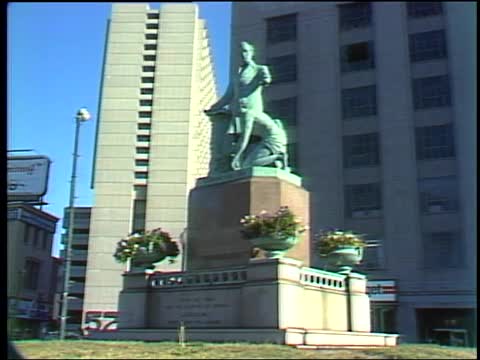
Description: Park Square environs. Carl Fischer Music store on Boylston Street. Entrance to Colonial Theater. Gilbert and Sullivan posters flank doors. Continental Trailways Bus sign and terminal. Park Square traffic. Emancipation statue of Abraham Lincoln and kneeling slave. Inscription on base: “A race set free and the country at peace. Lincoln rests from his labors.” Avis Rent a Car, Club Max, Teddy Bear Lounge, Park Square Lounge (“ladies invited”), Mouse Trap Cabaret marquee.
Collection: Ten O'Clock News
Date Created: 07/24/1978
Description: Carmen Fields reports that Richard Taylor, the Massachusetts Secretary of Transportation and Construction, will preside over the Central Artery/Third Harbor Tunnel Construction Project in Boston. Taylor is one of the few African American Republicans in Massachusetts. Interview with Taylor, who talks about his reasons for being a Republican and his career in business. Taylor talks about his commitment to affirmative action and his plans to encourage participation by women and minorities in the Central Artery/Third Harbor Tunnel Project. Taylor says that he has always pushed for fair and equitable opportunities for minority businesses. Fields notes that Taylor says that his appointment signals a commitment to affirmative action on the part of Governor William Weld. Fields' report is accompanied by footage of Rev. Graylan Hagler and unemployed construction workers at a press conference at a construction site in Roxbury. This edition of the Ten O'Clock News also included the following item: Alexandra Marks interviews businessmen Derek Jeter and William Singleton on the challenges faced by minority businesses in Boston
1:00:03: Visual: Footage of Richard Taylor (Secretary of Transportation and Construction) being interviewed. Taylor says that he supports limited taxes, limited regulation, more research, and development and more private sector involvement. Carmen Fields reports that Taylor is a wealthy, well educated entrepreneur; that Taylor is a Republican; that Taylor is also African American. Fields reports that Taylor is part of a small but growing band of African American Republicans. V: Shot of Taylor in his office. Footage of Taylor being interviewed. Taylor says that some have argued that all African Americans should be Republicans; that Abraham Lincoln (former US president) was a Republican. Taylor says that he believes in limited taxation and limited government involvement. Taylor says that the Republican Party encourages people to pursue economic independence; that the Republican Party discourages people from looking to the government for sustainment. Fields reports that Taylor is the State Transportation Secretary; that he presides over the Central Artery-Third Harbor Tunnel Construction Project. V: Shot of Taylor greeting an African American man and a white man as they enter his office. Footage of Taylor at a meeting with the two men and another woman. Taylor talks about the risk of delays in the project. Fields reports that Massachusetts has a high unemployment rate; that the construction project will provide jobs. Fields notes that the Republican Party is often viewed as being anti-minority, anti-women, and anti-civil rights. V: Shots of Taylor at the meeting. Footage of Taylor being interviewed by Fields. Fields asks Taylor if he is against affirmative action. Taylor says that affirmative action is necessary. Taylor says that minority businesses should participate in the project if it strengthens their skills; that minority businesses should be paid for a job well done. Taylor says that affirmative action helps minority businesses be competitive; that affirmative action is part of the remedial process. Taylor says that some affirmative action models are troublesome. Taylor says that he does not support quotas. Taylor says that some affirmative action models do not give minority businesses enough significant responsibility. Fields asks if he will be a reluctant or an enthusiastic supporter of affirmative action. Taylor says that he is inclined to have active and strong participation by women and minorities. Taylor says that he has always pushed for fair and equitable opportunities for minority businesses. Taylor talks about his career in business before entering government.Taylor says that he will do a good job in this area. Fields reports that Roxbury residents halted construction on a new Post Office facility in Dudley Square recently. Fields notes that residents wanted more jobs for community workers on the project. V: Footage of Graylan Ellis-Hagler (Church of the United Community) speaking at a press conference held at the construction site of the new Post Office in Dudley Square. A group of African American men stand behind Hagler. Hagler says that he and the men will not go away with "crumbs." Shots of the construction site. Fields notes that Taylor says that he has learned from the experience in Roxbury. V: Footage of Taylor being interviewed by Fields. Taylor says that the MBTA recently began a $9 million project to renovate Dudley Station. Taylor says that he incorporated some recent provisions from the Post Office project into the MBTA project. Turner says that it is important for the major contractor to be in agreement with the provisions of the contract. Turner says that he hopes that these provisions will be used in the Central Artery Project. Fields reports that Taylor says that his appointment signals the commitment of William Weld (governor of Massachusetts) to affirmative action. Fields notes that Turner believes that there are many opportunities for qualified people of color. V: Shots of Taylor in his office. Footage of Taylor being interviewed by Fields. Taylor talks about a recent business seminar at the Boston World Trade Center. Taylor says that the seminar focused on how minority businesses could participate in the Central Artery Project. Taylor says that he will soon meet with major contractors for the Central Artery Project. Taylor says that he hopes to link minority businesses with the major contractors in order to provide work for minorities.
Collection: Ten O'Clock News
Date Created: 03/29/1991