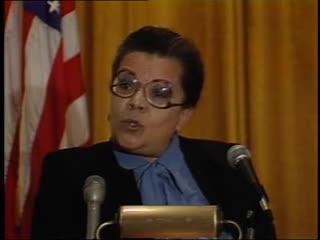
Description: E. Edward Clark, a ninety-two-year-old African American man, speaks to a racially integrated class at the Hennigan Elementary School. The son of slaves, Clark tells vivid stories about his family's experiences in the south following emancipation and about growing up in Cambridge. He stresses the importance of a good education and respect for people of all races. The students ask Mr. Clark questions. Tape 1 of 2.
1:00:00: Visual: E. Edward Clark speaks to a racially integrated class at the Hennigan school. Clark describes the lives of his parents, who were slaves. Clark's father bought his freedom eight years before emancipation. His father bought the freedom of his mother, then the two were married. Clark's parents had 13 children. Clark describes the schools he attended as a boy, and the good education he received from New England missionaries who traveled south to teach former slaves. Clark describes race relations in the south after the Civil War. Clark says that his family moved to a cold-water flat at 143 Erie Street in Cambridge in 1898. Clark talks to the students about the importance of a good education and respect for others; about his impressions of how the world has changed. Clark warns the students that an education will prepare them to make a living later on. He reminds the students that the teachers are there to help them. Clark describes growing up in Cambridge in the early part of the century. He describes how the city has changed and how little things cost back then. 1:18:32: V: Clark invites the students to ask him questions. One student asks him about the secret to long life. Clark says that his parents were healthy; that he does not drink or smoke; that he does not believe in hate or violence. Clark stresses again that an education is necessary for success in life. Another student asks Clark if he was ever married.
Collection: Ten O'Clock News
Date Created: 04/27/1977
Description: Examination of per pupil expenditures in Boston Public Schools. "Fixed costs" keep increasing. Special education requires disproportionate funding. Elementary classroom and kindergarten file.
Collection: Ten O'Clock News
Date Created: 03/22/1989
Description: Marcus Jones reports on efforts to provide positive male role models for young African American boys through the Paul Robeson Institute for Positive Self-Development. Third and fourth grade boys attend the Institute every Saturday, and 25 men from diverse backgrounds assist the boys in developing their understanding of math, science and history. Interviews with Pamela Brodie and Delores Wilson, who are both teachers at the Holland Community School. Both teachers praise the program. Brodie talks about the need for positive male role models. Interview with Keith Motley, a member of the Paul Robeson Institute, about the program. Motley says that programs like this one can help to end the violence on the streets. Interviews with two African American boys who attend the Institute. Following the edited story is additional footage of Brodie and her students in class at the Holland School.
1:00:14: Visual: Footage of students in a classroom at the Holland Community School in Dorchester. Shot of students are getting out their textbooks. The students are seated at their desks. Pamela Brodie (teacher, Holland Community School) stands at the front of the room. Shot of students raising their hands to be called on. Most of the students are non-white. Marcus Jones reports that the majority of students in public elementary schools in Boston are non-white. Jones reports that most of the teachers are female. Jones notes that male authority figures are limited; that African American male authority figures are virtually absent. V: Footage of Brodie being interviewed. Brodie says that most school systems have a lot of female teachers. Brodie says that it is important to have positive male role models for students; that some students do not have a male role model at home. Brodie says that schools need more male role models. Jones reports that elementary school students are in their formative years. Jones reports that a group called Concerned Black Men of Massachusetts visit the Holland School to help students make the right choices. V: Shots of students eating lunch at their desks. Shots of an African American boys walking around the classroom. Footage of Keith Motley (Paul Robeson Institute) being interviewed. Motley says that the group wants to fight against violence; that education is necessary to end violence. Footage from the Paul Robeson Institute. An African American man addresses a group of African American boys. The man speaks from a podium, while the boys sit in seats. The man encourages the boys to be the best people they can be. The man says that the future depends on them. Jones reports that the organized effort to provide positive role models is called The Paul Robeson Institute for Positive Self-Development. Jones reports that African American boys from the third and fourth grades in the Holland and Fifield Schools are involved in the program; that the boys visit the African American Institute at Northeastern University on Saturdays. Jones reports that 25 men from diverse backgrounds assist the boys in developing their understanding of math, science, and history. Jones says that the Institute focuses on African American history. V: Shot of an African American man speaking to a group of African American boys in a classroom. The boys are seated at desks. Shot of a sign for the African American Institute on the exterior of a building. Shot of an African American man standing at the front of a classroom. African American boys are seated at desks. A second African American man leans on a chalkboard as the other man teaches. Shot of a group of African American boys in orange T-shirts standing in a circle. The boys hold hands. An African American man stands in the center of the circle. African American men stand in a circle surrounding the boys. Footage of an African American boy being interviewed by Jones. Jones asks if the teachers at the institute are teaching him to be proud of himself. The boy says yes. Footage of another African American boy being interviewed by Jones. The boy says that the program has taught him that he can do something else besides sell drugs on the street. Shots of Brodie standing in her classroom; of an African American boy flipping through a textbook. Jones reports that the Robeson Institute has been operating for a year; that the Robeson Institute has earned praise from parents and teachers. V: Footage of Delores Wilson (teacher, Holland Community School) being interviewed. Wilson talks about one of her students who has behavior problems. Wilson says that the student's behavior has improved since attending the Robeson Institute. Wilson says that the student now helps other kids. Footage of Motley being interviewed. Motley says that programs like the Robeson Institute should be promoted and encouraged; that men and women should get involved. Shot of the African American boys at the Institute standing in a circle while holding hands. African American men form a circle around the boys. An African American man stands in the center.
Collection: Ten O'Clock News
Date Created: 12/13/1990
Description: OFFICIALS SUGGEST RESTRUCTURING OF SCHOOL COMMITTEE FOR BETTER EDUCATION. RAY FLYNN, EDWARD DOHERTY.
Collection: Ten O'Clock News
Date Created: 04/21/1987
Description: Hope Kelly reports that Superintendent Laval Wilson must improve the reading skills of students in the Boston public schools. Students of all different races read a statement about the importance of literacy. Wilson speaks about the importance of reading skills at a press conference. He says that students are reading below target levels. This edition of the Ten O'Clock News also included the following item: Princess Zenani Dlamini and her husband Prince Thumbumuzi Dlamini will attend Boston University
1:00:00: Visual: Shot of a typed document. The first paragraph of the document summarizes the educational mission of the Boston Public Schools. The last line of the document reads, "For young people to be successful, they have to be literate." Footage of students of different ages and races reading the document. Hope Kelly reports that Dr. Laval Wilson (Superintendent, Boston Public Schools) believes that the Boston Public Schools must improve the reading skills of its students. V: Footage of Wilson at a press conference. Wilson says that students are reading below target levels. Footage of students reading the document. One boy has trouble with the word "literate." Kelly asks him what the word means. The boy answers correctly. Footage of an African American female student says that Wilson is right in saying that students need to be literate; of an Asian American male student saying that students must know how to read in order to get a good job. Footage of an African American male student and an Asian American male student standing together. Both boys say that students need to know how to read. Footage of Wilson says that not all of the schools are performing at the same level. Footage of an Asian American male student saying that he needs to read more books in order to become a better reader; of an African American male student saying that he is "a little good at reading, but not a lot." Footage of an African American male student saying that he is an average reader. Footage of an African American female student saying that her learning environment is not ideal; that her school needs better books. Footage of Wilson saying that school promotion standards are not rigorous enough. Footage of a group of female students. A white female student reads a portion of Wilson's speech about the need for improved reading skills; of an African American female student saying that everyone cannot be expected to read at the same pace. Footage of a white female student saying that her father is not a native English speaker; that he taught her to read. Footage of an African American female student saying that Wilson's standards should not be too strict; that high school students may drop out of school if strict standards are imposed. Footage of a male student saying that a parent is responsible for his or her child's performance in school; of an Asian American male student saying that the student is responsible for his or her performance in school. Footage of an African American male student saying that parents need to take responsibility for their children's performance in school; that parents need to help children with their homework every night. Footage of a white female student saying that she would like to be a doctor when she grows up; of a male student saying that he would like to be a basketball player; of an African American male student saying that he would like to be a lawyer.
Collection: Ten O'Clock News
Date Created: 05/13/1987
Description: Evening Compass special. In-studio operators take phone calls from parents with questions about school assignments and busing for the next school year. Ed Baumeister gives the answers to several true-or-false questions regarding the state plan to achieve racial balance in Boston schools. Judy Stoia gives statistics for the maximum travel distance of students and the racial makeup of schools in each elementary and intermediate school district. Paul deGive reports on a plan proposed by the Boston School Department to hire aids to help care for children and locate parents in case of sickness or family emergency. Baumeister and Pam Bullard (Boston Herald American) interview John Coakley (Boston School Department) and Dr. Charles Glenn (Massachusetts State Department of Education) about implementation of the racial balance plan. Both men respond to questions about the busing of kindergarten students. Judy Stoia explains the term geocode. Stoia and Bob Murray (Boston School Department) give on-air answers to some of the most common questions received by the operators. In studio Bullard, Baumeister and Dr. John Finger of Rhode Island College discuss plan developed to integrate schools. WGBH reporter and Bob Murray have question-and-answer session with questions from callers. Joan Buckley, representative from Boston Teachers Union, discusses plan for teachers with Bullard and Baumeister.
0:02:11: Visual: Introduction to A Compass Special: September in April, a special broadcast concerning the state racial balance plan for the Boston schools. Ed Baumeister is in the studio, along with several volunteers covering the phones. Baumeister introduces the program as informational, designed to answer parents' questions about the plan and its implementation. Baumeister gives out a number for parents to call to reach volunteers in the studio. Baumeister provides true/false answers to basic questions about the plan. Questions touch on the reimbursement of transportation costs, general travel distances for students of various ages and numbers of white and non-white students to be bused. 0:06:08: V: Paul deGive reports on parents who worry about being able to reach their child at a distant school in the case of sickness or emergency. He reports that the Boston School Department will propose a plan to hire transitional aids at each school to contact parents and to care for children in an emergency. 0:09:15: V: Baumeister encourages parents to call studio for information. Volunteers answer the phones. 0:09:55: Report on the Boston elementary school districts under the racial balance plan. Narrator describes the standardization of grade structure in elementary schools and the changes to various elementary school districts. The districts are as follows: Hennigan Kennedy, Bacon Dearborn, Tobin Farragut, Washington Park, Sumner-Conley, Tileston Chittick Greenwood, Lee, Murphy, Marshall Dever Mason, Mendell-Parkman, Paine-Audobon, Milmore, Prince, Faneuil, Lincoln Quincy, Hurley-Bates, Carter, Eliot, South Boston, Hyde Park, Cannon, Ohrenburger, Parker Longfellow. V: Shot of a map of Boston's elementary school districts. Narrator gives information for each district, including district boundaries, names of schools within the district, maximum travel distance for any student in the district and projected non-white enrollment for each school in the district. A map of each district is shown as the narrator reads the information for that district. 0:20:11: V: Judy Stoia encourages parents to call the studio for information concerning their child's school assignment. Shots of telephone volunteers. Stoia mentions that the volunteers are from the Citywide Education Coalition, the Teachers Union and the Boston School Department. Stoia talks to volunteer Lee Grant and explains the term "geocode." Stoia talks to volunteer Scott Campbell about what kind of information he can give to parents over the phone. 0:23:30: V: Baumeister introduces Pam Bullard (Boston Herald American) and John Coakley (Education Planning Center of the Boston School Department). Baumeister refers to Coakley as the man charged with making the racial balance plan work. Coakley refutes the claim that he is in charge of the plan, but discusses preparation for implementation of the plan. Baumeister asks Coakley if the School Department has any flexibility in implementing the plan. Bullard asks Coakley to respond to parental complaints about kindergarten assignments. Bullard presses kindergarten issue, asking if kindergarten children will be bused to the Martha Baker School or to kindergarten centers. Coakley summarizes School Department efforts to minimize busing of kindergarten students and cites the inadequacies of state plan concerning kindergarten students. Baumeister asks Coakley how he would change plan if he could. Coakley cites preliminary plans for integration by the Boston School Department and the Boston School Committee. Coakley says these plans were never developed. Baumeister thanks Coakley. 0:33:27: V: Baumeister provides answers to more true/false questions about the racial balance plan. Questions touch on the following issues: state reimbursement for travel under the desegregation plan, reimbursement of MBTA travel under the plan, major thoroughfares as school district boundaries, classification of Spanish-speaking students, overcrowding of Boston schools. 0:35:14: Report on intermediate school districts under the racial balance plan. Narrator talks about the redistricting of intermediate schools under the plan. Narrator gives the following information for each district: district boundaries, maximum travel distance for any student in the district and percentage of non-white students within each intermediate district school. Narrator reads the information for each district over a map of that district and a shot of the district school. The districts follow: Cleveland, Curley, Dearborn, Edison, Gavin, Holmes, Irving, King, Lewenberg, Lewis, Mackey, McCormack, Michelangelo, Roosevelt, Shaw, Taft, Thompson, Timilty, Wilson. V: Shot of a map of Boston's intermediate school districts. 0:44:41: V: An in-studio reporter asks a volunteer named Fran to describe the phone calls she has received. The reporter addresses a specific situation concerning the placement of 6th grade students in Hyde Park. 0:46:31: V: Baumeister and Bullard interview Dr. Charles Glenn (Office of Equal Education Opportunity of the State Department of Education). Baumeister asks Glenn how the plan determines which children will be bused at the high school level. Bullard asks Glenn about the busing of kindergarten students under the state plan. Glenn explains the intricacies of the plan and its implementation. Baumeister asks Glenn why the state plan to desegregate schools is better than any put forth by the Boston School Committee. Glenn explains that the state desegregation plan goes as far as it can under state law. Bullard questions Glenn about hurried implementation of the racial balance plan, and if the communities involved will be adequately prepared. Glenn responds that the plan has been implemented as well as can be expected in the time given. 0:55:15: V: Baumeister provides answers to more true/false questions. Questions touch on the following issues: definition of non-white students, school assignments and school assignment changes, Massachusetts state racial imbalance regulations, teacher assignments. 0:56:49: V: Stoia and Bob Murray (Education Planning Center of the Boston School Department) answer the most difficult questions received by phone volunteers. Questions involve travel distance within a school district, whether Dr. Glenn lives in Boston, the assignment of students in sub-system schools (Trotter school, Lewis school and Copley High School), and the assignment of seniors in the high schools.
Collection: Evening Compass, The
Date Created: 04/22/1974
Description: Blind and deaf teens and other special needs students demonstrate inside the State House for preservation of Chapter 766 education funding in the state budget.
Collection: Ten O'Clock News
Date Created: 05/22/1991
Description: State college students march to State House to protest decreased education funding. James Braude, Barry Crimmins.
Collection: Ten O'Clock News
Date Created: 04/12/1990
Description: Pam Bullard interviews Marion Fahey (Superintendent, Boston Public Schools). Fahey talks about the assignment of bus monitors and school aides for the coming school year. Fahey explains the roles of transitional aides, security aides and instructional aides. She says that there will also be more special needs aides and bilingual aides in the schools. Fahey comments on the need for all students to attend school in order to learn basic skills. She says that parents should be confident in the educational programs at the Boston public schools. Tape 2 of 2.
0:00:13: Visual: Pam Bullard interviews Marion Fahey (Superintendent, Boston Public Schools) in her office. Fahey sits behind her desk. Fahey says that bus monitors will ride the buses with students again this year; that parents have made it clear that they want bus monitors on the buses with their children. Fahey says that there will be just as many aides this year as in previous years; that there will be fewer transitional aides in the school buildings; that transitional aides will perform duties assigned to them by the headmasters of the schools. Fahey says that the transitional aides will be supplemented by security aides from the Safety and Security Department; that the security aides have additional training in dealing with crises. Fahey says that there will be many instructional aides in the classrooms; that instructional aides will be funded under Title I of the Emergency School Assistance Act; that instructional aides will work with elementary and middle school students in reading and math. Fahey says that there will be bilingual aides as well as aides for the special needs programs in the schools. Bullard asks Fahey what she would tell parents who are skeptical about the quality of the Boston Public Schools. Fahey says that it is important for parents to send their children to school; that parents who keep their children out of school are condemning their children to an unproductive future. Fahey says that the Boston Public Schools have strong educational programs; that school faculty and staff are always working to improve school programs; that students in the Boston Public Schools receive good instruction in basic skills like reading, math and communication. Bullard closes the interview. 0:04:53: V: Bullard and Fahey speak informally. Fahey says that Boston schools are no longer in the "numbers game." Fahey notes that the focus is no longer on desegregation; that her staff is focusing on assessing the performance of students and teachers; that the tension caused by school desegregation hindered classroom learning. Shot of a spreadsheet on Fahey's desk. The spreadsheet gives the racial breakdown of students in each grade level.
Collection: Ten O'Clock News
Date Created: 09/07/1976
Description: 1) Attorney general Frank Bellotti on trying to stop Seabrook full power operating license. 2) Interview with NH governor candidate Paul McEachern on Seabrook. 3) Public health commissioner Bailus Walker on studying incidence of cancers near nuclear power plants; testifies before House Ways and Means chair Richard Voke. 4) Jesse Jackson at State House urges access to higher education by keeping state college tuition affordable. 5) Interview with Dudley Herschbach, professor of chemistry at Harvard, after winning Nobel Prize. Likes teaching freshmen because it keeps him focused on fundamentals. Compares science to art and music because they "can change they way you look at things." He assigns poetry writing to his students and reads a sample on quantum mechanics. Anchor Lydon.
Collection: Ten O'Clock News
Date Created: 11/26/1986