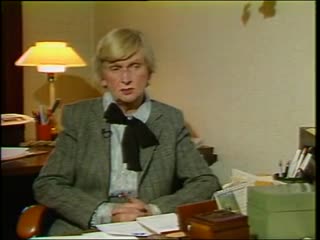
Description: Back Bay advocate and mental health programmer talk about objections to siting group homes in upper income areas. Commonwealth Avenue mall, resident permit parking signs. Arlington Street Church. Vinfen.
Collection: Ten O'Clock News
Date Created: 03/11/1991
Description: Municipal officials gather at Parker House to complain about "level funding," effectively a cut in local aid. Police carry placards. Peabody mayor Peter Torigian, Rep. Robert Havern, Newton mayor Theodore Mann, Sheila Cheimets. Coffee filling cup from urn. Arlington Town Hall and housing.
Collection: Ten O'Clock News
Date Created: 03/01/1989
Description: Meg Vaillancourt reports that the Federal Reserve Bank has released a study finding that banks in Boston are guilty of redlining. Vaillancourt notes that three times as many mortgages are approved in Boston's white neighborhoods as in African American neighborhoods. Vaillancourt reviews the findings of the study. Vaillancourt interviews African Americans on the street. They talk about their experiences in applying for mortgages. Vaillancourt reports that African Americans earn less than whites on average. She adds that these economic factors do not explain the gap in mortgage lending practices. Vaillancourt interviews Joseph Kennedy (US Congressman). Kennedy condemns redlining practices. He adds that banks should not practice discrimination, noting that many banks receive federal funds. Vaillancourt reports that Boston banks have agreed to change their lending practices. She adds that meetings between community activists and banks are scheduled for next month. Vaillancourt's report is accompanied by footage of employees and customers in banks and shots of residential homes.
1:00:14: Visual: Shots of residential homes in suburban areas. Meg Vaillancourt reports that home prices are on the rise. Vaillancourt notes that race can also be obstacle to home ownership. V: Footage of an African American man being interviewed at Downtown Crossing in Boston. The man says that he is turned down every time he applies for a mortgage. Footage of an African American woman being interviewed at Downtown Crossing. The woman says that she has had to submit a great deal of paperwork when applying for a mortgage; that she has been examined more carefully than her income would merit. Footage of Joseph Kennedy (US Congressman) saying that redlining is practiced across the nation; that many officials try to deny it. Vaillancourt reports that the Federal Reserve Bank has released a study which finds that three times as many mortgages are approved in Boston's white neighborhoods as in Boston's African American neighborhoods. V: Shot of an African American woman looking out of the window of an apartment building. On-screen visuals and text detail the findings of the study. Footage of an African American man being interviewed at Downtown Crossing. The man says that banks seem to believe that African Americans do not have money. Footage of another man being interviewed. The man says that there should be no discrimination in lending practices. Shots of homes in a residential neighborhood; of two white women and a child standing in front of one of the homes. Vaillancourt reports that some blamed economic factors instead of race for redlining practices. Vaillancourt quotes statistics which show that African Americans earn less than whites on average; that homes in African American neighborhoods cost less; that there is less development in African American neighborhoods. V: Shots of residential homes in a variety of neighborhoods. Vaillancourt notes that economic factors do not explain the gap in mortgage lending practices. Vaillancourt quotes the study as finding that a 24% difference in mortgages between white and African American neighborhoods is found even when economic factors are taken into account. Vaillancourt reports that the study found that economic factors do not explain the gap in lending practices. V: On-screen text and visuals detail the study findings. Footage of Kennedy saying that poor people are receiving credit; that people of color are being denied access to credit. Vaillancourt reports that the banking industry is in crisis after the savings and loan scandal; that many banks have been forced to close. Vaillancourt notes that taxpayers are bailing out some banks; that banks are having a hard time collecting on bad loans. V: Shots of employees and customers in the lobby of a bank; of a client filling out a loan application; of bank employees sitting at their desks while helping customers. Shot of an African American bank employee helping a white customer with a loan application. Footage of Kennedy saying that banks have access to federal funds; that banks receiving federal funds should not practice discrimination. Shot of two triple-decker houses in a residential neighborhood. One of the houses is dilapidated. Vaillancourt reports that Boston banks have agreed to change their lending practices; that meetings between community activists and banks are scheduled for next month. V: Footage of the first African American man at Downtown Crossing. The man says that he has been forced to look elsewhere for loans; that the banks' lending practices will not stop him.
Collection: Ten O'Clock News
Date Created: 08/31/1989
Description: Residential property assessments have increased in Boston neighborhoods through revaluation. Real estate agent Margaret MacMillan. Assessing commissioner William Coughlin. Examples of houses that gained value through successive sale prices.
Collection: Ten O'Clock News
Date Created: 03/27/1985
Description: David Boeri reports on expansion plans by the State Street Bank. The bank's activities are focused on mutual funds, pension funds, and informational services, and it has a presence on the international scene. The bank needs approval from the State Banking Commission before opening an office in Tokyo. Critics accuse the bank of abandoning its local responsibilities. State Banking Commission Hearing. State Senator Bill Owens says that the bank does not provide credit to low- and moderate-income neighborhoods. William Edgerly, Chairman of the State Street Bank and Trust says that the bank does not provide a full range of consumer services. Interview with Edgerly, who says that the bank needs to go global in order to be an industry leader. He adds that the bank is committed to the local community. Interview with Diane Strother from the Massachusetts Affordable Housing Alliance, who says that the bank does not do enough for the community. Boeri reports that affordable-housing advocates want the bank to renew its commitment to low-income neighborhoods.
1:00:13: Visual: Shots of the exterior of the State Street Bank building on Franklin Street. David Boeri reports that the State Street Bank has been in operation in Boston since 1792; that the bank has been expanding in the 1980s. V: Footage of William Edgerly (Chairman, State Street Bank and Trust) saying that the bank needs to go global in order to be a leader in the industry. Shots of the exterior of the bank; of the entrance to the bank. Boeri reports that loans are a small part of the bank's business; that the bank's focus is on mutual funds, pension funds, and informational services. V: Shots of the floor of the New York Stock Exchange (NYSE) on October 13, 1989; of a NYSE official banging a gavel. Footage of Edgerly saying that the bank is no longer a regional bank; that the bank is now a national and international bank. Shots of the floor of the stock exchange in Tokyo; of business workers on a busy street. Shots of Japanese workers at the Tokyo stock exchange; of a screen listing stocks at the Tokyo stock exchange. Boeri reports that State Street Bank has a presence on the international scene in London, Luxemborg, and Hong Kong; that the bank is planning an office in Tokyo. Boeri reports that advocates of affordable housing have challenged the bank's plans. V: Footage of William Owens (State Senator) at a hearing of the state banking commission. Owens says that poor urban neighborhoods remain in the "backyards" of the multinational banks. Shots of attendees and audience members at the hearing of the banking commission. Boeri reports that State Street Bank needs approval from the banking commission before it opens an office in Tokyo; that the bank remains a state bank. Boeri reports that critics say that the bank has abandoned its local responsibilities. Boeri notes that critics say that the bank has shut down branch offices in Dorchester, Roxbury, and other neighborhoods. V: Shots of audience members at the hearing. Footage of Owens addressing the banking commission. Owens says that the State Street Bank is responsible for a decrease in access to banking services in minority neighborhoods. Boeri stands in front of the State Street Bank building. Boeri reports that the Community Reinvestment Act (CRA) requires banks to provide credit to their local communities. Boeri notes that a bank can have its applications denied if it does not provide credit to low- and moderate-income neighborhoods. Boeri adds that critics want the State Street Bank to take care of business in Boston before opening up a Tokyo office. V: Footage of Edgerly addressing the banking commission. Edgerly says that the State Street Bank is a wholesale bank; that the bank does not provide a full range of consumer services. Shots of audience members at the hearing. Boeri notes that State Street Bank officials say that the bank does not do home mortgages. V: Footage of Edgerly being interviewed by Boeri. Edgerly says that the State Street Bank is devoted to helping the local community become successful. Shot of Edgerly at the bank commission hearing. Boeri reports that Edgerly helped to form the Boston Housing Partnership and the Boston Compact. V: Footage of Diane Strother (Massachusetts Affordable Housing Alliance) saying that the bank does not do enough for the community. Shots of the exterior of the State Street Bank building. Boeri reports that housing advocates want the approval of the bank's Tokyo office to be linked to a renewed effort by the bank to provide banking services and loans to low-income neighborhoods.
Collection: Ten O'Clock News
Date Created: 10/13/1989
Description: B-roll of bulldozer clearing debris from Symphony Road fire. Exteriors of buildings with broken and boarded up windows and smoke stains. Interview with David Scondras of Symphony Tenants Organizing Project. He talks about why the rash of 29 fires in three years is suspected as arson: absentee landlords, high vacancy rate, poor condition of structures, lodging houses, lapsed mortgages. He adds that there is nothing the city can do about the problem and explains why. He hopes that State legislators will back his organization's bill which removes the financial motivation for landlords to burn down houses in poor condition. He discusses the number of people affected while they shoot cutaways. Reporter reasks question for editing purposes. Exteriors of a Red Cross Disaster Service Center. Several takes of reporter standup.
Collection: Ten O'Clock News
Date Created: 02/23/1977
Description: 1) In State of the City address at JP High Mayor Ray Flynn laments struggling economic health of Boston even as state is booming. 2) Interview with Samuel Tyler of Boston Municipal Research Bureau on city's tenuous finances. 3) Gov. Michael Dukakis signs bill to hasten conversion of abandoned buildings to affordable housing. 4) Reps. William Robinson and David Cohen debate rules reform on late night legislative sessions; Reps. Gregory Sullivan, Lawrence Alexander, Andrew Natsios; Robinson on speaker's platform with George Keverian. 5) Brief on aggressive tactics of anti- abortion protesters, reporting that Joseph Stanton of Citizens for Life denies escalating attacks on clinics, calling protesters “sidewalk counselors.” 6) Interview with Roger Fisher on Geneva arms limitations talks. 7) Felicia Lamport verse on arms talks. Anchors Lydon and Vaillancourt.
Collection: Ten O'Clock News
Date Created: 01/07/1985
Description: BRA will require of developers concessions to public benefits: contributions to affordable housing, inclusion of day care facilities in new construction. Stephen Coyle. Chinatown, Lafayette Place.
Collection: Ten O'Clock News
Date Created: 12/08/1988
Description: Four stories from 1983. 1) Urban development in Boston is an issue in the mayoral race. Helicopter aerial of skyline from harbor. Tilt up Prudential and Hancock towers. Pan of Copley Place. Anthony Tappe of Boston Society of Architects comments on deterioration of Victorian Boston because of the scale of new development, making for a less desirable and livable city. Controversy over Mayor Kevin White's intense involvement in urban planning process is discussed by mayoral candidates at a BSA forum on the future of city planning. David Finnegan, Dennis Kearney, Lawrence DiCara, Robert Kiley, Ray Flynn, Mel King. Robert Ryan, BRA director. Marriott Long Wharf Hotel. 2) The dichotomy between preserving rent control/affordable housing and encouraging free market business development through condo conversions in Boston. Struggle of 87-year-old Hester Hurlbutt of 250 Commonwealth Avenue to stay in her apartment. Mel King comments on housing displacement. Ray Flynn favors ban on evictions. David Finnegan disagrees, worried about economic climate. Scenes of Back Bay, Copley Place, Boston Public Library. Sign for luxury condominium for sale. Mayoral candidates Dennis Kearney and Lawrence DiCara campaigning. 3) Latino voters will have an impact on Boston's mayoral race. Alex Rodriguez, Jorge Hernandez, Yohel Camayd-Freixas endorse Mel King. Jose Masso, Gov. Dukakis' Hispanic liaison, says Latinos will split ideologically according to their respective nationalities. 4) Joseph Nelson and Mabel "Matty" Matheson talk about the tradition of the Fenway Victory Gardens. Other plot tenders revel in the therapeutic value and beauty of gardening. Views of flower beds and vegetables.
Collection: Ten O'Clock News
Date Created: 1983
Description: Boston waterfront environs. Lewis Wharf sign. Pilot House. Pleasure boats docked at pier. Interview with Bruce Taymore who lives on a houseboat.
Collection: Ten O'Clock News
Date Created: 01/14/1980