Description: Composer John Cage creates a live musical performance event on WGBH radio's “Chamberworks.” "Chamberworks" host Bill Cavness introduces the piece and invites listeners to call in and become part of it. Cage sits in the booth and takes calls. Interview with Cage on the acceptance and understanding of his enigmatic, elusive work. Musicians play as part of the live musical performance. Interview with musicians on playing pieces composed by Cage.
Collection: Ten O'Clock News
Date Created: 10/25/1988
Description: Composer John Harbison working with Boston Symphony Orchestra conductor Seiji Ozawa on a piece commissioned by the BSO. Interview Harbison on his composing process and what he wants to listener to get out of his work. Ozawa leads the BSO in rehearsal of Harbison's work. Violinist Joel Smirnoff in back of orchestra.
Collection: Ten O'Clock News
Date Created: 03/22/1984
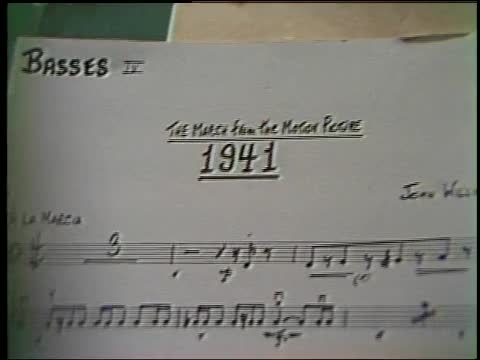
Description: Conductor John Williams in rehearsal with the Boston Pops Orchestra at Symphony Hall.
Collection: Ten O'Clock News
Date Created: 01/21/1980
Description: John Williams and the Boston Pops Orchestra in rehearsal at Symphony Hall.
Collection: Ten O'Clock News
Date Created: 12/04/1979
Description: Interview with Boston Pops conductor John Williams in back room at Symphony Hall. He compares the repertoires and missions of the Pops versus the Boston Symphony Orchestra. He speaks about his possible plans for expanding the repertoire of the orchestra, the types of music they might adapt, and the changes it would require. He says he doesn't want to use Pops as a place to showcase his own work. He laughs about kids always asking why he doesn't play Star Wars. He discusses his future involvement with Pops and staying in Boston. They shoot cutaways with no audio. Lydon reasks questions, with audio.
Collection: Ten O'Clock News
Date Created: 07/01/1981
Description: Erich Kunzel conducts Boston Pops Orchestra in rehearsal for New Year's Eve concert. Several views of Symphony Hall stage with seasonal decorations.
Collection: Ten O'Clock News
Date Created: 12/31/1979
Description: Stevie Wonder demonstrates a Kurweil Reading Machine with text-to-speech capability, which enables blind people to read printed text. He uses the machine to help him read instructions for his synthesizer, so he can compose a song. He jokes around with the audience. He sings part of "I Just Called to Say I Love You." A Boston politician presents Wonder with a commemorative award of his visit to Boston. Wonder addresses the crowd and talks about how the Reading Machine is making a more "harmonious world." Several takes of reporter stand up. A man demonstrates a computer with a touchscreen and Deck Talk features.
1:00:00: Visual: An audience from the technology industry is gathered in the ballroom of the Boston Park Plaza Hotel. Stevie Wonder (pop singer) is at the front of the room, preparing to demonstrate the Kurzweil reading machine and DECtalk machine, which allow him to fully operate a synthesizer. Wonder stands before the keyboard. Wonder explains that the computer keyboard interfaces with the synthesizer; that he cannot operate the machine because he cannot see the controls. Wonder pushes a knob and a computerized voice says what the button does. Wonder begins to program the keyboard. Wonder program the keyboard to play like a piano. Wonder programs the synthesizer to lay down a drumbeat. Wonder stops the drumbeat. Wonder plays and records the tune to the song, "I Just Called To Say I Love You." The audience applauds when he finishes. 1:05:57: V: Wonder says that the synthesizer allows him to create the sound of a band. He jokes that he cannot afford a band of his own. Wonder programs the synthesizer to sound like drums. Wonder plays the drum track over the recorded tune to the song, "I Just Called To Say I Love You." Shots of the audience. The audience applauds when he finishes. Wonder programs the synthesizer to play bass and strings. Wonder has to try a few times before successfully programming the machine. Wonder adds a track with strings to the other tracks of the song, "I Just Called To Say I Love You." 1:13:48: V: The audience applauds. Wonder sings along to the recorded tracks of the song, "I Just Called To Say I Love You." He adds a line to the song, singing "What it is, is something true, that technology like this makes it possible for me to do." The audience sings and claps along with Wonder. Wonder sings a line, thanking DEC (Digital Equipment Corporation) and Raymond Kurzweiler (inventor of the reading machine). The audience gives Wonder a standing ovation. Wonder is guided to the podium. 1:17:16: V: Shots of the audience. A speaker presents Wonder with a silver Revere Bowl from Ray Flynn (Mayor of Boston) commemorating his visit to Boston. The audience applauds. 1:18:15: V: Shot of Wonder from the back of the room. Wonder stands at the podium. He talks about how technology makes communication easier. Shots of audience applauding. Meg Vaillancourt stands at the back of the room. Vaillancourt reports on Wonder's demonstration of new technology. 1:20:08: V: Shots of a computer on display at a vendor's table. Vaillancourt interviews the computer vendor. The computer vendor demonstrates the touch-sensitive screen on his computer. A computerized voice identifies which icon has been pushed. The computer vendor explains that the screen can show either text icons or picture icons. The computer vendor talks about the different voice options on the computer. The computer vendor programs the computer voices to repeat stock phrases for the camera.
Collection: Ten O'Clock News
Date Created: 04/29/1985
Description: Students from Moscow State Conservatory & New England Conservatory live and rehearse together to present series of Soviet / American joint musical programs in Boston. "Making Music Together" part 1
Collection: Ten O'Clock News
Date Created: 03/10/1988
Description: Students from Moscow State Conservatory and New England Conservatory comment on Soviets' technical proficiency and on rehearsing. "Making Music Together" part 2
Collection: Ten O'Clock News
Date Created: 03/11/1988
Description: Grand lobby, interior of Music Hall. Ornate chandelier, marble columns, heavenly mural. Gilded architectural details — carved moldings, capitals, medallions, angels. Interview with Harry Lodge, who gives history of Music Hall (formerly Metropolitan Theater), originally designed in 1920s by Clarence Blackhall for Vaudeville and movies. Describes the proposed restoration program to be completed in fall 1980 if lease secured and funds raised. In order to bring the Metropolitan Opera to Boston, the theater needs deeper stage for performing arts, updated communication systems, ventilation systems, and a renovated auditorium (seats 4,300). The theater is used for ballet, concerts, movies. Lodge states that this renovation with revitalize Boston as a major center for the performing arts. Lodge shows a drawing of the proposed plan.
Collection: Ten O'Clock News
Date Created: 06/21/1977