Description:
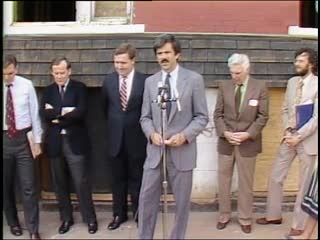
Thomas Saltonstall (Regional Director, EEOC) speaks at a press conference to mark the opening of the Boston office of the Equal Employment Opportunity Commission (EEOC). Saltonstall calls for an end to employment discrimination against minorities; he remarks that minorities in Boston are concentrated in low-paying jobs. Saltonstall refers to charts illustrating the under representation of minorities in office/clerical and sales positions. Saltonstall advocates affirmative action programs and discusses the EEOC's intention to pursue litigation against companies that continue to discriminate in their employment practices. Saltonstall says that minority underemployment is a problem in the Boston area. He defends and explains the intended function of affirmative action programs.Saltonstall discusses the under representation of minorities in the public sector and some pending investigations against employers in the Boston area. Saltonstall describes the realtionship between the EEOC and the Civil Rights Commission; he talks about EEOC enforcement of Title VII of the Civil Rights Act. A reporter asks if employers are receiving mixed messages from a conservative federal government and a more liberal EEOC. Saltonstall says that businesses should comply voluntarily with EEOC guidelines and explains the importance of goals and timetables in a voluntary compliance program. Saltonstall says that discrimination exists in the New England region even though there are fewer minorities in northern New England. Saltonstall says that he does not know of a city with worse statistics regarding job discrimination. Tape 2 of 2.
1:00:01: Visual: Thomas Saltonstall (Regional Director, EEOC) stands at a podium speaking to the media at a press conference on the opening of a Boston office of the Equal Employment Opportunity Commission (EEOC). Saltonstall notes that minorities in Boston are better educated than in other areas of the country; that minorities in Boston are more likely to be concentrated in lower-paying jobs. Saltonstall refers to charts indicating industries which underutilize minorities in office/clerical and sales positions. Saltonstall calls for an end to job discrimination and job segregation. Saltonstall says that some Boston employers may not want to hire minority workers to represent their companies in sales positions; that racial discrimination is unacceptable. Saltonstall says that the problems of job discrimination and the underemployment of minorities must be solved; that action must be taken in the face of these complex problems. Saltonstall notes that advances in the elimination of job discrimination in Boston have been made only through litigation; that the EEOC will pursue litigation to this end; that employer efforts including voluntary affirmative action programs and voluntary compliance with the law will bring about change more quickly. Saltonstall talks about the necessity and importance of affirmative action programs. Saltonstall refers to EEOC guidelines for employer affirmative action programs. Saltonstall notes that affirmative action is a "remedy" for discrimination; that affirmative action programs are not discriminatory. Saltonstall adds that the EEOC wants to work with employers to promote diversity and to end job discrimination. Saltonstall says that Clarence Thomas (Chairman, EEOC) has initiated a voluntary assistance program to help employers understand federal anti-discrimination statutes. Shots of audience members. Saltonstall announces that an EEOC symposium will be broadcast to Chambers of Commerce across the nation. Saltonstall says that he hopes that voluntary compliance will be the norm in Boston; that the EEOC will pursue litigation if necessary. 1:09:21: V: Saltonstall answers questions from the audience. Saltonstall talks about the problem of underemployment of minorities in the greater Boston area. Saltonstall says that the problem is caused by inadequate attention to the problem and by discriminatory practices; that the problem is widespread in Boston. Saltonstall says that the underrepresentation of minorities in the public sector is a problem; that the mayor and the governor are committed to redressing the problem. Saltonstall says that the EEOC is pursuing investigations of employers in the Boston area; that he will not discuss the employer(s) against whom the EEOC will file suit. Saltonstall talks about the relationship between the EEOC and the Civil Rights Commission. Saltonstall talks about the EEOC's enforcement of Title VII of the Civil Rights Act. Saltonstall reads a section of Title VII to the audience. 1:13:32: V: A reporter asks if employers are getting mixed messages from the EEOC and from a more conservative federal government. Saltonstall says that employers should be paying attention to the EEOC instead of other government agencies. Saltonstall says that many cases are settled before litigation is filed. Saltonstall says that voluntary compliance by private employers is important; that the EEOC does not have the resources to pursue every case. Saltonstall notes the presence in the audience of directors from several civil rights enforcement agencies from across New England. Saltonstall says that there are fewer minorities in northern New England; that discrimination exists in the region. Saltonstall does not say that Boston is the "worst city in the nation" in terms of job discrimination. Saltonstall says that he does not know of a US city with a worse problem. Saltonstall says that the 1983 mayoral elections created a dialogue about race in the city; that it is important to take action to solve the problem of job discrimination; that voluntary compliance programs are an effective in resolving the problem. Saltonstall explains the importance of goals and timetables in a voluntary compliance program. Saltonstall explains that statistics for the metropolitan area can be skewed because of the low number of minorites living in the suburbs; that he does not know if Boston is the "worst city in the nation" in terms of this problem.
1:00:01: Visual: Thomas Saltonstall (Regional Director, EEOC) stands at a podium speaking to the media at a press conference on the opening of a Boston office of the Equal Employment Opportunity Commission (EEOC). Saltonstall notes that minorities in Boston are better educated than in other areas of the country; that minorities in Boston are more likely to be concentrated in lower-paying jobs. Saltonstall refers to charts indicating industries which underutilize minorities in office/clerical and sales positions. Saltonstall calls for an end to job discrimination and job segregation. Saltonstall says that some Boston employers may not want to hire minority workers to represent their companies in sales positions; that racial discrimination is unacceptable. Saltonstall says that the problems of job discrimination and the underemployment of minorities must be solved; that action must be taken in the face of these complex problems. Saltonstall notes that advances in the elimination of job discrimination in Boston have been made only through litigation; that the EEOC will pursue litigation to this end; that employer efforts including voluntary affirmative action programs and voluntary compliance with the law will bring about change more quickly. Saltonstall talks about the necessity and importance of affirmative action programs. Saltonstall refers to EEOC guidelines for employer affirmative action programs. Saltonstall notes that affirmative action is a "remedy" for discrimination; that affirmative action programs are not discriminatory. Saltonstall adds that the EEOC wants to work with employers to promote diversity and to end job discrimination. Saltonstall says that Clarence Thomas (Chairman, EEOC) has initiated a voluntary assistance program to help employers understand federal anti-discrimination statutes. Shots of audience members. Saltonstall announces that an EEOC symposium will be broadcast to Chambers of Commerce across the nation. Saltonstall says that he hopes that voluntary compliance will be the norm in Boston; that the EEOC will pursue litigation if necessary. 1:09:21: V: Saltonstall answers questions from the audience. Saltonstall talks about the problem of underemployment of minorities in the greater Boston area. Saltonstall says that the problem is caused by inadequate attention to the problem and by discriminatory practices; that the problem is widespread in Boston. Saltonstall says that the underrepresentation of minorities in the public sector is a problem; that the mayor and the governor are committed to redressing the problem. Saltonstall says that the EEOC is pursuing investigations of employers in the Boston area; that he will not discuss the employer(s) against whom the EEOC will file suit. Saltonstall talks about the relationship between the EEOC and the Civil Rights Commission. Saltonstall talks about the EEOC's enforcement of Title VII of the Civil Rights Act. Saltonstall reads a section of Title VII to the audience. 1:13:32: V: A reporter asks if employers are getting mixed messages from the EEOC and from a more conservative federal government. Saltonstall says that employers should be paying attention to the EEOC instead of other government agencies. Saltonstall says that many cases are settled before litigation is filed. Saltonstall says that voluntary compliance by private employers is important; that the EEOC does not have the resources to pursue every case. Saltonstall notes the presence in the audience of directors from several civil rights enforcement agencies from across New England. Saltonstall says that there are fewer minorities in northern New England; that discrimination exists in the region. Saltonstall does not say that Boston is the "worst city in the nation" in terms of job discrimination. Saltonstall says that he does not know of a US city with a worse problem. Saltonstall says that the 1983 mayoral elections created a dialogue about race in the city; that it is important to take action to solve the problem of job discrimination; that voluntary compliance programs are an effective in resolving the problem. Saltonstall explains the importance of goals and timetables in a voluntary compliance program. Saltonstall explains that statistics for the metropolitan area can be skewed because of the low number of minorites living in the suburbs; that he does not know if Boston is the "worst city in the nation" in terms of this problem.
Collection:
Ten O'Clock News
Date Created:
01/19/1984