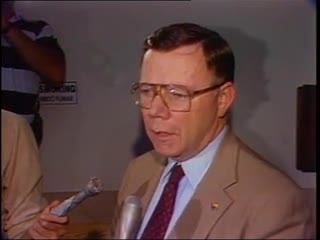
Description: Meg Vaillancourt reports that the Boston City Council has delayed voting on the school reform package proposed by Mayor Ray Flynn, which includes a home rule petition that transfers decision-making power from the Boston School Committee to the superintendent of schools. Reverend Bruce Wall of the Twelfth Baptist Church delivers an invocation before a City Council meeting, presided over by President Bruce Bolling. Some councilors, including Dapper O'Neil, are opposed to the plan. O'Neil criticizes the plan because it gives too much power to the superintendent. Jim Kelly and Joseph Tierney also speak at the meeting. Critics accuse the Boston City Council of delaying their vote on the proposal in order to garner media attention. Interview with Boston School Committee member John Nucci. Vaillancourt notes that school reform is an important issue for voters. Shots of a newspaper article criticizing the City Council. Interview with City Councilor Christopher Ianella, who says that the councilors are practicing "the art of politics" and that they will eventually vote in favor of the proposal. This edition of the Ten O'Clock News also included the following item: Callie Crossley reports on a proposal to allow for AIDS testing by insurance companies
1:00:01: Visual: Footage of Reverend Bruce Wall (Twelfth Baptist Church) delivering an invocation before a meeting of the Boston City Council in the City Council Chambers. City Councillors Charles Yancey and Bruce Bolling stand behind him. Shots of the City Councillors in the Chambers. Bruce Bolling presides over the meeting. The other councillors sit behind desks. Meg Vaillancourt reports that the Boston City Council met to consider the school reform package proposed by Ray Flynn (Mayor of Boston). Vaillancourt notes that the package includes the home rule petition, which is the "cornerstone" of school reform in Boston. V: Footage of Dapper O'Neil (Boston City Council) saying that the Boston School Commitee is "crucifying the teachers"; that the School Committee is giving too much power to the superintendent. O'Neill compares Wilson's power to that of Adolph Hitler. O'Neil says that he will never vote for the school reform package. Vaillancourt reports that O'Neil was the only City Councillor to say that he would vote against the package; that consensus is never easy in an election year. V: Shot of the stenographer in the center of the Chambers. Footage of James Kelly (Boston City Council) saying that there is no rush to vote on the home rule petition; that the state legislature will not meet to approve the petition until September. Vaillancourt reports that most City Councillors agree with the petition; that the petition transfers power from the School Committee to the superintendent. V: Shots of a School Committee meeting in session. Vaillancourt reports that the School Committee has agreed to share power; that the proposal to allow Wilson to make personnel decisions has strong backing in the business community. Vaillancourt notes that Flynn's proposal includes changes suggested by councillors; that Boston newspapers called the councillors' suggested changes "absurd." V: Shots of the City Council meeting; of a newspaper editorial with a headline reading, "Games Councillors Play." Vaillancourt reports from outside of the City Council Chambers. Vaillancourt reports that the City Council delayed voting on the package; that the Council referred the school reform package to its Education Committee for review. Vaillancourt notes that the Council objected to the package last week. Vaillancourt speculates that the Council did not want to appear to back down from their objections by approving the package; that the Council did not want to open themselves up to criticism by rejecting the package. V: Footage of Bolling preciding over a vote in the Coucil Chambers. Shot of Joseph Tierney (Boston City Council) addressing the Council. Vaillancourt reports that politics may be behind the City Council's delay. Vaillancourt adds that school reform is the focus of Tierney's mayoral campaign. V: Footage of Tierney saying that he will not vote in favor of the package until he has the opportunity to make an "intelligent, informed vote." Footage of John Nucci (President, Boston School Committee) saying that the City Council is delaying on the issue in order to garner attention from the media. Vaillancourt speculates that Nucci is correct; that school reform is a major issue for voters; that most City Councillors will probably endorse the plan. V: Shot of students playing ring-around-the rosey at the Jackson Mann Elementary School. Footage of Christopher Ianella (Boston City Council) being interviewed by Vaillancourt. Ianella says that Councillors are practicing the "art of politics"; that the vote will eventually come out in favor of the package.
Collection: Ten O'Clock News
Date Created: 08/03/1987
Description: Meg Vaillancourt reports that members of the Citywide Parents Council have criticized the Boston School Committee's decision to release superintendent Laval Wilson from his contract. Press conference with Council members Jackie van Leeuwen and Glenola Mitchell. Van Leeuwen says that School Committee members acted unethically and unfairly in firing Wilson. Mitchell says that she believes that race played a role in Wilson's firing. School Committee members were critical of Wilson's communication skills, but rated him as fair or better in all other categories. School Committee members deny that race played a role in the firing. Parents are demanding a voice in the selection of Wilson's successor. Vaillancourt adds that the School Committee has been forced to cut back on spending and that money will be tight for the next year. Vaillancourt's report is accompanied by footage of a Boston School Committee meeting and footage of Wilson speaking to the media.
1:00:06: Visual: Footage of Dr. Laval Wilson (Superintendent, Boston Public Schools) speaking to the media on February 14, 1990. Wilson says that he is Boston's first African American superintendent of schools; that he has been a successful superintendent who has worked hard for all groups. Meg Vaillancourt reports that the Boston School Committee voted to replace Wilson last week. Wilson notes that Wilson has had problems in the past with the Citywide Parents Council; that the organization spoke out in support of Wilson today. V: Footage of Jackie van Leeuwen (Citywide Parents Council) at a press conference. Van Leeuwen says that members of the Boston School Committee acted unethically and unfairly in firing Wilson; that Wilson should have been provided an opportunity to discuss his evaluation. Vaillancourt reports that the School Committee evaluation rated Wilson as fair or better in all categories; that members were critical of his communication skills. V: Shot of John O'Bryant (Boston School Committee) speaking to members of the School Committee during a break in a meeting in February of 1989. Wilson looks on. Vaillancourt reports that Wilson's supporters believe that his professionalism is more important than his personality; that Wilson's supporters question the professionalism of the School Committee. V: Shots of a white female teacher teaching students in a classroom. Shots of individual white and African American students. Footage of Glenola Mitchell (Citywide Parents Council) at the press conference. Mitchell questions how the School Committee found the money to buy out Wilson's contract. Mitchell says that the School Committee could not find any money for crucial programs or teacher contracts. Footage of Von Leeuwen saying that the School Committee is supposed to represent the interests of parents and schoolchildren. Von Leeuwen says that the School Committee has shown no regard for the opinions of parents and students. Shot of members of the media in the audience. Vaillancourt asks Mitchell if race played a role in the School Committee's vote against Wilson. Mitchell says that the pattern of the vote shows that race did play a role for some members. Footage from a School Committee meeting in February of 1989. Shots of the members of the School Committee seated at the front of the School Committee chambers; of audience members crowded into the School Committee chambers. Shot of Wilson standing alone as he drinks from a cup. Shots of School Committee members Daniel Burke, Peggy Davis-Mullen, Kitty Bowman, and Robert Cappucci conferring during a break in the meeting. Vaillancourt reports that white members of the School Committee deny that race played a part in the decision; that Wilson declined comment on camera today. Vaillancourt reports that Wilson is being considered for superintendent's post in Florida. V: Shot of the audience at the press conference of the members of the Citywide Parents Council. Vaillancourt notes that the Miami Herald has quoted Davis-Mullen as saying that Wilson is a "rigid, inflexible centralist." Vaillancourt notes that the Miami Herald quoted Davis-Mullen as saying that Wilson is unable to take criticism or move with the flow. V: Shot of Davis-Mullen speaking at a School Committee meeting. The quote by Davis-Mullen appears written in text on-screen. Vaillancourt reports that parents have demanded to meet with the School Committee; that parents want a voice in the selection of Wilson's replacement. V: Shots of attendees at the Citywide Parents Council press conference. Shot of Julio Henriquez (aide to School Committee member Daniel Burke) standing at the rear of the room. Footage of Mitchell saying that she is concerned about the members who do not have children in the school system; that those members are not users of the system. Vaillancourt reports that the School Committee's decison to fire Wilson comes at a bad time; that the state budget crunch has forced the School Committee to cut back on spending. Vaillancourt notes that the Boston City Council has not come up with funding for next year's teacher contracts; that a new student-assignment plan was scheduled to go into effect in the fall. Vaillancourt adds that Wilson will have to meet those challenges as "a lame-duck superintendent."
Collection: Ten O'Clock News
Date Created: 02/20/1990
Description: SCHOOL COMMITTEE DEBATES DISPENSING CONTRACEPTIVES IN SCHOOLS. birth control. Laval Wilson, Joseph Casper, Abigail Browne.
Collection: Ten O'Clock News
Date Created: 09/09/1986
Description: The Boston School Committee holds a meeting in the School Committee chambers. Members of the School Committee discuss school business. John O'Bryant (Boston School Committee) reports on the need for school repairs; Robert Spillane (Superintendent, Boston Public Schools) reports on staffing issues. Sharon Stevens (WGBH reporter) interviews Kathleen Kelly (President, Boston Teachers Union) about a proposed school choice plan. Kelly says that many parents support a school choice plan because the current system allows little flexibility. Kelly says that the school choice plan must be considered carefully to prevent a return to segregated schools. Stevens interviews O'Bryant about the proposed school choice plan. O'Bryant says that the plan promotes greater access to schools across the city; that the current system is archaic and inflexible. Stevens interviews Barbara Gray (parent) about the proposed school choice plan. Gray says that parents should be allowed to choose a school with programs suited to the needs of their children. Gray says that the schools need to be improved; that the Boston Public Schools are not truly integrated because there are few white students. Stevens has extended conversations with interviewees while cutaways are shot. Takes of Stevens doing standup about supporters of the school choice plan working on an official proposal for the end of the month. The audio quality on this tape is uneven.
1:00:12: Visual: A Boston School Committee meeting is held in the chambers of the Boston School Committee. School committee members Jean McGuire, John O'Bryant, Jean Sullivan McKeigue, Kevin McCluskey, and Rita Walsh Tomasini are seated at the front of the room. Robert Spillane (Superintendent, Boston Public Schools) sits at the front with the members of the School Committee. Community members and the press are seated in the audience. O'Bryant talks about the need for $40 million to make school repairs. He says that the mayor, the Boston City Council, and the community must be made aware of the money needed for repairs. Shots of the various committee members. McKeigue agrees that school repairs are needed. A vote is taken on approving a draft of a letter to the mayor and the Boston City Council. O'Bryant thanks Spillane for his report. O'Bryant asks Spillane a question about staffing. Spillane says that more staff is needed before instituting a certain program. Audio is muffled. Shots of Sharon Stevens (WGBH reporter); of members of the audience; of the stenographer; of the committee; of the audience. The committee members discuss school business. Audio remains muffled. Shot of the committee members from the perspective of the audience. 1:05:10: Visual: Spillane talks about setting objectives for the school Social Studies programs. Shots of the committee members; of the audience. Audio is muffled. The committee members take a vote. Committee members discuss school contract issues. Shot of Stevens; of Kathleen Kelly (President, Boston Teachers Union) speaking to another audience member; of audience members. 1:08:15: V: Stevens sets up an interview with Kelly. Stevens asks Kelly about a "freedom of choice" proposal supported by some African American parents. Kelly says that she has not yet seen the proposal; that many African American and white parents support a "freedom of choice" plan because the geocode system allows little flexibility; that parents are more interested in good education than racial statistics. Kelly says that a control mechanism must be put in place to prevent a return to segregated schools; that the plan must be given careful thought. Kelly says that the choice of educational programs is more important than the choice of school location. Stevens asks Kelly if busing is "almost dead." Kelly says that busing is no longer the only remedy for Boston schools; that busing can serve as a tool to further the goals of desegregation and educational quality. The crew takes cutaway shots of Stevens and Kelly. Stevens and Kelly speak informally. 1:12:36: V: Stevens sets up an interview with O'Bryant. Stevens asks for O'Bryant's opinion of the "freedom of choice" proposal. O'Bryant says that parents are trying to reform the rigid geocode system; that students have been denied access to schools because of the geocode system. O'Bryant mentions students who have been denied access to the Trotter School. O'Bryant says that the parents are asking for more accessibility to the schools; that the "freedom of choice" proposal has been made into a bigger issue than it should be. O'Bryant says that the geocode system assigns students to schools based upon their residence; that the geocode system is archaic and inflexible; that the geocode system must be addressed in the consent decrees put forth by the court; that leaving the geocode system in place would have "disastrous" consequences. Stevens asks O'Bryant about NAACP intervention in the court case, and NAACP opposition to the "freedom of choice" plan. O'Bryant says that there is a lack of communication between the NAACP and supporters of the plan; that supporters of the plan want greater access to the schools. Stevens asks if the "freedom of choice" plan could result in a return to segregated schools. O'Bryant says that schools in Boston are already segregated because white parents refuse to send their children to most schools located in African American communities; that African American parents want greater access to quality schools all over the city. The crew takes cutaway shots of Stevens and O'Bryant. O'Bryant says again that the "freedom of choice" plan does not represent a return to segregated schools. 1:16:13: V: Stevens sets up an interview with Barbara Gray (parent), who supports the "freedom of choice" plan. Gray says that the supporters of the plan want greater access to all of the schools; that supporters of the plan want an end to the rigid geocode system. Gray explains that the geocode system assigns children to schools according to address and race. Gray says that all of Boston schools need to have high standards; that the each of the schools should have different programs designed to suit specific needs; that students should be able to choose a school whose programs suit their needs. Gray says that education needs to be improved so that all of the schools are equally competitive and able to provide a good education. Stevens asks if the "freedom of choice" plan could result in a return to segregated schools. Gray says that she does not want to go back to segregated schools; that true integration does not exist in Boston because there are not enough white students in the school system; that white students might return to the system if the schools are reformed. The crew takes cutaway shots of Stevens and Gray. Gray says that parents want more control over the education of their children. 1:19:59: V: Stevens records the closing segment of the story from outside of the headquarters of the Boston School Committee. She reports that the supporters of the "freedom of choice" plan are working on an official proposal for the end of the month; that the Massachusetts State Board of Education will propose an end to court intervention in the Boston School System. Stevens does two more takes of the closing segment.
Collection: Ten O'Clock News
Date Created: 03/08/1982
Description: Acting superintendent Joseph McDonough tells City Council that School Department needs more money. Thomas Menino says they must live within their means. Albert O'Neil, Bruce Bolling, Rosaria Salerno, Michael McCormack in council chamber.
Collection: Ten O'Clock News
Date Created: 12/06/1990
Description: Meg Vaillancourt reports on controversy over a new student assignment plan for the Boston Public Schools, which minority members of the Boston School Committee spoke out against at a breakfast commemorating the birthday of Martin Luther King, Jr.. School Committee members John O'Bryant, Juanita Wade, Jean McGuire, and Gerald Anderson speak to the media. They do not believe that the plan will provide equitable education for all. The plan was proposed by mayor Ray Flynn. It will allow parents to choose which schools their children will attend. Interview with Flynn, who defends the proposal, saying that it's supported by parents. He adds that School Committee members have been asked for input on the plan. Vaillancourt also reports that Flynn has proposed the decentralization of the Boston School Department and selling off the headquarters of the Boston School Department. Vaillancourt reports that minority members of the School Committee may rescind their support for superintendent Laval Wilson if he supports Flynn's school choice proposal. This edition of the Ten O'Clock News also included the following items: Elma Lewis in Marsh Chapel at Boston University on Martin Luther King Day and Carmen Fields interviews Robert Nemiroff about the playwright Lorraine Hansberry
1:00:26: Visual: Footage of city and state leaders including Michael Dukakis (Governor of Massachusetts), Charles Stith (Union United Methodist Church), Bernard Cardinal Law (Archidiocese of Boston), and Ray Flynn (Mayor of Boston) singing together at celebration in honor of the birthday of Martin Luther King, Jr. (civil rights leader). Meg Vaillancourt reports that local leaders gathered over breakfast today to celebrate Martin Luther King's birthday. Vaillancourt notes that there was controversy at the breakfast over a new assignment plan for students in Boston Public Schools. V: Footage of Juanita Wade (Boston School Committee) speaking to the media. School Committee members John O'Bryant and Jean McGuire sit beside Wade. Wade calls the new plan "segregation redux." Wade says that the Boston Public Schools need to provide choice, equity, and a quality education right now. Footage of Flynn speaking to the media. Flynn says that the plan has the support of the citizens of Boston; that parents are looking for this kind of reform. Vaillancourt reports that the new plan would allow parents to choose which schools their children will attend; that parents have not been able to choose schools since school desegregation began in 1974. V: Shots of buses pulling up to the front of South Boston High School in 1974; of South Boston residents jeering at the buses. Shots of buses parked in front of South Boston High School; of African American students walking among the buses. Vaillancourt notes that the population of white students in Boston Public Schools has declined since 1974; that non-white students make up 70% of the student population in Boston Public Schools. Vaillancourt adds that the School System has been criticized for not providing students with a quality education. V: Shots of non-white students in a classroom; of an African American male student sitting in a classroom. Shot of Flynn. Vaillancourt reports that Flynn and two consultants have proposed a plan to improve the schools and to increase parental choice. V: Footage of School Committee members O'Bryant, Wade, McGuire, and Gerald Anderson sitting on a couch. African American community leaders, including Charles Yancey (Boston City Council), Eugene Rivers (African Peoples Pentecostal Church) and Louis Elisa (Boston chapter of the NAACP), stand behind them. Anderson addresses the media. Anderson says that the Boston School System needs to provide a quality education to all before it can claim to be equitable. Anderson says that the mayor needs to provide more funding to the schools. Shots of O'Bryant and other community leaders. Footage of Flynn being interviewed by Vaillancourt. Vaillancourt asks Flynn if he is surprised by the attitude of the African American community leaders. Flynn says that he has been working on the proposal for several months; that community leaders have had many opportunities to review and give input on the proposal. Footage of Anderson saying that he is offended by Flynn's attitude. Anderson notes that Flynn has said that the statements of the African American leaders are "bogus." Anderson says that the community leaders are standing up for their constituents; that Flynn's statements are "bogus." Footage of Flynn saying that the members of the School Committee have had input on the proposal; that the members of the School Committee voted twelve-to-one in favor of the plan. Flynn says that the School Committee members were told that they would have further opportunities to give input on the proposal. Footage of McGuire saying that Flynn's proposal will cost more money. McGuire says that the School Committee has not been given additional money to fund Flynn's proposal. Vaillancourt reports that the Boston Public School System spends more money per student than any other public school system in the nation. V: Shot of an African American teacher and student at the front of a classroom; of a white male student seated in a classroom; of an African American female student seated in a classroom. Vaillancourt notes that Flynn has come up with another controversial proposal to fund neighborhood schools; that Flynn has suggested the decentralization of the Boston School Department. Vaillancourt adds that the proposal would sell off the downtown headquarters of the Boston School Department on Court Street. V: Shots of the exterior of the Boston School Department headquarters. Footage of Flynn saying that the downtown headquarters of the School Department should be sold; that the money should be put into neighborhood schools. Footage of O'Bryant saying that the School System is going to end up back in court if it does not receive support from the city. Vaillancourt reports that Dr. Laval Wilson (Superintendent, Boston Public Schools) has supported Flynn's school choice plan; that Wilson's contract ends in June. V: Shots of a meeting in the chambers of the Boston School Committee; of Wilson speaking at a School Committee meeting. Vaillancourt reports that the African American members have voted to extend Wilson's contract in the past. Vaillancourt notes that Wilson's future support among the Committee's African American members may depend on his position on Flynn's school choice plan.
Collection: Ten O'Clock News
Date Created: 01/16/1989
Description: Hope Kelly reviews the major events and key issues during the tenure of Boston superintendent of schools Laval Wilson. The Boston School Committee has voted to remove him from his post. Kelly adds that there are racial overtones in the vote to dismiss Wilson. Kelly notes that Wilson's opponents are all white. Kelly reviews Wilson's interview and selection, his record and the school bus drivers' strike. Kelly also discusses the school consolidation controversy and his contract renewal in 1989. The Boston Public Schools experienced a rise in achievement test scores and a decrease in the dropout rate under Wilson. Kelly's report is accompanied by footage illustrating these events during Wilson's tenure. This edition of the Ten O'Clock News also included the following items: Controversy surrounds the Boston School Committee's decision to fire Laval Wilson and Meg Vaillancourt interviews Nthabiseng Mabuza about the release of Nelson Mandela
1:00:04: Visual: Footage of Dr. Laval Wilson (Superintendent, Boston Public Schools) being interviewed by Eileen Jones (WGBH reporter) on July 19, 1985. Wilson says that he wants to convince the Boston Public School community that he is the best person for the job of superintendent. Shots of posters prepared by Wilson for his presentation to the Boston School Committee; of Wilson adjusting the position of the charts. Hope Kelly reports that Wilson interviewed for the position of superintendent in July of 1985. Kelly notes that Wilson showed little charisma; that he was well prepared for the interview. V: Footage of Wilson being interviewed by the Boston School Committee in the School Committee chambers on July 19, 1985. Wilson says that his planning skills are excellent. Shots of Wilson and the members of the School Committee. Kelly reports that Wilson stressed his planning skills; that Wilson was self-confident and stubborn. Kelly notes that Wilson did not mention his people skills or his passion. V: Footage of Wilson being interviewed by Jones on July 19, 1985. Wilson repeats that he classified himself "as a school superintendent." Shot of Wilson during his interview with the School Committee. Kelly reports that Wilson never made any reflections on race. V: Footage of Wilson being interviewed by the School Committee on July 19, 1985. Wilson says that he is an educator who happens to be African American. Footage of the members of the School Committee as they cast their votes for the position of superintendent on July 31, 1985. Jean McGuire (Boston School Committee) votes for Dr. Peter Negroni (candidate for superintendent of schools). School Committee members John O'Bryant and Thomas O'Reilly vote for Wilson. Kelly notes that Wilson had held the position of superintendent of schools in Rochester, New York, and Berkeley, California. Kelly reports that the Boston School Committee voted nine-to-four in favor of hiring Wilson. Kelly reports that Wilson became Boston's first African American superintendent of schools. Kelly adds that the Boston Public School System was rife with poverty and patronage in 1985. V: Footage from August 21, 1985. Wilson walks on Devonshire Street with a group of school officials, including John Nucci (President, Boston School Committee), Ellen Guiney (Citywide Education Coalition), John Grady (Boston School Committee), and Julio Henriquez (aide to School Committee member Daniel Burke). Footage of Wilson at a press conference of May 12, 1987. Wilson says that 20% of first-graders did not pass first grade last year. Kelly reports that a bus strike paralyzed the school system in Wilson's fourth month on the job. Kelly notes that students and parents became enraged at Wilson's plan to consolidate schools. V: Shot of buses parked outside of South Boston High School. African American students walk among the buses. Shot of a group of angry protesters. Shots of students and parents protesting outside of the Boston School Committee headquarters on Court Street. The students and parents hold signs. Shot of a jacket being held up in the air. Writing on the jacket reads, "Save our school." Kelly reports that Wilson threatened to resign over the school consolidation issue; that Wilson pursued a job offer from the New York City Public School System in 1987. Kelly notes that Wilson receives a salary of nearly $100,000 per year. Kelly adds that there were questions about his performance. V: Shot of Wilson at a press conference. Footage from a Boston School Committee meeting on October 11, 1988. Shot of Daniel Burke (Boston School Committee). Shot of Wilson saying that progress is being made. Shot of the audience at the meeting. Kelly reports that progress is being made in the school system; that achievement scores are rising. Kelly notes that the drop-out rate has declined to its lowest level in eleven years. V: Shots of Wilson in an elementary school classroom; of Wilson and school officials walking through a high school corridor. Footage from a Boston School Committee on April 11, 1989. Don Muhammad (Muhammad's Mosque) addressing the members of the School Committee. Muhammad says that Wilson's contract should be renewed; that Wilson has begun to turn the school system around. Shots of audience members crowded into the School Committee chambers; of the School Commitee members in the School Committee chambers. Kelly reports that Wilson's contract was renewed in 1989; that Wilson survived by one vote. Kelly reports that Wilson did not receive a ringing endorsement from the Boston School Committee; that Wilson had wanted a four-year contract in 1989; that he did not receive one. Kelly notes that Ray Flynn (Mayor of Boston) suggested abolishing the Boston School Committee during the summer of 1989. V: Footage of Flynn at a press conference in May of 1989. Flynn says that the present system fails the schoolchildren and parents of Boston. Shot of the members of the School Committee seated at the front of the School Committee chambers. Kelly reports that Flynn wanted to replace the elected school committee with an appointed school committee. V: Footage from July of 1985. Wilson sits at a press conference with Flynn, Edward Doherty (President, Boston Teachers Union), Peggy Davis-Mullen (Boston School Committee), Rita Walsh-Tomasini (Boston School Committee) and other school officials. The officials stand up and raise their linked hands. Kelly reports that the debate over the schools has become divisive and political. Kelly reports that Flynn took no questions about Wilson today; that Flynn released a short statement. V: Footage of Wilson being interviewed by the School Committee on July 19, 1985. Wilson says that issues are more important than skin color. Kelly stands outside of the headquarters of the Boston School Committee. Kelly notes that the situation has racial overtones. Kelly reports that an all-white majority on the School Committee has voted to remove an African American superintendent from a school system with a 75% non-white student population.
Collection: Ten O'Clock News
Date Created: 02/14/1990
Description: Judge rules Boston School Committee cannot order school closings. Parents rejoice over injunction but still have questions about assignments.
Collection: Ten O'Clock News
Date Created: 08/22/1989
Description: Kathleen Sullivan complains that her chief role as School Committee member is helping constituents obtain patronage jobs, rather than focusing on public education issues.
Collection: Ten O'Clock News
Date Created: 09/28/1976
Description: Kathleen Sullivan complains that the School Committee is too much a 'political' organization rather than a guardian of educational interests of the city. Patronage.
Collection: Ten O'Clock News
Date Created: 09/28/1976