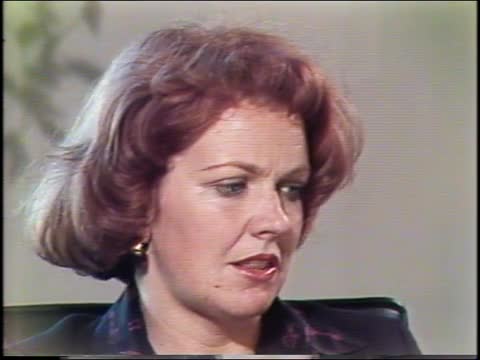
Description: School Committee member Kathleen Sullivan talks about evening centers (night classes in vocations for adults) run by Boston Public Schools. She says they are underenrolled and should be closed.
Collection: Ten O'Clock News
Date Created: 10/04/1976
Description: Interview with John Kerrigan, chairman of the Boston School Committee. He discusses the recent distribution of Students for a Democratic Society (SDS) literature at the girls Latin and English high schools.
Collection: WHDH
Date Created: 09/18/1969
Description: Kevin White addresses Boston Latin students.
Collection: Ten O'Clock News
Date Created: 01/21/1987
Description: Press conference at City Hall. Boston Mayor Kevin White and Police Commissioner Robert DiGrazia read prepared statements about the following day's school opening in the third year of court-ordered busing. White expresses confidence in a peaceful opening of schools. DiGrazia says that police have been instructed to use minimum force, but to act decisively against any disruptions of public order. Both men hope that police can be removed from schools as soon as possible. White notes that the atmosphere seems calmer this year than during the previous two years. White says that he would like to remove police from the schools as soon as possible because their presence hinders the development of a healthy learning environment. Reporters question them on the school opening. Shots of Pam Bullard listening to the press conference.
2:09:33: Visual: Members of the press are assembled for a press conference at City Hall with Kevin White (Mayor, City of Boston) and Robert DiGrazia (Police Commissioner, City of Boston). White begins reading a statement, then stops because there is a problem with sound. 2:11:53: V: White reads a prepared statement. He says that school opens tomorrow; that fewer students face assignments to new schools this year; that more students are attending the schools of their choice; that many schools are benefitting from programs linked with universities and businesses; that three new schools are opening; that he is confident that the school year will be productive. White says that the city is prepared to guarantee the safety of all schoolchildren; that he hopes to reduce the police presence at the schools this year; that police will restore order if disruptions occur. White urges citizens to share in the responsibility for a peaceful school opening; that the city will focus on improving schools this year. 2:14:32: V: DiGrazia reads a prepared statement. He expresses confidence in a peaceful school opening. He reports that police have received instructions to allow peaceful demonstrations, but to maintain public order; that police officers have been instructed to use minimum force and to treat those arrested with respect and courtesy. DiGrazia says that police will not tolerate any acts of violence or disruption; that these acts are often committed by only a few citizens. 2:15:56: V: White invites questions from the reporters. A reporter asks DiGrazia what kind of preparations have been made for additional police support. DiGrazia says that Massachusetts State Police will be assigned to South Boston; that MDC Police will be assigned to Charlestown; that US Marshals will be present for the opening of schools. DiGrazia says that the atmosphere on the streets seems calm; that a few citizens are engaging in disruptive behavior; that the atmosphere seems calmer than in the previous two years; that police presence will be less visible than last year; that additional police will stand by for support. DiGrazia says that the police have not received any indication that there will be outside agitators at the schools. DiGrazia says that he hopes there will be little overtime for police officers this year. DiGrazia says that uniformed State Police officers will be assigned to South Boston High School; that community service officers and juvenile officers will be assigned to monitor the other schools. 2:18:52: V: A reporter asks about cooperative efforts between the School Department, the city of Boston, and the Police Department. White says that the three entities have been working together on school desegregaton for three years; that differences about the school budget have not affected efforts to achieve a successful school opening. DiGrazia says that police will continue to enforce ordinances forbidding the assembly of more than three people along a bus route, or assemblies within 100 yards of schools. Shot of Pam Bullard. White says that he would like to remove police from schools as soon as possible; that police presence hinders a healthy learning atmospheres; that police can be removed if citizens refrain from disrupting the schools. A reporter asks DiGrazia to clarify the term "minimum force" in police conduct. DiGrazia says that he hopes police can dissuade citizens from engaging in disruptive behavior; that he would like to see the police removed from the schools as soon as possible. DiGrazia refuses to elaborate on minimum tolerance policy guidelines, but says that warnings will be given to disruptors before action is taken. DiGrazia says that the school department instituted the use of metal detectors at the schools; that they will be used again this year. DiGrazia refuses to give out information on the number of police officers assigned to the schools
Collection: Ten O'Clock News
Date Created: 09/07/1976
Description: Compilation of footage on the Martin Luther King, Jr. Middle School. Press conference with Mr. Rollins and other people concerned about racist education at the King School, talking about the first day of school, the Boston School Committee's actions, and appropriate learning resources for the students at the King School. Another press conference about Operation Exodus, which is setting up learning centers for students who are assigned to attend the King School. They criticize the racist education of the current curriculum in Boston Schools. Cutaways of reporter asking questions. Press conference with John Bradley, new principal of the King School, answering questions about school problems and his proposed solutions. Interview with Louis Vangel, executive director of the Boston Teachers Union, on the teachers position at the King School. Interview with another man about the School Committee meeting to occur next Monday on the fate of the teachers and reopening of the King School. Interview with Louise Day Hicks on her proposed repeal of the 1965 Racial Imbalance law. Reporter asks her about soon to be Massachusetts Commissioner of Education Neil Sullivan and his busing programs. People walking into a building. Another interview with Mr. Vangel on the BTU's demands for the closing of the King School. Interview with man from the Boston School Committee on relationship between the School Committee and the King-Timility Advisory Council on resolving the problems at the King School. Silent footage of a hearing. Cutaways from Louise Day Hicks interview.
Collection: WHDH
Date Created: 11/1968...12/1968
Description: Family and friends attend funeral for Kingsley Allen, 16 year old student stabbed in Boston High School.
Collection: Ten O'Clock News
Date Created: 12/17/1990
Description: Marcus Jones reports that superintendent Laval Wilson is frustrated because the Boston School Committee has twice rejected his proposal to consolidate Boston high schools. Interviews with School Committee members John Nucci, Joseph Casper and John O'Bryant. Nucci says that Wilson is frustrated by a lack of support from some members of the Committee. Casper accuses the minority members of the School Committee of causing trouble for Wilson. O'Bryant resents Casper's accusations that the minority members of the Committee vote in a bloc. Jones notes that some critics accuse the committee of focusing too much on the daily operations of the schools and not enough on educational policy. Interview with City Councilor Michael McCormack. O'Bryant and Casper differ on how much parental participation they think should be encouraged by Wilson and the School Committee. A spokesperson for Wilson says that Wilson has no intention of leaving his post. Footage of a Boston School Committee meeting.
1:00:08: Marcus Jones reports that school officials are are concerned that Dr. Laval Wilson (Superintendent, Boston Public Schools) may leave the Boston Public Schools. Jones notes that Wilson was frustrated after the Boston School Committee's second rejection of his plan to consolidate Boston high schools. Visual: Shots of Wilson and members of the School Committee at a meeting of the Boston School Committee. Footage of John Nucci (President, Boston School Committee) saying that Wilson is committed to the Boston Public Schools; that Wilson is frustrated by a lack of support from certain members of the School Committee; that this lack of support needs to be addressed. Jones reports that Wilson's consolidation plan for Boston Latin Academy, Boston Technical High School and Madison Park High School initially won council approval by a margin of 5 to 4; that the four minority votes were abstentions. Jones notes that School Committee members Jean McGuire and John O'Bryant voted against the plan on a second vote. V: Shots of a plaque reading "Boston Latin Academy"; of the sign reading "Boston Technical High School," hanging above the door to the school; of the exterior of Madison Park High School. Shots of McGuire and O'Bryant at a School Committee meeting. Shots of Wilson. Jones notes that the proposal was defeated; that Wilson suggested that the School Committee should begin looking for another superintendent. V: Footage of Joe Casper (member, Boston School Committee) saying that the superintendent is getting "nailed" by the minority members of the School Committee; that the white members of the school committee are not causing trouble for Wilson. Footage of John O'Bryant (member, Boston School Committee) saying that the votes of the minority members of the School Committee are often split; that no one ever accuses white members of the School Committee of voting in a bloc. Jones reports that Wilson has won more battles with the School Committee than he has lost. V: Shots of Wilson and the School Committee members in a meeting. Shots of School Committee members John Grady, Kevin McCluskey, Casper and Thomas O'Reilly. Jones says that some critics see flaws in the ways that the School Committee is administering to the schools. V: Footage of Michael McCormack (Boston City Council) saying that the School Committee needs to focus on educational policy; that the operations of the schools should be left up to the superintendent. Footage of O'Bryant saying that Wilson does not consult parents on issues affecting the schools. O'Bryant says that parental participation in the school system should be encouraged. Footage of Casper saying that parents are being encouraged to attend the meetings to push for their special interests; that Wilson cannot be expected to cater to parents while running the schools effectively. Jones stands outside the offices of the Boston School Committee. Jones quotes a spokesman for Wilson as saying that Wilson has no intention of leaving his post. Jones notes that Wilson will have another encounter with the School Committee at next month's meeting. V: Shot of Nucci.
Collection: Ten O'Clock News
Date Created: 01/21/1987
Description: Boston law firm makes grant to city for early childhood education. Laval Wilson, first grade classroom.
Collection: Ten O'Clock News
Date Created: 02/11/1987
Description: Dangerous lead level detected in drinking water in Boston schools. Pediatrician explains why this is a threat to children. Young children playing indoors and outdoors. Laval Wilson
Collection: Ten O'Clock News
Date Created: 05/31/1988
Description: Meg Vaillancourt reports on black South African leader Nelson Mandela's visit to Madison Park High School. Vaillancourt reports that a large crowd waited in the hot gymnasium for Mandela to arrive. She adds that Madison Park High School was one of many stops on Mandela's itinerary during his visit to Boston. Vaillancourt's report includes footage of the crowd in the gymnasium and footage of a musical group performing traditional African music. Vaillancourt reports that the crowd erupted in ecstatic cheers when Mandela arrived. Vaillancourt's report also includes footage of Mandela's arrival at the high school. Members of the crowd are on their feet as they cheer. Mandela talks about the importance of education to today's youth. Vaillancourt reports that Mandela also spoke of the struggle against apartheid and the importance of sanctions. Vaillancourt notes that many people in the crowd consider Mandela to be a hero. Vaillancourt's report includes shots of Mandela with Winnie Mandela (wife of Nelson Mandela) and his entourage on stage at the high school.
1:00:01: Visual: Footage of a crowd filling the bleachers of a gymnasium at Madison Park High School on June 23, 1990. The crowd claps and applauds. Shots of crowd members on the bleachers. Meg Vaillancourt reports that many Roxbury residents waited at Madison Park High School for an opportunity to see Nelson Mandela (black South African leader). Vaillancourt notes that Mandela is a hero to many people of color; that the Roxbury community used the Mandela visit as an opportunity to showcase its strenghts. V: Footage of Roxbury community members performing for the audience. A musical group in African dress plays on African instruments. African-American girls perform a dance in front of the audience. A man plays a rhythm on a drum strung around his neck. Vaillancourt reports that Mandela's plane arrived late at Logan Airport; that a luncheon at the John F. Kennedy Library ran long. Vaillancourt reports that every stop on Mandela's itinerary ran long; that a faithful crowd at Madison Park High School waited while chanting his name. V: Shots of the crowd standing on the bleachers. The crowd sings, claps and chants. Many crowd members hold up signs welcoming Mandela. Vaillancourt reports that the gymnasium was sweltering; that the crowd stayed to wait for Mandela. Vaillancourt notes that the crowd erupted in cheers when Mandela arrived. V: Shots of members of the crowd; of people fanning themselves. Footage of Mandela approaching the stage as the crowd cheers. Mandela and Winnie Mandela (wife of Nelson Mandela) wave at the crowd. Mandela raises his clenched fist. Mandela is accompanied by an entourage including Charles Yancey (Boston City Council). Vaillancourt reports that the crowd's ovation for Mandela lasted five minutes. V: Shots of the crowd on its feet. The crowd cheers for Mandela. Vaillancourt reports that Mandela spoke of the struggle against apartheid and the importance of sanctions. V: Footage of Mandela addressing the crowd. Mandela says that he and others are concerned by the high drop-out rate among schoolchildren in Boston. Mandela says that the youth of today are the leaders of tomorrow. Shots of the crowd. Vaillancourt reports that Mandela emphasized education. Vaillancourt notes that the drop-out rate in Boston Public Schools is nearly 40%. V: Footage of Mandela addressing the crowd. Mandela says that many students leave school because of poverty and frustration. Mandela urges students to stay in school. Shots of the crowd. Many members of the crowd fan themselves. Vaillancourt reports that Mandela spoke briefly; that Mandela's visit to Madison Park High School was the high point of Mandela's visit for many Roxbury residents. V: Footage of Mandela addressing the crowd. Mandela tells the crowd that he loves them. The crowd cheers. Mandela greets community leaders who are on stage with him, including Shirley Owens Hicks (State Representative), Bruce Bolling (Boston City Council) and Byron Rushing (State Representative). Themba Vilakazi (South African exile) and Louis Elisa (NAACP) are on stage with Mandela.
Collection: Ten O'Clock News
Date Created: 06/25/1990