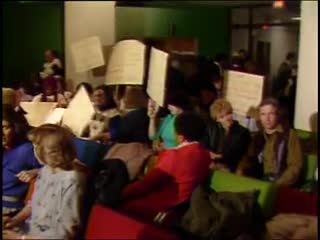
Description: SCHOOL COMMITTEE HEARING ON HEMENWAY AND PHILBRICK SCHOOLS, PARENTS, SIGNS. JOHN NUCCI, JOHN GRADY.
Collection: Ten O'Clock News
Date Created: 01/29/1985
Description: School Lunches, Mollica, Statehouse. .
Collection: Ten O'Clock News
Date Created: 11/24/1980
Description: Impasse continues in Boston school bus drivers' strike. Parents disgusted at having to transport children. Laval Wilson about to propose making drivers public employees (who cannot strike).
Collection: Ten O'Clock News
Date Created: 09/28/1987
Description: Boston City Council compromises on school reform legislation, giving superintendent authority over teacher tenure, hiring, demotion, dismissal…leaving school committee to focus on policy.
Collection: Ten O'Clock News
Date Created: 08/12/1987
Description: Marcus Jones reports that Jack E. Robinson (President, National Association of Black Americans) is trying to get a voluntary school uniform program started in the Boston Public Schools. Jones notes that some schools have found that voluntary dress codes have led to better grades and behavior. He adds that opponents of school uniforms believe that they stifle creativity. Jones interviews Robinson about school uniforms. Jones reports that Robinson believes that students are more concerned about their clothes and possessions than they are about their studies. Jones quotes from a Boston Herald newspaper article about a nine-year old drug runner who impresses his friends with his clothes. Jones also interviews John Grady (Boston School Committee), Elizabeth Foley (Boston parent), and a Boston school child about school uniforms. Jones reviews some of the benefits to school uniforms.
1:00:02: Visual: Footage of white elementary students in school uniforms rising to greet their teacher at the St. Columbkille School in Brighton. Shots of students in the classroom. Marcus Jones reports that uniforms are a long-standing tradition in private and parochial schools. Jones notes that supporters of school uniforms believe that uniforms help inspire discipline. Jones notes that opponents of school uniforms believe that they stifle creativity. V: Shots of white uniformed students in classrooms. Shots of African American uniformed students in an elementary school in Washigton DC. Jones reports that an elementary school in Washington DC and five elementary schools in Baltimore have instituted a voluntary dress code; that the schools have found that the dress code has led to better grades and behavior. V: Footage of Jack E. Robinson (President, National Association of Black Americans) being interviewed by Jones. Robinson says that school uniforms lead to a decrease in disciplinary problems. Jones notes that Robinson is trying to get a voluntary uniform program started in the Boston Public Schools. V: Footage of Robinson saying that adults wear uniforms; that business people wear suits; that people in all professions wear uniforms all over the world. Shot of a Boston Herald newspaper article with a headline reading, "He's the littlest pusher." Jones reports that Robinson says that children are more concerned about clothes and stylish possessions than they are about their studies. Jones quotes from the Boston Herald newspaper article; the newspaper article says that a nine-year-old drug runner impresses his friends with his clothes. V: On-screen text quotes from the Boston Herald newspaper article. Footage of John Grady (Boston School Committee) saying that he will support uniforms if they contribute to a good learning environment in the schools. Footage of Jennifer Foley (Boston public school student) saying that she would not want to wear the same colors all year long. Footage of Elizabeth Foley (parent) saying that students are entitled to their own identities. Jones reports that there are some good reasons to institute a school uniform program. Jones notes that parents can save money on clothing bills; that students have one less peer pressure to worry them; that teachers have one less distraction in the classroom. Johnson adds that Robinson has suggested that the community can profit by having the uniforms manufactured in the neighborhoods.
Collection: Ten O'Clock News
Date Created: 05/09/1988
Description: Interview with interim superintendent Joseph McDonough who is optimistic about the Boston school system.
Collection: Ten O'Clock News
Date Created: 08/29/1990
Description: Students at Boston Technical and Madison Park High Schools learn mediation techniques to settle disputes and prevent violence.
Collection: Ten O'Clock News
Date Created: 05/15/1991
Description: Ellen Guiney, Lloyd King, Ted Landsmark tell what is lacking in Boston school reform after Mayor Flynn requests appointed school board. They say parent involvement, diversity, accountability are needed.
Collection: Ten O'Clock News
Date Created: 03/22/1991
Description: First day of school in Boston, Phase IIB of court ordered desegregation. 1) Superintendent Marion Fahey is proud of faculty and students. Associate superintendent Charles Leftwich reports van and three buses were stoned. Mayor Kevin White says unlawful conduct will not be tolerated. 2) Gary Griffith reports on opening commotion at Charlestown High. One-third of enrolled students show up. Federal marshals and police outside. One arrest for disorderly conduct. Neighborhood crowd gathers in street. 3) Pamela Bullard at South Boston High. Black students get off bus to less tension than last year. Police are present but not in riot gear. 4) Art Cohen at Mackey Middle School where teacher student ratio is 1:18. Principal Lloyd Leake. 5) Bullard on magnet program encompassing 21 schools. Exterior, interior of English High. Gregory Anrig, state commissioner of education. Headmaster William Peterkin. 6) Karin Giger on bilingual program at Grover Cleveland Middle School. 7) Bullard talks to boycotting (white) Cormiers of Charlestown. Mother keeps son out of Timilty School where he was assigned to be bused; he has part-time tutoring. 8) Steve Curwood talks to participating (black) Price family from Roxbury, whose children are bused to white neighborhoods. 9) 5 Hyde Park High students, 3 minority, 2 white, discuss racial separation inside school. They expect conflict to be less than last year. 10) Steve Nevas was almost thwarted from covering a Kevin White press conference because mayor felt Nevas could not be objective. (He had investigated fundraising in White campaign.) White attempts to disassemble Channel 2 microphone and asserts he can exclude any reporter from access. Ed Baumeister says this raises First Amendment issue.
Collection: Ten O'Clock News
Date Created: 09/08/1976
Description: Rebecca Rollins reports that the murder rate in the city is rising. She notes that an overwhelming number of teenagers are involved in these homicides. Rollins interviews teenagers Grantley Payne, Michael Duval, and Pinto Triplett about why teenagers carry guns. Payne says that guns provide protection and grant status to teenagers. Payne and another teenager play basketball on an outdoor court. Rollins interviews Franklin Tucker (counselor) about teenagers and guns. Tucker talks about how teenagers obtain firearms. Tucker talks about the lack of programs aimed at preventing violence. He adds that many teenagers involved in violence come from disadvantaged backgrounds. Rollins' report is accompanied by footage of an African American teenager being treated by paramedics. This tape includes additional footage of Payne and another teenager playing basketball on an outdoor court.
1:00:01: Visual: Footage of a body on a stretcher being wheeled by medics to an ambulance; of an African American police officer speaking to an African American male suspect. Shots of Grantley Payne (age 18) and another teenager playing basketball on an outdoor court. Rebecca Rollins reports that the death toll in the city is rising at record pace; that the number of homicides may total 150 by the end of the year. Rollins notes that an overwhelming number of teenagers are involved in the homicides as victims or suspects. V: Shot of medics lifting the body of an African American teenager onto a stretcher. Shots of guns and weapons laid out on a table. Footage of Payne being interviewed. Payne says that guns provide protection and grant status to teenagers. Footage of Franklin Tucker (Barron) being interviewed by Rollins. Tucker says that teenagers are importing their own guns; that teenagers are ordering them by mail from states with lenient gun laws. Barron says that guns are being brought in by bus and car. Tucker says that teenagers are carrying new guns and serious firearms. Rollins reports that Tucker is an expert on the subject of kids, guns, and schools; that Tucker directs counseling services for kids caught with weapons on or near school property. V: Footage of Tucker being interviewed by Rollins. Tucker says that many teenagers carry guns for protection. Footage of Michael Duval (age 16) being interviewed by Rollins. Duval says that fighting and violence have progressed from hands to knives to guns. Duval says that a lot of movies have violence. Duval mentions the 1988 film Colors. Rollins asks why kids carry guns. Pinto Triplett (age 18) says that it is difficult to be a teenager in the projects; that teenagers who carry guns live in rough neighborhoods. Triplett says that many of these teenagers do not come from good backgrounds; that many teenagers cannot get jobs. Triplett says that some of these teenagers are the victims of racial discrimination. Footage of Tucker being interviewed by Rollins. Tucker says that there are no programs focusing on prevention; that society is trying to put these kids in jail. Tucker says that prisons are already overcrowded. Rollins stands in front of a basketball court. A group of teenagers play basketball on the court. Rollins says that the Boston Police Department and City Hall will officials will meet to discuss the problem of guns and violence.
Collection: Ten O'Clock News
Date Created: 12/19/1990