Description:
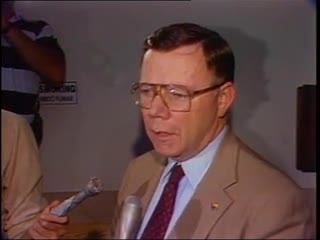
Hope Kelly reports on the incidence of hate crimes in Boston. Kelly explains that hate crimes are defined as incidents of racial violence; she cites statistics that illustrate how hate crimes have affected various racial and ethnic groups. Kelly's report includes footage of Jack McDevitt (Center for Applied Research, Northeastern University) giving a seminar on hate crimes in Boston. The small audience includes uniformed police officers. McDevitt says that most hate crimes are not initially categorized as such by police officers. McDevitt talks about the seriousness of hate crimes. He notes that all racial and ethnic groups are affected. Kelly's report includes shots of Boston residents on the streets and shots from a moving car of downtown Boston in the evening.
1:00:13: Visual: Shots from a moving car of downtown Boston at night. Hope Kelly reports that hate crimes are defined as incidents of racial violence; that Boston has had 452 hate crimes over the past four years. Kelly notes that hate crimes are rarely recognized for what they are. V: Footage of Jack McDevitt (Center for Applied Research, Northeastern University) addressing a small audience. McDevitt says that his research looks at how Boston's 452 hate crimes were initially categorized by the responding officer. McDevitt says that 19 of the 452 incidents were initially categorized as racially motivated. Shots of the audience listening to McDevitt. Shots of police officers in uniform as they listen to McDevitt. Kelly reports that one of the goals of the study is to teach police officers and citizens to recognize these crimes for what they are. V: Footage of McDevitt saying that Boston's hate crimes were more serious than statistics show them to be. Kelly reports that half of Boston's 452 hate crimes involved assaults; that thirty percent of the assaults were serious enough to require hospitalization. Kelly reports that national statistics show only 7% of assaults as serious enough to require hospitalization. V: Shots from a moving car of residents on the streets of Boston at night. Audio of McDevitt saying that many of Boston's hate crimes involve multiple offenders attacking a single victim. Shots of Washington Street in Roxbury during the day. Elevated train tracks are visible. Shots of African American men gathered outside of Joe's sub shop on Washington Street. Kelly reports that McDevitt found turf issues to be the motivation of many hate crimes in Boston. V: Footage of McDevitt saying that members of every racial and ethnic group were victims of hate crimes. Kelly reports that the study found that Africans Americans and whites were equally apt to be victims of hate crimes; that the perpetrators were usually of another race than their victim. V: Shots of residents walking on the streets of Boston in the daylight. On-screen text and visuals detail hate crime statistics. Kelly reports that 118 African Americans were victims of hate crimes; that 92% of those victims were attacked by whites. Kelly reports that 111 whites were victims of hate crimes; that 78% of those victims were attacked by African Americans. Kelly reports that whites and African Americans accounted for 2/3 of all victims. Kelly reports that 6% of victims were Latino; that the rest of the victims were Asian. Kelly notes that Vietnamese residents were victimized at a rate far out of proportion to their population. V: Shot of a white business man walking and an African American business man walking in the financial district. Shots of Latino residents walking on a street; of two Asian men conversing on a sidewalk. Kelly reports that the perpetrators were unknown in 25% of Boston's hate crimes. V: Shots of a police car traveling slowly through a parking lot. On-screen text and visuals detail statistics about perpetrators of hate crimes. Kelly reports that 63% of known offenders are white; that 33 % of known offenders are African American; that 4% of known offenders are Latino and Asian. Kelly notes that victims are often reluctant to report hate crimes. V: Shots of McDevitt talking about his study; of police officers and officials in the audience, including Francis "Mickey" Roache (Commissioner, Boston Police Department). Shot from a car of a street in downtown Boston.
1:00:13: Visual: Shots from a moving car of downtown Boston at night. Hope Kelly reports that hate crimes are defined as incidents of racial violence; that Boston has had 452 hate crimes over the past four years. Kelly notes that hate crimes are rarely recognized for what they are. V: Footage of Jack McDevitt (Center for Applied Research, Northeastern University) addressing a small audience. McDevitt says that his research looks at how Boston's 452 hate crimes were initially categorized by the responding officer. McDevitt says that 19 of the 452 incidents were initially categorized as racially motivated. Shots of the audience listening to McDevitt. Shots of police officers in uniform as they listen to McDevitt. Kelly reports that one of the goals of the study is to teach police officers and citizens to recognize these crimes for what they are. V: Footage of McDevitt saying that Boston's hate crimes were more serious than statistics show them to be. Kelly reports that half of Boston's 452 hate crimes involved assaults; that thirty percent of the assaults were serious enough to require hospitalization. Kelly reports that national statistics show only 7% of assaults as serious enough to require hospitalization. V: Shots from a moving car of residents on the streets of Boston at night. Audio of McDevitt saying that many of Boston's hate crimes involve multiple offenders attacking a single victim. Shots of Washington Street in Roxbury during the day. Elevated train tracks are visible. Shots of African American men gathered outside of Joe's sub shop on Washington Street. Kelly reports that McDevitt found turf issues to be the motivation of many hate crimes in Boston. V: Footage of McDevitt saying that members of every racial and ethnic group were victims of hate crimes. Kelly reports that the study found that Africans Americans and whites were equally apt to be victims of hate crimes; that the perpetrators were usually of another race than their victim. V: Shots of residents walking on the streets of Boston in the daylight. On-screen text and visuals detail hate crime statistics. Kelly reports that 118 African Americans were victims of hate crimes; that 92% of those victims were attacked by whites. Kelly reports that 111 whites were victims of hate crimes; that 78% of those victims were attacked by African Americans. Kelly reports that whites and African Americans accounted for 2/3 of all victims. Kelly reports that 6% of victims were Latino; that the rest of the victims were Asian. Kelly notes that Vietnamese residents were victimized at a rate far out of proportion to their population. V: Shot of a white business man walking and an African American business man walking in the financial district. Shots of Latino residents walking on a street; of two Asian men conversing on a sidewalk. Kelly reports that the perpetrators were unknown in 25% of Boston's hate crimes. V: Shots of a police car traveling slowly through a parking lot. On-screen text and visuals detail statistics about perpetrators of hate crimes. Kelly reports that 63% of known offenders are white; that 33 % of known offenders are African American; that 4% of known offenders are Latino and Asian. Kelly notes that victims are often reluctant to report hate crimes. V: Shots of McDevitt talking about his study; of police officers and officials in the audience, including Francis "Mickey" Roache (Commissioner, Boston Police Department). Shot from a car of a street in downtown Boston.
Collection:
Ten O'Clock News
Date Created:
03/27/1989