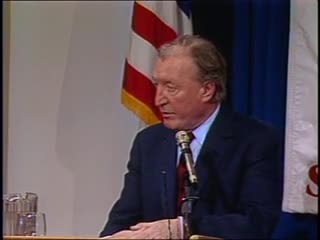
Description: Andrew Young, Ambassador to the United Nations, speaks at the John F. Kennedy School of Government at Harvard University. He takes questions about the UN, divestment from South Africa, the Middle East peace process and the Carter Administration. He also discusses his transition from the civil rights movement to politics. Young has a good rapport with the students in the audience.
0:00:44: Visual: Andrew Young (Ambassador to the United Nations) speaks at the John F. Kennedy School of Government at Harvard University. A representative from the school sits on stage while Young speaks. Young talks about the Trilateral Commission. He says that the Trilateral Commission "is the rich people of the world getting together to talk." Young says that UN has been criticized for being a part of the "Western Bloc"; that five members of the UN Security Council are western nations; that the UN must make policy with all nations in mind. Young describes UN efforts to initiate an arms embargo against South Africa; that the UN resolution on South Africa was not as strong as many would have liked; that the resolution is effective because all of South Africa's trading partners have agreed on it. Young mentions the "North-South dialogue." He says that it is important for nations to deal with issues like trade, debt relief and foreign aid as a group; that the Trilateral Commission is a negotiating group. Young says that there are competition and adversarial relationships among members of the Trilateral Commission; that the members of the Trilateral Commission are competing with each other, not with the Third World. 0:04:12: V: Young responds to an audience member's question about the UN Security Council. Young says that the US, France and England are permanent members of the Security Council; that France and Canada hold two of the rotating seats. Young has a good rapport with the crowd. The crowd laughs at his jokes. An audience member asks about UN policy in Africa. Young says that he does not think pressure should be put on US corporations to divest from South Africa. Young adds that companies would continue to invest in South Africa through complicated transactions using foreign subsidiaries. Young notes that the students at Harvard should be learning all about the complicated finances of multi-national corporations. Young says that nothing would change through divestment; that US corporations are complicit with the government of South Africa; that change can be wrought through the guilt felt by these corporations. He notes that the students should continue to put pressure on Harvard's Board of Directors to divest from South Africa. He says that students should be idealistic, while administrators like him must be realistic. An audience member asks about the Carter Administration's policy in the Middle East. Young says that Jimmy Carter (US President) has been willing to expend political capital pushing for a peace settlement in the Middle East. Young says that Carter has never tried to impose peace on the parties involved in the conflict. Young says that Anwar Sadat (President of Egypt) has moved boldly to move the peace process forward; that the Carter Administration must work with Sadat; that the USSR must be forced to participate in the peace process; that the USSR will undermine the peace process if they are not involved. Young notes that Sadat and the Soviets have had a difficult relationship. 0:12:55: V: An audience member asks how he can remain morally conscious when the policy he conducts for the US is not always morally conscious. Young says that protest movements in the 1960s have led to a reawakening of the nation's moral conscience; that the Carter Administration was voted into office by morally conscious voters. Young notes that it is easier to protest than it is to govern; that the Carter Administration is staffed with idealistic, moral people of all races and ethnicities. Young notes that he chose to enter politics to put his ideals into action; that effective change can be made through politics as well as protest. Young talks about his experiences in the civil rights movement and the movement against the Vietnam War. Young says that there was a logical progression from the protest movements of the 1960s to the politics of change in the 1970s. Young says that he took his post in order to effect change in foreign policy; that foreign policy issues and domestic policy are closely related; that he has not compromised his ideals in performing his job. Young jokes that he tries to stand up for what is right while doing his job; that he might be looking for a new job someday because of that; that perhaps Harvard will hire him if he ever needs a job. The audience laughs at the joke. 0:18:30: V: An audience member asks Young if he has seen an increase in "television diplomacy." Young says that he has seen an increase in "television diplomacy." Young responds to another audience question. Young says that the Carter Administration is staffed with people who are advocating change; that these people were outside of politics before. Young notes that Ernie Green (Assistant Secretary for Manpower) was one of the students who integrated Little Rock High School in 1958; that Green is working hard to create jobs within the African American communities; that he has been working on the problem for only six months. Young notes that an African American lawyer from Harvard helped prepare the brief for the Bakke court case. Young notes that Patricia Harris is Carter's Secretary for Housing and Urban Development. Young says that African American organizations needs to work within the structure of the government; that the activists in the civil rights movement were working with the Kennedy Administration in the early 1960s.
Collection: Ten O'Clock News
Date Created: 12/06/1977
Description: JOE BIDEN SPEAKS AT MIT ON SCIENCE RESEARCH vs DEFENSE SPENDING. MICHAEL DUKAKIS SPEAKS AT HARVARD CLASS DAY.
Collection: Ten O'Clock News
Date Created: 06/10/1987
Description: JOE BIDEN SPEAKS at KENNEDY SCHOOL, FRANK MCNAMARA'S FATE AS U.S. ATTORNEY IN HIS HANDS IN JUDICIARY COMMITTEE
Collection: Ten O'Clock News
Date Created: 05/28/1987
Description: SEN. DANIEL PATRICK MOYNIHAN'S GODKE LECTURE ON THE FAMILY AT THE KENNEDY SCHOOL
Collection: Ten O'Clock News
Date Created: 04/09/1985
Description: Meg Vaillancourt reports that Derrick Bell (Professor, Harvard Law School) has announced that he will take a voluntary leave of absence from Harvard Law School until an African American female is granted tenure. Vaillancourt notes that Harvard Law School has only five tenured female professors and three tenured African American male professors on staff. She adds that the student body is 25% minority and 40% female. Vaillancourt's report includes footage of Bell speaking at a student demonstration. Bell makes his announcement. Bell adds that it is necessary to make sacrifices to advance one's beliefs. Students applaud Bell. Many students hold protest signs. Three students address the demonstrators. They talk about the lack of minority faculty. Vaillancourt's report also includes footage of Louis Kaplow (Associate Dean, Harvard Law School) speaking at a press conference. Kaplow defends the school's record of minority hiring. Vaillancourt notes that Bell does not know if his act of conscience will have any effect on the school administration. Vaillancourt's report includes footage from May 1988, of Harvard Law School students occupying the dean's office to protest the lack of minority faculty. Following the edited story is additional footage of the demonstration, including law student Barack Obama introducing Derrick Bell.
1:00:09: Visual: Footage of Harvard Law School students at a demonstration outside of Harvard Law School. Meg Vaillancourt reports that Harvard Law School counts fifteen Supreme Court Justices among its alumni; that tenure is granted only to the academic elite. Vaillancourt reports that Derrick Bell (Professor, Harvard Law School) is a tenured professor who has announced his departure. V: Shot of a student at the demonstration. Footage of Bell at the demonstration. Bell says that he will remove himself from the Harvard payroll as a "sacrificial financial fast." Bell says that he is not trying to coerce his colleagues; that he is trying to honor a commitment to those responsible for his presence at Harvard. The students applaud. Shots of the media and students at the demonstration. Vaillancourt reports that Bell was the first African American to be granted tenure at Harvard; that he was granted tenure in 1969. Vaillancourt reports that Bell has decided to take a leave of absence until an African American female is granted tenure. V: Footage of Bell saying that students have already enrolled in his classes; that he can ill afford to live for a year without his salary. Bell says that he he has urged students to take risks to further their beliefs; that he must do the same. Shots of students holding a sign reading, "Where are our tenured black women professors?" Shots of students applauding for Bell; of female students holding signs reading, "Come out of the ivory tower" and "No education without representation." Vaillancourt reports that approximately 500 students are supporting Bell's decision; that student are urging alumni to boycott Harvard's current fundraising drive. V: Footage of an African American female student addressing the crowd of demonstrators. She says that Robert Clark (Dean of Harvard Law School) has plans to improve the school by building a new library; that he should instead improve the school by making the faculty more diverse. The students applaud. A white male student holds a sign reading, "reflect reality." Footage of a Latina female student saying that Bell has set an example for all of the students. The student says that she has not role model at the school; that there are no Latino or Latina professors on the faculty. Footage of an African American female student addressing the demonstrators. The student says that people must make sacrifices to advance their cause. Shot of Bell outside of a Harvard Law School building, with chanting demonstrators. Vaillancourt reports that Bell is giving up a salary of more than $100,000 per year. Vaillancourt notes that students have staged sit-ins to protest the lack of minority faculty; that the issue has been contested for nearly twenty years. V: Footage from May, 1988 of a student sit-in at the dean's office in the administration building of Harvard Law School. Students study textbooks as they occupy the office. Vaillancourt stands on the campus of Harvard Law School. Vaillancourt reports that there are 1600 students at Harvard Law School; that nearly 25% are minority students; that nearly 40% are women. Vaillancourt notes that the Harvard Law School faculty has 5 tenured female professors and three tenured African American male professors. V: Footage of Louis Kaplow (Associate Dean, Harvard Law School) speaking at a press conference. Kaplow says that Harvard Law School only hires a few people each year; that some years they do not hire anyone. Kaplow says that positions at Harvard Law School are often permanent; that hiring decisions are made carefully and cautiously. Vaillancourt reports that Kaplow spoke at a press conference after Bell's announcement. Vaillancourt notes that Kaplow does not believe that Harvard Law School will make any significant changes to its hiring practices. V: Shots of student demonstrators in the audience of the press conference. The demonstrators stand together, raising linked arms. Some demonstrators hold protest signs. Footage of Kaplow saying that Harvard's hiring has been fully 50% minority and women over the past eight to ten years; that Harvard's job offers have been fully 50% minority and women over the past eight to ten years. Kaplow says that Harvard is making an effort; that Harvard has kept some positions empty in an effort to locate minority and women candidates. Shots of the students at the press conference. Shots of student demonstrators marching outside a Harvard Law School building. Vaillancourt reports that Bell does not know if his act of conscience will have any effect on the school's hiring record; that Harvard will have only two tenured African American professors if Bell leaves. V: Shots of student demonstrators with linked arms upraised. Footage of Bell addressing the demonstrators. Bell says that he hopes that student persistence will prevail for those minority candidates who deserve to be on the faculty. Bell says that hopes to be able to remain on staff if the students succeed.
Collection: Ten O'Clock News
Date Created: 04/24/1990
Description: David Boeri reports that a group of Harvard Law students occupied the Dean's office overnight to protest the lack of minority faculty at the school. The students held a rally for their cause this morning. Charles Ogletree, a visiting Ppofessor at Harvard Law School, addresses a rally of students outside of the school. The sit-in is over for now and that student leaders met with James Vorenberg, the Dean of Harvard Law School) to discuss their demands for an increase in minority faculty members. Interview with Robert Wilkins, of the Harvard Black Law Students Association, about the meeting with the Dean. Boeri reads a quote from Vorenberg about the meeting. The students and the administration disagree about some of the students demands. The school faculty will need to vote on the students demands in the fall.
1:00:04: Visual: Shots of Harvard Law students studying their textbooks as they occupy the administration building of Harvard Law School. Most of the students are African American. David Boeri reports that a group of Harvard Law School students occupied the office of the Dean overnight; that the students are demanding that twenty minority professors be hired over the next four years; that an African American female professor be hired by fall. Boeri reports that the students held a rally today outside of Harvard Law School. Boeri notes that the faculty of the school has only two tenured African Americans and five tenured white women. V: Shots of the student rally outside of Harvard Law School; of a protest sign reading, "Black female on Harvard Law School faculty now." Footage of Charles Ogletree (Visiting Professor, Harvard Law School) addressing the students at the rally. Ogletree says that he is proud of the students; that the students have picked up where the civil rights movement left off twenty years ago. Ogletree leads the students in chanting, "Enough is enough." The students applaud for Ogletree. Boeri reports that student leaders met this morning with the Dean of Harvard Law School. V: Footage of Robert Wilkins (Harvard Black Law Students Association) saying that the sit-in is over for now. Wilkins says that the dean has agreed to seven of the student's twelve demands. Shot of a protest sign reading, "Stop H.L.S. Racism now." Shots of the students at the rally. Boeri reports that the students say that the Dean agreed to a fellowship program to train minority students to become law professors; that the students says that the Dean agreed to student participation in a minority search committee. Boeri quotes James Vorenberg (Dean, Harvard Law School) as saying this evening, "I just wouldn't put it that way. . . I don't know where you draw the line between agreeing to look into something and agreeing to do it." V: Vorenberg's quote appears written on-screen. Shot of a student at the rally holding a sign reading, "The fire this time." Shots of the students at the rally. Boeri reports that there is major disagreement between the Dean and the students on five of the students' demands. Boeri quotes a statement from the school administration as saying that the school will give priority to minority hiring but will not guarantee that specific numbers of minorities will be hired in a given time period. V: The quote from the administration's statement is written out in text on-screen. Boeri stands outside of Harvard Law School. Boeri reports that the students' demands will require faculty approval; that student leaders predict that a vote will take place in the fall. Boeri notes that the students are threatening to take action against faculty members who vote against them.
Collection: Ten O'Clock News
Date Created: 05/11/1988
Description: Charles Haughey, prime minister of Ireland, visits Boston and speaks at Kennedy School. Protesters outside Ritz-Carlton.
Collection: Ten O'Clock News
Date Created: 04/22/1988
Description: Christy George reports that Jesse Jackson spoke about leadership in a speech at the John F. Kennedy School of Government at Harvard University. George reports that Jackson is very active in this non-election year. George's report includes footage of Jackson walking a picket line with striking Eastern Airline employees and footage of Jackson visiting an Armenian earthquake zone. George talks about Jackson's activities since the 1988 election. George's report also features footage from Jackson's speech at Harvard. Jackson talks about voter cynicism in the 1988 election and the qualities of a good leader. Jackson says that the US must invest in itself in order to flourish. He explains a metaphorical term: "honeybee sense." George's report also includes footage from Jackson's 1988 presidential campaign. This edition of the Ten O'Clock News also included the following item: Lee Atwater visits Massachusetts for a Republican Party fundraiser
1:00:07: Visual: Footage of Jesse Jackson (African American political leader) as he enters an auditorium at the John F. Kennedy School of Goverment at Harvard University. The audience applauds for Jackson. Shot of a man in the crowd. Footage of Jackson addressing the audience. Jackson jokes about his speech being televised on C-Span. Jackson waves to his mother. Christy George reports that Jackson talked about the scarcity of good leaders in American politics during his speech at the Kennedy School of Government. V: Footage of Jackson delivering his speech. Jackson says that public cynicism won more voters than Bush did in the 1988 campaign. Jackson notes that 50% of the eligible voters did not vote; that 70% of voters expressed a desire for a different choice. Jackson says that Bush's campaign won while the country lost. Footage of Jackson at a campaign rally in New Hampshire on February 16, 1988. The crowd chants, "Win, Jesse, Win." George notes that Jackson travels the country regularly in non-election years. V: Shots of Jackson doing a television interview; of Jackson picketing with striking Eastern Airline employees. George reports that Jackson has walked with striking Eastern Airline employees across the nation; that Jackson turned a tour of an Armenian earthquake zone into a Soviet-American people's summit. V: Shot of a Soviet news anchor reading the news; of Jackson kissing a baby in Armenia. Footage of Jackson looking out of a window while riding on a bus in Armenia. Jackson speaks to the media, saying that human beings must care for one another. Footage of Jackson at a 1988 campaign rally. George calls Jackson a "perpetual candidate" and a "peripatetic preacher." V: Footage of Jackson speaking at the Kennedy School. Jackson says that he is a "liberal" who fights for change. Jackson says that pollsters and pundits are looking for a manufactured candidate. Jackson says that great leaders do not follow opinion polls; that great leaders mold public opinion. Jackson says that John F. Kennedy (former US President) was not following opinion polls when he reached out to Martin Luther King, Jr. (civil rights leader). Jackson says that Kennedy's actions were based on courage and principles. Jackson says that the US needs bold leadership to deal with the nation's "structural crisis." Jackson talks about "honeybee sense." Jackson says that honeybees know to drop pollen when they pick up nectar; that honeybees know the importance of keeping the flowers alive. Jackson says that the US needs to invest in itself in order to stay alive and flourish. The crowd rises to its feet and applauds for Jackson.
Collection: Ten O'Clock News
Date Created: 04/25/1989
Description: Marcus Jones reports that anti-war activists protested across the nation to rally public opinion against the use of force in the Persian Gulf, including in downtown Boston. Jesse Jackson visited MIT to speak out against going to war in the Middle East on the birthday of Martin Luther King, Jr. Jones notes that the MIT Initiative for Peace in the Middle East brought Jackson to the campus. Jackson says that the US must not rush to war on January 15. Interviews with MIT graduate students Corrie Lathan and Steve Penn, who oppose the war. Interview with Jesse Jackson, who says that the US and Iraq should negotiate because war is inevitable if talking is impossible. Jones' report includes footage from Inside Edition of Jackson in Iraq. Following the edited story is additional b-roll of anti-war demonstrations and of Jackson at MIT talking about Martin Luther King, Jr.
1:00:36: Visual: Footage of anti-war protesters on Winter Street in downtown Boston. The protesters carry signs protesting the Gulf War. They chant together, "We remember Vietnam. We won't go." Shot of two police officers standing in front of a building. Marcus Jones reports that a group of anti-war protesters demonstrated outside of the Army recruiting headquarters in Boston. V: Shot of a protesters carrying a sign reading, "U.S. Troops out of the Gulf." The protesters chant, "We won't fight for Texaco." Shot of a protester handing out leaflets. Jones reports that anti-war activists took to the streets across the country today; that the protesters are trying to rally public opinion against the use of force in the Persian Gulf. V: Shot of an older white woman wearing a sign around her neck. The sign reads, "Bring our troops home." Shot of two white children standing among the protesters. Jones reports that Jesse Jackson (African American political leader) visited MIT (Massachusetts Institute of Technology) tonight; that the members of the MIT Initiative for Peace in the Middle East brought Jackson to the campus. Jones reports that Jackson spoke out against going to war in the Middle East on the birthday of Martin Luther King Jr. (civil rights activist). V: Shots of Jackson greeting an MIT student; of Jackson greeting students as he walks to the podium. Shots of students in the audience. Footage of Jackson addressing the students. Jackson says that the US must not rush to war on January 15. Jackson says that efforts toward peace must be made on King's birthday. Footage of Corrie Lathan (MIT graduate student) being interviewed. Lathan says that she is opposed to the war; that the situation should be resolved in a non-violent manner. Footage of Steve Penn (MIT graduate student) being interviewed by Jones. Penn says that decision-makers in the US understand pressure; that the voice of the people must speak out against the war. Jones reports that Jackson's call for restraint may reflect a change in his thinking. Jones notes that Jackson met with Saddam Hussein (Iraqi leader) last year. Jones reports that Jackson said last year that war would be inevitable if talking proved impossible. V: Footage from Inside Edition of Jackson entering a building in Iraq; of Jackson speaking to Hussein. Jones questions whether Jackson has changed his position. V: Footage of Jackson speaking at MIT. Jones asks Jackson if he has changed his position. Jackson says that he has kept the same position. Jackson says that war is inevitable if talking is impossible. Jackson says that the US and Iraq should "talk"; that the two countries must choose negotiation over confrontation. The audience applauds for Jackson as he walks away from the podium.
Collection: Ten O'Clock News
Date Created: 01/14/1991
Description: Meg Vaillancourt reports that Jesse Jackson gave a speech at Sanders Theatre at Harvard University as part of his effort to support the presidential campaign of Michael Dukakis. Jackson attacked George Bush and the Republican Party on issues of race, and defended the term "liberal" from Republican attacks. Additional footage of Jackson and Dukakis at the 1988 Democratic Convention. Independent presidential candidate Lenora Fulani also visited Boston today. Fulani is the African American progressive candidate of the New Alliance Party. Interview with Fulani, who says that progressive voters need to vote against Dukakis. She adds that the Democratic Party needs to differentiate itself from the Republican Party in order to win the votes of progressives. Vaillancourt notes that Fulani is a Jackson supporter. Vaillancourt reports that Fulani will probably not be a threat to Dukakis in the 1988 election. She adds that a future Jackson candidacy could threaten the Democratic Party by attracting disenchanted progressive voters from the Democratic Party.
1:00:14: Visual: Footage of Jesse Jackson (African American political leader) addressing an audience at Sanders Theatre at Harvard University. Jackson talks about the civil rights movement. Shots of the audience. Meg Vaillancourt reports that Jackson attacked the Republican Party in his speech at Saunder Theatre today; that Jackson accused the Republicans of misusing the term "liberal" in the presidential campaign. V: Footage of Jackson at Sanders Theatre. Jackson accuses George Bush (Republican US presidential nominee) of attacking civil liberties as "subversive." Jackson riffs on the term "liberal." Shots of the audience applauding for Jackson. Vaillancourt notes that Jackson was campaigning for Michael Dukakis (Democratic US presidential nominee); that Jackson attacked Bush on issues of race. V: Footage of Jackson accusing Bush of buying a property labeled "caucasians only" in Houston. Footage from CNN of Dukakis, Kitty Dukakis (wife of Dukakis), Jackson, Jaqueline Jackson (wife of Jackson), and other Democratic Party leaders on stage at the 1988 Democratic Convention. Vaillancourt notes that Jackson appears frequently with Dukakis; that Jackson defended Dukakis's campaign style in his speech today. V: Footage of Jackson saying that "passion is a new extra-constitutional requirement" for the presidency. Vaillancourt stands outside of Memorial Hall at Harvard University. Vaillancourt reports that Lenora Fulani (Independent candidate for US President) was in Boston today; that Fulani is an African American progressive candidate for the presidency. V: Footage of Fulani being interviewed by Vaillancourt. Fulani says that voters should not vote for Dukakis; that the Democratic Party needs to learn not to take African American and white progressive voters for granted. Vaillancourt reports that Fulani is the candidate of the New Alliance Party. Vaillancourt adds that Fulani describes the New Alliance Party as a progressive party which is mindful of gay and minority voters. V: Footage of Jackson shaking hands with supporters after his speech. Jackson holds up a young white girl. He gives the thumbs-up sign to the crowd. Vaillancourt reports that Fulani is a Jackson supporter; that Fulani is running against Dukakis. V: Footage of Fulani being interviewed by Vaillancourt. Fulani says that progressive voters need to vote according to their own self-interests; she urges progressive voters to vote against Dukakis. Vaillancourt asks if progressive voters should vote for Fulani and risk having a Republican president. Fulani says that the Democratic Party is responsible for the Republican victories of Ronald Reagan (US President) and Richard Nixon (former US President). Fulani says that the Democratic Party needs to differentiate itself from the Republican Party. Fulani says that Dukakis is now paying attention to progressive voters because he is down in the polls. Vaillancourt reports that Fulani will probably not be a threat to Dukakis; that her criticism may signal a future problem for the party. V: Shot of Jackson on stage at the end of his speech. Vaillancourt reports that the Democratic Party would be threatened if a candidate like Jackson decided to run as an independent candidate; that his candidacy would attract disenchanted Democratic voters. Vaillancourt reports that Jackson is still campaigning strongly for Dukakis; that Jackson's campaign efforts make him a force within the Democratic Party.
Collection: Ten O'Clock News
Date Created: 10/24/1988