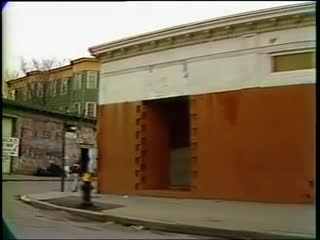
Description: Ride along Blue Hill Avenue. Decrepit, boarded up and abandoned storefronts. Many defunct businesses. Vacant lot. Zion Apostolic and Immanuel Pentecostal Churches. Warren Street intersection. Bridge Free Medical Van. Houses on Supple Road. Prince Hall Masonic Lodge. Sign for the Mayor's Office of Housing. Street sweeping vehicle. Mayor Kevin White walks with Julian Bond through neighborhood with press entourage. White answers questions about his candidacy and housing policy decisions as mayor especially involving the Boston Housing Authority, and says urban revitalization will come to reality within 3-5 years but need more federal $$. White and Bond meet local business owners and community members.
Collection: Ten O'Clock News
Date Created: 06/20/1979
Description: Environs of Blue Hill Avenue and Morton Street in Roxbury. Drive by decrepit boarded up storefronts and abandoned lots. Graffiti and trash abound. Sign "Mayors [sic] Office Public Service of Franklin Field Little City Hall."
Collection: Ten O'Clock News
Description: Bars in Dudley Square. Noise of the elevated train in background (not seen). Patio Lounge, Giant Liquors, other package stores on Washington Street. Street signs at the corner of Zeigler and Washington. Highland Tap. Men loiter on corner. Pedestrians and cars.
Collection: Ten O'Clock News
Date Created: 09/27/1976
Description: Mayor Ray Flynn holds a press conference in Roxbury to unveil plans for a new housing and commercial development to be built on a vacant lot in Douglass Square. The Boston Redevelopment Authority (BRA) cleared the land in the 1960s and never rebuilt on the lot. The owners and developers of the new project are African American. Flynn and City Councilor Bruce Bolling talk about the new development. Flynn says that all neighborhoods and all residents must share in the growth of the city. Bolling says that the proposal for the creation of Mandela, Massachusetts is a no longer an issue. Bolling and other Mandela opponents believe that the new development signifies a renewed commitment to the Roxbury neighborhood by the city of Boston.
1:00:10: Visual: Footage of Ray Flynn (Mayor of Boston) at an outdoor gathering in Roxbury. Flynn stands under a tent, addressing a crowd. Flynn talks about the vote against the proposal for the creation of Mandela, Massachusetts. Flynn says that the vote shows that the racial polarization of the city is in the past. Shot of the gathering from the back of the tent; of an architectural model. David Boeri reports that Flynn is advocating affordable housing and economic opportunity in every neighborhood. Boeri notes that Flynn unveiled a plan for a project in Douglass Square; that the Boston Redevelopment Authority (BRA) cleared a two-acre plot of land in Douglass Square in the 1960s; that the lot has been abandoned since then. V: Shot of a mural on the wall of a building in Douglass Square in Roxbury; of buildings in Douglass Square; of a vacant lot in Douglass Square; of architectural plans and an architectural model. Boeri reports that a housing and commercial complex is slated to be built on the vacant lot; that one-quarter of the units will be set aside for low-income housing. V: Footage of Bruce Bolling (Boston City Council) saying that the project addresses the need for economic re-investment in Roxbury. Boeri reports that the developers and owners of the project will be African American; that Bolling noted that Roxbury is becoming a full and equal partner in the city of Boston. V: Shots of African American crowd members; of an African American man standing beside an architectural drawing of the project. Footage of Bolling saying that the incorporation of minority neighborhoods into a new city is a dead issue. Boeri reports that Flynn had a unity breakfast with Roxbury leaders this morning; that Flynn pledged to make the city of opportunity for all. V: Shots of the crowd at the gathering. Footage of Flynn saying that all residents need to share in the city's growth and prosperity; that development of the downtown must be accompanied by development of the neighborhoods. Boeri stands in the vacant lot in Douglass Square. Boeri says that the lot has represented an empty promise by the city of Boston to the people of Roxbury. Boeri says that Bolling and other leaders fought the idea of secession from the city. Boeri adds that these leaders say that the plans for the new project are a signal that "their time has come."
Collection: Ten O'Clock News
Date Created: 11/05/1986
Description: Former Berkeley mayor Gus Newport comes to Roxbury to lead the Dudley Street Neighborhood Initiative in rebuilding the community by attracting developers. Empty lot.
Collection: Ten O'Clock News
Date Created: 01/02/1989
Description: ROXBURY NEIGHBORHOODS AND HOUSING PROJECTS, HUD-OWNED BUILDINGS, INTERVIEWS WITH TENANTS
Collection: Ten O'Clock News
Date Created: 04/16/1985
Description: ROXBURY NEIGHBORHOODS AND HOUSING PROJECTS, HUD-OWNED BUILDINGS, INTERVIEWS WITH TENANTS
Collection: Ten O'Clock News
Date Created: 04/16/1985
Description: Marcus Jones reports that supporters of the proposed city of Mandela, Massachusetts, are raising the issue again. Voters rejected the 1986 proposal to incorporate the Greater Roxbury neighborhood into a new city. Supporters of the proposal have put together a video to educate voters about the benefits of forming a new city, by Maverick Video. Andrew Jones (Greater Roxbury Incorporation Project) is shown in the video. Interview with Curtis Davis (Greater Roxbury Incorporation Project) about the video and about the Mandela proposal. The referendum question on Mandela will be on the ballot again this year. Review of the boundaries of the proposed city and the specifics of the proposal. Marcus Jones notes that the 1986 referendum question received national media attention. Marcus Jones' report includes footage of Davis, Andrew Jones and other Mandela supporters at a press conference in 1986 and footage from an episode of the Phil Donahue Show in 1986 with community leaders Mel King (community activist), Andrew Jones, Charles Stith (Union United Methodist Church), and Bruce Bolling (Boston City Council). Marcus Jones reports that the referendum question has not received as much media coverage this year. He adds that Mandela supporters may try again in the future if the referendum question is defeated again this year. Jones' report includes footage from Say Brother of Andrew Jones talking about Mandela and footage of Bruce Bolling at a press conference. This edition of the Ten O'Clock News also included the following item:Members of Boston's African American community voice their support for Bush
1:00:15: Visual: Footage from Say Brother of Andrew Jones (co-founder, Greater Roxbury Incorporation Project) in June of 1987. Jones says that he is not sure that the people do not want Mandela. Marcus Jones reports that voters in the predominantly African American neighborhoods of Boston overwhelmingly rejected the referendum quesion on the incorporation of Mandela in 1986. V: Shots of African American residents crossing under the elevated train tracks on Washington Street in Roxbury; of a map of the boundaries of the proposed city of Mandela. Marcus Jones reports that many believed the issue to be dead. V: Footage of Bruce Bolling (President, Boston City Council) addressing an audience in November of 1986. Bolling says that the issue of incorporation has been put aside "for once and for all." Marcus Jones reports that proponents of Mandela have raised the issue again; that Mandela proponents have put together a videotape to educate voters about the virtues of forming a new city. V: Footage from Maverick Video of the pro-Mandela videotape. The videotape shows Andrew Jones talking about building a new city hall for the city of Mandela. Footage of Curtis Davis (co-founder, Greater Roxbury Incorporation Project) being interviewed by Marcus Jones. Davis says that many people have liked the videotape. Davis says that the videotape is biased in favor of the proposal; that the videotape does not try to fool the voters. Marcus Jones reports that Davis and Andrew Jones were responsible for putting the Mandela referendum question on the ballot in 1986; that the referendum question will be on the ballot again this year. V: Footage of Davis, Andrew Jones, and other Mandela supporters at a press conference in front of the state house in October of 1986. Footage of Davis being interviewed by Marcus Jones. Davis says that the city of Mandela would be predominantly African American; that the residents of the Greater Roxbury neighborhoods have common concerns. Davis says that those issues are best addressed by a local neighborhood government. Marcus Jones reports that Roxbury, Mattapan and parts of Dorchester, Jamaica Plain, the South End, and the Fenway would form the proposed city. Marcus Jones reports that the referendum question gained national attention in 1986. V: Footage from the Phil Donahue Show on Mandela on October 30, 1986. An African American male audience member says that he supports Mandela. African American community leaders Andrew Jones, Mel King (community activist), Bolling, and Reverend Charles Stith (Union United Methodist Church) are guests on the show. Stith says that the incorporation of Mandela would signal a retreat from the progress made by the civil rights movement. Marcus Jones reports that the Mandela question has not received as much media attention this year; that the proponents of Mandela are presenting their case in a calmer atmosphere. V: Footage from the pro-Mandela videotape. The videotape shows Andrew Jones talking to a group of African American women outside of a housing project building. Marcus Jones reports that Mandela supporters are campaigning for the passage of the referendum question; that the supporters may try again in the future if the referendum question is defeated this year. V: Footage of Davis saying that a narrow defeat will inspire supporters to work harder for passage of the referendum. Footage from the pro-Mandela videotape.
Collection: Ten O'Clock News
Date Created: 10/27/1988
Description: David Boeri reports that the referendum question on the creation of Mandela, Massachusetts, was soundly defeated in the 1986 elections. Supporters of incorporation of a new city from the Greater Roxbury neighborhood are raising the issue again. Community leaders gathered at a press conference in support of the issue. Those present included Andrew Jones (Greater Roxbury Incorporation Project), Chuck Turner (teacher), and Byron Rushing (State Representative). Jones and Rushing speak out in favor of Mandela. They criticize the city of Boston for not dealing effectively with problems in the Roxbury neighborhood. Boeri reports that the Roxbury neighborhood is suffering from an epidemic of violence and drug-related crime. He notes that Mandela supporters believe that crime could be fought more effectively if Roxbury were an independent city. Interviews with Mandela supporters Sadiki Kambon and Donald Madrey talking about the problems in the neighborhood. City Councilor Bruce Bolling talks about street violence. Footage of William Celester (Deputy Superintendent, Boston Police Department) and Ray Flynn at a press conference.
1:00:09: Visual: Footage of Andrew Jones (Greater Roxbury Incorporation Project) at a press conference. Supporters stand behind him. Jones says that the time has come to "free Mandela, Massachusetts." Shot of Mandela supporters with Jones including Chuck Turner (teacher). David Boeri reports that the referendum question on Mandela, Massachusetts was overwhelmingly rejected by voters in the 1986 elections. Boeri notes that Mandela supporters are raising the question again. V: Footage of Byron Rushing (State Representative) at the press conference. Rushing asks if it is better to be a poor neighborhood in a rich city, or a poor city in a rich state. Boeri reports that little has changed in Boston's African American neighborhoods since 1986; that Mandela supporters can exploit the fact that little has changed in their favor. Boeri notes that Roxbury may be worse off than it was in 1986. V: Shot of white police officers at a crime scene. Roxbury residents stand behind police cordons. A pool of blood appears on the street. Footage of Sadiki Kambon (Mandela initiative supporter) saying that Roxbury continues to suffer from high unemployment, poor housing, an increase in the infant mortality rate, and a high drop-out rate from schools. Shot of two white police officers patrolling a residential street in Roxbury. Boeri reports that drug-related crime and violence have created a crisis in the community. V: Shot of a Boston Herald newspaper article featuring a photo of Darlene Tiffany Moore (Roxbury resident and shooting victim). Footage of Bruce Bolling (Boston City Council) speaking to the press on August 22, 1988. Bolling says that there is open warfare going on in the district. Footage of Donald Madrey (Roxbury resident and Mandela initiative supporter) saying that Roxbury residents are living in fear from crime. Madrey says that it seems like all of the drugs in the state of Massachusetts are being dropped in Roxbury. Shot of African American residents crossing Washington street underneath elevated train tracks in Roxbury. Boeri reports that supporters of the Mandela initiative say that crime could be fought more effectively if Roxbury were an independent city. V: Shot of a group of African American men outsde of Joe's sub shop on Washington Street in Roxbury. Footage of Jones at the press conference saying that an independent city has its own police force which can set its own priorities. Jones says that the Boston Police Department is corrupt; that an independent police department could establish a better relationship with the community. Footage of Rushing saying that officers of the Mandela Police Department would live in the city; that the police officers would be living on the streets where crime takes place. Boeri notes that Boston city officials have declared war on drugs and crime in Roxbury. V: Shot of William Celester (Deputy Superintendent, Boston Police Department) speaking at a press conference. Ray Flynn (Mayor of Boston) stands at his side. Shot of two white police officers stopping an African American man in order to search him. Footage of Rushing at the press conference. Rushing says that the city has not responded to questions about why they have not applied for federal funds for anti-drug campaigns in the city.
Collection: Ten O'Clock News
Date Created: 08/24/1988
Description: Marcus Jones reports on a referendum question concerning the incorporation of a new city made up of Boston's minority neighborhoods, which would be called Mandela, Massachusetts. Interview with Andrew Jones of the Greater Roxbury Incorporation Project about the proposal. Jones reports on the local and national controversy generated by the referendum question. Footage from a press conference with Mandela supporters and officials from East Palo Alto, California. Jones' report also features footage from an episode of the Phil Donahue Show. African American community leaders Andrew Jones, Mel King, Bruce Bolling, and Charles Stith debate the question with Donahue. Jones reports that the referendum is not expected to pass. Chuck Turner, a teacher, and Nathan Allen, the Executive Director of Lena Park Community Development, debate the question at tan Urban League Forum.
1:00:07: Visual: Shot of the referendum question concerning the incorporation of Mandela, Massachusetts on the 1986 election ballot. Marcus Jones reports that the referendum question on Mandela, Massachusetts has generated much publicity. V: Footage of Andrew Jones (Greater Roxbury Incorporation Project) saying that minority neighborhoods have a "colonial relationship with the city of Boston;" that the city of Boston has treated minority residents like "second-class citizens." Jones explains that the ballot question asks whether minority neighborhoods should break ties with the city of Boston in order to incorporate a new city. V: Shot of African American residents crossing under the elevated train tracks on Washington Street; of a map of the proposed border of the new city. Jones notes that the new city would encompass Roxbury, Mattapan, and parts of Dorchester, Jamaica Plain, the Fenway, South End and Columbia Point; that proposal supporters have chosen Mandela as the name for the new city. V: Shots of young African American men standing in front of Joe's Sub Shop; of a newspaper article with a headline reading, "Flynn says Roxbury secession would halt progress." The article includes a photo of Ray Flynn (Mayor of Boston) with Reverend Michael Thomas (Charles Street African Methodist Episcopal Church). Jones reports that Flynn (Mayor of Boston) is urging residents to vote against the proposal; that supporters of the proposal have brought in officials from East Palo Alto, California. Jones notes that East Palo Alto was formed by seceding from Palo Alto. V: Shot of proposal supporters at a press conference with officials from East Palo Alto. Campaign signs supporting the proposal read, "Vote yes on question 9. Land control, A new city. Mandela, Mass." Jones notes that the referendum is getting national exposure; that Phil Donahue (talk show host) broadcast his show live from WCVB today. V: Shot of the front page of The New York Times; of an article in The New York Times. Footage of the Phil Donahue Show (national TV talk show) from October 30, 1986. Donahue challenges supporters of the proposal, saying that the racial problems will worsen if minority neighborhoods secede from the city. African American community leaders Andrew Jones (Greater Roxbury Incorporation Project), Mel King (community activist), Bruce Bolling (President, Boston City Council), and Reverend Charles Stith (Union United Methodist Church) are guests on the show. Jones says that the issue behind the proposal is land control, not race. Bolling says that African American leaders and other leaders are poised to take control of city government; that the new leaders need to take advantage of the opportunity to bring the city of Boston together. Jones reports that African American community leaders debated the question at a Urban League Forum. V: Footage of Chuck Turner (teacher and community activist) saying that a victory for the referendum will force the Flynn administration to "open the books of the city." Turner talks about the large amount of land to be developed in minority neighborhoods. Footage of Nathan Allen (Executive Director, Lena Park Community Development) saying that the proposal for a new city is not financially feasible; that the new city would be incorporated with a deficit of $100 million; that community residents would be jeopordized by a large deficit. Jones stands at the back of the Urban League Forum. Jones reports that 71% of voters oppose the referendum, according to a poll.
Collection: Ten O'Clock News
Date Created: 10/30/1986