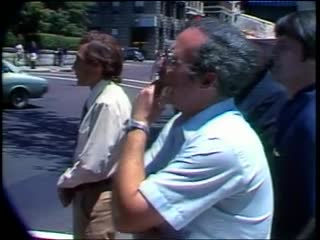
Description: Immigration advocates hope to reopen the amnesty program to get underground aliens legalized. State House hearing.
Collection: Ten O'Clock News
Date Created: 03/29/1989
Description: People buying lobsters at Bay State Lobster. Lobsters removed from tank, placed on scale, put in paper bags, some crated. Displays of seafood for sale. Newly caught lobsters, tightly packed, claws banded, move around in crate. Interview with proprietor on falling prices and fluctuation of supply and demand. Boston is principal lobster distribution point.
Collection: Ten O'Clock News
Date Created: 08/07/1979
Description: Members of Local 509 of state workers union march in front of State House to protest lack of paycheck. High wide shot of State House.
Collection: Ten O'Clock News
Date Created: 06/30/1978
Description: Police Commissioner Francis Roache calls fighting drug crime and abuse World War III, for which resources are inadequate. He hopes drug czar William Bennett will focus on drug education. Drug packet.
Collection: Ten O'Clock News
Date Created: 03/01/1989
Description: Mayors, firefighters and police gather forces at State House to demand local aid cuts not be implemented in budget. Mayors Mary Hurley, Jordan Levy, Michael Capuano, Rep. Tom Birmingham.
Collection: Ten O'Clock News
Date Created: 05/20/1991
Description: At Boston recruiting center, man enlists in army to escape high unemployment in civilian world. Officer describes what is sought in new recruits, including intelligence.
Collection: Ten O'Clock News
Date Created: 12/10/1990
Description: Longshoremen's hiring hall. Men crowd around window for work assignments. Interview with union worker, who says job shortage due to progress and automation. He has not been paid under contract guaranty because of loopholes. He predicts October 1 strike against Boston Shipping Association. Containerization calls for fewer workers, from about 1,200 men to about 400 men, though tonnage of port has remained stable. Man hours have decreased, some men have left the industry, others try to collect their guaranty. A man being interviewed says that the men are very angry.
Collection: Ten O'Clock News
Date Created: 09/24/1976
Description: Lottery sales are on the rise in Medford though residents will not override Prop 2 1/2. Cashier sells lottery ticket. Daily numbers drawing. Convenience store.Medford center.State House exterior,bare trees.
Collection: Ten O'Clock News
Date Created: 03/19/1991
Description: LOTTERY OFFICE AT PRUDENTIAL CENTER, SELLING TICKETS, MACHINES, CASH REGISTERS
Collection: Ten O'Clock News
Date Created: 09/11/1984
Description: Marcus Jones interviews Louis Elisa, from the State Office of Environmental Affairs. Jones notes that Elisa is a neighborhood environmental activist in Roxbury. Elisa and Jones walk through Roxbury and Franklin Park while they talk. Elisa talks about the need for the environmental movement to open up to minorities. Elisa notes that many people do not believe that African Americans are committed to the environment. Elisa talks about his efforts to improve his own neighborhood. Elisa notes that he is trying to prevent the dumping of garbage on a nearby vacant lot. Jones and Elisa discuss the rehabilitation of Franklin Park in Roxbury. Elisa says that the Franklin Park Coalition sought corporate funding to clean up the park, leading to a public/private partnership. Elisa talks about the need to give young people access to the outdoors. He adds that access to the outdoors and recreational activities might decrease violence in the city. Following the edited story is additional footage of Elisa and Jones walking through the city as they discuss environmental issues.
1:00:05: Visual: Shots of the exterior of the Saltonstall Building on Cambridge Street in Boston; of Louis Elisa (State Office of Environmental Affairs) and Marcus Jones (WGBH reporter) exiting the building. Marcus Jones reports that Elisa works in the Saltonstall Building for the State Office of Environmental Affairs. Jones notes that Elisa is a neighborhood environmental activist in Roxbury. V: Footage of Elisa being interviewed by Jones on the street. Elisa says that the environmental movement is often associated with rural and suburban areas; that many urban residents are concerned about the environment. Jones notes that Elisa is an African American urban resident; that the environmental movement has not done enough to reach minority and urban constituents. V: Footage of Elisa being interviewed by Jones. Elisa says that the environmental movement has been shortsighted; that many people see a great divide between rural and urban areas. Elisa says that many people do not believe that African Americans are committed to the environment. Elisa says that the environmental movement does not understand that African Americans use and enjoy parks and open spaces. Elisa says that the environmental movement needs to open up to minorities. Shot of Elisa and Jones walking down a Roxbury street. Jones reports that problems with crime and violence take precedence over environmental issues in Roxbury; that a group of environmentalists in Roxbury are trying to make a difference. Jones notes that Elisa and his neighbors have been trying to get a lot near his apartment building cleaned off. V: Shots of Jones and Elisa walking through an abandoned lot. Audio of Elisa saying that the lot is an eyesore; that the lot is an affront to the residents of the community. Elisa says that he called the city of Boston to complain about garbage being dumped on the lot. Elisa says that the city told him that the owner of the lot could do what he wanted with the lot. Elisa says that the neighboring houses are looked after carefully. Jones reports that Franklin Park is an example of an environmental success story in Roxbury. V: Shot of a golfer hitting a golf ball at Franklin Park. Footage of Elisa saying that a group of Roxbury residents including Elma Lewis got together to advocate for Franklin Field Park; that the advocates began to clean up the park. Elisa says that the park was created by Frederick Law Olmsted (landscape architect); that the park is an asset for the city. Elisa says that the advocates found corporate funding to clean up the park. Elisa says that the rehabilitation of the park is an example of a public-private partnership. Shots of golfers walking across the fairway at the golf course at Franklin Park; of the golf course. Shot of Elisa and Jones walking along a path in Franklin Park. Audio of Elisa saying that it is important for young people to have access to parks, campgrounds, ice skating rinks and coastal areas. Elisa says that more access to the outdoors might decrease violence in the inner city.
Collection: Ten O'Clock News
Date Created: 04/18/1990