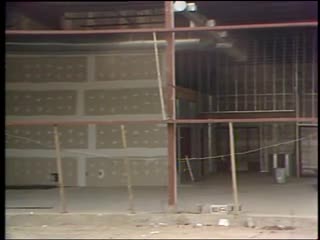
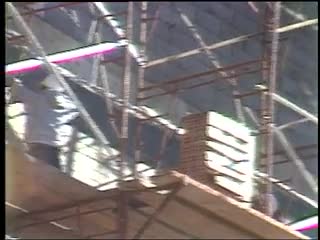
Description: Digital Equipment Corp. Crosstown Industrial Park. Construction site of the Roxbury facility. Project sign lists John B. Cruz as contractor, Stull Associates as architect, showing minority developer involvement. Black construction workers. Building in progress. Huge mounds of excavated dirt, concrete blocks stacked up.
Collection: Ten O'Clock News
Date Created: 07/12/1979
Description: Construction industry in state is in a slump and accounts for much unemployment. Hard hats, cranes, jackhammer, oozing cement, excavated lot, heavy equipment.
Collection: Ten O'Clock News
Date Created: 07/16/1990
Description: HYNES AUDITORIUM UNDER CONSTRUCTION, HEAVY EQUIPMENT, HARD HATS, STEAM SHOVEL
Collection: Ten O'Clock News
Date Created: 11/18/1985
Description: Harvard University medical area energy plant under construction; will produce electric power via diesel engines. Located on corner of Brookline Avenue and Francis Street near Mission Hill. Men on scaffolding laying bricks. Big buckets of mortar hoisted with crane. Wheelbarrow is lifted to platform. Signs “men working” and “no trespassing.” Giant claw deposits cement in dump truck. Contractors J.E. White, Dorel, Anastasi Brothers.
Collection: Ten O'Clock News
Date Created: 10/24/1978
Description: Interior renovation of house in Dorchester. Two young men taping blueboard splices on ceiling. Sanding plaster patches on wall. Ladders, metal tape measure. Hammering sounds. Sweat equity. (1983)
Collection: Ten O'Clock News
Date Created: 10/31/1982
Description: Air piece on women construction workers being stopped from working. Interview with a construction worker about a visit from Inspector Kelly ordering him to stop the women from working. Interview with two women construction workers, Candy and Isabel. Interview with a representative of the inspector defending the order. Reporter standup.
Collection: WHDH
Date Created: 08/14/1970
Description: Some drop out at the beginning. Construction site of Lafayette Place. Cement truck. Workers in hard hats. Heavy equipment. Chain link fence surrounds site. Wide shot of excavated site. Volpe/Shuman campaign sign.
Collection: Ten O'Clock News
Date Created: 09/10/1982
Description: Emerson College will be moving from downtown Boston to Lawrence in 1992. Interview with a representative of Emerson on the reasons for the move. Interview with Lawrence Mayor Kevin Sullivan on the urban renewal project that will help improve the city. Sullivan, Gov. Dukakis, and Sen. Patricia McGovern speak at a ceremony held at the site along the Merrimack River. Construction in progress on site. Interview with William Callaghee, publisher of the Lawrence News, who speaks against the project. Interviews with Lawrence residents on the benefits they predict will come from the relocation of Emerson into their city.
Collection: Ten O'Clock News
Date Created: 12/27/1988
Description: Deborah Wang reports on a labor dispute concerning the Boston Harbor Cleanup project. Wang notes that labor have signed an agreement with the Massachusetts Water Resources Authority (MWRA), in which the unions have promised not to strike if the MWRA agrees to hire only union workers for the project. Interview with John Cruz of J.B. Cruz Construction, who says that many minority businesses would like to bid on the project. Cruz can afford union wages but cannot afford union rules. He says that his business is more efficient because his workers are not unionized. Interview with Richard Fox of the MWRA), who says that the MWRA wants to avoid a work stoppage during the project. Interview with Joe Nigro of the Building Trades Council, who says that unions give workers good healthcare and pensions. Wang reports that Cruz and other non-union contractors may challenge the agreement in court. Following the edited story is additional b-roll footage of construction workers and construction sites.
1:00:08: Visual: Shots of two African American men moving a heavy object from the basement of a building; of a truck belonging to the J.B. Cruz Company; of rowhouses being renovated in Roxbury. Deborah Wang reports that the J.B. Cruz Company has been building and renovating homes in Roxbury since 1948. V: Shots of two African American men lifting a heavy object onto the back of a truck. Wang reports that the J.B. Cruz Company hopes to bid on the Boston Harbor Cleanup project; that the Boston Harbor Cleanup project is the largest public works project to date. V: Shot of an African American man working on the wiring of a home. Footage of John Cruz (J.B. Cruz Construction) being interviewed by Wang. Cruz says that he hopes the project will have a 30% minority set-aside; that minority businesses see the program as a great opportunity. Shots of an African American man operating a tractor; of rubble being transported out of a building on a conveyor belt. Wang reports that the J.B. Cruz Company may not be able to bid on work for the Harbor Cleanup project because the J.B. Cruz Company runs an "open shop" using non-union labor. Wang reports that the city's unions do not want non-union workers to participate in the project. V: Shots of two African American construction workers examining a document; of a construction worker measuring a pipe. Footage of Cruz saying that the union policy is discriminatory. Cruz says that he has been fighting discrimination all of his life. Shots of a construction worker operating a backhoe; of a construction worker using a welding torch. Wang reports that the unions are in control of the Boston Harbor Cleanup project; that the unions have signed a labor agreement with the Massachusetts Water Resources Authority (MWRA). Wang notes that the unions have promised not to strike during the ten-year project. Wang adds that the unions consider the no-strike clause as a major concession. V: Shots of a construction site; of a worker descending stairs on a piece of scaffolding; of a construction worker using a mallot. Footage of Richard Fox (MWRA) saying that a work stoppage during the project could cost millions of dollars. Fox says that the MWRA wanted an agreement which guaranteed good relations with labor and construction workers. Shot of two construction workers walking on a job site; of a construction worker working in a subterranean structure; of a construction worker operating a backhoe. Wang reports that the unions fought for a clause stating that all workers on the project must be union members. Wang notes that Cruz must enroll all of his workers in a union if he wants to bid on the Harbor Cleanup Project. Wang reports that Cruz says that he can afford union wages but cannot afford union rules. V: Shots of construction workers working at a construction site; of Cruz being interviewed by Wang. Shots of a gravel truck at a construction site; of the driver of the gravel truck. Footage of Cruz saying that his business runs more efficiently because his business is not subject to union work restrictions. Shots of workers shoveling rocks down a chute into a building. Footage of Joe Nigro (Building Trades Council) saying that unions try to give workers good healthcare and a healthy pension. Nigro says that Cruz pays his workers low wages; that Cruz does not offer health and welfare benefits. Wang stands at a construction site. Wang reports that unions have a highly skilled work force; that unions get most of the jobs on big construction projects. Wang notes that unions can often dictate the labor terms on big construction projects. V: Footage of Cruz being interviewed by Wang. Cruz says that the unions are threatened by open-shop contractors because they are more efficient. Shots of a construction site near Boston Harbor. A worker climbs on a half-built structure. Another worker stands on a large piece of equipment. Wang reports that other non-union contractors are unhappy about the labor agreement for the Boston Harbor Cleanup project. Wang notes that a trade group may challenge the agreement in court; that the lawsuit could signal further delays for the Harbor Cleanup Project. V: Shots of construction workers at a site near Boston Harbor; of the Boston skyline; of large equipment operating in the harbor.
Collection: Ten O'Clock News
Date Created: 06/26/1989
Description: Meg Vaillancourt reports that the city of Boston is experimenting with a parcel-to-parcel linkage program to promote development in both the downtown area and in the outlying neighborhoods of the city. A new development project has linked a development in Chinatown to the development of Parcel 18 near the Ruggles MBTA station in Roxbury; the developers had to agree to develop both parcels of land. Vaillancourt reviews the details of the proposed development in each neighborhood. Interview with Stephen Coyle of the Boston Redevelopment Authority about the linkage project. Coyle says that the city is linking desirable downtown sites to sites in other neighborhoods in an attempt to bring jobs and services to the neighborhoods. Mayor Ray Flynn, Governor Michael Dukakis, and City Councilor Bruce Bolling at a press conference in Roxbury talk about the benefits of the linkage project. The Columbia Plaza Associates are a group of minority developers who will most likely develop the sites in Chinatown and Roxbury. Vaillancourt reviews the city's criteria for the development project. The project may bring more jobs and better housing to the Roxbury neighborhood. Following the edited story is b-roll of the area near the Ruggles MBTA station. This edition of the Ten O'Clock News also included the following item: Jesse Jackson campaigns for president in New Hampshire
1:00:06: Visual: Footage of Stephen Coyle (Boston Redevelopment Authority) saying that public land is being used to create "community equity." Shots of a street in Chinatown.<br /><br />Meg Vaillancourt reports that a new development project will affect two communities; that a parking garage and another lot on Essex Street will be developed into office space, retail space, a hotel, and moderate-income housing. Vaillancourt adds that land near the Ruggles MBTA station in Roxbury will be developed into a commercial center with two office buildings, a cultural center, and mixed-income housing for over 150 families. <br /><br />: V: Shots of a parking garage in Chinatown; of the area near the Ruggles Street MBTA station in Roxbury.<br /><br />Vaillancourt notes that developers who wanted the land in Chinatown had to agree to develop the land in Roxbury. <br /><br />: V: Shot of shoppers on a street in Chinatown; of African American commuters entering the Ruggles MBTA station. Shot of a sign reading, "Parcel-to-parcel linkage program project #1. Kingston-Bedford/Parcel 18."<br /><br />Vaillancourt reports that the parcel-to-parcel linkage program is the first program of its kind in the nation. <br /><br />V: Footage of Coyle saying that the downtown sites are desirable to developers; that the city is linking downtown sites with sites in other neighborhoods; that the city would like to bring the service economy into other neighborhoods. Coyle says that Roxbury can benefit from a service economy, especially with the new MBTA orange line trains. Footage of Ray Flynn (Mayor of Boston) addressing a crowd seated outside of the Ruggles MBTA station. Flynn talks about the necessity of good jobs, affordable housing, and neighborhood revitalization. The crowd applauds. The crowd is mostly African American. Shots of an older African American woman in the crowd.<br /><br />Vaillancourt reports that the $400 million project will provide benefits to both communities; that the projects will create more than 2,000 jobs in construction; that the projects will provide more than 8,000 permanent jobs when complete. <br /><br />V: Shots of construction workers working on building sites. Footage of Michael Dukakis (Governor of Massachusetts) saying that these projects will prove to students that there are opportunities for them if they stay in school to be trained. Shot of the audience members. Footage of Bruce Bolling (President, Boston City Council) says that the projects are about the "economic mainstreaming" of those who had been factored out of the process. Shots of an African American woman and her child in the audience; of an African American man at the podium.<br /><br />Vaillancourt reports that Roxbury and Chinatown residents met with the Columbia Plaza Associates; that Columbia Plaza Associates are the minority developers of the projects. Vaillancourt notes that the Columbia group must satisfy five criteria before being officially designated as the developer of the projects. Vaillancourt reports that the group must expand minority and community participation in the project beyond 30%; that the group must develop a plan with clear community benefits; that the plan must get maximum benefit from the $6.6 million in linkage funds; that the project plans must be sensitive in scale and design; that the group must find private investors who promote community ownership and who will insure the projects. <br /><br />V: Shot of the Boston skyline from area near the Ruggles MBTA station. Text on screen lists the city's criteria for development. Footage of Coyle being interviewed by Vaillancourt. Coyle says that the plan requires that the land be put to use for the community. Shot of an African American woman holding her child.<br /><br />Vaillancourt stands in front of the Ruggles MBTA station. Vaillancourt reports that Roxbury community activists blocked a 1970 plan to extend an interstate highway; that the plan would have destroyed several area neighborhoods; that the activists argued for more jobs, more housing and better transportation. Vaillancourt notes that the project looks like it will fulfill the wishes of those community activists.:
Collection: Ten O'Clock News
Date Created: 10/12/1987