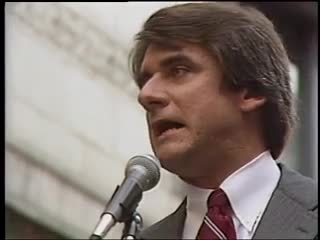
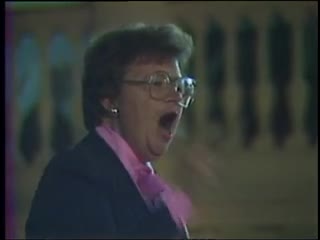
Description: Rally outside Jordan Marsh and Filene's in downtown Boston to support boycott and unionization of J.P. Stevens. Little Flags Singers, George Wald, James Laughlin of Mass. Labor Council, Lt. Governor Tom O'Neill on stage on behalf of Stevens workers. Boycott button on coat. Man dressed in Santa Claus suit collects money for Krishna Consciousness (ISKAN), duping people into believing they are donating to a Christmas charity.
Collection: Ten O'Clock News
Date Created: 11/30/1978
Description: JOHN SEARS, LEON LOMBARDI, JOHN VOLPE SPEAK AT NORTH END RALLY FOR SEARS IN REPUBLICAN GOVERNOR CAMPAIGN.
Collection: Ten O'Clock News
Date Created: 10/06/1982
Description: Interview with James Kelly, director of South Boston Information Center, about a demonstration at Carson Beach. He describes it as a visit by armed black militants from Columbia Point. Then he expounds on his strident views on busing and affirmative action. SBIC storefront and sign “Welcome to Boston. The city is occupied. A boycott exists. A tyrant reigns. Law is by decree. People are oppressed. The spirit of freedom still lives.” Kelly on the street, talking to a pedestrian. Kelly sitting at desk in back room answering phone.
Collection: Ten O'Clock News
Date Created: 08/02/1977
Description: Marcus Jones reports that anti-war activists protested across the nation to rally public opinion against the use of force in the Persian Gulf, including in downtown Boston. Jesse Jackson visited MIT to speak out against going to war in the Middle East on the birthday of Martin Luther King, Jr. Jones notes that the MIT Initiative for Peace in the Middle East brought Jackson to the campus. Jackson says that the US must not rush to war on January 15. Interviews with MIT graduate students Corrie Lathan and Steve Penn, who oppose the war. Interview with Jesse Jackson, who says that the US and Iraq should negotiate because war is inevitable if talking is impossible. Jones' report includes footage from Inside Edition of Jackson in Iraq. Following the edited story is additional b-roll of anti-war demonstrations and of Jackson at MIT talking about Martin Luther King, Jr.
1:00:36: Visual: Footage of anti-war protesters on Winter Street in downtown Boston. The protesters carry signs protesting the Gulf War. They chant together, "We remember Vietnam. We won't go." Shot of two police officers standing in front of a building. Marcus Jones reports that a group of anti-war protesters demonstrated outside of the Army recruiting headquarters in Boston. V: Shot of a protesters carrying a sign reading, "U.S. Troops out of the Gulf." The protesters chant, "We won't fight for Texaco." Shot of a protester handing out leaflets. Jones reports that anti-war activists took to the streets across the country today; that the protesters are trying to rally public opinion against the use of force in the Persian Gulf. V: Shot of an older white woman wearing a sign around her neck. The sign reads, "Bring our troops home." Shot of two white children standing among the protesters. Jones reports that Jesse Jackson (African American political leader) visited MIT (Massachusetts Institute of Technology) tonight; that the members of the MIT Initiative for Peace in the Middle East brought Jackson to the campus. Jones reports that Jackson spoke out against going to war in the Middle East on the birthday of Martin Luther King Jr. (civil rights activist). V: Shots of Jackson greeting an MIT student; of Jackson greeting students as he walks to the podium. Shots of students in the audience. Footage of Jackson addressing the students. Jackson says that the US must not rush to war on January 15. Jackson says that efforts toward peace must be made on King's birthday. Footage of Corrie Lathan (MIT graduate student) being interviewed. Lathan says that she is opposed to the war; that the situation should be resolved in a non-violent manner. Footage of Steve Penn (MIT graduate student) being interviewed by Jones. Penn says that decision-makers in the US understand pressure; that the voice of the people must speak out against the war. Jones reports that Jackson's call for restraint may reflect a change in his thinking. Jones notes that Jackson met with Saddam Hussein (Iraqi leader) last year. Jones reports that Jackson said last year that war would be inevitable if talking proved impossible. V: Footage from Inside Edition of Jackson entering a building in Iraq; of Jackson speaking to Hussein. Jones questions whether Jackson has changed his position. V: Footage of Jackson speaking at MIT. Jones asks Jackson if he has changed his position. Jackson says that he has kept the same position. Jackson says that war is inevitable if talking is impossible. Jackson says that the US and Iraq should "talk"; that the two countries must choose negotiation over confrontation. The audience applauds for Jackson as he walks away from the podium.
Collection: Ten O'Clock News
Date Created: 01/14/1991
Description: Jon Parker & AIDS Brigade give out clean needles in Mission Hill. Addict deposits used works, gets kit w/alcohol wipes & condom. Neighborhood residents protest.File of Parker's fight w/Graylan Ellis-Hagler.
Collection: Ten O'Clock News
Date Created: 01/30/1991
Description: Marcus Jones profiles Julian Bond. Jones notes that Bond was a lecturer at Harvard University last fall. Jones interviews Bond about his role in the Eyes on the Prize series and his involvement in the civil rights movement. Bond talks about his beginnings in the civil rights movement and about the 1968 Democratic Convention. Jones notes that Bond was nominated for vice president during that convention. Jones' report includes footage from the 1968 Democratic Convention and footage from Eyes on the Prize. Jones interviews Harvard students Carlos Watson and Natosha Reid about the class they took with Bond at Harvard. Jones' report also features footage of Bond in class with his students. This tape includes additional b-roll footage of Bond in class with his students. This edition of the Ten O'Clock News also included the following items: Banks agree to improve access to banking services in low-income neighborhoods Banks improve services to low-income neighborhoods Christopher Lydon interviews Sarah Small Sarah Small
1:00:06: Visual: Footage from the opening credits of Eyes on the Prize II. Footage of Julian Bond (narrator, Eyes on the Prize) talking about the success of the Eyes on the Prize series. Bond says that the first series had a tremendous impact on the viewing public. Bond says that the second series will also have an impact; that he is proud to be associated with the series. Black and white footage from Eyes on the Prize, with narration by Bond. Marcus Jones reports that Bond is the narrator for the six episodes in the first series; that Bond will be the narrator for the eight episodes in the second series. Jones notes that Bond is proud of his social activism. V: Footage of Bond being interviewed by Jones. Bond talks about the accomplishments of the civil rights movement. Footage from Eyes on the Prize with narration by Bond. Jones reports that Bond was a senior at Morehouse College in Atlanta in 1959; that Bond joined the student sit-in movement. V: Footage of Bond being interviewed by Jones. Bond talks about how he became involved in the sit-in movement. Bond says that he has been involved in the civil rights struggle ever since. Black and white footage from Eyes on the Prize of the 1964 Democratic Convention. Jones reports that an African American delegation from Mississippi demanded to be seated in the place of an all-white delegation at the 1964 Democratic Convention. Jones notes that the effort failed; that Bond and other activists challenged the rules of representation at the 1968 Democratic Convention; that Bond was named as a nominee for vice president. V: Color footage from the 1968 Democratic Convention. Footage of Bond being interviewed by Jones. Bond talks about being nominated for vice president at the 1968 Democratic Convention. Bond says that he was nominated in an attempt to seize control of the microphones; that he was only twenty-eight years old. Bond says that the attempt failed; that the reformers were not allowed enough input on the convention floor. Jones reports that Bond lectured on southern politics at Harvard University last fall. V: Shots of Bond with his students at Harvard. Footage of Natosha Reid (freshman, Harvard University) saying that Bond's class has given her perspective on African Americans in politics. Footage of Carlos Watson (junior, Harvard University) saying that Bond's class was one of the best classes of the semester. Shot of Bond in class with his students. Jones reports that Bond intends to do more teaching and television work in the future. V: Footage of Bond being interviewed by Jones. Bond says that great leaders and fiery orators are important. Bond says that ordinary people need to be the leaders of the civil rights movement; that ordinary people can accomplish extraordinary things without depending on a leader.
Collection: Ten O'Clock News
Date Created: 01/15/1990
Description: EDWARD KENNEDY AND WALTER MONDALE SPEAK AT FANEUIL HALL RALLY IN FAVOR OF Equal Rights Amendment (ERA). reel 3 of 3
Collection: Ten O'Clock News
Date Created: 10/18/1982
Description: Karen Silkwood Day commemorated by anti-nuclear activists at Seabrook. Clamshell Alliance protesters conduct civil disobedience and are dragged away by NH police.
Collection: Ten O'Clock News
Date Created: 11/13/1987
Description: Judy Stoia interviews Dennis Kearney (State Representative), Gloria Conway (Editor, Charlestown Patriot) and Mon O'Shea (Associate Dean, Bunker Hill Community College) on the steps of the Bunker Hill Monument. They talk about the anti-busing movement in Charlestown. O'Shea says that the media have portrayed Charlestown as a violent community; that the Charlestown anti-busing movement is working for public safety and rumor control. Conway discusses the damage the media can cause by reporting unverified rumors. Paul deGive interviews Conway on police presence in Charlestown and about violent youth in Charlestown. Conway says that police officers in Charlestown allowed a peaceful demonstration to proceed today; that residents need to vent their frustrations. Conway discusses the ways local and national media interact with the people involved in the busing situation, while they shoot cutaways. Tape 3 of 3
1:00:01: Visual: Judy Stoia interviews Dennis Kearney (State Representative), Gloria Conway (Editor, Charlestown Patriot) and Mon O'Shea (Associate Dean, Bunker Hill Community College) on the steps of the Bunker Hill Monument. 1:00:34: V: Stoia asks about the image of Charlestown as a violent community. O'Shea says that Charlestown's image is created by the media; that he does not condone violence; that anti-busing leaders in Charlestown have worked for public safety and the establishment of a rumor control center. Conway talks about the importance of the rumor control center. 1:03:16: V: Stoia winds up the interview. Two police officers descend steps beside them. The group talks informally. Stoia explains the editing process. Stoia compares anti-busing resistance in South Boston to resistance in Charlestown. The crew takes extra cutaway shots of the group. Conway talks about her work at The Patriot. Shots of area around Bunker Hill Monument. 1:07:39: V: The crew sets up Paul deGive's interview with Conway. DeGive asks about possible removal of TPF from Charlestown. Conway says that some police presence is necessary; that she will not speculate on numbers; that tension in the community has diminished; that the police were effective today because they allowed a peaceful demonstration to proceed; that peaceful demonstrations allow residents to vent their frustration; that many police deployed on Bunker Hill Street today were local officers known to the community; that the MDC Police officers have tried to work with the community. DeGive asks about violent youth gangs. Conway says that it is not unusual for youth to be out in the streets in Charlestown; that she cannot identify the element that needs to be controlled by the police. DeGive rephrases his question about potential violence of Charlestown youth. Conway says that there are a few leaders making trouble, but many kids are caught up in the events. 1:14:33: V: The crew sets up cutaway shots of Conway and deGive. DeGive and Conway talk informally. Conway comments on local and national media coverage of busing. Conway comments on TPF action against female residents of Charlestown. The crew wraps up the shoot.
Collection: Evening Compass, The
Date Created: 09/10/1975
Description: Sarah Robertson, mayor of Worcester, introduces Rep. Barbara Mikulski who introduces Sen. Edward Kennedy who introduces Walter Mondale at Faneuil Hall rally for women supporting the ERA. reel 1 of 3
Collection: Ten O'Clock News
Date Created: 10/18/1982