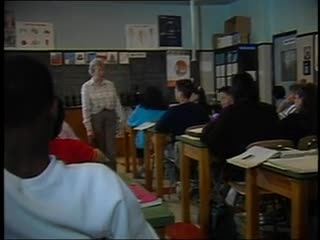
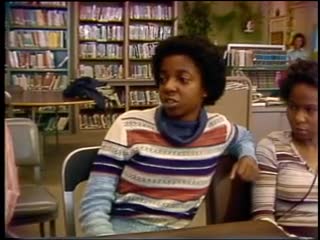
Description: South Boston High exterior on first day of school. Press photographers stand around outside waiting for something to happen. Three upperclassmen say it is quieter inside since desegregation furor has died down, and learning can take place. They discuss news programs in the school. Several takes of reporter standup. Graffiti “stop forced busing” still visible on street. School bus arrives, lets off two black girls. Interview in front of School Committee headquarters with woman from Citywide Education Coalition who appraises current state of Boston schools: parents are involved and important to educational improvement; vocational education is woefully lacking; must upgrade reading and basic skills. “City can someday have an attractive and credible public school system.” She cautions that just because it is quiet now compared to the first years of busing, people should not assume the school system is okay; it still needs criticism and community input. Editor's note: Content given off the record was edited out of this footage.
Collection: Ten O'Clock News
Date Created: 09/06/1978
Description: America scores lowest among 17 nations in science education. Physics classroom at Edwards Middle School. Students tell their career ambitions.
Collection: Ten O'Clock News
Date Created: 10/11/1988
Description: Evening Compass special. In-studio operators take phone calls from parents with questions about school assignments and busing for the next school year. Ed Baumeister gives the answers to several true-or-false questions regarding the state plan to achieve racial balance in Boston schools. Judy Stoia gives statistics for the maximum travel distance of students and the racial makeup of schools in each elementary and intermediate school district. Paul deGive reports on a plan proposed by the Boston School Department to hire aids to help care for children and locate parents in case of sickness or family emergency. Baumeister and Pam Bullard (Boston Herald American) interview John Coakley (Boston School Department) and Dr. Charles Glenn (Massachusetts State Department of Education) about implementation of the racial balance plan. Both men respond to questions about the busing of kindergarten students. Judy Stoia explains the term geocode. Stoia and Bob Murray (Boston School Department) give on-air answers to some of the most common questions received by the operators. In studio Bullard, Baumeister and Dr. John Finger of Rhode Island College discuss plan developed to integrate schools. WGBH reporter and Bob Murray have question-and-answer session with questions from callers. Joan Buckley, representative from Boston Teachers Union, discusses plan for teachers with Bullard and Baumeister.
0:02:11: Visual: Introduction to A Compass Special: September in April, a special broadcast concerning the state racial balance plan for the Boston schools. Ed Baumeister is in the studio, along with several volunteers covering the phones. Baumeister introduces the program as informational, designed to answer parents' questions about the plan and its implementation. Baumeister gives out a number for parents to call to reach volunteers in the studio. Baumeister provides true/false answers to basic questions about the plan. Questions touch on the reimbursement of transportation costs, general travel distances for students of various ages and numbers of white and non-white students to be bused. 0:06:08: V: Paul deGive reports on parents who worry about being able to reach their child at a distant school in the case of sickness or emergency. He reports that the Boston School Department will propose a plan to hire transitional aids at each school to contact parents and to care for children in an emergency. 0:09:15: V: Baumeister encourages parents to call studio for information. Volunteers answer the phones. 0:09:55: Report on the Boston elementary school districts under the racial balance plan. Narrator describes the standardization of grade structure in elementary schools and the changes to various elementary school districts. The districts are as follows: Hennigan Kennedy, Bacon Dearborn, Tobin Farragut, Washington Park, Sumner-Conley, Tileston Chittick Greenwood, Lee, Murphy, Marshall Dever Mason, Mendell-Parkman, Paine-Audobon, Milmore, Prince, Faneuil, Lincoln Quincy, Hurley-Bates, Carter, Eliot, South Boston, Hyde Park, Cannon, Ohrenburger, Parker Longfellow. V: Shot of a map of Boston's elementary school districts. Narrator gives information for each district, including district boundaries, names of schools within the district, maximum travel distance for any student in the district and projected non-white enrollment for each school in the district. A map of each district is shown as the narrator reads the information for that district. 0:20:11: V: Judy Stoia encourages parents to call the studio for information concerning their child's school assignment. Shots of telephone volunteers. Stoia mentions that the volunteers are from the Citywide Education Coalition, the Teachers Union and the Boston School Department. Stoia talks to volunteer Lee Grant and explains the term "geocode." Stoia talks to volunteer Scott Campbell about what kind of information he can give to parents over the phone. 0:23:30: V: Baumeister introduces Pam Bullard (Boston Herald American) and John Coakley (Education Planning Center of the Boston School Department). Baumeister refers to Coakley as the man charged with making the racial balance plan work. Coakley refutes the claim that he is in charge of the plan, but discusses preparation for implementation of the plan. Baumeister asks Coakley if the School Department has any flexibility in implementing the plan. Bullard asks Coakley to respond to parental complaints about kindergarten assignments. Bullard presses kindergarten issue, asking if kindergarten children will be bused to the Martha Baker School or to kindergarten centers. Coakley summarizes School Department efforts to minimize busing of kindergarten students and cites the inadequacies of state plan concerning kindergarten students. Baumeister asks Coakley how he would change plan if he could. Coakley cites preliminary plans for integration by the Boston School Department and the Boston School Committee. Coakley says these plans were never developed. Baumeister thanks Coakley. 0:33:27: V: Baumeister provides answers to more true/false questions about the racial balance plan. Questions touch on the following issues: state reimbursement for travel under the desegregation plan, reimbursement of MBTA travel under the plan, major thoroughfares as school district boundaries, classification of Spanish-speaking students, overcrowding of Boston schools. 0:35:14: Report on intermediate school districts under the racial balance plan. Narrator talks about the redistricting of intermediate schools under the plan. Narrator gives the following information for each district: district boundaries, maximum travel distance for any student in the district and percentage of non-white students within each intermediate district school. Narrator reads the information for each district over a map of that district and a shot of the district school. The districts follow: Cleveland, Curley, Dearborn, Edison, Gavin, Holmes, Irving, King, Lewenberg, Lewis, Mackey, McCormack, Michelangelo, Roosevelt, Shaw, Taft, Thompson, Timilty, Wilson. V: Shot of a map of Boston's intermediate school districts. 0:44:41: V: An in-studio reporter asks a volunteer named Fran to describe the phone calls she has received. The reporter addresses a specific situation concerning the placement of 6th grade students in Hyde Park. 0:46:31: V: Baumeister and Bullard interview Dr. Charles Glenn (Office of Equal Education Opportunity of the State Department of Education). Baumeister asks Glenn how the plan determines which children will be bused at the high school level. Bullard asks Glenn about the busing of kindergarten students under the state plan. Glenn explains the intricacies of the plan and its implementation. Baumeister asks Glenn why the state plan to desegregate schools is better than any put forth by the Boston School Committee. Glenn explains that the state desegregation plan goes as far as it can under state law. Bullard questions Glenn about hurried implementation of the racial balance plan, and if the communities involved will be adequately prepared. Glenn responds that the plan has been implemented as well as can be expected in the time given. 0:55:15: V: Baumeister provides answers to more true/false questions. Questions touch on the following issues: definition of non-white students, school assignments and school assignment changes, Massachusetts state racial imbalance regulations, teacher assignments. 0:56:49: V: Stoia and Bob Murray (Education Planning Center of the Boston School Department) answer the most difficult questions received by phone volunteers. Questions involve travel distance within a school district, whether Dr. Glenn lives in Boston, the assignment of students in sub-system schools (Trotter school, Lewis school and Copley High School), and the assignment of seniors in the high schools.
Collection: Evening Compass, The
Date Created: 04/22/1974
Description: John Silber is booed at Chelsea public hearing where he defends BU's management of school system; advises no cuts in education budget and home rule petition raising property taxes for local services.
Collection: Ten O'Clock News
Date Created: 05/14/1991
Description: South Boston High. Walking shot down corridor and dark stairs. In library, a group of black and white students discuss their experience in school since desegregation started four years ago. They attest to better educational programs and improved racial harmony now. “No fights.” They think police presence in the early years worsened tension.
Collection: Ten O'Clock News
Date Created: 06/08/1978
Description: No audio at the beginning. Horse-mounted police officers, police cars, police bus. Police officers are gathered along G Street outside of South Boston High School. Exteriors of the school building. School buses, accompanied by a police motorcycle escort, pull up outside of the school. African American and white students exit the school. White students walk away from the school. African American students board the buses. The buses depart. Pam Bullard interviews four South Boston High School teachers: Jerry Power, Bob Healey, Bob Donovan, and Paul Grueter. The four teachers says that conditions in the school are improving, despite negative reports in the media. Donovan says that Judge Arthury Garrity (federal judge) is among those receiving inaccurate reports about the school. They discuss some of the good things that they think are happening in South Boston High despite the racial tensions.
1:00:04: Boston Police Department vehicles are lined up along the side of the road in South Boston. A mounted police officer exercises his horse. A horse stands in a yard with grass. 1:02:21: Visual: Boston Police Department vehicles are parked in the schoolyard of South Boston High School. Police are gathered along G Street in front of the high school. Shot of the exterior of South Boston High School. A Massachusetts State Police vehicle is parked in the schoolyard. A Boston Police station wagon is parked on G Street. 1:04:55: V: Buses pull up in front of South Boston High School. The buses are accompanied by a police motorcycle escort. White students exit the high school, walking out of the schoolyard. African American students exit the high school and walk toward the buses. A young African American male student raises a clenched fist and looks at the camera. Some white students continue to exit the school, along with African American students. Two African American female students pose for the camera and say, "Hi, mom." A few of the African American students wave at the camera as they walk to the buses. Police officers stand casually on the sidewalk in front of the buses. A white student walks by the camera crew and says, "We don't watch Channel 2 news." 1:10:13: V: A group of four police officers are gathered on G Street. They laugh casually at a joke. A female African American student rushes toward her bus. Police officers mount their motorcycles. The buses pull away from the school and travel down G Street with the police escort. 1:11:57: V: Shot of the exterior of South Boston High School. Pam Bullard exits the high school, followed by four white teachers. She sets up an interview in front of the school with Jerry Power (teacher, South Boston High School), Bob Healey (teacher, South Boston High School), Bob Donovan (teacher, South Boston High School), and Paul Grueter (teacher, South Boston High School). Donovan makes it clear to Bullard that each teacher is speaking as an individual; that they are not speaking for the faculty of the school. Bullard asks each of them to say and speak their names for the camera. Bullard tells them that negative reports have been circulating about the situation inside South Boston High School. Donovan asks where the negative reports are from. Bullard says that they are from the media. Donovan says that the situation is slowly getting better after a hectic beginning of the school year. Grueter agrees that the situation is improving. Healey says that sweep teams have been established in the corridors in order to get students to class; that the school corridors had been a problem until now. Donovan says that the school faculty took some drastic measures to control the situation inside the school. Power says that the atmosphere in the school has swung between periods of tension and periods of calm; that there has been a decrease in the number of suspensions and separations of students from the school. Bullard says that many school officials and teachers outside of South Boston High School are calling the school "a lost cause." Donovan says that the faculty and staff at South Boston High School are committed to educating the students and keeping the school open. Healey says that many people are not aware of the good programs at South Boston High School. He mentions the automotive shop, business courses, and computer courses. Power says that he was quoted in a Boston Herald article that was critical of the school. He says that his quote was taken out of context. He had meant to say that not all of the students are taking full advantage of the programs offered to them; that there are both white and African American students at the school who are not interested in getting an education. Donovan says that the faculty is not ashamed of their school; that Judge Arthur Garrity (federal judge) is among those receiving inaccurate information about the situation at South Boston High School; that Garrity received a letter from the CCC which contained inaccurate information about the school.
Collection: Ten O'Clock News
Date Created: 11/01/1976
Description: Vietnamese and Cambodian refugee students excel at private Cathedral High. If general relief fund which supports them is cut, their education will be in jeopardy. Southeast Asian names on honor roll.
Collection: Ten O'Clock News
Date Created: 05/09/1991
Description: Little girl uses Speak & Spell computer toy with synthesized voice. Interview with man from Texas Instruments about development of this learning tool game with integrated speech, and on future applications of speech recognition and synthesis technology.
Collection: Ten O'Clock News
Date Created: 09/25/1978
Description: Blind and deaf teens and other special needs students demonstrate inside the State House for preservation of Chapter 766 education funding in the state budget.
Collection: Ten O'Clock News
Date Created: 05/22/1991
Description: State college students march to State House to protest decreased education funding. James Braude, Barry Crimmins.
Collection: Ten O'Clock News
Date Created: 04/12/1990