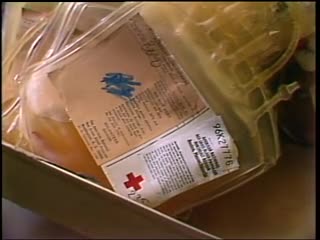
Description: AIDS patient Paul D'Angelo in hospital bed, extremely ill.
Collection: Ten O'Clock News
Date Created: 08/08/1983
Description: Pondville Hospital exterior in Norfolk. Snow on ground. State public health facility specializing in cancer treatment.
Collection: Ten O'Clock News
Date Created: 03/02/1979
Description: David Boeri reports on Project Mattapan, which is a community-based prenatal care program aimed at reducing the infant mortality rate in Boston. Boeri notes that the infant mortality rate is very high in the city of Boston. He adds that the infant mortality rate in the African American community is 2.5 times the rate in the white community. Boeri interviews June Cooper (Community Health Associate) and John Ramsey (Boston Foundation) about the program. Boeri reports that Project Mattapan is a yearlong project funded by the Boston Foundation. Boeri notes that the program will provide outreach to poor and uneducated women in an effort to combat premature births and low-birth weights. Boeri's report is accompanied by footage of women and health care workers at a health care center, by footage of infants at a hospital nursery, and by footage of children at an urban playground.
1:00:03: Visual; Shot of children playing at an urban playground. Shot of a woman standing at the window of an apartment, holding a baby. David Boeri reports that Boston is the medical capital of the world; that the infant mortality rate in some African American neighborhoods is as high as the infant mortality rate in third-world nations. Boeri notes that the infant mortality rate for African Americans is 2.5 times the infant mortality rate for white Americans. V: Shot of an urban landscape from the window of a health care clinic. Shot of an African-American infant hooked up to breathing equipment. Shot of a white health care worker tending to an infant. The infant is hooked up to breathing equipment. Footage of June Cooper (Community Health Associate) being interviewed. Cooper says that people need to know that prenatal care is important. Cooper says that more prenatal care could result in a decrease of the infant mortality rate. Boeri reports that Cooper is one of the founders of Project Mattapan; that Project Mattapan has launched a community-based campaign against low birth weights and premature births. V: Shot of a poster which reads, "Give your baby a healthy start." Shot of a black and white photo of an infant in a medical brochure. Footage of John Ramsey (Boston Foundation) being interviewed. Ramsey says that Project Mattapan has the cooperation of eight agencies; that Project Mattapan deals with housing, mental health, education, and other issues along with health care. Ramsey says that Project Mattapan promotes stable families. Boeri reports that Project Mattapan is a year-long project; that the Boston Foundation has funded the $100,000 project. Boeri reports that Project Mattapan will help local health care centers to reach out to poor and uneducated women. Boeri notes that these women are in need because federal programs have been cut. V: Shots of a pregnant African American woman being examined; of an African American health care worker filling out a medical chart. Shot of a health care worker and a patient in a medical examination room. Footage of Cooper being interviewed. Cooper says that outreach efforts are nonexistent in many agencies. Cooper says that the project will attempt to provide outreach and services to women. Boeri reports that the founders of Project Mattapan believe that infant mortality and low-weight births can be prevented. V: Shot of a health care worker placing a teddy bear on top of an incubator containing an infant. Shot of an African American infant hooked up to breathing equipment. Shot of a health care worker wheeling an incubator through the nursery of a health clinic.
Collection: Ten O'Clock News
Date Created: 12/10/1987
Description: RONALD McDONALD HOUSE. CHILD STRAPPED DOWN TO TABLE. DOCTOR, NURSE, X-RAYS. EMERGENCY RUNS IN HALL.
Collection: Ten O'Clock News
Date Created: 12/24/1981
Description: Northeast Regional Red Cross Blood Program Center building in rain. Inside lab technicians process blood and components in rotating coiled tubes. Numbered vials of blood in racks. Lab worker peers into microscope. Centrifuge spins and slows to stop. Technician with gloved hands draws plasma from test tubes. Typed units (A positive, B negative, etc.) in plastic packs on refrigerated shelves. Units packed in carton marked "Rush Human Blood" lined with styrofoam and covered with ice bag for shipping to University Hospital.
Collection: Ten O'Clock News
Date Created: 04/09/1979
Description: Special legislative commission on hospital finance hears health care advocates' ideas for refining universal health care and reducing costs. Sen. Salvatore Albano.
Collection: Ten O'Clock News
Date Created: 10/24/1990
Description: Dr. Mary Ellen Avery, pediatrician at Children's Hospital, talks about hyaline membrane disease and respiratory distress syndrome in premature infants. (Lung tissue is stiff, making breathing difficult, and can lead to broncho-pulmonary dysplasia.) Vitamin E as antioxidant is suggested as treatment in recent study at Yale New Haven Medical Center. Neonatal unit of extremely tiny babies in incubators with breathing apparatus.
Collection: Ten O'Clock News
Date Created: 09/13/1978
Description: Reye's Syndrome, aspirin, drugs, drugstores, Tylenol; Jerry Haller interview at Tufts New England Medical Center.
Collection: Ten O'Clock News
Date Created: 08/14/1982
Description: Mostly black and white footage, with some color. Shots of police responding to riots after Martin Luther King, Jr.'s assassination. Police patrolling the streets, arresting men and loading them into police van. Crowd of young people calling to the camera. Fires and fire fighters with ladders, hoses, fire engines. Man on a stretcher in an ambulance. Destroyed gas pump. People sitting in at Boston public welfare office. Police officers jumping through open window. Broken storefront windows. Overturned cars. Exteriors of Boston City Hospital. Boston Police Radio Field Operations Unit. Crowd of police and army officers in a stadium. People being treated in hospital. Pedestrians. Police officers board MBTA buses en masse. Sounds comes in for a little bit halfway through the video.
Collection: WHDH
Date Created: 04/05/1968
Description: Carmen Fields reports that the infant mortality rate in Boston's African American community is three times the rate in white communities. Fields interviews Jeanne Taylor, PhD (Roxbury Comprehensive Health Center) and David Dolin (Executive Vice President, Beth Israel Hospital)) about the partnership between the two facilities and the rising infant mortality rate in Boston. Dolin says that the high infant mortality rate is a social problem involving health, education, housing, employment, and crime. He adds that advances must be made in all of those areas in order to combat the high infant mortality rate in Boston. Taylor talks about the role of community health centers and the benefits of relationships between community health centers and large hospitals. Taylor says that the infant mortality rate is only one indicator of distress in the African American community. Fields reports that the concept of linkage is being applied to health care through the partnerships between the large and small medical facilities. Fields's report includes footage of infants being cared for in the nursery of a health facility.
1:00:15: Visual: Footage of Jeanne Taylor, PhD (Roxbury Comprehensive Health Center) being interviewed by Carmen Fields. Taylor says that Roxbury Comprehensive Health Center has always been an independently licensed health center; that the health center is federally funded. Taylor says that Roxbury Comprehensive Health Center does not have a relationship with the city or the state. Taylor says that the health center has had informal relationships with hospitals in the past. Taylor says that hospitals provide a wealth of resources to health centers; that hospitals can provide specialists to health centers; that hospital residents can come to work in health centers. Fields reports that the infant mortality rate in Boston's African American community is three times the rate in white communities. Fields notes that the gap grew in 1989 and in 1990. Fields notes that the African American community is called a "death zone." V: Shots of an African American infant hooked up to breathing equipment; of a health care worker monitoring medical equipment in a hospital nursery; of a monitor on the medical equipment. Shot of the health care worker tending to an infant; of the infant hooked up to equipment. Footage of David Dolin (Executive Vice President, Beth Israel Hospital) being interviewed by Fields. Dolin suggests that there is no one to blame for the high infant mortality rate; that you cannot place blame on any one segment of the health care community. Dolin says that the problem may not be a health problem; that the problem is a social problem involving health, education, housing, the police department, and the mayor's staff. Fields reports that the concept of linkage is being applied to health care and the infant mortality rate. V: Footage of Taylor being interviewed by Fields. Taylor says that many hospitals have had limited interest in partnering with health care centers in the past; that many hospitals and health care centers had relationships of mistrust. Taylor says that the mistrust stems from the African American community. Taylor says that the health care profession has performed questionable research on African Americans; that African Americans have not been included in medical research in the past. Taylor says that hospitals are usually interested in partnering with health care centers for research purposes. Taylor says that the relationship of mistrust between hospitals and health care centers has changed. Footage of Dolin being interviewed by Fields. Dolin says that funding is coming from health care centers and hospitals; that there is little funding from the government. Dolin says that health care centers and hospitals are underfunded; that some areas get neglected. Dolin says that many factors affect maternal and infant health; that increased funds from hospitals and health care centers can be undermined by these other factors. Footage of Taylor being interviewed by Fields. Fields asks Taylor to explain linkage as it applies to community health centers. Taylor says that linkage promotes relationships between large medical facilities and smaller health care centers with limited resources. Taylor says that the health care centers can gain access to hospital amenities. Taylor says that health care centers can take advantage of hospital residents and hospital purchasing discounts for equipment and supplies. Taylor says that health care center physicians can admit patients to the partnering hospital; that the health care physicians can be on the faculty of these hospitals. Taylor says that physicians at health care centers need extra benefits because they do not make high salaries. Footage of Dolin being interviewed by Fields. Dolin says that hospitals have a responsibility to the local community. Dolin says that the best way to deliver care to the community is through the health care center. Dolin says that the hospitals need to provide their expertise and resources to aid the health care centers. Dolin says that he sees no disadvantages to the relationships between hospitals and health care centers. Footage of Taylor being interviewed by Fields. Fields asks what will happen if linkage is not adopted. Taylor says that costs will rise; that there will be a double standard in health care across the nation. Footage of Dolin being interviewed by Fields. Dolin says that the high infant mortality rate and other problems will not be solved if linkage is not adopted. Dolin says that there are other factors; that problems in the areas of crime, drugs, housing, and education must also be solved. Footage of Taylor being interviewed by Fields. Taylor says that the infant mortality rate in the African American community is only one indicator of the distress in that community. Taylor says that the major hospitals in Boston did not realize that the infant mortality rate was a problem until a major newspaper printed a story about it. Taylor says that the African American community has been neglected; that the neglect must stop.
Collection: Ten O'Clock News
Date Created: 01/28/1991