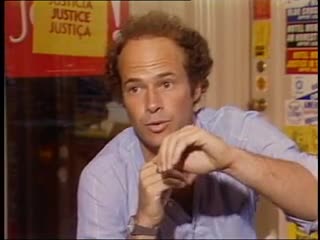
Description:
Judy Stoia interviews Elvira "Pixie" Palladino about her reaction to the Supreme Court's refusal to hear arguments against court-ordered busing in Boston. She is angry about the decision and calls the members of the court a "pack of flaming liberals." Palladino urges the anti-busing movement to continue their protest through legitimate means, like demonstrations and picketing, without resorting to violence. Palladino says that the anti-busing movement will pressure elected officials to redress the grievances of the anti-busing movement. Palladino notes that she is more concerned with a politician's stance on busing than with his or her political party; that she would switch to the Republican Party if the party came out against busing. Palladino says that she is opposed to all forms of busing, including a metropolitian busing plan. Palladino accuses the courts of dictating to parents how they should raise their children; she says that forced busing in Boston represents "reverse discrimination."
0:34:47: Visual: Elvira "Pixie" Palladino is interviewed as she sits behind a table. She says that she is disappointed in the Supreme Court's refusal to hear arguments against court-ordered busing in Boston; that the Supreme Court is a "pack of flaming liberals" and "out of touch with reality"; that she would expect to hear about this kind of "judicial oppression" in the USSR, Cuba or China; that the "shocking" decision will result in increased "white flight" from Boston schools; that the Supreme Court is more interested in redressing the grievances of criminals than law-abiding citizens. Pam Bullard asks Palladino if this is the end of anti-busing action in the courts. Palladino says that they are waiting for an appeal to be heard on the receivership of South Boston High School; that she hopes the court will void the receivership of South Boston High School. Palladino says that the Supreme Court decision will probably result in further resistance to busing; that the anti-busing movement needs to unite in demonstrating against busing through whatever means are left open to them; that the anti-busing movement must concentrate on furthering anti-busing legislation and on electing officials who take an anti-busing position. 0:38:49: V: Bullard asks Palladino about being elected to public office through an anti-busing campaign. Palladino says that government is no longer "of, for and by" the people; that government is now "to" the people; that citizens must be vigilant in protecting their rights; that citizens must elect officials who represent their position on the issues. Bullard asks what recourse anti-busers have if the courts can strike down anti-busing legislation. Palladino says a grass-roots movement could unite the people and put pressure on elected officials. Bullard asks Palladino about the court case concerning Wilmington, Delaware (Evans v. Buchanan), in which suburbs could be forced to integrate their schools. Palladino says that she is opposed to metropolitanization; that she is opposed to forced busing in any form; that forced busing is a failed social experiment. Bullard quotes Palladino as saying that she would not be surprised if anti-busers reacted to the decision in a disruptive manner. Palladino says that she is opposed to violence in any form; that she has received sympathetic calls from anti-busers in Akron, Ohio and Tulsa, Oklahoma; that she is interested in organizing a "constructive" anti-busing reaction. Palladino says again that she would not be surprised if anti-busers react negatively to the decision; that anti-busers may be called on to act as "patriots" to save democracy; that she would like anti-busers to demonstrate their feelings through all legitimate means available. Palladino says that she has never committed an act of violence in her life; that the people of South Boston and Charlestown have been pushed to their limit; that no relief is in sight for the people. 0:43:51: V: Bullard asks Palladino if she feels conflicted as a public official, who must ask her constituents to obey a law she believes is wrong. Palladino says that she is not asking her constituents to do anything illegal; that demonstrating through legitimate means is a legal right; that anti-busers must demonstrate legally, work to further legislation and vote their consciences at the ballot box; that some parents have kept their children out of school for two years; that she fears for the safety of her own children. Palladino says that the government is denying people the basic right to raise their children as they see fit; that the Supreme Court should not dictate where parents send their children to school; that the situation in Boston is a blatant case of "reverse discrimination". Bullard asks Palladino if the anti-busing movement will lobby Tip O'Neill to their cause. Reporter notes that O'Neill will be the new Speaker of the US House of Representatives. Palladino says that O'Neill has not been receptive to the anti-busing movement in the past; that pressure will be brought to bear upon him to represent the anti-busing majority in Boston. Palladino says that voters are crucial to the careers of politicians. Bullard asks Palladino about her voting preferences. Palladino says that she has always voted for the Democratic party; that she would switch to the Republican party if they were to come out against forced busing; that a candidate's position on busing is more important than his or her party affiliation. Palladino says that she is committed to demonstrating against busing through legal means; that she would urge the anti-busing movement to demonstrate non-violently.
0:34:47: Visual: Elvira "Pixie" Palladino is interviewed as she sits behind a table. She says that she is disappointed in the Supreme Court's refusal to hear arguments against court-ordered busing in Boston; that the Supreme Court is a "pack of flaming liberals" and "out of touch with reality"; that she would expect to hear about this kind of "judicial oppression" in the USSR, Cuba or China; that the "shocking" decision will result in increased "white flight" from Boston schools; that the Supreme Court is more interested in redressing the grievances of criminals than law-abiding citizens. Pam Bullard asks Palladino if this is the end of anti-busing action in the courts. Palladino says that they are waiting for an appeal to be heard on the receivership of South Boston High School; that she hopes the court will void the receivership of South Boston High School. Palladino says that the Supreme Court decision will probably result in further resistance to busing; that the anti-busing movement needs to unite in demonstrating against busing through whatever means are left open to them; that the anti-busing movement must concentrate on furthering anti-busing legislation and on electing officials who take an anti-busing position. 0:38:49: V: Bullard asks Palladino about being elected to public office through an anti-busing campaign. Palladino says that government is no longer "of, for and by" the people; that government is now "to" the people; that citizens must be vigilant in protecting their rights; that citizens must elect officials who represent their position on the issues. Bullard asks what recourse anti-busers have if the courts can strike down anti-busing legislation. Palladino says a grass-roots movement could unite the people and put pressure on elected officials. Bullard asks Palladino about the court case concerning Wilmington, Delaware (Evans v. Buchanan), in which suburbs could be forced to integrate their schools. Palladino says that she is opposed to metropolitanization; that she is opposed to forced busing in any form; that forced busing is a failed social experiment. Bullard quotes Palladino as saying that she would not be surprised if anti-busers reacted to the decision in a disruptive manner. Palladino says that she is opposed to violence in any form; that she has received sympathetic calls from anti-busers in Akron, Ohio and Tulsa, Oklahoma; that she is interested in organizing a "constructive" anti-busing reaction. Palladino says again that she would not be surprised if anti-busers react negatively to the decision; that anti-busers may be called on to act as "patriots" to save democracy; that she would like anti-busers to demonstrate their feelings through all legitimate means available. Palladino says that she has never committed an act of violence in her life; that the people of South Boston and Charlestown have been pushed to their limit; that no relief is in sight for the people. 0:43:51: V: Bullard asks Palladino if she feels conflicted as a public official, who must ask her constituents to obey a law she believes is wrong. Palladino says that she is not asking her constituents to do anything illegal; that demonstrating through legitimate means is a legal right; that anti-busers must demonstrate legally, work to further legislation and vote their consciences at the ballot box; that some parents have kept their children out of school for two years; that she fears for the safety of her own children. Palladino says that the government is denying people the basic right to raise their children as they see fit; that the Supreme Court should not dictate where parents send their children to school; that the situation in Boston is a blatant case of "reverse discrimination". Bullard asks Palladino if the anti-busing movement will lobby Tip O'Neill to their cause. Reporter notes that O'Neill will be the new Speaker of the US House of Representatives. Palladino says that O'Neill has not been receptive to the anti-busing movement in the past; that pressure will be brought to bear upon him to represent the anti-busing majority in Boston. Palladino says that voters are crucial to the careers of politicians. Bullard asks Palladino about her voting preferences. Palladino says that she has always voted for the Democratic party; that she would switch to the Republican party if they were to come out against forced busing; that a candidate's position on busing is more important than his or her party affiliation. Palladino says that she is committed to demonstrating against busing through legal means; that she would urge the anti-busing movement to demonstrate non-violently.
Collection:
Ten O'Clock News
Date Created:
06/14/1976