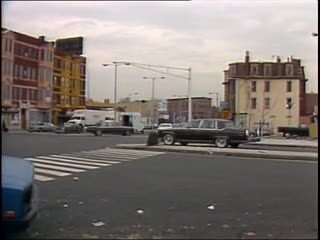
Description: BLUE HILL AVENUE ENVIRONS, COUPLE ARGUING, POLICE OFFICER ON FOOT PATROL, STREET SIGNS, BOARDED BUILDINGS.
Collection: Ten O'Clock News
Date Created: 02/15/1985
Description: Black students rally on City Hall Plaza because of shooting of black football player Darryl Williams during high school game. Interview with several students who plead for racial unity so everyone can go to school together in peace. Black adult representatives demand that Mayor Kevin White guarantee the safety of students with police details.
Collection: Ten O'Clock News
Date Created: 10/03/1979
Description: Press conference at City Hall on day 3 of Phase I desegregation of Boston Schools. Frank Tivnan (Director of Communications for Mayor Kevin White) commends the performance of the police department and reports no serious injuries to residents or schoolchildren. John Coakley (Boston School Department) gives school attendance figures. Coakley reports that the atmosphere in the schools is reasonably calm. Joseph Jordan (Superintendent, Boston Police Department) reports on a liquor ban imposed in South Boston. Jordan notes that police made 20 arrests today. Leroy Chase (Deputy Superintendent, Boston Police Department) reports that Freedom House is helping to patrol streets in Roxbury/North Dorchester. Kevin White (Mayor, city of Boston) talks about antibusing sentiment in South Boston; answers questions about efforts by South Boston neighborhood leaders to calm the tension in the neighborhood; about the possible underworld and criminal background of some agitators in South Boston; about the school boycott by South Boston residents. William Leary (Superintendent, Boston School Department) and Robert Kiley (Deputy Mayor, City of Boston) are also present at the press conference. Anne O'Brien (Principal, John P. Holland School) gives a positive report on the opening of the Holland School.
0:03:46: Visual: Opening title reads Compass Special: Boston School Report. Paul deGive reports on the day's events from press conference at Boston City Hall: a ban on a protest march by South Boston residents; 20 arrests. Frank Tivnan (Director of Communications for Mayor Kevin White) thanks the media for the opportunity to report the day's events to the public. Tivnan reports no serious injuries to Boston residents or to children on school buses. Tivnan commends the police department for managing crowds in South Boston. Tivnan reports an increase in school attendance. 0:06:33: V: John Coakley (Boston School Department) reports that 57,000 students (69%) were in attendance: 66% at the high school level, 68% at the middle school level and 73% at the elementary school level. V: Video changes from color to black and white. Coakley notes a marked increase in attendance from the previous Friday. He adds that attendance is still very low in South Boston. Coakley reports a reasonably calm atmosphere at schools; that the superintendent visited schools in Hyde Park and Roslindale; that some scheduling difficulties remain to be worked out at the secondary school level (English High School, Roslindale High School, Jamaica Plain High School); that Robert Peterkin (Headmaster, English High School) is optimistic about the situation at his school. 0:12:31: V: Tivnan introduces Joseph Jordan (Superintendent, Boston Police Department). Jordan reports that crowds in South Boston gathered sporadically throughout the day and were broken up by police; that 20 arrests were made; that the ban on liquor during the day will continue; that the police will continue to deploy a maximum number of officers in South Boston. 0:14:30: V: Tivnan introduces Leroy Chase (Deputy Superintendent, Boston Police Department). Chase reports that Freedom House and members of the community are helping police monitor the streets of Roxbury and North Dorchester. 0:15:27: V: Kevin White (Mayor, City of Boston) joins the panel. He commends the performance of the police department, school officials, and Robert Kiley (Deputy Mayor, City of Boston). White talks about his goals of getting children back in school and withdrawing police from South Boston. He says he is prepared to increase police presence if necessary, but hopes to see a continued decrease in violence. 0:17:49: V: Tivnan invites reporters to ask questions. White answers questions about the afternoon's hearings in Judge Garrity's courtroom; about a possible decrease in the police presence in South Boston. V: Color video returns. White responds that police presence will decrease when the city can guarantee the safety of students. He again commends the performance of the police. Reporter asks the mayor how groups of people in South Boston managed to assemble if police were present in the neighborhood. White comments that children and young people were out on the streets despite a commitment by antibusing parents to keep children at home. 0:20:39: V: A reporter asks Mayor White if the city is getting cooperation from some moderates in South Boston. White responds that the moderate leaders must assert themselves over the groups causing disruption. A reporter asks Mayor White what it will take to end the white boycott of schools. White responds that it will take some time until emotions are cooled down. A reporter asks Mayor White when truancy laws will be enforced. White responds that the decision will be made by the School Department. A reporter asks Mayor White if Senator William Bulger, Councilor Louise Day Hicks, and other South Boston leaders will exert a calming influence on the neighborhood. White says that he has met with them and they are eager to resolve the situation. 0:25:41: V: A reporter asks Mayor White if he asked South Boston leaders to join him in an appeal to the people of South Boston. White says no. DeGive asks White how long the city can sustain the police presence in South Boston, and where the money comes from to pay overtime. Reporters ask White how bad the situation in South Boston will be allowed to get before outside help is sought; if he can confirm reports that agitators in South Boston are connected to the underworld. A reporter asks if a group of agitators in South Boston has been infiltrated by police. White says that all agitators are dealt with in the same manner. Jordan adds that the police will gather intelligence on anyone involved in the unrest. A reporter asks Jordan if he will identify any particular group associated with the unrest. Jordan confirms that police have identified agitators who have been involved in past criminal activity in South Boston. 0:29:31: V: A reporter asks Mayor White about comments by South Boston leaders which could be seen as supportive to the white boycott. White says he cannot control the opinions and comments of other leaders. He mentions that white students have been going to B.C. High School and other schools located in difficult neighborhoods for many years. Superintendent William Leary (Boston School Department) mentions Boston Technical High School in Roxbury. A reporter asks White about whether he will admit to isolating some groups in South Boston and failing to seek their input. White denies this charge. A reporter asks White if the liquor ban in South Boston will be enforced for the next day. White says that the decision is made by the police department. 0:32:53: V: A reporter asks Leary if he has information on increased discipline problems in the schools. Leary replies that he has visited several schools across the city and that the number of problems is no greater than normal. A reporter asks Jordan for a breakdown of arrests. White excuses himself and leaves the room. Jordan reads a list of arrest locations and charges. Tivnan asks Deputy Mayor Kiley if he has anything to add. Kiley says no. A reporter asks Tivnan how the city will pay for police overtime. Tivnan says that it will come from Police Department budget. A reporter asks Tivnan about the reaction of liquor store owners to the liquor ban. Tivnan responds that most stores complied with the ban. 0:36:52: V: A reporter asks Jordan if the liquor ban is effective. Jordan says yes. Leary breaks in to introduce Anne O'Brien (Principal, John P. Holland School). O'Brien reports a successful school opening; that teachers are prepared; that progress is good. Tivnan closes the press conference. Panelists and reporters rise and exit.
Collection: Evening Compass, The
Date Created: 09/16/1974
Description: Evening Compass special. Press conference at Boston City Hall during the second week of Phase I desegregation of Boston schools. Frank Tivnan (Director of Communications for Mayor Kevin White) introduces the speakers at the press conference. John Coakley (Boston School Department) gives school attendance figures and analyzes trends in attendance. Robert Kiley (Deputy Mayor, City of Boston) reports that sixteen people were arrested in South Boston and Roslindale today. Kiley voices his concern about the number of young people involved in violent incidents. Joseph Jordan (Superintendent, Boston School Department) and Charles Barry (Deputy Superintendent, Boston Police Department) report that a bus was stoned while passing the Old Colony Housing Project in South Boston. Jordan and Barry report that 200 people were gathered outside of the housing project in the afternoon. Jordan is optimistic that the tension in South Boston will abate. The officials take questions from reporters about school attendance, police tactics in South Boston and the safety of bus routes.
3:02:56: Visual: Ed Baumeister reports live from Boston City Hall, at a briefing by Mayor Kevin White's office and the Boston School Department, after a day of violence and arrests stemming from court-ordered busing in Boston. Reporters include Walt Sanders and John Henning. 3:03:25: V: Frank Tivnan (Director of Communications for Mayor Kevin White) thanks the media for the opportunity to keep the public informed, then outlines the agenda and introduces the speakers: John Coakley (Boston School Department); Robert Kiley (Deputy Mayor, City of Boston); Joseph Jordan (Superintendent, Boston Police Department); Charles Barry (Deputy Superintendent, Boston Police Department). 3:04:24: V: Coakley reports that 54,000 students (67.4% of projected enrollment) attended classes in grades 1 - 12. Shots of reporters looking at handout sheets and taking notes. Coakley notes that attendance decreased in South Boston High School, Roxbury High School, Gavin and McCormack middle schools and South Boston elementary schools but increased at other schools. Coakley gives further analysis of attendance numbers and notes some logistical issues to be resolved in the schools. 3:06:51: V: Kiley gives an overview of the day's events: 16 arrests in South Boston and Roslindale, and 2 injuries requiring hospital treatment. Shots of reporters taking notes. Kiley notes an upswing in calls from parents reporting bruises and minor injuries to their children in the schools. He says that the city is working hard to control and deter incidents of violence and is concerned at the number of young adolescents (aged 12-13) involved in violent incidents. 3:09:45: V: Superintendent Jordan reports on arrests in South Boston; he notes a slight reduction in tension among citizens. He voices the police commitment to the safety of students, calls the violence "deplorable" and is optimistic that the situation will abate. 3:12:00: V: Deputy Superintendent Barry reports that one student was injured by a projectile thrown at a bus in an incident in front of the Old Colony Project in South Boston; that the fine weather attracted many people to the streets, including 200 people outside of the project. Shots of reporters in audience. Jordan takes the microphone and reports that 2 youths were arrested in Roslindale. 3:13:56: V: The panelists take question from reporters. Kiley responds to questions about a possible NAACP motion for US Marshals to come to Boston. Barry responds to questions about the presence of police or US Marshals on buses. Coakley responds to questions about the accuracy of the school attendance figures. Kiley and Tivnan respond to questions about a communication lag between the site of the incidents in South Boston and the communications center at City Hall. Jordan responds to questions about the reaction of South Boston residents to a police rule banning assembly of large groups of people; about the incident outside the Old Colony Project; about security along bus routes; about new police tactics in the coming weeks; about maintaining personnel on the streets and the possibility of changing the bus routes. 3:22:35: V: The panelists take more questions from reporters. Coakley responds to questions about changes in school enrollment percentages from the day before. Kiley responds to questions about whether African American students are really safe in South Boston; about communication between the city government and community leaders in the Old Colony Project; about whether authorities learned about the incident at the Old Colony Project from MDC police. Barry responds to questions about a possible increased police presence at the Old Colony Project. Jordan responds to questions about whether the increased police presence in South Boston will keep South Boston parents from sending their children to school. Coakley responds to questions about the accuracy of attendance figures at South Boston High School; about whether it is possible to educate students in the environment at South Boston High School. 3:31:30: V: Tivnan closes by asking, "any other questions, gentlemen?" Reporters rise to leave. Kiley comments to Tivnan that there is a woman in the audience. Recording ends.
Collection: Evening Compass, The
Date Created: 09/13/1974
Description: African American beachgoers are escorted onto Carson Beach in South Boston by Metropolitan District Commission (MDC) police officers. Officers are posted on the beach, forming a ring around the African American beachgoers. Police officers station themselves at the edge of the water as children play. Police officers line up near the recreation building, observing the action on the beach. Three MDC police boats patrol the water. Three white males are escorted from the beach. White beachgoers stand around, observing the scene.
0:00:26: Visual: Four Metropolitan District Commission (MDC) police officers escort a small group of African American youth on to Carson Beach in South Boston. There are white swimmers and sunbathers on the beach. The Boston skyline is visible in the distance. A group of older white men sit under a shelter near the road. Cars pass by slowly on the road. Groups of white people sit under the shelters or sunbathe on the sand. 0:01:50: V: A larger group of African Americans walk on to the beach, accompanied by police officers. The group of African Americans ranges in age from young kids to adults. The group walks along the beach, heading toward the recreation building. Young African American children play in the water along the shore. Police officers stand casually on the beach as the African American beachgoers get settled . An older white man greets some of the African American youth. White beachgoers are seated near the African American beachgoers. Many whites stare at the African Americans. MDC police officers are lined up near the recreation building, observing the scene on the beach. 0:06:25: V: White residents and beachgoers are standing up, watching the African American beachgoers and the police on the beach. Police officers walk among the crowd. A police officer escorts a white man from the beach. A large line of MDC police officers circles approaches the recreation building to join the other group of officers. Approximately 50 police officers stand in front of the recreation building. Two helmeted police officers escort another white man from the beach. Another group of police officers walks toward the beach. A group of 20 more African Americans are escorted onto the beach by a police officer. 0:09:31: V: An older white man with a walkie talkie walks down the beach toward the crowd. Police officers stand at the edge of the water while African American children play. A few white beachgoers mill about near the police officers. Most white beachgoers sit separately from the African American beachgoers. Other white beachgoers observe the scene from further up the beach. A group of police officers stands in front of the recreation building. A group of five African American adults walk down the beach toward the African American beachgoers. They are followed by a police officer. 0:12:05: V: African American beachgoers are seated in small groups on the beach. A line of police officers forms a ring around them. A group of white beachgoers stands nearby. Shot of a young white boy sitting by himself on the beach. African American children play in the water. MDC police officers stand at the edge of the water. White beachgoers stand near the police officers, watching the African American children. The African American beachgoers enjoy themselves. Police stand by. The media record the scene. White beachgoers stand around in groups. Two MDC Police boats patrol the water. 0:15:33: V: A line of MDC police officers with riot helmets stands in front of the recreation building. MDC police officers observe the action on the beach from the MDC boats in the water. A line of police cordons off the African American beachgoers from the white beachgoers. Members of the media and white bystanders stand near the African American beachgoers. White beachgoers sit and stand apart from the African American beachgoers. Two police officers escort a young white man from the beach. A group of African American beachgoers heads toward the recreation building.
Collection: Ten O'Clock News
Date Created: 08/03/1977
Description: Bunker Hill Monument, exteriors of Charlestown High School, and Charlestown environs. A few police officers are stationed along Monument Square outside of Charlestown High School. Robert Murphy (Headmaster, Charlestown High School) stands in front of the school. School buses, accompanied by a police motorcycle escort, pull up in front of the school. African American students exit the buses and enter the school. Police officer tells camera operator that there is a standing order that the press has to remain across the street. A small number of photographers record the arrival of the buses from across the street. White students walks towards school and enter. Gary Griffith does several takes of reporter standup saying that the arrival of school buses at Charlestown High School was routine.
0:00:18: Visual: Shots of the Bunker Hill Monument; of the exterior of Charlestown High School. Two police officers stand outside of Charlestown High School. A white woman walks into the school. A muffled voice yells out, "No busing." Robert Murphy (Headmaster, Charlestown High School) stands out in front of the high school. Shot of Concord Street. Police motorcycles approach the school. Five police officers on motorcycles receive instructions from a police official. The motorcycles pull away. 0:03:41: V: School buses circle Monument Square and approach the high school. Police motorcycles escort the buses. A police officer stands near a Boston Police Department station wagon parked across the street from the high school. The officer watches the buses pull up in front of the school. African American students exit the buses and enter the school. Shot of the Hudson Bus Lines logo on one of the buses. The school buses pull away from the high school, accompanied by the police motorcycles. Murphy, a police officer, and a few school officials remain in front of the school. 0:07:06: V: White students walk toward the entrance of the school. Murphy and another school official greet a few of the students. A police officer is heard telling members of the media to move across the street. Two police officers stand casually on the corner of Bartlett Street and Monument Square. White students walk toward the school. Fewer than ten members of the media record the scene from the sidewalk across the street. A Hudson Bus Lines airport van pulls up in front of the school. An African American student is inside of the van. The van pulls away. The sidewalk in front of the school is empty. Some members of the media depart as two police officers walk up the opposite side of the street. Murphy speaks to two police officers on the corner of Bartlett Street and Monument Square. A man in a business suit speaks to a two-person camera crew. The street is quiet. Murphy and a police officer walk toward the school. 0:12:11: V: Gary Griffith stands outside of Charlestown High School. Griffith reports on the routine arrival of five buses at the high school this morning. He reports that there is no sign of unrest. The crew does two more takes of Griffith reporting on the story.
Collection: Ten O'Clock News
Date Created: 09/08/1977
Description: Police lined up outside Charlestown High. Teachers gathered at the front of the school. Black students get off bus. Person on the street interviews with students boycotting school in busing protest. They discuss the purpose of their boycott. Some fiercely defend sovereignty of sports teams, make racist comments.
1:00:04: Visual: Police are lined up in the street in front of Charlestown High School on the first day of school. Graffiti on the front of the school is painted over. The media is gathered behind a fence across the street from the school. 1:01:30: V: A police car approaches slowly, escorting a school bus. The school bus pulls up to the front of the school. African American students exit the bus and enter the school. White students watch the action on the street from an upper window of the school. Police officers on motorcycles wait alongside the bus. The bus pulls away, followed by motorcycles. Shot of the bus circling Monument Square; of two police motorcycles circling Monument Square; of police stationed in Monument Square. 1:05:48: V: Crowds of people, including school-aged kids, are assembled outside of the Bunker Hill Housing Project on Bunker Hill Street. Cars pass by slowly. Shots of the top of the Bunker Hill Monument, visible over a building. 1:08:14: V: A group of white youth are gathered near a fence on Bunker Hill Street. A voice yells, "No busing." The group waves at the camera. Judy Stoia approaches the group and brings some members over to the camera for an interview. Two males convince a girl named Patty to join the interview. She is reluctant. They are joined by an older man. The older man says that he has six grandchildren who are being bused out of Charlestown. One of the males (Mike) says he plans to boycott school all year; that Charlestown has been quiet "because we are not racists." The older man says that he has spoken to some African American residents of the Dudley Street Housing Project; that they were "good people." Members of the group say that crowds of anti-busers will stay in the street until the end of the schoolday. Mike says that a total boycott of the school could stop busing; that anti-busing demonstrations in Charlestown may turn violent. Another male says that demonstrators in Charlestown will be peaceful. The group is reluctant to talk further and begins to move away from the camera. Stoia asks them how they feel about dropping out of sports programs because of the boycott. Members of the group say that they can play sports among themselves; that they do not mind African American students being bused into Charlestown; that they resent Charlestown students being bused out; that "townies" must stick together. 1:13:20: V: A group of young white male students are gathered in the street. A reporter asks them about sports in Charlestown. One student says that you can't go to sports practice if you have missed school. A second student says that Charlestown sports teams should not have to admit players from outside of Charlestown; that players from outside of Charlestown will be given a hard time in practice until they quit. Members of the group say that Charlestown students who are assigned to schools outside of Charlestown are boycotting school; that buses leaving Charlestown are empty. Another student says that there are no cops on the field for sports practices; that Charlestown players will be rough on outsiders during sports practices. Members of the group say that Charlestown sports teams do not need players from outside of Charlestown. The group says that Charlestown students were turned away from Charlestown High School this morning because they were late. Several members of the group use racist language. One student says that tardy students were turned away unless they had a note from their parents; that African American students on buses were let in to school. Several of the group say that they had been planning to take over the school this morning. One student shows his Charlestown High School identity card to the reporter.
Collection: Evening Compass, The
Date Created: 09/08/1975
Description: No audio at very beginning. Police officers and US Marshals are stationed outside of Charlestown High School. African American and white students exit the school. White students walk away from the school. African American students board buses and depart. Members of the media record the event from across the street, under Bunker Hill Monument. Gary Griffith does several takes of reporter standup from the South End. He gives an update on the senatorial race in the second Suffolk district. Elevated train tracks are visible on Washington Street. South End environs Shot of the Prudential Center. Washington St. street sign.
0:00:00: Visual: School buses pull up to the front of Charlestown High School. Graffiti on the front of the school has been painted over. A Boston Police Department cruiser pulls up behind the buses. A police officer on a motorcycle waits behind the buses. A US Marshal surveys the school from across the street. A group of officials and another US Marshal stand at the entrance of the school. Members of the media observe the scene from behind the fence at the foot of the Bunker Hill Monument. 0:01:49: V: An African American police officer is stationed at the corner of Monument Square and Concord Street. Shot of Concord Street. A group of white youth observe events at the school from across Monument Square. A girl sits on the fence watching the school. Three young men stand on the steps of a brownstone house on Monument Square. A group of police officers are stationed on Monument Square where the youth have gathered. Some members of the media stand at the foot of the Bunker Hill Monument. Shot of the Bunker Hill Monument. School buses and police motorcycle escorts remain parked in front of the school. Police radios are audible. Shots of Charlestown High School through the fence at the foot of the Bunker Hill Monument. 0:06:37: V: A police officer talks to school officials at the entrance of the school. Two white US Marshals and one African American US Marshal are gathered in front of the school. Police officials and a US Marshal confer at the corner of Monument Square and Bartlett Street. Police officers are stationed along Concord Street. Shot of the Bunker Hill Monument and the gathered media. 0:08:25: V: African American and white students exit the school together. Some white students walk away from the school. African American students and some white students head toward the buses. Shot of the exterior of Charlestown High School. A student makes a gesture of peace to the media. The video is overly bright during this scene. 0:12:02: V: Buses pull away from the school, followed by a police motorcycle and a police cruiser. White students are gathered at the corner of Concord and Bartlett Streets. Police officials leave the scene. Another group of white students is gathered on the corner of Bartlett Street and Monument Square. One girl makes a peace sign for the camera. Two police officers with riot helmets walk up the street. 0:14:24: V: Gary Griffith reports on the senatorial race in the second Suffolk district. He stands on a street corner. The Prudential Tower is visible in the distance. Griffith says that the election will be determined in the Democratic primary because there are no Republican or independent candidates; that the Democratic primary will take place in four days. Griffith makes a mistake in his delivery and does two more takes. The camera pans to Washington Street. Elevated train tracks run down the center of the street. Shot of the fire escape of a building on the corner of Washington Street. The windows of the building are boarded up. Shots of rowhouses and buildings along the street perpendicular to Washington Street. Shots of a garden behind a chain link fence. A colorful sign on the fence reads "Community Garden". Shot of the street and the Prudential Tower. Clothes are hanging out to dry on the fire escape of a building on the street. Shots of Washington Street and elevated train tracks. Shot of street sign for Washington Street. Shots of overgrown lot on the corner of Washington Street.
Collection: Ten O'Clock News
Date Created: 09/09/1976
Description: Police officers and US Marshals are present outside of Charlestown High School on the first day of school during the third year of court-ordered busing in Boston. The media is gathered across the street from the school, at the foot of the Bunker Hill Monument. Robert DiGrazia (Boston Police Commissioner) confers with police and surveys the scene outside of the school. A group of buses with a police motorcycle escort pulls up to the school. African American students exit the buses and enter the school. A crowd of white youth gathers near the school. Dennis Kearney (State Representative) and Robert Murphy (Headmaster, Charlestown High School) talk to the crowd of youths. DiGrazia and Captain Bill MacDonald (Boston Police Department) confer near the crowd
0:00:05: Visual: Members of the media pass two police officers as they enter the enclosure surrounding the Bunker Hill Monument in Monument Square. Shot of three US Marshals walking toward Charlestown High School. An MDC Police officer exits a police vehicle parked near the high school. Shot of the exterior of Charlestown High School. A few police officers stand in front of the high school. Two US Marshals confer near the high school.
Collection: Ten O'Clock News
Date Created: 09/08/1976
Description: Buses with a police motorcycle escort pull up outside of Charlestown High School at the end of the first day of school. Police presence in front of the school is heavy. Members of the media watch from across the street as African American students and a few white students board buses. The buses pull away from the school, escorted by police motorcycles. White students wait to be released at the front doors of the school.
0:58:50: Visual: Buses pull up in front of Charlestown High School. Graffiti on front of school is painted over. Police line the sidewalk in front of the school. Police officers on motorcycles pull up alongside buses. Members of the press watch the buses pull up from across the street. 0:59:51: V: Long shot of large crowd making its way around opposite side of Monument Square. Media is gathered at the foot of the Bunker Hill Monument. Buses wait in front of the school as as a line of police officers assembles in the street. 1:01:43: V: A group of white students boards the first bus. African American students are directed towards buses. African American students board buses. Shot of Charlestown High School exterior. A lone African American student makes his way toward his bus. School officials and US Marshals gather outside of the school and in the street. Shots of students through the windows of the buses. Bus monitors board one of the buses. A police officer signals the buses to leave. The buses pull away from the school, accompanied by police officers on motorcycles. Traveling shot of bus passing through Monument Square. 1:06:56: V: White students wait at the doors of the school to be released. School officials are gathered in front of the school. Police officers march up the street away from the school. A group of US Marshals stands near the sidewalk in front of the school.
Collection: Evening Compass, The
Date Created: 09/08/1975