Description: Jesse Jackson (African American political leader) speaks at a campaign rally on behalf of Mel King (candidate for mayor of Boston) at the Concord Baptist Church in the South End. Jackson endorses King's candidacy. King answers a question about the role of newly registered voters in his campaign. The audience cheers for the two men and chants "Win Mel win," and "Run Jesse run." Tape 2 of 2.
1:00:00: Visual: Jesse Jackson (African-American political leader) speaks at a campaign rally on behalf of Mel King (candidate for mayor of Boston). Jackson says that Boston voters have an opportunity to vote for a Rainbow Coalition candidate for mayor. Shots of audience members. A reporter asks if newly registered voters will make a difference in the mayoral election. Mel King says that new voters and old voters will vote for him if they want an accessible and caring city. Shot of Charles Stith (Union United Methodist Church) and Dr. Alvin Poussaint (Harvard University) standing in the audience. A moderator thanks the audience. Shot of Gail Harris (WGBH reporter) in the audience. 1:01:18: V: An audience in a church cheers for Jackson and King. Jackson and King are at the front of the church. Shots of the members of the audience as they cheer and clap. The audience chants, "Win, Mel, Win" and "Run, Jesse, Run." Shot of a sign hanging on the front of the church balcony. The sign reads, "Mel King is the key in 1983." The audience applauds for a speaker.
Collection: Ten O'Clock News
Date Created: 10/06/1983
Description: Mel King (candidate for mayor of Boston) attends a meeting of the Tent City Corporation, chaired by Joan Tighe (chairwoman, Tent City Corporation), regarding the development of the Tent City site. Tighe says that the group will work to maintain affordable housing units at the site and to scale down a proposed plan for a parking garage on the site. Crowd sings happy birthday to Tinghe. Christy George interviews King about his position on housing issues and those of his opponents Ray Flynn (candidate for mayor of Boston) and David Finnegan (candidate for mayor of Boston). King criticizes condominium conversions and talks about the need for a strong rent control program. King discusses the link between employment and housing, and says that the community needs more low- and moderate-income housing units. King notes that the federal government is not aware of the housing crisis across the nation; he adds that the federal government needs a better housing policy.
1:00:04: Visual: Mel King (candidate for mayor of Boston) enters a room where a meeting about the Tent City Development is being held. White and African American attendees sit on either side of a long table. King greets a few of the attendees, then sits down near a window at the side of the room. Joan Tighe (chairwoman, Tent City Corporation) reviews the goals of the Tent City Corporation. Tighe says that the Tent City Corporation aims to be the sole developer of the Tent City site; that they will work with the mayor to maintain affordable housing units at the site; that they will work to scale down a proposed plan for a parking garage. The meeting is adjourned. Meeting members tidy up the room. King greets the attendees. Meeting members and King sing "Happy Birthday" to Tighe. King continues to greet attendees. 1:05:22: V: Christy George interviews King. She asks him about his position on housing and about the positions of his opponents Ray Flynn (candidate for mayor of Boston) and David Finnegan (candidate for mayor of Boston). King talks about the need for a strong rent control program and criticizes condominium conversions. King says that new public housing must be built. King says that there is a link between jobs and housing; that people need employment in order to afford housing. King says that the city and the voters must lobby the federal government for a better housing policy. George asks about the differences between King's position and the positions of Flynn and Finnegan. King says that housing must be community-based; that the community needs low- and moderate-income housing. King says that there are other housing issues besides rent control and condominium conversion; that public housing must be protected and improved; that the city must work to provide more housing. King says that he would like to investigate the possibility of a city-wide housing and finance program. King adds that the federal government needs to be aware of the housing crisis across the nation; that the nation needs a good federal housing program. George comments that there are differences between King's position and Finnegan's position. She asks about the differences between King's position and Flynn's position. King says that he has been involved with groups like the Tent City Corporation, who have worked to provide housing. King notes that Flynn has not advocated for a federal approach to the housing crisis. King talks about the need for a tenant equity program in Boston. George thanks King and closes the interview. The crew takes cutaway shots of George and King. George and King speak informally.
Collection: Ten O'Clock News
Date Created: 09/19/1983
Description: Mel King (candidate for mayor of Boston), accompanied by 15 supporters of all ages, greets and talks with residents in a housing project. King walks through the streets with children and adult supporters. The children hold campaign signs and chant "Vote for Mel King" and "Mel King for mayor." A campaign truck voices support for King. King greets drivers in their cars.
1:00:06: V: Mel King (candidate for mayor of Boston) walks across a parking lot and continues down a street. King is surrounded by 15 supporters of all ages. Supporters on the street hold campaign signs for King. A campaign truck drives slowly down the street; the driver voices support for King over the loudspeaker. King enters the front door of an apartment in a housing project. His supporters wait for him outside. King exits the project and crosses the street to the housing project on the other side. King walks through the project, shaking hands with passersby and greeting people. King encourages people to come out of their houses to talk to him. A man comes out to his front stoop to talk to King. King continues to walk through the project, greeting people. 1:03:25: V: King greets and shakes hands with four young African American men. King continues to walk through the projects, followed by his supporters. He greets two older women. 1:04:15: V: King approaches the Shawmut Variety store. His young supporters chant, "Vote for Mel King." King greets people as he passes them in the street. King greets drivers as they sit in their car at a red light. He gestures to his young supporters to stay on the sidewalk. King continues to greet drivers in their cars as they pass by on the street. His young supporters chant, "Mel King for mayor."
Collection: Ten O'Clock News
Date Created: 11/01/1983
Description: Christopher Lydon interviews Mel King (candidate for mayor of Boston) in King's home. King talks about the benefits of growing up in a diverse neighborhood and about his own childhood in Boston. Lydon asks King about his philosophy of government. King says that the government must serve those who are most in need; he adds that the government should take an active role in issues of poverty, education, the environment, and women's issues. King talks about the interconnectedness of different issues and problems. Lydon asks whether there is an ideology behind King's politics. King says that he tries to take a realistic approach to government. King believes that love and change are the two fundamentals of life. Lydon asks how King rates himself as an administrator. King says that he is a good administrator who tries to identify problems and work together with people to find solutions. The tape includes shots of the exterior of King's home.
1:00:01: V: Shots of the exterior of the King home in the South End. 1:01:10: V: Christopher Lydon sets up an interview with Mel King (candidate for mayor of Boston) in King's home. Lydon asks King about his political formation on the streets where he grew up. King talks about growing up in the diverse "New York streets" neighborhood of Boston. King says that he grew up with an appreciation for other cultures. Lydon and the camera crew discuss the set-up of the shot. King continues to talk about his experiences growing up on Seneca Street. King says that diverse urban neighborhoods provide a model for cooperation among groups of different backgrounds. King talks about the benefits of growing up with people of different cultures and ethnicities. 1:05:41: V: Lydon asks King about his philosophy of government. King says that government must serve those who are most in need; that all of society benefits when the neediest are served. King says that government must serve society's needs in the areas of poverty, education, the environment, and women's issues. King says that government must serve the needs of all people. He uses the example of access for the disabled. King says that all of society is guaranteed access when access is granted to the disabled. King says that problems in Boston's neighborhoods cannot be ignored; that these problems must be solved before they spread to other areas. King says that problems in one neighborhood affect every resident of the city. King stresses the connections between people and problems. He gives an example of the local problems caused by the oil crisis in the 1970s. 1:11:46: V: Lydon asks if there is an ideology behind King's politics. King says that his approach to government is realistic; that there is no "pure" form of government. King says that he has tried to address the realities of his life as an African American man living in Boston; that he has tried to address the realities and needs of his community and his city. King says that there are essential needs which must be met; that he has tried to look at the forces impacting the needs of people and communities. King says that love and change are the two fundamentals of life. 1:15:35: V: Lydon asks King to rate himself as an administrator. King says that he tries to identify problems; that he gathers people together to find creative solutions; that he works with people to implement solutions; that he tries to evaluate the solution to find out if it works. King talks about using this approach as director of the Urban League of Boston. King says that he is using this approach to solve problems in his current job at MIT (Massachusetts Institute of Technology). King says that a city government must deliver services efficiently on a fixed budget. King notes that Joseph Jordan (Police Commissioner, City of Boston) has provided ineffective leadership for the Boston Police Department. King says that it is important to appoint good administrators for city programs. King notes that he has proven experience as a good administrator.
Collection: Ten O'Clock News
Date Created: 11/07/1983
Description: Christopher Lydon interviews Mel King (Boston mayoral candidate) in his home. Lydon asks King about his experiences and strengths as a social worker. King says that he believes in empowering people and encouraging them to solve their own problems. King answers questions about similarities between his background and the background of Ray Flynn (Boston mayoral candidate). King says that Flynn has adopted a "me, too" approach to politics. King emphasizes his own commitment to diversity and says that he has taken the lead on many issues. Lydon asks King whether Flynn has learned from him. Lydon also asks King about his silent nature. King says that there is thought and reflection behind his silences. Some sound interference at the end of the interview. Tape 2 of 2 Editor's note: Content given off the record was edited out of this footage.
1:00:30: Visual: Christopher Lydon interviews Mel King (candidate for mayor of Boston) in his home. Lydon asks King to describe his experiences and strengths as a social worker. King says that it is important to help people in need; that it is important to feel good about yourself in order to feel good about other people; that people feel good when they can solve their own problems. King talks about his work with the Symphony Tenants Organizing Project. King says that he encouraged the tenants to use their skills to solve problems. King says that it takes a lot of people to effect change. King says that he is inspired by the actions of Rosa Parks (African American civil rights activist); that the civil rights movement required the participation of many. King says that he believes in empowering people to solve their own problems. 1:04:57: V: Lydon asks King about similarities between his background and the background of Ray Flynn (candidate for mayor of Boston). King says that he has never remarked on similarities between him and Flynn; that Flynn has adopted a "me, too" approach to politics which leads people to see similarities between them. King says that their experiences and worldviews are vastly different; that Flynn's positions are narrower and more parochial. King notes that Flynn does not live in a diverse community; that his legislative achievements are different than Flynn's legislative achievements; that Flynn has not pushed for the same kind of programs. Lydon asks if Flynn has learned from King. King says that people are aware of his successes. King notes that he is usually out in front on the issues; that Flynn has not been out in front on the issues. King adds that he filed the first bills dealing with housing displacement and condominium conversion; that Flynn lagged behind him on this issue. King says that his politics have been informed by the issue of oppression. King says that he and Flynn come from different places in respect to the issue of oppression. 1:12:05: V: Lydon asks King what is behind King's silence. King says that there is thought and reflection behind his silence; that he expresses his anger at oppression through action. King says that he likes to think about the causes of problems and the solutions to problems. The crew takes cutaway shots of Lydon and King. Lydon says that King should consider Flynn as a student; that Flynn needs to learn from King, even if he wins the election. King and Lydon speak informally about the staffing of Flynn's administration in the event of a Flynn victory. Lydon asks King if he would consider working for a Flynn administration.
Collection: Ten O'Clock News
Date Created: 11/03/1983
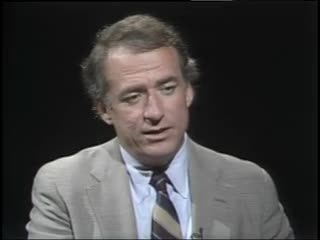
Description: Interview with Michael Gelber, Lyndon LaRouche disciple, as Boston mayoral candidate. Bases his campaign on rearrangement of world debt and finances, and industrialization policy.
Collection: Ten O'Clock News
Date Created: 09/21/1983
Description: INTERVIEW WITH GARY HART ON UPCOMING PRESIDENTIAL NOMINATION, MORRIS UDALL SPEECH, RECEPTION
Collection: Ten O'Clock News
Date Created: 11/30/1983
Description: Interview with Raymond Flynn as Boston mayoral candidate. Proudly justifies becoming more liberal than in his earlier political life. Emphasizes neighborhood orientation and constituent services.
Collection: Ten O'Clock News
Date Created: 09/20/1983
Description: Robert Kiley WITH HIS POLLSTER PAT CADDELL DURING RUN FOR MAYOR
Collection: Ten O'Clock News
Date Created: 05/10/1983
Description: Interview with Robert Kiley as Boston mayoral candidate. Formerly deputy mayor, MBTA manager, CIA bureaucrat. Makes fighting racism a priority.
Collection: Ten O'Clock News
Date Created: 09/16/1983