Description: Christopher Lydon interviews cultural historian Kiku Adatto (Harvard University) about Jesse Jackson as a presidential candidate. Lydon's interview with Adatto is accompanied by footage of Jackson throughout his political career. The footage illustrates Jackson's dynamic style of speaking. Adatto notes that Jackson is a religious figure in the political arena. She notes that Jackson's energy and moral fervor are more suited to a preacher than a politician. She says that Jackson's strength lies in his ability to articulate social criticism. Adatto says that many voters see Jackson as an outsider or a social critic instead of as a politician; she adds that some voters may not be able to envision him as president. Lydon's report also includes footage of Martin Luther King, Jr. (American civil rights leader) and Andrew Young (Mayor of Atlanta).
1:00:02: Christopher Lydon interviews Kiku Adatto (Harvard University) about Jesse Jackson (candidate for the Democratic nomination for US President). Adatto talks about the tradition of preachers in American history. She says that many of these preachers, including Martin Luther King (civil rights leader) and Jackson, have become political leaders. Visual: Shot of a black and white photo of Jackson on a balcony with King. Black and white footage of King giving a speech. Shot of a black and white photo of Jackson in a crowd, raising his arm in the black power salute. Adatto says that Jackson has tried to pick up the mantle of King; that Jackson has tried to be the "conscience of America" in the way that King was. V: Footage of Jackson addressing a crowd at Harvard University on April 4, 1985. Jackson talks about the evils of apartheid. Adatto says that there is a tradition in the US of the preacher staying outside of politics; that Jackson has tried to move into the political system in order to effect change. V: Footage of Jackson passing a lobby of a building. He shakes hands with African American bystanders. Jackson enters a room full of supporters. Adatto says that Jackson is concerned with equality and civil rights; that Jackson has been caught exhibiting prejudice against Jews; that Jackson was linked with Reverend Louis Farrakhan (African American Muslim leader). V: Shots of newspaper articles detailing the controversy surrounding Jackson's remarks about Jews in 1984. Adatto adds that the preacher must remain "morally sound" when entering the political arena. V: C-Span footage of Jackson addressing the Democratic Convention in 1984. Adatto says that Jackson has an "insider-outside dilemma"; that Jackson finds it difficult to make the compromises required by electoral politics. Adatto notes that Andrew Young (Mayor of Atlanta) made an easy transition into electoral politics. V: Shot of Young at a press conference in Boston in 1983. Adatto notes that Jackson has lost none of his energy or "moral fervor"; that Jackson still criticizes society from an outsider's point of view. Adatto adds that Young is an "insider." V: Shot of Young at a press conference. Adatto says that Jackson strength lies in his ability to articulate social criticism. V: C-Span footage of Jackson addressing the Democratic Convention in 1984. Shots of audience members. Adatto says that Jackson stirs the emotions of voters in his "outsider" role; that Jackson troubles many voters in his "insider" role. Adatto notes that Jackson's role as social reformer and critic undermines his strength as a presidential candidate; that many voters cannot envision Jackson as president. Adatto notes that many of the nation's great presidents have been calm and quietly strong; that some see Jackson as too much of a preacher; that Jackson's energy and moral fervor are more suited to preacher than politician. V: C-Span footage of Jackson addressing the Democratic Convention in 1984. Adatto says that some see voters as too much of an outsider, social critic or civil rights leader; that some white voters are turned off by Jackson. Adatto quotes statistics from a study which found that 23% of American voters are not ready to vote for any African American for president. V: C-Span footage of Jackson addressing the Democratic Convention in 1984. Adatto says that Jackson has the ability to stir the emotions of the American people; that he is most powerful in his role as "outsider" or critic. Adatto says that many voters are stirred by his message, but cannot envision him as president because he is an outsider. V: Footage of Jackson announcing his candidacy for president in 1988. His supporters stand behind him, cheering. Jackson promises "bold leadership."
Collection: Ten O'Clock News
Date Created: 10/16/1987
Description: Boston mayoral candidate Robert Kiley is flanked by his campaign team: Jim Marcelino, Dan Payne, Pat Caddell. Press conference on his prospects, recognition, and fundraising progress.
Collection: Ten O'Clock News
Date Created: 05/10/1983
Description: Mayoral candidates Mel King and Ray Flynn participate in a forum on education sponsored by the Citywide Education Coalition (CWEC) at English High School. Flynn talks about his experience in government and his commitment to the public schools. He notes his familiarity with the city and school budgets, and he discusses the importance of public education and public housing. King stresses the importance of early childhood education programs and a "child-centered" school system. King speaks of the need for the mayor to work together with the Boston School Committee. King says that the city must continue to demonstrate its support of integrated schools. King and Flynn respond to a question about requiring students to pass a standardized test in order to graduate. Tape 1 of 2.
1:00:05: Visual: Four members of the Citywide Education Coalition (CWEC) sit at a table on stage at English High School. A member of the CWEC welcomes mayoral candidates Ray Flynn and Mel King to the annual meeting of the CWEC. Flynn and King are seated at a table at the center of the stage. Shots of Flynn and King. The CWEC member says that the candidates and the audience will discuss the future of public education in Boston. 1:01:55: V: Flynn thanks the moderator and the CWEC. Flynn mentions his experience as a state legislator and a member of the Boston City Council. He says that he was a student in the Boston Public Schools. Flynn congratulates the CWEC for their commitment ot public education. Flynn stresses the importance of public education and a good school system. Flynn says that he has a Master's Degree in education from Harvard; that he is committed to education. Flynn says that he would visit a few public schools and a few public housing projects on his first day as mayor; that education and public housing will be major concerns for his administration. Flynn says that the mayor should be involved in public education; that politicians in Boston have distanced themselves from the public schools since desegregation. Flynn says that the mayor should serve as an ex-officio member of the Boston School Committee; that the mayor needs to be aware of the situation in the schools. Flynn says that he is familiar with the city and school budgets. Flynn says that fiscal stability and predictable student placements are important for the schools. The audience applauds. 1:07:56: V: King thanks the audience and the CWEC. King says that the students in the school system must be served from birth to graduation; that early childhood education programs are important. King says that resources must be allocated to support Head Start programs and other early childhood education programs. King says that "child-centered" school system must guarantee education for all students; that the school system must believe that all children can be educated. King says that the mayor must work with the Boston School Committee; that the members of the School Committee will be newly elected; that the mayor and the Boston School Committee must determine the problems and the needs of the school system. King says that the newly elected School Committee must be unified in support of integrated schools. Jump cut in videotape. King says that he would provide leadership on the issue of education; that he would work to create a good climate and to end divisiveness on the issue of education. King says that the Boston Public School System must demonstrate its commitment to integrated education. The audience applauds. 1:14:52: V: An audience member asks if students should pass a standardized test in order to graduate from high school. King says that standards need to be established in the early grades as well as upon graduation. King says that the school administration must be held responsible for the education of the students; that diagnostic testing and evaluation is needed at every grade level, not just upon graduation.
Collection: Ten O'Clock News
Date Created: 10/13/1983
Description: Mayoral candidates Ray Flynn and Mel King participate in a forum on education sponsored by the Citywide Education Coalition (CWEC) at English High School. Flynn says that students graduating from Boston public schools must be prepared to compete in the workplace. He adds that there must be a working relationship between parents, teachers, administrators, and the community. King speaks about the workings of the school administration and advocates the inclusion of parents in the process. King and Flynn respond to questions about how they would have handled school desegregation if they had been mayor at the time. Both candidates answer questions about the role of the mayor upon the court's withdrawal from its supervisory role over the school system and about the school budget. Audience members include John O'Bryant of the Boston School Committee. Tape 2 of 2.
1:00:00: Visual: Ray Flynn (candidate for mayor of Boston) speaks at a forum on education sponsored by the Citywide Education Coalition (CWEC) at English High School. The candidates' forum is held in conjuction with their annual meeting. Flynn says that students graduating from Boston public schools must be able to compete in the workplace. Long shot of candidates on stage from the back of the auditorium. Flynn says that there must be a working relationship between parents, teachers, administrators and the community. The audience applauds. 1:00:56: V: King speaks about the workings of the school administration. Jump cut in the videotape. Shots of John O'Bryant (Boston School Committee); of members of the audience. King says that parents must be included in the workings of the school system. Shot of the candidates on stage. An audience member asks what each candidate would have done about school desegregation if he had been mayor at the time. The audience member also asks about the role of the mayor when the court pulls withdraws from its supervisory role over the school system. King says that community control over schools is important; that community accountablility is an important aspect of community control; that members of the community must be held accountable for the state of neighborhood schools. King says that he had suggested a community approach to schools which could have prevented the kind of sweeping court order imposed by the federal court to accomplish school desegregation. King says that he would have tried to bring people together in support of school desegregation if he had been mayor at the time; that there were many people acting in opposition to the court order at the time of school desegregation. King says that he would provide leadership on the issue of quality, integrated education upon the withdrawal of the court. 1:05:08: V: Flynn responds to the same question about school desegregation. Flynn notes that the State Department of Education will continue to oversee the Boston Public School System after the withdrawal of the court. Flynn says that he will work with the State Department of Education to protect the Constitutional rights of public schoolchildren in Boston. Flynn says that political and moral leadership was absent during school desegregation in Boston. Flynn says that he would have defended the rights and the safety of Boston schoolchildren as mayor, even if he disagreed with the court order. Flynn notes that he was a state legislator at the time of school desegregation; that he was criticized at the time for standing up for his beliefs; that he was criticized for living in a certain community; that he acted responsibly on behalf of all of Boston's schoolchildren at the time. 1:07:15: V: An audience member asks about the school budget. Flynn says that it is important to educate children; that it is more expensive to remedy social problems resulting from poor education. Flynn says that he supported funding for Boston schools even when it was politically unpopular to do so; that he is committed to providing the necessary funds to assure a good school system. Flynn says that accountability is as important as funding; that the school system has too many administrators. King responds to the same question. King says that he is aware of the lack of resources available to teachers and students in the Boston Public School System; that the lack of resources is embarrassing for a school system with a large budget; that the school administrators must make a commitment to provide resources for students and teachers.
Collection: Ten O'Clock News
Date Created: 10/13/1983
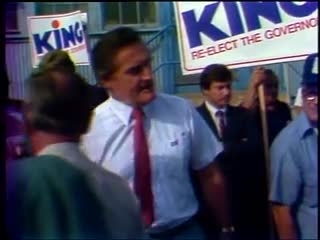
Description: Gov. Edward King campaigns for reelection, shaking hands with workers outside General Dynamics plant.
Collection: Ten O'Clock News
Date Created: 09/15/1982
Description: At USS Constitution Museum press conference Henry Kissinger endorses Edward Brooke for reelection to US Senate. “Ed is a man of courage, integrity, character.” Former governor John Volpe.
Collection: Ten O'Clock News
Date Created: 10/17/1978
Description: Men in front of James Michael Curley Recreation Center aka L Street Bathhouse in South Boston. Exteriors of the building. Governor Ed King talks and poses for pictures, shakes hands, and talks to constituents. State Senator William Bulger walks across street toward L Street Bathhouse. Bulger shakes hands and makes jokes. They hold a press conference. Bulger says he spent five summers lifeguarding at the Bathhouse and it was the best job he ever had. He endorses Governor King for reelection. King presents Bulger with a check for $15 million from state takeover of Hynes Auditorium. Senator Chester Atkins joins them at podium. Shots of reporter Janet Wu listening to the press conference. King continues talking about the accomplishments of his administration. King leaves press conferences and shakes hands. Wu asks King why he chose to give the check to Bulger rather than the mayor, and why they held the press conference at the L Street Bathhouse.
Collection: Ten O'Clock News
Date Created: 09/09/1982
Description: Douglas Wilder, the Democratic candidate for Governor of Virginia, visits the African Meeting House in Boston. Wilder speaks to Director Ruth Batson. Reporter Marcus Jones notes that Wilder is expected to win the election; he adds that Wilder will become the first African American governor of any state in the nation. Jones reviews Wilder's career. Interview with Wilder at the African Meeting House. He talks about his campaign for governor. Wilder downplays speculation that he could be a presidential candidate in 1992. Jones notes that Wilder is visiting Boston to meet supporters and to raise funds for his campaign. Following the edited story is additional footage of Wilder visiting the Meeting House and footage of Jones's interview with Wilder.
1:00:03: Visual: Footage of L. Douglas Wilder (Democratic candidate for governor of Virginia) autographing his picture for an admirer outside of the African Meeting House on Joy Street in Boston. Shots of Wilder entering the Meeting House; of a group of people following Wilder into the Meeting House. Shot of the exterior of the Meeting House. Marcus Jones reports that Wilder is not a familiar face to Massachusetts voters. V: Footage of Ruth Batson (Director, African Meeting House) speaking informally to Wilder and a small group of people. Batson tells Wilder that he joins a long list of illustrious African Americans to pass through the Meeting House. Wilder says that he was named for Frederick Douglass (Nineteenth-century abolitionist). Shots of Wilder in the Meeting House; of the media in the Meeting House. Jones reports that Wilder is the current Lieutenant Governor of Virginia; that Wilder will become the Democratic nominee for governor of Virginia next month. Jones reports that Wilder is attracting national attention because he is expected to win the election. V: Shot of Wilder examing an exhibit in the Meeting House. Shot of a newspaper headline reading, "Black Virginia Politician rests at brink of history." The article is accompanied by a photo of Wilder. Jones reports that no African American has been elected governor of any state in the US. V: Footage of Wilder being interviewed by Jones at the Meeting House. Wilder says that he had high aspirations when he was young; that he never expected to be in this position when he entered politics in 1969. Wilder says that it is significant for an African American to be the Democratic nominee for governor of Virginia. Jones reports that Wilder is in Boston to meet supporters and to raise money for his campaign. Jones notes that Wilder has tried to remain neutral on racial issues; that 80% of Virginia's electorate is white. V: Shots of a black and white photo in an exhibit at the Meeting House; of Wilder talking to an African American woman as he stands near an exhibit at the Meeting House. Jones reports that Wilder entered politics as a state senator in 1969; that Wilder represented the city of Richmond. Jones notes that Wilder has become more conservative on some issues since 1969; that Wilder has run unopposed for the gubernatorial nomination in Virginia. Jones adds that Wilder is a highly respected member of the Democratic establishment in Virginia; that some predict that Wilder could move into national politics. V: Shot of the newspaper article about Wilder. Footage of Wilder being interviewed by Jones. Jones asks Wilder if he could see himself as president in 1992. Wilder says that he hopes to be enjoying his post as governor of Virginia in 1992. Wilder says that he is concentrating on the gubernatorial race in Virginia; that he thinks he is the most qualified candidate to become governor of Virginia. Shot of Wilder with supporters outside of the African Meeting House.
Collection: Ten O'Clock News
Date Created: 05/18/1989
Description: FRED LANGONE ANNOUNCING RUN FOR MAYOR WITH NORM CROSBY, SIGNS, APPLAUSE
Collection: Ten O'Clock News
Date Created: 04/19/1983
Description: FRED LANGONE RUNS FOR CITY COUNCIL
Collection: Ten O'Clock News
Date Created: 09/09/1985