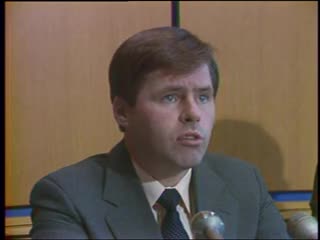
Description: Christy George reports that the Reverend Allan Boesak, an anti-apartheid activist, received an award at Harvard University. He gives a speech at the university in which he urges western countries to place economic sanctions on the South African government. He criticizes Ronald Reagan and other western leaders for supporting the South African government. Boesak, at a press conference after the awards ceremony, praises Dukakis for imposing sanction and and urges George Bush to impose sanctions on South Africa. Boesak talks about the effectiveness of sanctions. George's report includes footage of Bush talking about South Africa and footage of apartheid South Africa. Following the edited story is additional footage of Boesak's press conference at Harvard.
1:00:00: Visual: Footage of Dr. Allan Boesak (anti-apartheid activist) preaching at Memorial Church at Harvard University. Boesak says that the lives of many South African blacks could have been saved if Ronald Reagan (US President) and other Western leaders had divested from South Africa in 1985. Footage of South African police brutally arresting South African blacks. Christy George reports that Boesak is one of the few South African church leaders who would dare to blame Reagan for the deaths of South African children. V: Footage of Boesak at Harvard. Boesak accuses Reagan, Margaret Thatcher (Prime Minister of Great Britain), and Helmut Kohl (Chancellor of Germany) of supporting the South African government. Boesak says that these leaders refused to impose sanctions on the apartheid government. George reports that Boesak is outspoken; that Boesak received an award from Harvard University today; that Boesak chided Harvard for investing in South Africa. V: Shots of Memorial Church at Harvard University; of Boesak receiving an award from a Harvard official. George notes that Boesak praised Michael Dukakis (Governor of Massachusetts) for imposing sanctions against South Africa; that Boesak begged George Bush (US President-elect) to do the same. V: Footage of Bush on October 25, 1988. Bush says that the South African government is racist; that the US needs to stay engaged; that the US needs to use its "moral influence" to change the South African government. Footage of Boesak at a press conference at Harvard University. Boesak says that he hopes Bush will follow the example of Massachusetts; that the US should divest from South Africa. Boesak says that he wishes Dukakis had been elected president. Boesak says that Bush has talked about his commitment to civil rights; that Bush needs to act on his commitment. Footage of South African blacks running from police on January 10, 1988. George reports that Boesak says that the South African government is redoubling its efforts to enforce apartheid laws. V: Footage of Boesak saying that he his tired of lame excuses from western governments. Boesak says that western leaders are lying when they talk about their concern for South African blacks. Boesak talks about the US government's commitment to sanctions against Cuba, Libya, Argentina and Nicaragua. George reports that Boesak says that sanctions are effective; that war has become too expensive for the South African government. George reports that Boesak points to the end of wars in Namibia and Angola as proof of the effectiveness of sanctions. V: Footage of Africans celebrating in the streets; of Africans marching in the street; of African soldiers watching a plane taxi on a runway. Footage of Boesak at a press conference. Boesak talks about sanctions. Boesak says that the South African government should be cut off from oil and from access to the international money market. Boesak says that no South African blacks would be hurt if air links to and from South African were cut off. Boesak says that he and Desmond Tutu (South African anti-apartheid leader) are the only two South African blacks who fly anywhere.
Collection: Ten O'Clock News
Date Created: 01/17/1989
Description: Meg Vaillancourt reports that Robert Mugabe (Prime Minister of Zimbabwe) was awarded an honorary degree from the University of Massachusetts at Amherst. Vaillancourt's report includes footage of Mugabe receiving his doctoral hood from Maki Mandela (daughter of Nelson Mandela) and footage from Mugabe's speech and press conference. Vaillancourt reports that Mugabe spoke out against apartheid in South Africa and advocated sanctions against the South African government. Vaillancourt reviews Mugabe's career. Comments on President Reagan's political actions concerning Apartheid. Vaillancourt's report includes footage of Mugabe in Zimbabwe.
1:00:06: Visual: Footage of Robert Mugabe (Prime Minister of Zimbabwe) speaking at the commencement ceremonies at University of Massachusetts in Amherst. Mugabe applauds the US Congress for considering sanctions against South Africa. Meg Vaillancourt says that Mugabe talked about sanctions against South Africa in his speech at UMass Amherst; that Mugabe was honored by the university for "his efforts to establish racial harmony between blacks and whites." Vaillancourt notes that Mugabe was presented with an honorary doctorate of laws. V: Shot of Mugabe receiving his doctoral hood from Maki Mandela (daughter of Nelson Mandela). Vaillancourt reports that Mugabe became Zimbabwe's first prime minister in 1980; that Zimbabwe had been known as Rhodesia under colonial rule. V: Shots of Mugabe and his cabinet in 1980; of white colonial rulers before 1980; of a newspaper headline reading, "Black Hitler." Vaillancourt reports that Mugabe was a fierce opponent of apartheid in neighboring South Africa; that Mugabe had spent ten years in prison before emerging as the leader of the Zimbabwean struggle for independence. V: Shots of Mugabe in the Zimbabwean Parliament; of Mugabe being led away by two police officers; of Mugabe entering a military garrison. Vaillancourt notes that Mugabe is a strong supporter of black South African leaders. V: Footage of Mugabe at a press conference. Mugabe says that he advocates using all legitimate means to overthrow apartheid; that he advocates armed struggle against South Africa. Mugabe says that he can understand the desire to fight apartheid using non-violent means. Mugabe encourages the use of "maximum non-violence" through sanctions and political pressure. Shot of the press at the press conference. Vaillancourt says that Mugabe dismissed concerns that sanctions would hurt South African blacks. V: Footage of Mugabe saying that black South Africans are already suffering and dying under apartheid; that black South Africans are prepared to suffer under sanctions because they will yield a positive result. Vaillancourt says that Mugabe was questioned about his leadership of Zimbabwe; that there have been accusations of human rights violations in Zimbabwe under Mugabe. V: Shots of Mugabe in a government building; of Zimbabwean troops uncovering an arms cache. Vaillancourt reports that Mugabe says that he has detained those who have tried to overthrow his government. V: Footage of Mugabe at the commencement ceremony. Mugabe says that the struggle for human rights is a universal struggle. Vaillancourt stands on the campus of UMass Amherst. Vaillancourt says that Ronald Reagan (US President) is trying to win enough votes in the US Congress to sustain his veto of sanctions against South Africa. Vaillancourt notes that Reagan is promising an African American ambassador to South Africa as part of his weaker sanctions package; that Reagan is expressing concern over a disruption of summit talks if sanctions are approved by Congress. Vaillancourt adds that Mugabe said that the time for compromise in South Africa is over.
Collection: Ten O'Clock News
Date Created: 10/01/1986
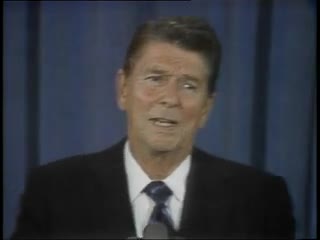
Description: President Ronald Reagan press conference 10/1/1981.
Collection: Ten O'Clock News
Date Created: 10/01/1981
Description: Hope Kelly reports on charges of racism against the Boston Irish Rowing Club. Larry Otway, President of St. Brendan's Rowing Club of New York said that he was discouraged from bringing African American rowers to compete against the Boston Irish Rowing Club in South Boston. Otway later rescinded his accusations. Mayor Ray Flynn holds a press conference to cite progress in fighting racism across the city. Flynn, William Geary, the Commissioner of the Metropolitan District Commission, City Councilor Bruce Bolling, John Joyce, the President of Boston Irish Rowing Club, and Otway speak at the press conference. Joyce denies any discriminatory practices on the part of the Boston Irish Rowing Club. Andrew Jones and Curtis David of the Greater Roxbury Incorporation Project hold a rival press conference in front of the L Street Bath House in South Boston, spekaing out against racism Jerry Cullitary (South Boston resident) defends South Boston against charges of racism. Interview with Susan Moir, a South Boston resident, about racism in South Boston. People rowing in curraghs on Pleasure Bay.
1:00:00: Visual: Footage of Andrew Jones (Greater Roxbury Incorporation Project) and Curtis Davis (Greater Roxbury Incorporation Project) at a press conference in front of the L Street Bathhouse in South Boston. Jones reads a prepared statement. The statement reads that Ray Flynn (Mayor of Boston) should not invite New York residents to Boston; that African Americans from New York and Boston are not welcome in Flynn's neighborhood. Footage of Flynn at a press conference. Flynn says that acts of discrimination in the city will not be tolerated. Shots of Davis and Jones at their press conference; of Bruce Bolling (Boston City Council) speaking at Flynn's press conference. Footage of Jones saying that African Americans were stoned when they tried to visit Carson Beach in 1974. Footage of William Geary (Commissioner, Metropolitan District Commission) at Flynn's press conference. Geary says that Carson Beach is open to all citizens. Shots of Flynn speaking at his press conference. White and African American city officials stand behind him. Hope Kelly says that Flynn's press conference included a full array of testimony about the city's progress in fighting racism; that it is rare for African American community leaders to hold press conferences in South Boston. V: Shot of the press conference in front of the L Street Bathhouse. The sign over the entrance to the bathhouse reads, "James Michael Curley Recreation Center." A crowd of white residents and media stand in front of the entrance. Shot of a white man standing at the entrance of the bathhouse. Footage of Jones saying that Flynn is doing nothing to combat racism in his own neighborhood. Footage of Flynn saying that a number of minority youngsters have participated in events in South Boston. Footage of John Joyce (President, Boston Irish Rowing Club) saying that the rowing club does not discriminate; that their activities are open to all. Kelly reports that Joyce directs a group of rowers who row on Pleasure Bay in curraghs; that curraghs are boats which are native to Ireland. Kelly notes that the club competes against other curragh clubs; that the club will host a New York curragh club on Sunday. V: Shot of Joyce in a curragh; of rowers in curraghs on Pleasure Bay; of white male members of the club on shore; of a white male getting into a boat with two other white rowers. Shots of curragh races. Kelly reports that Larry Otway (President, St. Brendan Rowing Club of New York) filed a complaint against the Boston club; that the Otway contends that Joyce told the New York club not to come to Boston with African American rowers. V: Shot of Joyce at Flynn's press conference. Kelly notes that Joyce apologized; that Otway has now exonerated Joyce. V: Footage of Otway at Flynn's press conference. Otway says that Joyce is not a racist; that Joyce has always welcomed all of the members of the New York Club; that Joyce has been mistakenly targeted as a racist. Kelly reports that some people agree that the rowing club has been unfairly targeted as racist. Footage of Jerry Cullitary (L Street bather) saying that the residents of South Boston are hard-working, working-class people; that racism is more of a problem in the white suburbs than it is in South Boston. Kelly reports that South Boston has become synonymous with racism. V: Shot of a front page headline in the Boston Herald. The headline reads, "Southie rowing club beached by racial uproar." Footage of a white man addressing Jones and Davis at the press conference at the bathhouse. The man says that "good news in South Boston is no news; that bad news is big news." Davis says that he has not heard anyone utter a racial slur at the press conference. The man says that he would like Davis and Boyce to talk about "good news" in South Boston. Kelly says that the press conferences pointed up the stereotypes which still exist on both sides of the race issue in Boston; that the "sunny side-up" tone of Flynn's press conference only reinforced skepticism about the issue. V: Shot of Flynn leaving his press conference. Hope Kelly stands in the room where Flynn's press conference was held. Kelly said that she wanted to ask Flynn if Carson Beach was presently open to everyone; that Flynn did not answer the question. V: Footage of Susan Moir (white South Boston resident) in South Boston. Moir says that her son is white; that he gets insulted at Carson Beach because he has dark skin. Moir adds that she has brought African American children to the beach with her; that the children have been hassled by white beachgoers. Moyer says that non-white people cannot use the beach.
Collection: Ten O'Clock News
Date Created: 05/22/1987
Description: Carolyn Sawyer reports that a group of unemployed laborers are picketing the construction site of the new Post Office in Dudley Square in Roxbury. The picketers are demanding that fifty percent of the laborers on the site be residents of the Roxbury community. Press conference held by the picketers at the site. Rev. Graylan Hagler from the Church of the United Community says that the men will not go away with "crumbs." Picketers Ivan Singleton, James Gun, and Ron Nelson also speak out at the press conference. Interview with Stephen Coyle of the Boston Redevelopment Authority, who is trying to mediate the dispute. Coyle says that the community is legitimately concerned about the high rate of unemployment among residents. He adds that he expects similar protests during upcoming construction projects. Sawyer reviews the agreement concerning minority participation in the construction project.
1:00:37: Visual: Footage of Graylan Ellis-Hagler (Church of the United Community) speaking at a press conference held at the construction site of the new Post Office in Dudley Square. A group of African American men stand behind Ellis-Hagler. Ellis-Hagler says that he and the men will not go away with "crumbs." Ellis-Hagler says that if his men do not work, then nobody works. Shots of the Post Office construction site in Dudley Square. Carolyn Sawyer reports that no one has worked at the Post Office construction site since last Friday. Sawyer reports that picketers have refused to be moved. V: Footage of Ivan Singleton (unemployed laborer) speaking at the press conference. Singleton says that he lives in the community; that laborers on the construction site are coming in from outside of the community. Singleton says that he wants to work on the site. Footage of James Gun (unemployed laborer) speaking at the press conference. Gun says that unemployed laborers in the community are not working on any of the construction jobs in the community. Shot of the Post Office construction site. Sawyer reports that the workers want the fifty percent of the laborers on the site to be residents of the Roxbury community. Sawyer notes that federal law requires minority participation to be ten percent. Sawyer reports that the Post Office has agreed to hire 30% of the work force from the community. V: Shot of a Post Office building in the city. Footage of Stephen Coyle (Boston Redevelopment Authority) being interviewed in his office. Coyle says that the Post Office has satisfied the law and made an agreement with the community. Coyle says that the community is not satisfied. Coyle says that the Post Office and the community appear to be on a collision course. Sawyer reports that Coyle is charged with keeping the project on schedule; that the project is due to be completed next August. Sawyer notes that Coyle met separately today with Suffolk Construction (general contractor of the construction site), with Post Office officials and with Roxbury residents. V: Footage of Coyle being interviewed by Sawyer. Coyle says that the community has legitimate concerns; that unemployment rates are high. Sawyer reports that he expects more of these kinds of disputes in the future. V: Footage of Coyle being interviewed by Sawyer. Coyle says that there will be more tension surrounding upcoming construction projects; that there are not enough jobs and contracts for everyone. Coyle says that he hopes the public sector will engage in more capital projects in the future; that an increase in capital projects would ease the tension. Sawyer reports that government budgets are tight; that more capital projects appear unlikely. V: Shots of the Post Office construction site; of an African American man at the press conference. Footage of Ron Nelson (unemployed carpenter) at the press conference. Nelson says that laborers are coming in from outside to take food from the mouths of community residents. Nelson says that money from the construction is not circulating in the community. Nelson says that the unemployed laborers will continue to picket until they are allowed to work.
Collection: Ten O'Clock News
Date Created: 12/21/1990
Description: Meg Vaillancourt reports on the street violence that resulted in the accidental shooting of Darlene Tiffany Moore (eleven-year-old Roxbury resident). Vaillancourt interviews Maleka Few (Roxbury resident, age twelve) and Jessica Moore (Roxbury resident, age 10). The girls are afraid of the violence that resulted in Tiffany Moore's death. Vaillancourt reports that Roxbury residents went to City Hall to ask for more police protection in the neighborhood. Vaillancourt's report includes footage of Roxbury community leaders at a press conference. Amanda Houston (Roxbury resident), Bruce Bolling (Boston City Council), and Louis Elisa (Roxbury resident) talk about the need for more police on the streets. Vaillancourt reports the Ray Flynn (Mayor of Boston) has put more police on the streets and has pledged a full investigation of Moore's shooting. Vaillancourt's report includes footage of William Celester (Deputy Superintendent, Boston Police Department) and Flynn at a press conference. Vaillancourt reports that Roxbury is experiencing its worst violence in twenty years. She notes that city and state officials gathered at a press conference to discuss the problem. Vaillancourt's report includes footage of the press conference in Roxbury with Francis "Mickey" Roache (Police Commissioner, City of Boston), Royal Bolling, Sr. (former State Senator), and John Kerry (US Senator). Roache blames drug traffic for the violence. Kerry criticizes the ineffectual drug policy and social programs of the Reagan administration. Vaillancourt's report includes footage of police officers stopping African American men on the streets of Roxbury.
1:00:26: Visual: Footage of Maleka Few (Roxbury resident, age 12) saying that she thinks it might happen to her next. Shot of a Boston Herald newspaper article with a headline reading, "Police vow to capture girl's killers." A photo of Darlene Tiffany Moore (Roxbury resident, age 11) accompanies the article. Meg Vaillancourt reports that Moore was sitting outside on Humboldt Avenue in Roxbury when she was killed by a stray bullet; that Moore was the unintentional victim of a war between two rival gangs. V: Shot of a Humboldt Avenue in Roxbury. Footage of Few saying that the gang members were not shooting at Moore; that Moore was in the wrong place at the wrong time. Few says that she does not want to go out to the store with her mother anymore. Footage of Jessica Moore (Roxbury resident, age 10) saying that she used to sit in the same place on Humboldt Street. Shots of African American girls standing on a street in Roxbury. Vaillancourt reports that Roxbury parents went to City Hall today to ask for more police protection. V: Footage of Amanda Houston (Roxbury resident) saying that she is a "gutsy lady;" that she is starting to feel frightened. Footage of Bruce Bolling (Boston City Council) speaking to the press. Bolling says that there is open warfare going on in the city. Shot of media camera crews. Footage of Louis Elisa (Roxbury resident) saying that Roxbury residents pay their taxes; that Roxbury citizens are demanding equal protection under the law. Vaillancourt reports that forty extra police officers are patrolling Humboldt Avenue; that Ray Flynn (Mayor of Boston) has pledged a full investigation of the shooting. V: Shot of two police officers patrolling a street. Footage of William Celester (Deputy Superintendent, Boston Police Department) speaking to the press. Flynn stands beside him. Celester says that the community has been providing information about the shooting to police; that the police are investigating suspects. Footage of two white police officers stopping an African American man to search him. Vaillancourt reports that Roxbury is experiencing its worst violence in twenty years. V: Footage of Francis "Mickey" Roache (Police Commissioner, City of Boston) speaking at press conference in Roxbury. John Kerry (US Senator) and Royal Bolling Sr. (State Senator) are among the crowd standing with Roache. Roache says that drugs equal violence. Shots of the press at the press conference. Vaillancourt notes that Kerry visited Roxbury today to talk to residents about the drug problem. V: Footage of Kerry saying that the government cannot ask kids in Roxbury to say no to drugs if the Reagan administration cannot say no to General Manuel Noriega (leader of Panama). Kerry says that the drug policy of the Reagan administration is hypocritical and ineffective; that the administration's policy is contributing to the drug problem. Vaillancourt reports that Roxbury residents are calling for drastic measures to fight violence; that some curfews, night-court sessions, and the National Guard have all been suggested. V: Footage of Kerry saying that the presence of the National Guard will not solve the drug problem; that overcrowded prisons, an inadequate school system, and a lack of treatment centers are all contributing to the drug problem. Shot of two white police officers talking to an African American teenage boy on a street in Roxbury. Vaillancourt reports that Roxbury residents want increased aid on all levels. Vaillancourt notes that residents are worried that the situation will not improve after Moore's killer is found. V: Shot of a cameraman filming a man in a business suit on the street; of Humboldt Avenue in Roxbury.
Collection: Ten O'Clock News
Date Created: 08/22/1988
Description: PC AT OLD CAMBRIDGE BAPTIST CHURCH ABOUT BREAK-INS SINCE CENTRAL AMERICAN SANCTUARY PROGRAM
Collection: Ten O'Clock News
Date Created: 03/23/1984
Description: MIDDLESEX COUNTY DISTRICT ATTORNEY SCOTT HARSHBARGER AT PC ON MEDFORD BANK HEIST (c.1985)
Collection: Ten O'Clock News
Description: MICHAEL DUKAKIS PC ANNOUNCING MANDATORY SEAT BELT LAW
Collection: Ten O'Clock News
Date Created: 10/22/1985
Description: RAY SHAMIE PRESS CONFERENCE ON TAX INCREASE
Collection: Ten O'Clock News
Date Created: 09/27/1984