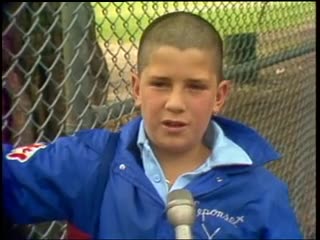
Description: Interview with residents at Orient Heights housing project about prejudice among residents, and outside groups, including white supremacy groups, coming in causing trouble. Two white boys say “the white kids don't want to live with the blacks or the spics [sic].” Interview with woman from Lawyers Committee for Civil Rights about unresponsiveness of city officials to racial violence, following fire bombing of Guatemalan family by 200 whites. Interview with man from an advocacy group on the history of similar racially motivated attacks in East Boston and the lack of response from the community and officials. He mentions that violence in housing projects, specifically, is not given enough attention by the police. He also describes lawsuits brought by minorities who have been discriminated against. Exteriors of Orient Heights project, many windows boarded up. Black and white kids play. Mural of JFK and Big Bird.
Collection: Ten O'Clock News
Date Created: 07/27/1978
Description: Reporter Christopher Lydon interviews attendees of the inauguration of Ray Flynn as Mayor of Boston, in the Wang Center. The crowd cheers as Flynn and former mayor Kevin White pass by. Lydon interviews attendees of the inauguration in the lobby of the Wang Center. Interviewees express concerns about unemployment, crime, the restoration of city services and the city budget. Cynthia Silveira (Dorchester resident) says that she appreciates Flynn's commitment to diversity and unity but is suspicious of his past voting record on racial issues. Lydon interviews people outside of the Wang Center. Harry Spence (Boston Housing Authority) says that Flynn delivered a "solid" speech, but will face difficulties in delivering city services and achieving racial harmony. George Keverian (State Representative) says that Flynn is the right person to unite the city. Louise Day Hicks (former member of the Boston City Council) says that Flynn must strike a balance between downtown concerns and neighborhood interests. Hicks says that South Boston is the "center of the city." Hicks speaks to Dapper O'Neil outside of the Wang Center. Felix Arroyo (Latino activist) hopes that Flynn will deliver on his promises; Arroyo believes that it will be difficult for Flynn to integrate the city's neighborhoods. Elma Lewis (African American activist) says that she and others will work with Flynn to improve the city. Lewis adds that she is "always looking for diversity." Claire Crawford (Boston resident) says that Flynn is a "people's mayor." Flynn exits the Wang Center and gets in his station wagon; crowd cheers. Lydon interviews James Kelly (South Boston Information Center). Kelly expresses reservations about Flynn's proposal for District Advisory Councils. Thomas Menino (Boston City Council) compliments Flynn's inaugural speech.
1:00:00: Visual: Christopher Lydon interviews a white male about the inaugural speech of Ray Flynn (Mayor, City of Boston) at the Wang Center for the Performing Arts. The man says that Flynn gave a strong speech; that he is optimistic about Flynn's administration. The man says that Flynn will face challenges in improving the schools. Lydon speaks informally to the man. 1:00:45: V: Uniformed officers march up the stairs in the lobby of the Wang Center. People are gathered in the lobby. The audience cheers as Flynn exits a room and proceeds up the stairs. Flynn's young daughter holds his hand as he walks up the stairs. Flynn stops to greet bystanders as he passes. Kevin White (former Mayor of Boston) and Kathryn White (wife of Kevin White) proceed up the stairs after Flynn. 1:02:12: V: Lydon interviews a white man who is a Dorchester resident. The man says that Flynn is the first mayor since Josiah Quincy to have a "sense of the city"; that Flynn is familiar with the neighborhoods and the downtown. Lydon interviews a white middle-aged man about Flynn's speech. The man says that Flynn's speech was very good; that Flynn understands that the government exists to serve the people. The man says that Flynn will face a challenge in restoring city services during an economic crisis. An older white woman says that Flynn's speech was "wonderful." The woman says that Flynn will face a challenge in reducing unemployment; that Flynn's emphasis on unity was important. Cynthia Silveira (Dorchester resident) says that Flynn's speech was good; that she hesitates to trust Flynn because of his past voting record on racial issues. Silveira says that it will be difficult for Flynn to give his full attention to Boston neighborhoods; that she appreciates his commitment to diversity and unity. An older Irish woman recognizes Lydon from television. Her companions explains that they are from the region of Ireland where Flynn's family is from. The second Irish woman says that the speech was "wonderful." An older white woman says that Flynn will be a good mayor if he delivers what he promised in the speech; that it will be difficult for Flynn to reduce the crime rate. An older white man says that Flynn has the right idea; that Flynn will "economize." 1:06:59: V: A crowd streams out of the doors of the Wang Center. Lydon interviews Harry Spence (Boston Housing Authority). Spence says that Flynn delivered a "solid" speech; that it will be difficult for Flynn to deliver services and to achieve racial harmony. Spence says that Flynn's speech expressed his decency and commitment to the people. The crowd continues to exit the building. Groups of people are gathered outside of the doors. Members of the crowd greet Lydon. George Keverian (Massachusetts House of Representatives) greets Lydon and his two daughters. Keverian says that Flynn delivered a good speech; that Flynn's humanity was in evidence. Keverian says that Flynn is the right person to unite the people of Boston. Keverian continues to speak informally to Lydon and his daughters. 1:12:07: V: Louise Day Hicks greets Lydon. Hicks says that Flynn's speech covered many "interesting" and important topics; that South Boston is the "center" of the city. Hicks says that Flynn will need to strike a balance between the neighborhoods and the downtown interests; that Flynn needs to concentrate on affordable housing and crime reduction. Hicks confers with Dapper O'Neil (Boston City Council) on the street outside of the Wang Center. Lydon interviews Felix Arroyo (Latino activist). Arroyo says that the city will be a better place if Flynn can deliver on his promises. Arroyo says that Flynn will face challenges in integrating the neighborhoods; that he appreciates Flynn's commitment to education. Shot of a black car pulled up to the curb in front of the Wang Center. Lydon asks Elma Lewis (African American activist) about Flynn's speech. Lewis say that Flynn put on a good "show"; that inaugural speeches do not mean much; that she and others will work with Flynn to improve the city. Lewis says that she has attended inaugurals for many years; that she would like to have seen "more diversity"; that she is "always looking for more diversity." 1:17:04: V: Claire Crawford (Boston resident) says that Flynn is a "people's mayor." Crawford says that Flynn will face challenges in eliminating racial discrimination. Flynn exits the Wang Center. He greets several groups of bystanders. Photographers crowd around Flynn's station wagon. Flynn clears snow from his windshield. Flynn gets in the car and drives away. The crowd cheers briefly. 1:20:37: V: Lydon interviews Jim Kelly (South Boston Information Center). Kelly says that Flynn gave a good speech; that parts of the speech "concerned" him. Kelly expresses reservations about the District Advisory Councils. Kelly says that Flynn face difficulties in providing services to the city during an economic crisis. Kelly says that the people of South Boston are happy to "have a say" in how the city is run. Lydon begins to interview Thomas Menino (Boston City Council). Menino says that Flynn made an excellent speech.
Collection: Ten O'Clock News
Date Created: 01/02/1984
Description: Sounds goes in and out at the beginning. Dr. Pinderhughes gives a speech to an audience. He addresses contemporary racism and its societal causes. He uses his term "body image" to explain different perceptions and projects of different types of people. He says that the Black Power Movement is providing a forceful change in white people's project of what black people are. He compared the Black Power Movement to youths rebelling against adults to assert their autonomy, which is socially accepted.
Collection: WHDH
Date Created: 06/18/1967
Description: Interview with Boston School Committee Chairman John Kerrigan. He speaks about the failings of the current busing system, especially concerning elementary school children. He talks about busing on a voluntary basis, but says that he would rather fund other School Committe projects things over any form of busing. He mentions a current bill which proposes amending the racial imbalance law where it concerns elementary school children.
Collection: WHDH
Date Created: 03/1969
Description: Air piece on replacement of nine antiquated Boston schools with new facilities by 1971. Reporter standup at the John A. Andrews School in South Boston. Interview with man from the Board of Education on the new schools that will have a greater capacity, which will be opened up to non-white students, in order to help with the racial imbalance in the Boston city schools. Exteriors of a school building. African American children get off of a bus and enter school.
Collection: WHDH
Date Created: 07/19/1969
Description: Man addresses Massachusetts state government arguing against the Racial Imbalance Law. He notes that it will be impossible to adhere to that law without compulsory busing, and therefore the law should be amended or abolished.
Collection: WHDH
Date Created: 12/08/1970
Description: Press conference addressing Racial Violence in public housing in Boston, Harry Spence, Melbourne firebombing. .
Collection: Ten O'Clock News
Date Created: 08/14/1982
Description: Marcus Jones reports that Sadiki Kambon (community activist) and others have accused police of using excessive violence when pursuing African American crime suspects. He notes that Donald Johnson (shooting victim) was shot dead this evening by police while he was driving a stolen bus. Jones' report includes footage of the bus and the aftermath of Johnson's shooting. Jones notes that police have shot and killed five suspects of non-violent crimes this year; he adds that four of those five suspects were African American. Jones interviews Kambon. Kambon blames police for Johnson's death, saying that police officers would not have fired on Johnson if he were white. Kambon says that he fears for his life when interacting with police because he is an African American male. Jones reviews the case of Levi Hart (shooting victim), who was shot by police while fleeing a stolen car. Jones adds that African American communities across the nation are concerned about police behavior toward African Americans. Jones' report features footage from various sources of African Americans interacting with police and footage of race riots in Miami. Following the edited story is b-roll of the aftermath of Johnson's shooting. Police and EMTs on the scene.
1:00:08: Visual: Footage from WNEV-TV of police running after a bus on a crowded street in Jamaica Plain. Footage of police and paramedics in Jamaica Plain transporting an injured Donald Johnson (shooting victim) on a stretcher. The footage is from January 31, 1988. Marcus Jones reports that Donald Johnson was shot dead by police while driving a stolen bus in Jamaica Plain. Jones reports that some members of the African American community say that police used excessive violence against Johnson. V: Footage of Sadiki Kambon (community activist) saying that Johnson would still be alive if police had reacted properly to the situation. Shots of Johnson being put into an ambulance by police and paramedics. Jones reports that police say that they fired at Johnson because he posed a threat to their safety and the safety of others. V: Footage of Kambon saying that every issue revolves around race; that situations are seen in terms of "us and them." Jones asks Kambon if he thinks the police would have fired on Johnson if he had been white. Jones says that Kambon would not have been shot if he were white; that police knew an African American man was driving the bus. Jones reports that Johnson's shooting marks the fifth time that police have shot and killed suspects of non-violent crimes. Jones reports that four of the five shootings involved teenagers; that one of the shootings involved a case of mistaken identity; that only one of the five shooting victims was white. V: Shots of police officers and residents standing near a cordoned-off crime scene. On-screen text details statistics of police shootings. Footage of Kambon saying that he fears for his life when he interacts with police because he is an African male. Kambon describes the behavior of police officers when they stop African American males for speeding violations. Jones reports on the case of Levi Hart (shooting victim). Jones says that Hart was shot by police while fleeing from a stolen car. Jones reports that African American communities across the nation are concerned over police behavior toward African Americans. Jones notes that a police shooting touched of riots in Miami recently. Jones adds that an African American man was searched during a church service in Broward County, Florida; that churchgoers thought his afro pick was a gun. V: Shots of a photo of Hart; of a newspaper article with a headline reading, "Hart case will go to grand jury." Footage from Say Brother of an African American man fleeing from police. Footage from NBC of race riots in Miami. Footage from Fox television of police searching an African American man in the back of a church. Police pull an afro pick from the man's coat. Shot of an ambulance on a Boston street. Jones reports that the Boston Police Department will not comment on the shooting of Johnson or on any other shootings. Jones notes that the matter is under investigation.
Collection: Ten O'Clock News
Date Created: 02/06/1989
Description: Racial tension, Atkinson. 8/1982.
Collection: Ten O'Clock News
Description: Racial tensions in aftermath of the murder of William Atkinson , Sen. Owens, Sadiki Kambon. .
Collection: Ten O'Clock News
Date Created: 03/23/1982