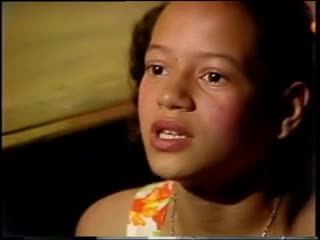
Description: Marcus Jones reports that Jack E. Robinson (President, National Association of Black Americans) is trying to get a voluntary school uniform program started in the Boston Public Schools. Jones notes that some schools have found that voluntary dress codes have led to better grades and behavior. He adds that opponents of school uniforms believe that they stifle creativity. Jones interviews Robinson about school uniforms. Jones reports that Robinson believes that students are more concerned about their clothes and possessions than they are about their studies. Jones quotes from a Boston Herald newspaper article about a nine-year old drug runner who impresses his friends with his clothes. Jones also interviews John Grady (Boston School Committee), Elizabeth Foley (Boston parent), and a Boston school child about school uniforms. Jones reviews some of the benefits to school uniforms.
1:00:02: Visual: Footage of white elementary students in school uniforms rising to greet their teacher at the St. Columbkille School in Brighton. Shots of students in the classroom. Marcus Jones reports that uniforms are a long-standing tradition in private and parochial schools. Jones notes that supporters of school uniforms believe that uniforms help inspire discipline. Jones notes that opponents of school uniforms believe that they stifle creativity. V: Shots of white uniformed students in classrooms. Shots of African American uniformed students in an elementary school in Washigton DC. Jones reports that an elementary school in Washington DC and five elementary schools in Baltimore have instituted a voluntary dress code; that the schools have found that the dress code has led to better grades and behavior. V: Footage of Jack E. Robinson (President, National Association of Black Americans) being interviewed by Jones. Robinson says that school uniforms lead to a decrease in disciplinary problems. Jones notes that Robinson is trying to get a voluntary uniform program started in the Boston Public Schools. V: Footage of Robinson saying that adults wear uniforms; that business people wear suits; that people in all professions wear uniforms all over the world. Shot of a Boston Herald newspaper article with a headline reading, "He's the littlest pusher." Jones reports that Robinson says that children are more concerned about clothes and stylish possessions than they are about their studies. Jones quotes from the Boston Herald newspaper article; the newspaper article says that a nine-year-old drug runner impresses his friends with his clothes. V: On-screen text quotes from the Boston Herald newspaper article. Footage of John Grady (Boston School Committee) saying that he will support uniforms if they contribute to a good learning environment in the schools. Footage of Jennifer Foley (Boston public school student) saying that she would not want to wear the same colors all year long. Footage of Elizabeth Foley (parent) saying that students are entitled to their own identities. Jones reports that there are some good reasons to institute a school uniform program. Jones notes that parents can save money on clothing bills; that students have one less peer pressure to worry them; that teachers have one less distraction in the classroom. Johnson adds that Robinson has suggested that the community can profit by having the uniforms manufactured in the neighborhoods.
Collection: Ten O'Clock News
Date Created: 05/09/1988
Description: In Chelsea Sen. Edward Kennedy campaigns for John Silber. Silber cozies up to children in bilingual class. Marjorie Clapprood smiles,claps for singing children. Silber, Clapprood, Kennedy, Diana Lam each at podium
Collection: Ten O'Clock News
Date Created: 11/05/1990
Description: Evening Compass special. In-studio operators take phone calls from parents with questions about school assignments and busing for the next school year. Ed Baumeister gives the answers to several true-or-false questions regarding the state plan to achieve racial balance in Boston schools. Judy Stoia gives statistics for the maximum travel distance of students and the racial makeup of schools in each elementary and intermediate school district. Paul deGive reports on a plan proposed by the Boston School Department to hire aids to help care for children and locate parents in case of sickness or family emergency. Baumeister and Pam Bullard (Boston Herald American) interview John Coakley (Boston School Department) and Dr. Charles Glenn (Massachusetts State Department of Education) about implementation of the racial balance plan. Both men respond to questions about the busing of kindergarten students. Judy Stoia explains the term geocode. Stoia and Bob Murray (Boston School Department) give on-air answers to some of the most common questions received by the operators. In studio Bullard, Baumeister and Dr. John Finger of Rhode Island College discuss plan developed to integrate schools. WGBH reporter and Bob Murray have question-and-answer session with questions from callers. Joan Buckley, representative from Boston Teachers Union, discusses plan for teachers with Bullard and Baumeister.
0:02:11: Visual: Introduction to A Compass Special: September in April, a special broadcast concerning the state racial balance plan for the Boston schools. Ed Baumeister is in the studio, along with several volunteers covering the phones. Baumeister introduces the program as informational, designed to answer parents' questions about the plan and its implementation. Baumeister gives out a number for parents to call to reach volunteers in the studio. Baumeister provides true/false answers to basic questions about the plan. Questions touch on the reimbursement of transportation costs, general travel distances for students of various ages and numbers of white and non-white students to be bused. 0:06:08: V: Paul deGive reports on parents who worry about being able to reach their child at a distant school in the case of sickness or emergency. He reports that the Boston School Department will propose a plan to hire transitional aids at each school to contact parents and to care for children in an emergency. 0:09:15: V: Baumeister encourages parents to call studio for information. Volunteers answer the phones. 0:09:55: Report on the Boston elementary school districts under the racial balance plan. Narrator describes the standardization of grade structure in elementary schools and the changes to various elementary school districts. The districts are as follows: Hennigan Kennedy, Bacon Dearborn, Tobin Farragut, Washington Park, Sumner-Conley, Tileston Chittick Greenwood, Lee, Murphy, Marshall Dever Mason, Mendell-Parkman, Paine-Audobon, Milmore, Prince, Faneuil, Lincoln Quincy, Hurley-Bates, Carter, Eliot, South Boston, Hyde Park, Cannon, Ohrenburger, Parker Longfellow. V: Shot of a map of Boston's elementary school districts. Narrator gives information for each district, including district boundaries, names of schools within the district, maximum travel distance for any student in the district and projected non-white enrollment for each school in the district. A map of each district is shown as the narrator reads the information for that district. 0:20:11: V: Judy Stoia encourages parents to call the studio for information concerning their child's school assignment. Shots of telephone volunteers. Stoia mentions that the volunteers are from the Citywide Education Coalition, the Teachers Union and the Boston School Department. Stoia talks to volunteer Lee Grant and explains the term "geocode." Stoia talks to volunteer Scott Campbell about what kind of information he can give to parents over the phone. 0:23:30: V: Baumeister introduces Pam Bullard (Boston Herald American) and John Coakley (Education Planning Center of the Boston School Department). Baumeister refers to Coakley as the man charged with making the racial balance plan work. Coakley refutes the claim that he is in charge of the plan, but discusses preparation for implementation of the plan. Baumeister asks Coakley if the School Department has any flexibility in implementing the plan. Bullard asks Coakley to respond to parental complaints about kindergarten assignments. Bullard presses kindergarten issue, asking if kindergarten children will be bused to the Martha Baker School or to kindergarten centers. Coakley summarizes School Department efforts to minimize busing of kindergarten students and cites the inadequacies of state plan concerning kindergarten students. Baumeister asks Coakley how he would change plan if he could. Coakley cites preliminary plans for integration by the Boston School Department and the Boston School Committee. Coakley says these plans were never developed. Baumeister thanks Coakley. 0:33:27: V: Baumeister provides answers to more true/false questions about the racial balance plan. Questions touch on the following issues: state reimbursement for travel under the desegregation plan, reimbursement of MBTA travel under the plan, major thoroughfares as school district boundaries, classification of Spanish-speaking students, overcrowding of Boston schools. 0:35:14: Report on intermediate school districts under the racial balance plan. Narrator talks about the redistricting of intermediate schools under the plan. Narrator gives the following information for each district: district boundaries, maximum travel distance for any student in the district and percentage of non-white students within each intermediate district school. Narrator reads the information for each district over a map of that district and a shot of the district school. The districts follow: Cleveland, Curley, Dearborn, Edison, Gavin, Holmes, Irving, King, Lewenberg, Lewis, Mackey, McCormack, Michelangelo, Roosevelt, Shaw, Taft, Thompson, Timilty, Wilson. V: Shot of a map of Boston's intermediate school districts. 0:44:41: V: An in-studio reporter asks a volunteer named Fran to describe the phone calls she has received. The reporter addresses a specific situation concerning the placement of 6th grade students in Hyde Park. 0:46:31: V: Baumeister and Bullard interview Dr. Charles Glenn (Office of Equal Education Opportunity of the State Department of Education). Baumeister asks Glenn how the plan determines which children will be bused at the high school level. Bullard asks Glenn about the busing of kindergarten students under the state plan. Glenn explains the intricacies of the plan and its implementation. Baumeister asks Glenn why the state plan to desegregate schools is better than any put forth by the Boston School Committee. Glenn explains that the state desegregation plan goes as far as it can under state law. Bullard questions Glenn about hurried implementation of the racial balance plan, and if the communities involved will be adequately prepared. Glenn responds that the plan has been implemented as well as can be expected in the time given. 0:55:15: V: Baumeister provides answers to more true/false questions. Questions touch on the following issues: definition of non-white students, school assignments and school assignment changes, Massachusetts state racial imbalance regulations, teacher assignments. 0:56:49: V: Stoia and Bob Murray (Education Planning Center of the Boston School Department) answer the most difficult questions received by phone volunteers. Questions involve travel distance within a school district, whether Dr. Glenn lives in Boston, the assignment of students in sub-system schools (Trotter school, Lewis school and Copley High School), and the assignment of seniors in the high schools.
Collection: Evening Compass, The
Date Created: 04/22/1974
Description: Marcus Jones reports that artist Robert Guillemin, also known as "Sidewalk Sam," is working with elementary-school students to create a mural to celebrate Boston's ethnic diversity. The mural will be two stories tall, made up of 30,000 personal drawings by children and student, and it will hang in the Grand Concourse of South Station. Guillemin talks to students about the mural and works with them in the classroom. Students sit together as they work on drawings for the mural. Jones interviews a fourth grade student from Hurley School, who talks about her drawing for the mural. Mayor Ray Flynn has endorsed the mural project, and he visits the classroom and talks to individual students about their drawings. Interview with Flynn, who says that the mural promotes peace and unity in the city. Jones reports that volunteers at Roxbury Community College are putting the mural together, and it will be unveiled to the public tomorrow. Following the edited story is additional b-roll footage of Guillemin and students working on the mural and footage of volunteers at Roxbury Community College putting together the mural.
Collection: Ten O'Clock News
Date Created: 05/14/1990
Description: Boston Teachers Union reaches tentative agreement with city on 3-year contract. Ray Flynn, Laval Wilson, Thomas O'Reilly, Edward Doherty. Young children walk behind teacher into corridor.
Collection: Ten O'Clock News
Date Created: 05/22/1989
Description: Pam Bullard reports on the Tobin Elementary School, which is located near the Mission Hill Housing Project.Bullard reports that 75 white children are bused into the Tobin school with no problems. Interviews with students and teachers talking about how much they like the school. Bullard reports that Charlie Gibbons, the principal, encourages teachers to develop innovative programs for students. During the report Principal Gibbons was in Puerto Rico learning about the schools there to better be able to serve the Latino students at his school. Bullard notes that the school has a good atmosphere and enjoys a good rapport with the community.
9:50:07: Visual: Shots of street sign for Tobin Ct.; of the Mission Hill Housing Project. Pam Bullard reports that the Mission Hill Housing Project is in one of Boston's toughest neighborhoods; that racial fighting occurred there two weeks before school opened; that the housing project is in the heart of a depressed neighborhood. Bullard reports that the Tobin Elementary School is located near the housing project. V: Footage of an African American male student (Derek) saying that he has attended the Tobin School for four years; that he knows all of the teachers and gets along with them; that the school is special because of the teachers, the kids, and the field trips. A white male student (Richard) says that Derek is his friend; that he likes the Tobin school; that he has fun taking the bus everyday; that he has met a lot of new people. Bullard reports that Charlie Gibbons (principal, Tobin School) and his assistant are in Puerto Rico; that they are learning about the Puerto Rican school system in order to understand the needs of Spanish-speaking students; that Gibbons and his assistant are paying for their own trips. V: Shots of Gibbons' office; of a button reading "I go to the best - Tobin School, Roxbury"; of a thank-you note written to Gibbons from the students. Bullard reports that the Tobin School has extensive reading and physical education programs set up with Boston University; that there is a program for dental care set up with the Harvard Dental school; that the Tobin School has one of the city's best bilingual programs; that the students receive a lot of individual attention. Bullard reports that Gibbons and the teachers at the Tobin set up most of these programs themselves. V: Footage of student reading Spanish; of a student writing on a chalkboard; of bilingual posters in a classroom. Footage of a teacher at a chalkboard; of students in classroom. A white female teacher says that the students respond well to the school's programs; that she tries to give the students individual attention; that she likes the students and the parents at the Tobin. Footage of children playing learning games. An African American female teacher says that she agrees with Gibbons that the Tobin is the best school in Boston; that the Tobin has a warm atmosphere, a good faculty and a lot of support from the community. An African American male student says that he likes the Tobin because he learns things. Bullard reports that the Tobin school is located in a predominantly African American neighborhood; that 75 white students have been bused in with no problems; that students and teachers like the school very much. V: Footage of children playing on a field outside of the school. The Church of Our Lady of Perpetual Help is visible.
Collection: Ten O'Clock News
Date Created: 03/26/1976
Description: Young children entering school. Buses pulls up and children exit buses and walk up stairs into school yard. Exteriors of the William Monroe Trotter School. Young, racially mixed students in Trotter School classroom. Teachers working with an individual student on a math word problem. Close ups on the decorations on the classroom walls.
Collection: Evening Compass, The
Date Created: 09/11/1975
Description: Christy George reports that the city of Lowell has chosen a central enrollment plan to accomplish school desegregation in its public schools. George notes that central enrollment plans are implemented through magnet schools; she adds that students choose schools according to the programs they offer instead of by location. George interviews Robert Kennedy (Mayor of Lowell). Kennedy says that the Lowell School Committee opted for a central enrollment plan in order to avoid court-ordered desegregation of the schools. George reports that the city of Cambridge uses a central enrollment plan and has become a national model for school desegregation. George interviews Peter Colleary (Director of Student Assignments, Cambridge Public Schools) about central enrollment in Cambridge Public Schools. George's report includes footage of a meeting between Colleary and school officials from Rochester, NY. The officials from Rochester ask questions about central enrollment in Cambridge. George notes that opponents to school desegregation in Lowell believe that central enrollment is a form of mandatory desegregation. George interviews George Kouloheras (Lowell School Committee) about his opposition to the central enrollment plan. George notes that Cambridge had a successful school system even before the adoption of the central enrollment plan. She adds that the Cambridge model may not work in every city. George's report includes footage of buses in front of schools in Lowell, footage of a girls' soccer game in Cambridge, footage of school children in classrooms, and footage of buses arriving at South Boston High School in 1976. This edition of the Ten O'Clock News also included the following item: Marcus Jones reports on tension over school desegregation in Lynn
1:00:05: Visual: Shots from a moving vehicle of students in front of South Boston High School in 1976; of buses with police escort travelling up G Street to South Boston High School; of African American students exiting buses in front of South Boston High School. Christy George reports that the city of Lowell wants to avoid court-ordered school desegregation and forced busing. George reports that Lowell is opting for a voluntary school enrollment plan; that students choose three schools which they would like to attend; that students will be bused to one of those schools. V: Shots of elementary school students in a school cafeteria; of a bus pulling up to an elementary school. Footage of Robert Kennedy (Mayor of Lowell) saying that the Lowell School Committee acted responsibly; that the School Committee wanted to avoid court intervention in Lowell schools. Shots of a white teacher teaching in a racially integrated elementary school classroom in Lowell. Shots of students in the classroom. George reports that the central enrollment plan is implemented through magnet schools; that the magnet schools offer diverse programs; that students can choose the school which offers programs which appeal to them. George notes that racial balance can result from the magnet school system; that the system has worked well in the city of Cambridge. V: Footage of Peter Colleary (Director of Student Assignments, Cambridge Public Schools) saying that school choice has been successful for Cambridge Public Schools. George notes that Colleary matches Cambridge students with their schools; that some schools have increased minority enrollment from 9% in 1981 to 43% in 1987; that students are willing to choose schools outside of their neighborhoods. V: Shots of the Cambridge High School girls' soccer team playing a soccer game. Footage of Colleary saying that 65% of Cambridge Public School students do not attend schools in their districts. Shots of the exterior of Cambridge Rindge and Latin School. George notes that the city of Cambridge owns many of its own buses; that half of the bus drivers work for the city. dShots of a school bus; of the exterior of Cambridge Rindge and Latin School. George notes that the Cambridge Public School System has become a national model for desegregation. V: Shots of Colleary talking to a delegation from the public school system of Rochester, NY. Members of the delegation ask Colleary questions about the Cambridge Public School System. George notes that critics in Lowell see the Cambridge model as another form of mandatory desegregation. V: Shot of a school bus pulling away from an elementary school in Lowell. Footage of George Kouloheras (Lowell School Committee) saying that central enrollment plans "are a euphemism for forced busing." Kouloheras says that central enrollment does not improve the education in the schools. Footage of Colleary saying that 35% of Cambridge students are bused; that the students have chosen to attend schools outside of their districts. Colleary calls it "busing by choice." George stands in front of a school at dusk. George reports that Cambridge was providing good education in its schools before the implementation of the voluntary desegregation plan. George notes that the Cambridge model may not work in every city.
Collection: Ten O'Clock News
Date Created: 10/26/1987
Description: David Goerlitz, a former model for Winston cigarette ads, has quit smoking and now visits schools to teach children dangers of the habit. Goerlitz speaking a at school assembly. Print ads featuring Goerlitz. Goerlitz accuses the tobacco industry on targeting children and young teens. Interview with students after assembly on teh lack of smoking education in schools. Interview with Goerlitz on why kids listen to him more than other antismoking advocates. Goerlitz talks with school kids after the assembly. Marcus Jones reports in front of a Winston cigarette ad featuring Goerlitz that is still up in Boston. Following the edited story is b-roll of Goerlitz talking to kids after school assembly. Closeups on print ads.
Collection: Ten O'Clock News
Date Created: 10/25/1989
Description: Student production of Wizard of Oz at Joseph Lee Elementary School. They perform “Ease on Down the Road” on stage, and seated chorus sings ”Ding Dong the Wicked Witch is Dead,” We're Off to See the Wizard” and “Somewhere Over the Rainbow.”
Collection: Ten O'Clock News
Date Created: 06/09/1978