Description: Pam Bullard interviews Kathleen Sullivan (Boston School Committee) about the quality of education in Boston. Sullivan says that she is frustrated because Boston schools have not improved since court-ordered desegregation began in 1974. Sullivan calls Arthur Garrity (federal judge) a "crazy judge." Sullivan says that the desegregation plans since 1974 have been disruptive. She says that neither African American nor white students have benefitted from school desegregation; that students should not be assigned to different schools each year. Sullivan and her assistant discuss Judge Garrity's latest order concerning the Boston schools. Bullard explains to Sullivan that she is putting together a piece which contrasts Sullivan's views on schools and court-ordered desegregation with the views of African American leader Melnea Cass
0:59:44: V: Pam Bullard interviews Kathleen Sullivan in her office. Bullard comments that Sullivan was elected to the School Committee because voters were impressed with her commitment to quality education and better schools. Bullard asks Sullivan how she would have fared if voters were less concerned with the state of the schools and more concerned with politics as usual. Sullivan says that she could have been re-elected. Sullivan says that parents are concerned about education; that a difficult economy coupled with the costs of school desegregation has made school improvement difficult. Sullivan says that the quality of education has not improved in the city since she was elected to the School Committee; that she feels frustrated in her efforts to improve the schools. 1:03:48: V: Bullard asks if it would damage Sullivan politically to admit that desegregation has improved Boston schools. Sullivan says that voters in Boston are beginning to accept desegregation as a fact; that the anti-busing movement has lost steam because people are tired; that voters would be happy to hear that schools have improved, even if the improvement was a direct result of desegregation and a "crazy judge on the scene." Sullivan says that there has been little improvement except in a few schools. Sullivan mentions that Roxbury High School, the Lewenberg School and the Curley School have seen improvement. Bullard asks why Sullivan never mentions the positive impact that desegregation has had on African American students, who now have access to an equal education. Sullivan says that she has been preoccupied with the budget this year; that she visited last year with African American students who had been assigned to three different schools in three years, and had not benefitted from the experience. Sullivan says that the school situation has begun to stabilize this year; that one can begin to talk about better education for African American students this year; that police presence in schools and community hostility to busing prevented a healthy school situation for African American students in 1974 and 1975; that she understands why African American parents might disagree with her because they wanted access to better schools for their children. Sullivan says that she hopes schools can be improved for all students; that she is worried because only 51,000 children attended Boston Public Schools last year, out of a school-age population of 117,000. Sullivan says that she taught African American students in Dorchester; that she thinks desegregation has been disruptive for those students; that the desegregation of Boston schools could have been beneficial for African American students and white students in 1974 and 1975 if it had been implemented differently. 1:10:34: V: An administrative assistant enters Sullivan's office to go over some papers with her. The assistant points out that Judge Garrity has ordered the School Committee to appoint a new Transitional Director of Program Development at South Boston High School. Sullivan and the assistant discuss Garrity's instructions. Sullivan and her assistant tell Bullard that Judge Garrity has approved 160 transfers out of 1,782 requests. Sullivan alludes to Garrity's heavy involvement in managing the Boston schools. 1:12:57: V: Bullard explains to Sullivan how she will edit the final piece. Shots of Sullivan's office. Bullard explains that she has also interviewed Melnea Cass (African American community leader) and wants the final piece to reflect the positions of the two women. Bullard says that both women are leaders, but that their positions on school desegregation reflect their ethnic heritage; that their positions are as far apart as the communities they represent. Sullivan points out that she has done a lot of work with African American students. Bullard says that Sullivan and Cass have a good working relationship because neither harbors strong racial prejudices; that both have friends of other races and backgrounds.
Collection: Ten O'Clock News
Date Created: 09/28/1976
Description: Kent Elementary School in Charlestown, exterior and open classrooms. Chinese students, Chinese storybook. Bilingual name placards. Interview with principal, Mr. Fuller, on problems of desegregation,the great teachers at Kent Elementary School, problems with lack of parental involvement and the Charlestown community. Ends with silent footage of Pam Bullard during the interview for cut-aways, and footage of the Bunker Hill monument.
Collection: Evening Compass, The
Date Created: 12/02/1975
Description: Kent Elementary School in Charlestown. Arithmetic lesson. Chinese calligraphy. Open classroom. Diverse student body. Students learn how to care for plants.
Collection: Evening Compass, The
Date Created: 12/03/1975
Description: Mayor Kevin White's message to citizens of Boston regarding the opening of school. He says that all residents share the responsibility for a safe opening of schools. He adds that no threat to school children or school buses will be tolerated, and that police, federal marshals, and the FBI will be on hand to enforce the court order. White reminds citizens that the education of schoolchildren must not be politicized. This tape has audible time code on track 2.
0:59:04: Visual: Chalk slate indicates production information: School Opening / Mayor White / 9 -3- 75 / Ferrante (producer) / DeBarger (director). 0:59:32: V: Kevin White reminds viewers that school starts on Monday; that the first week of school is a time of transition for teachers, students, and parents; that many are concerned about the safety of children in schools as well as safety on the streets; that many will have to adapt to the changes brought by new school assignments. White says that every citizen has a responsibility to make the school opening peaceful no matter how he or she feels about busing; that responsibility, judgement and restraint will be important. White says that every child has a right to attend school safely; that he will use every resource at his disposal to guarantee safe access to schools for all children. White says that a comprehensive safety plan has been developed to maintain peace on the streets and to avoid violence and disruption in schools. White pledges that he will not tolerate any breach of public safety; that unlawful activity posing a threat to schools, buses, or school children will be punished with the maximum sentence. 1:02:17: White says that many concerned citizens and parents have participated in the development of the public safety plan; that the plan for 1975 triples the efforts made in 1974; that 1,000 Boston police officers, 300 state troopers, 250 MDC police and 100 federal marshals will be on duty along bus routes and near schools; that 400 school crossing supervisors, 300 bus monitors and over 900 transitional aids will be employed by the city; that the FBI and special teams of prosecutors will be on hand to investigate unlawful activity. White says again that interference with school desegregation will not be tolerated; that violators of the court order risk arrest and prosecution under federal law; that the city is better prepared for the opening of school this year. White urges city residents to act with decency, compassion, and charity; to avoid violence; to set a good example for the city's children. White reminds viewers that children need to go to school; that schools need to be separate from politics and power struggles.
Collection: Evening Compass, The
Date Created: 09/03/1975
Description: Dr. Laval Wilson and members of the Boston School Committee assemble themselves at a press conference in Wilson's office. The media sets up a shot of Wilson and Nucci signing copies of Wilson's contract. Wilson and Nucci shake hands. Wilson shakes hands with each member of the School Committee. Wilson takes questions from reporters. Wilson talks about his enthusiasm for his new post. He says that his biggest challenge will be to familiarize himself with the issues and problems within the school system. A reporter asks Wilson about the politics of the school system. Wilson says that politics are always involved in public education. Wilson says that he and his family are making themselves at home in the city. Wilson answers reporters' questions about Arthur Garrity (federal judge) and his supervisory role over the Boston Public Schools. Wilson says that the city of Boston owes Garrity a debt of gratitude for his wisdom and leadership in the school desegregation case. Wilson talks about his meeting with Garrity in the courtroom. Wilson says that he is committed to integrated schools. Wilson adds that today's hearing in Garrity's courtroom was the last. He says that Garrity will soon turn over stewardship of the schools to Wilson and the School Committee. Meg Vaillancourt sets up an interview with Grady. Grady talks about the importance of Garrity's final hearings. He says that today is a "historic" day. Grady is optimistic about Wilson's selection as superintendent. Vaillancourt sets up an interview with Nucci. Nucci talks about the significance of Garrity's withdrawal from the schools. He says that the School Committee is ready to take on the responsibility of running the schools. Nucci adds that the School Committee is looking forward to working with Wilson as superintendent.
1:00:01: V: Laval Wilson (Superintendent, Boston Public Schools) walks over to a desk and lays out two copies of his contract. Microphones are set up on the desk. Shot of papers laid out on the desk. Wilson confers with Boston School Committee members John Nucci, Rita Walsh-Tomasini, John Grady, and Joe Casper. The School Committee members stand to the side of the desk. Wilson examines the papers with Nucci and Walsh-Tomasini. Boston School Committee members Abigail Browne and Jean McGuire walk behind the group with Wilson. Close-up shots of Wilson, Nucci and Walsh-Tomasini. Casper stands on the opposite side of the desk from the group with Wilson. The media sets up a shot of Wilson sitting at the desk with the members of the School Committee, including Kevin McCluskey, standing around him. Wilson takes his suitcoat off and settles into the desk. Wilson and Nucci each sign both copies of the contract. Wilson shakes hands with Nucci and each of the School Committee members. 1:03:12: V: Wilson sits down and takes questions from reporters. The School Committee members remain standing around his desk. A reporter asks Wilson if he has any second thoughts about coming to Boston. Wilson says that he is delighted to be in Boston; that he wishes he could have had more time to prepare for the coming school year. Wilson says that he will work with school staff to get to know the school system; that he will do his best to work with the School Committee and the mayor to benefit the schools. A reporter asks Wilson to name the biggest problem he faces. Wilson says that his biggest problem will be to get to know the system. Wilson says that he must understand the issues and the problems before he can address them. A reporter asks Wilson about the politics involved in the Boston Public School System. Wilson says that politics come with the territory of public education. Shot of the members of the media recording the event. A reporter asks Wilson about the insights given to him by the transition team. Wilson says that he has not yet received a briefing from the transition team. Shot of Grady. Wilson says that he is happy to be in Boston; that his three children will be attending Boston Public Schools; that he is in the process of looking for a home in the city. Wilson again shakes hands with Nucci and the members of the School Committee. 1:07:20: V: Wilson is interviewed by the media. Wilson talks about a conversation he had with Arthur Garrity (federal judge). Wilson says that Garrity told him that the problems in the school system may be exaggerated by the media. Wilson notes that the city of Boston owes Garrity a debt of gratitude for his wisdom and leadership in the school desegregation case. Wilson says that Garrity will soon turn over supervision of the school system to Wilson and the School Committee. A reporter asks Wilson about the challenges he will face in improving the schools. Wilson says that the community must commit itself to integrated schools; that all children must have equal access to the schools. A reporter asks Wilson how he felt while meeting with Garrity. Wilson says that the meeting was, in fact, "historic." Wilson adds that he appreciated the opportunity to talk to Garrity in the courtroom. A reporter asks how Garrity responded to Wilson's requests to meet with him privately. Wilson says that Robert Dentler (Dean of Education, Boston University) told him that Garrity had decided not to meet privately with any of the superintendents of the Boston Public Schools; that Dentler told Wilson not to feel slighted if Garrity does not meet with him. Wilson adds that he had a productive conversation with Dentler. A reporter asks Wilson if today's hearing was the last in the Boston school desegregation case (Morgan v. Hennigan). Wilson says that Garrity indicated that today's hearing was the last. Wilson says that he will do his best to provide equal access to integrated schools; that another hearing can be avoided if the schools remain integrated. 1:10:45: V: Meg Vaillancourt sets up a meeting with Grady. Vaillancourt asks him if today's hearing was the final hearing. Grady says that Garrity indicated that today's hearing was the last one. Grady notes that it is a "historic" day for the Boston Public School System; that the Boston School Committee and the Boston School Department have worked hard to arrive at this day. Vaillancourt asks Grady about the challenges facing Wilson and the School Committee. Grady says that Wilson will need to move ahead in the same direction; that the schools have "turned the corner." Grady says that there is "an air of optimism" throughout the school system; that Wilson will be a capable superintendent. Vaillancourt thanks Grady. 1:11:57: V: Vaillancourt sets up an interview with Nucci. Vaillancourt asks Nucci about the withdrawal of Garrity. She notes that Garrity told the Boston School Committee to pay heed to the parents and teachers. Nucci says that the School Committee recognizes the contributions of parents and teachers over the past ten years. Nucci says that he is optimistic; that Garrity is confident in the School Committee's commitment to integrated schools; that Garrity is optimistic about the selection of Wilson as superintendent. Nucci says that it is time to close "a chapter in Boston's history." Vaillancourt notes that Dr. Robert Spillane (former Superintendent of Boston Public Schools) left because the School Committee switched to district representation. She asks if Wilson will face a challenge in dealing with the School Committee. Nucci says that Garrity has cited the district-elected School Commitee's commitment to desegregated schools. Nucci adds that the new School Committee has led to Garrity's withdrawal from the schools. Another reporter asks Nucci if any potential problems could prevent Garrity's withdrawal from the schools. Nucci says that there are only minor differences to be resolved. The reporter asks about the significance of Garrity's withdrawal. Nucci says that the judge will set the parameters for desegregation in his final court orders; that the Boston School Committee will be responsible for running the schools. Vaillancourt asks Nucci if a larger School Committee could hinder Wilson's ability to get his programs approved. Nucci quotes Spillane as saying that the size of the committee is less important than the quality of the people who serve on the committee. Nucci says that the School Committee will help Wilson in his new role as superintendent.
Collection: Ten O'Clock News
Date Created: 08/21/1985
Description: Joseph Lee Elementary School students sing “Sur le Pont d'Avignon.” Young students practice reading. Black and white students sit together at tables. Cover of primer “In the Big City” illustrated with integrated children. Beginning of Wizard of Oz play on colorfully decorated stage in auditorium.
Collection: Ten O'Clock News
Date Created: 06/09/1978
Description: E. Edward Clark, a ninety-two-year-old African American man, speaks to a racially integrated class at the Hennigan Elementary School. The son of slaves, Clark answers questions from the students, and tells them vivid stories about his family's experiences in the south following emancipation and about growing up in Cambridge. Clark talks about his family and authenticating information about his family's history. He encourages the students to get a good education while they're in school. Tape 2 of 2. The original tape was damaged, and has been copied in sections. There are several jump cuts on the tapes dubbed from the original.
1:00:01: Visual: E. Edward Clark speaks to a racially integrated class at the Hennigan school. A student asks Clark how he found out so much about his background in Wilmington, North Carolina. Clark says that his mother and father talked a lot about the family background; that he was born in Wilmington, North Carolina. Clark says that he and his daughter visited Wilmington to find out facts about his family. Shot of a white female student in the classroom; of another white female student in the classroom. Clark says that he found a US census from the nineteenth century. Clark says that he found a listing for a slave in Wilmington; that he found a listing for his mother. Clark talks to the students about the Boer War in South Africa. Clark says that part of his family came from an area near Capetown, South Africa. A young white male student asks how much Clark's father paid for his freedom. Clark says that his father paid between $400 and $650. Clark says that $650 back then is like $5,000 today. A young white boy asks if free black people could get the same jobs as white people. Clark says that African Americans could not get the same jobs as white people in North Carolina. Clark says that there are now state and federal laws which force employers to hire people regardless of their race, creed or color. Clark says that his daughter's husband is the only African American judge in the Boston Municipal Court system; that his son is a colonel in the US Army. Clark says that African Americans who are educated and qualified can get jobs anywhere. Clark says that the south is better than the north today; that there are fewer problems with school desegregation in the south. Clark tells the students to get a good education in school. Clark says that the students can be whatever they want if they get a good education. Clark tells the students that Martin Luther King Jr. (civil rights leader) and Frederick Douglass (abolitionist) were both "doctors." Clark says that his son-in-law has a doctorate of law from Boston University. Clark tells the students that they have to be ready. Clark recites the saying about "building a better mousetrap." Clark says that the students will succeed if they are ready. 1:06:05: V: An African American female student asks Clark how many children he has. Clark says that he has five children. Another African American female student asks Clark about his job as a cook and waiter. Clark says that most of the waiters in Boston are white; that waiters are looking for good tips. Clark says that waiters do not have to associate with their clientele. Shot of a female teacher in the room. A white boy asks why Clark was not a slave if his parents were slaves. Clark says that he was born after emancipation. Clark says that he was born nineteen years after emancipation. Another white male student asks Clark if he would live his life differently if given the chance. Clark says that he would live the same life again. Clark says that he would not have his wife and children if he had lived his life differently. Clark tells the student that nothing in life is free. Clark says that he worked and paid his dues. A white female student asks Clark how old he was when he started working. Clark says that he started to work when he was twelve. A white male student asks Clark if his father fought in the Civil War. Clark says that his uncle fought in the Civil War. Clark says that he has a citation from the US State Department saying that a member of the Clark family has fought in every major American war. Clark says that he fought in WWI; that his son fought in WWII; that another son fought in the Korean War and the Vietnam War. The student asks if the Clark family documents are worth money. Clark tells the students that a person is not educated if he or she does not understand tolerance. Shot of an African American male student. Clark tells a student that he needs to judge people by their abilities; that people should not be judged by their race, creed, or color. A white female student asks Clark how his family traveled from North Carolina to Boston. Shot of a white male student. Clark says that a steamship traveled between Wilmington and New York; that most shipping, trade, and commerce was done by ship.
Collection: Ten O'Clock News
Date Created: 04/27/1977
Description: NEWBURY STREET APARTMENTS NEEDING REPAIR, REALTY OFFICES. Courtroom art of Laval Wilson, school department and desegregation plaintiff's attorneys, Judge Arthur Garrity.
Collection: Ten O'Clock News
Date Created: 08/21/1985
Description: Hubert Humphrey Occupational Resource Center (ORC) and MADISON PARK HIGH SCHOOL UNDERUTILIZED BECAUSE OF DESEGREGATION QUOTAS. VOCATIONAL EDUCATION.
Collection: Ten O'Clock News
Date Created: 05/05/1986
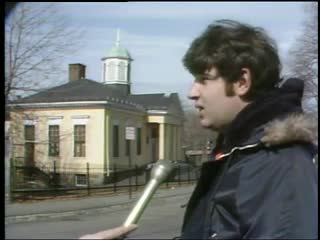
Description: Interview with Charlie Vasiliades about survival of Oak Square School on Nonantum Street in Brighton, being considered for closing. Last wood frame schoolhouse in Boston, serves integrated student body of 100. Small building with yellow clapboard exterior, columns, cupola. It might receive historic landmark designation. Nearby houses.
Collection: Ten O'Clock News
Date Created: 03/13/1979