Description: Press conference on the court-ordered plan for Phase III desegregation of the Boston Public Schools. Elvira "Pixie" Palladino (Boston School Committee), Charles Leftwich (Associate Superintendent, Boston Public Schools) and John Nucci (East Boston community activist) are among the interested parties and reporters in attendance. Attendees read over the court order. Robert Dentler (Dean of Education, Boston University) and Marvin Scott (Associate Dean of Education, Boston University) review the court order. They discuss efforts to desegregate Boston kindergartens. They announce the opening of the Mattahunt Elementary School and Madison Park High School. Smith and Dentler discuss the decision to close the McKinley School, the Storrow School and the Higginson Elementary School, because they remain segregated despite all efforts to integrate the student population.
0:00:13: Visual: People are seating themselves in a lecture hall before a press conference about the court-ordered plan for Phase III desegregation of Boston Public Schools. Elvira "Pixie" Palladino sits with several white women at a table at the front of the room. Walt Sanders (WBZ reporter) reads the paper at his seat, also near the front of the room. Charles Leftwich (Associate Superintendent, Boston Public Schools) greets people as they enter the room. The media set up cameras to record the press conference. 0:03:20: V: Marvin Scott (Associate Dean of Education, Boston University) and Robert Dentler (Dean of Education, Boston University) seat themselves at the front of the room. The moderator announces that copies of the court-ordered Phase III desegregation plan will be passed out. Audience members approach him for copies of the report. Scott and Dentler wait as the moderator passes out the report. 0:05:51: V: The moderator introduces Dentler and Scott, and says that they will answer questions about the report. Dentler and Scott are seated at a table with microphones. They quietly confer with one another and check their watches. The press conference attendees quietly read over the report. John Nucci (East Boston community activist) quietly studies it. Leftwich flips through the report. An attendee asks Dentler how the plan will affect East Boston. Dentler says that he will answer questions after the attendees have had a chance to read over the report. 0:09:49: V: Smith says that the court order for Phase III desegregation focuses on stability and continuity. He says that he and Dentler will review the order and then take questions. Smith says that a third theme of the court order is the disengagement of the court from the schools. Smith refers to the court order and explains some statistics. He points out how some school assignments have changed from last year to this year. He makes reference to the assignment of students to examination schools. Dentler notes that kindergarten classrooms in Boston have never been desegregated; that neighborhood kindergarten classrooms remain more accessible to white students than to African American students; that fewer minority students enter kindergarten. Dentler adds that the Phase III desegregation plan aims to increase accessibility to neighborhood kindergarten for all; that some students will be assigned to citywide magnet kindergartens for desegregation purposes; that magnet kindergarten assignments are made with the idea that children will stay in the same building for the elementary school grades. Dentler says that the goal of kindergarten desegregation was first stated in the original court order. Smith mentions some of the details of student assignments to District 9 schools. Dentler says that the court aims to stabilize the high student turnover rate. He names the deadlines for initial assignments and corrective assignments of students. Dentler notes the statistic that one in three students transfers from one school to another under the current plan; that there will be limitations on student transfers. Dentler says that a high turnover rate is detrimental to classroom learning. Smith announces the opening of the Mattahunt Elementary School and Madison Park High School. Dentler announces the closings of four schools. He says that the McKinley School, the Storrow School, and the Higginson Elementary School will be closed because they have remained segregated despite all efforts to integrate the student population. Dentler notes that alternative plans to desegregate these schools are infeasible or unconstitutional; that the student populations in these schools are small. Dentler notes that there are 60 students enrolled in the McKinley School; that there are less than 100 students enrolled in the Storrow School; that there are less than 150 students at the Higginson School, not including kindergarten students.
Collection: Ten O'Clock News
Date Created: 05/06/1977
Description: Air piece on replacement of nine antiquated Boston schools with new facilities by 1971. Reporter standup at the John A. Andrews School in South Boston. Interview with man from the Board of Education on the new schools that will have a greater capacity, which will be opened up to non-white students, in order to help with the racial imbalance in the Boston city schools. Exteriors of a school building. African American children get off of a bus and enter school.
Collection: WHDH
Date Created: 07/19/1969
Description: Man addresses Massachusetts state government arguing against the Racial Imbalance Law. He notes that it will be impossible to adhere to that law without compulsory busing, and therefore the law should be amended or abolished.
Collection: WHDH
Date Created: 12/08/1970
Description: Robert Spillane (Superintendent, Boston Public Schools) speaks to an audience in the chambers of the Boston School Committee. He is introduced by Jean Sullivan McKeigue (President, Boston School Committee), who notes that the School Committee will vote on March 5 about whether to keep Spillane in the post of Superintendent. Spillane addresses the issues of school desegregation and school violence. Spillane says past students in Boston Public Schools had been denied a good education due to segregated schools and cynicism among educators. Spillane talks about the continued involvement of Arthur Garrity (federal judge) in the supervision of the Boston Public Schools. Spillane says that the Boston School Department must begin to take responsibility for school desegregation. Spillane reminds the audience that racial discrimination will not be tolerated in the Boston Public School system; that the climate in the schools must be improved. Spillane stresses the importance of faculty integration. Spillane talks about school discipline and the fair implementation of the disciplinary code. Spillane says that a monitoring process will assure that minority students are no longer singled out for disciplinary action. Spillane promises to establish a task force to investigate school violence. Spillane says that school desegregation will have been a failure if quality education cannot be assured. Spillane also talks about additional programs for students, teacher training, teacher evaluation and community involvement in the schools. John O'Bryant (Boston School Committee) is interviewed by the media after the speech. O'Bryant says that Spillane has addressed school desegregation in a courageous manner; that he will vote for Spillane on March 5.
1:00:04: Press and members of the community are gathered in the Boston School Committee chambers. Jean Sullivan McKeigue (President, Boston School Committee) enters the room and announces that the vote on the office of school superintendent will take place on March 5. McKeigue introduces Robert Spillane (Superintendent, Boston Public Schools). Spillane enters the room and sits down. Spillane thanks McKeigue. He acknowledges the fact that the School Committee will be voting on whether to continue his superintendency. Spillane addresses the need for community involvement in Boston schools. Spillane says that he started as superintendent seven months ago; that he was aware of the social, fiscal and educational problems faced by Boston schools; that he has tried to provide constructive leadership. Spillane says that the schools are working with reduced resources; that he is trying to address the educational and social needs of nearly 60,000 students. Spillane refers to school desegregation across the nation. He says that Boston public school students had been denied a good education due to segregated schools and a cynicism among educators. Spillane says that he would like to address two problems today: school desegregation and school violence. Spillane talks about Judge Arthur Garrity's efforts to produce agreement among the parties in the Boston school desegregation case (Morgan v. Hennigan). He says that these agreements aim to secure the advances made by eight years of school desegregation; that these agreements would form the basis of a final set of court orders; that Garrity would cease to supervise the schools after these consent decrees were put in place. Spillane says that the consent decrees provide an opportunity to assess the progress made in school desegregation. Spillane reviews the state of the Boston Public School System before desegregation. Spillane says that he would like to eliminate racial inequality while improving educational quality. Spillane says that he would like to institute a long-range plan for the schools; that the plan would be presented to Garrity through the consent decree process. Spillane says that Boston schools must take responsibility for school desegregation; that equal educational opportunities must exist for all students; that the staff must be integrated as well as the students. Spillane says that the schools require strong leadership, a clear curriculum, conscientious teaching and a safe school climate. Spillane says that students must be prepared for higher education or the job market; that schools must work with parents to improve education. Spillane says that racial discrimination cannot be tolerated in and out of school; that he will not tolerate those who say that some children cannot learn. Spillane says that teachers must work hard to educate all children. Spillane says that he supports the integration of school faculty; that school staff must represent a cross-section of American society; that minority staff have been denied access to jobs in the past. Spillane says that African Americans and other minorities will be represented in key positions in the school administration. 1:10:44: Spillane says that youth violence is a problem in Boston's schools and neighborhoods. Spillane says that order must be kept in the schools; that alternative programs must be provided for all students in need of them. Spillane says that violence can stem from a lack of success in school; that school staff must help students to learn and achieve as best they can. Spillane says that fair and equitable disciplinary action must be assured; that minority students may have been singled out for disciplinary action in the past. Spillane says that he will set up a process to monitor disciplinary action and insure fair implementation of the disciplinary code. Spillane says that he will establish a task force to investigate school violence; that the task force can make recommendations on how to counter school violence. Spillane notes that students who are not taught to read and write are victims of another kind of violence; that some students are not encouraged to learn; that all students must be prepared to function as active and contributing members of society. Spillane says that desegregation will be rendered ineffective if quality education is not assured; that urban schools can make a difference in the lives of their students. Visual: Shot of a young African American boy who is fidgeting in the back of the room. Spillane says that teacher training is important. V: Jump cut in videotape. Spillane talks about alternative programs for students with special needs. V: Jump cut in videotape. Shots of audience from Spillane's perspective. Spillane says that a fair process of teacher evaluation will be implemented; that assistance and training must be given to teachers; that superior performance should be recognized and inferior performance should be addressed. V: Shot from the back of the room of Spillane addressing the audience. Spillane talks about the need for high academic standards. V: Jump cut in videotape. Spillane says that he will continue to work with the business community on employment and training programs for students. V: Jump cut in videotape. Spillane talks about the need for good vocational education programs. V: Jump cut in videotape. Spillane addresses the need for strong bilingual education programs. Spillane says that the programs must be assessed to assure that they are meeting the needs of the students. V: Jump cut in videotape. Spillane says that education must be a priority in the city; that civic leaders, parents and school administrators must work together to improve the schools; that all groups concerned about the schools must be listened to. V: Jump cut in videotape. The audience claps for Spillane. V: Jump cut in videotape. John O'Bryant (Boston School Committee) is interviewed by the media. He says that he is impressed with Spillane's growth since his stormy meeting with the school committee on February 8; that he will vote for Spillane. O'Bryant says that Spillane addressed school desegregation in a courageous manner; that very few high-profile officials talk about the beneficial effects of school desegregation in Boston; that few people give Garrity credit for instituting desegregation in Boston schools. O'Bryant says that he is optimistic about Spillane's ability to do the job. The media continues to question O'Bryant.
Collection: Ten O'Clock News
Date Created: 03/02/1982
Description: Profile of Robert Spillane, superintendent of Boston Public Schools as he prepares to leave Boston for a post in Virginia. Vaillancourt reports on Spillane's accomplishments in improving the Boston Public School System and cutting the school budget deficit. Interview with Spillane where he compliments the teaching staff in the Boston Public Schools and talks about his opinion of Arthur Garrity. He says that Garrity's stewardship of the school system was a disaster. Interview with Peter McCormick, the President of the Bank of New England, about Spillane's good relationship with the business community. Vaillancourt speculates about whether Spillane will one day pursue a career in politics.
1:00:21: Visual: Footage of Robert Spillane (Superintendent, Boston Public Schools) speaking to an audience. Spillane says that the quality of every school must be improved in order for school desegregation to be considered a success. Meg Vaillancourt reports that Spillane took over as Superintendent of the Boston Public Schools four years ago; that Boston was undergoing school desegregation. V: Shot of a young African American boy watching an anti-busing march. White protesters chant, "Here we go, Southie." Shot of a police officer pushing an angry white man against a car. Vaillancourt reports that the quality of education was very low. Vaillancourt notes that school officials admitted that more than one-third of the graduates from Boston Public Schools could not read. V: Shots of students descending an elevator at English High School. Shot of an African American male student reading at a his desk; of two white male students sitting together in a classroom; of students in a classroom. Shots of a group of students sitting together in a study hall; of a teacher in the study hall. Vaillancourt reports that there were six superintendents during the first seven years of school desegregation in Boston. Vaillancourt reports that Spillane was committed to changing the schools in Boston. V: Shot of Spillane seating himself as he prepares to speak to an audience. The audience applauds. Vaillancourt reports that Spillane instituted the first changes to the school curriculum in fifteen years; that promotion standards were established; that students' test scores began to improve. V: Shot of two elementary school students seated in front of computers. A teacher looks over the shoulder of one of the students. Vaillancourt reports that Spillane shares credit for success with his staff. V: Footage of Spillane being interviewed. Spillane says that there is an excellent teaching staff in the Boston Public Schools. Spillane says that the rising levels of student achievement reflect the dedication of the teaching staff. Spillane says that he provided help and direction. Spillane says that he challenged the teachers by publishing the test scores of each school. Shots of Spillane in his office. Vaillancourt reports that Spillane is known as the "velvet hammer." V: Shot of a hammer with a velvet grip on display in Spillane's office. Vaillancourt reports that Spillane is credited with pushing Arthur Garrity (federal judge) aside; that Spillane allowed the Boston School Department to take charge of the schools once again. Vaillancourt notes that Garrity is slowly handing over his control of the Boston Public Schools. V: Shot of Garrity at a community meeting in January of 1976. Vaillancourt reports that Spillane has few kind words for Garrity. V: Footage of Spillane being interviewed by Vaillancourt. Spillane says that Garrity was a "disaster"; that Garrity was not a good manager of the schools. Spillane says that Garrity did what was necessary to desegregate the schools; that Garrity tried to manage the schools as well. Spillane says that a federal judge has no qualifications to manage a school system. Vaillancourt reports that Spillane considers his ability to manage the school system as his strength. Vaillancourt reports that the school budget had tripled in the decade before Spillane's arrival. Vaillancourt reports that Spillane cut the school deficit from $30 million to $3 million within one year. Vaillancourt notes that Spillane got Boston businesses involved in the schools; that Boston businesses have given over $5 million in additional funds to the schools. Vaillancourt adds that the Boston Public Schools have the largest private endowment in the nation. V: Footage of a woman introducing Spillane to an audience. Spillane rises from his seat, shakes the woman's hand and prepares to address the audience. The audience applauds. Shots of audience members. Footage of Spillane receiving an award in front of an audience. Footage of Peter McCormick (President, Bank of New England) being interviewed. McCormick says that Spillane is highly respected by the business community. McCormick says that Spillane understands the problems of the business community; that Spillane has been willing to be flexible. McCormick says that the business community responded in kind to Spillane. Vaillancourt reports that Spillane is leaving Boston for Virginia; that Spillane will make an additional $30,000 per year in his new job. Vaillancourt reports that Spillane made $70,000 per year in Boston; that his salary is considered low. V: Footage of Spillane talking with a small group of people. Spillane shakes hands with an Asian American woman. Footage of Spillane being interviewed by Vaillancourt. Spillane says that superintendents are like athletes in that they have a short span of time in which to perform well and make money. Spillane says that there is a good market for superintendents. Vaillancourt reports that some are speculating that Spillane is looking for a political appointment in Washington DC. in the future. Vaillancourt notes that Spillane is a former Deputy Commissioner of Education in New York. V: Shot of Spillane socializing with a group of people at a gathering. Footage of Spillane being interviewed by Vaillancourt. Spillane says that public service is a great opportunity; that he loves public service. Spillane says that he may enter politics in the future; that he might like to be a city councillor or school committee member someday.
Collection: Ten O'Clock News
Date Created: 06/28/1985
Description: Charles Ray, the Headmaster of Roxbury High School, talking to students, parents and faculty members in the offices of Roxbury High School. Pam Bullard interviews Ray in the administrative offices of the school. Ray talks about how the school has changed since the beginning of school desegregation in 1974. He notes that white attendance is still low, but that it is improving. Ray describes the school's bilingual program, and the academic programs set up at the school in conjunction with Harvard University. He says that many students from Roxbury High School received college scholarships last year, and discusses their college opportunities. Ray talks about the atmosphere at the school, and the close relationships between the students and the faculty. He notes that very few students transfer out of the school. He adds that most students feel comfortable at Roxbury High School. Ray says that he tries to learn the names of every student in the school. Ray talks about the challenges of urban education. He says that he encourages pregnant students to remain in school as long as possible. Ray says that he would like to see a program set up to allow students to bring their children to school with them. Ray describes the school's building and facilities. Ray tells Bullard that it is important to treat each student with respect.
1:00:05: Visual: Charles Ray (Headmaster, Roxbury High School) speaks to an African American female student in the office of Roxbury High School. He tells the student what she needs to do in order to change school assignments. 1:01:37: V: Pam Bullard sets up an interview with Ray. Ray talks about some of the photographs in the school office. He notes that the photos were taken by students from the school. Ray talks to a student who has entered the office. The student asks Ray about the television crew in the school office. Bullard notes that the Boston Public Schools are beginning their fifth year of desegregation. Bullard asks Ray how things have changed in five years. Ray notes that Roxbury High School was paired with South Boston High School during the first year of desegregation. Ray notes that only a small percentage of students from South Boston attended Roxbury High School during the first year of school desegregation. Ray says that Roxbury High School was placed in the same district as Charlestown High School during the second year of school desegregation; that Roxbury High School has remained in that district. Bullard asks Ray about white attendance at Roxbury High School. Ray says that the school has more white students now than it had during the first year of school desegregation. He notes that sixty-three white students have been assigned to the school this year; that twenty-five white students are in attendance. Ray says that he would like the Boston School Department to assign more white students to the school. Ray says that Roxbury High School has a bilingual program for Asian and Spanish-speaking students. Bullard asks Ray about Roxbury High School's programs in conjuction with Harvard University. Ray explains that Roxbury High School has been paired with Harvard University by the federal court order governing school desegregation in Boston. Ray talks about a tutoring program in which Harvard students tutor Roxbury High School students. Ray talks about the Harvard Upward Bound Program. He adds that Harvard and Roxbury High School have set up programs for students in advanced math and sciences, reading, and art. Ray explains that teachers and advanced students can take courses at Harvard University. 1:06:46: V: Bullard notes that students who attend Roxbury High School tend to stay at the school and do not transfer out. Ray agrees that not many students transfer out of the school. He adds that most students like the school and the faculty. Bullard asks Ray if many students from Roxbury High School attend college. Ray says that 74 students graduated from Roxbury High School in 1978; that 37 of those students went on to college. He adds that many of the students received scholarships last year. Ray adds that the Girls High Alumni Association has contributed to a scholarship fund for the students. Ray notes that many Roxbury High School students have done well in their college careers. Bullard asks why Roxbury High School has been a successful school. Ray says that the teachers get to know the students and their families very well. Ray notes that the faculty know most of the students by name; that the students feel comfortable at the school. Ray adds that these close relationships are the key to the school's success. Bullard asks Ray if he knows the name of every student at the school. Ray says that he is learning the names of all of the incoming freshmen; that he makes an effort to talk to the students in the hallways. Ray adds that he knows the names of all of the returning students. Bullard notes that all of the students like Ray and speak highly of him. Ray talks about the importance of knowing the name of each student. He adds that the students know that the teachers and other faculty members care about them. 1:11:43: V: Bullard asks how urban education has changed in the past decade. Ray says that programs for special needs students have changed; that pregnant students now stay in school. Ray says that he encourages pregnant students to stay in school for as long as they can. He says that he encourages them to return to school as soon as possible. Ray adds that he would like to start a program that would allow students to bring their children to school with them. He says that it might be difficult for Roxbury High School to meet the safety requirements for such a program. Bullard asks Ray if he would have chosen to be assigned to Roxbury High School. Ray says that he likes Roxbury High School. He adds that the school is structurally sound and has good facilities; that he likes the layout of the building. Ray says that the faculty at the school have a good relationship with the community and with the parents. Ray adds that he likes the atmosphere at small high schools. He says that each student gets personal attention at Roxbury High School. Bullard asks Ray what he has learned over the course of his career. Ray says that he has learned the importance of treating each student with respect. He says that the students treat him respectfully in return. Bullard closes the interview. 1:16:38: V: Ray stands behind the counter of the office at Roxbury High School. He answers questions from a student about her school schedule. Ray confers with a teacher about two problem students. Ray tells the teacher that he will speak to the students. Ray talks to two more students about their school schedules. Ray confers with another teacher in the office.
Collection: Ten O'Clock News
Date Created: 09/13/1978
Description: Racially integrated, open classrooms at the Joseph Lee School in Dorchester. The teachers are primarily white. The classes are racially integrated; the majority of students are African American. Pam Bullard interviews Frances Kelley (Principal, Joseph Lee School) about school attendance, the faculty and the atmosphere at the school. Kelley is optimistic about the coming year. Bullard interviews two Roxbury High School students about their experiences at the school. Both are enthusiastic about the school, report little racial tension among students, and comment on how helpful headmaster Charles Ray is to the students.
0:59:58: Visual: Racially integrated classes enter the Joseph Lee School in Dorchester. The doors close. A few latecomers knock on the door to be let in. 1:02:01: V: Frances Kelley (Principal, Joseph Lee School) talks to a teacher about attendance. A white teacher helps students in an open classroom. The class is integrated, although a majority of the students are African American. The teacher helps the students learn how to print their names. The students color in pictures on their worksheets. Shot of a white student and an African American student sitting together at a table. 1:08:19: V: Shot of open classrooms at Lee School. Several classes are conducted at once. A teacher tells her students to stand up behind their chairs. The students stand and push their chairs in. Another white teacher teaches her class to read the names of colors. The class is racially integrated. 1:12:20: V: Pam Bullard sets up an interview with Frances Kelley (Principal, Joseph Lee School) in the open classrooms. Kelley admits that a certain percentage of students have not returned to the Lee School this year; that her staff will begin contacting their parents. Kelley says that parents are supportive of the programs at the Lee School; that some are upset because bus routes were consolidated this year; that there is some confusion over bus stops. Bullard comments that the Lee School lost some faculty this year. Kelley says that her faculty likes the school; that some are worried about losing their jobs due to the shrinking student population. Kelley says that morale tends to be low in June; that morale is higher in September when teachers return to school. Kelley says that the faculty at the Lee School is young, enthusiastic, and innovative; that the children like the school and its programs. 1:15:28: V: Bullard sets up an interview with a non-white female student (Betty) and a white male student (Paul) about their experiences at Roxbury High School. Both students opted to return to Roxbury High School after attending the previous year. Betty says that she likes the school because it is close to where she lives and it has good programs; that there are no problems. Paul says that he returned to Roxbury High School to play football; that he gets along well with the teachers and had no problems during the previous year; that he does not mind taking a bus to school. Betty says that there is no tension among the students at the school. Paul agrees that there are no racial problems. Betty says that it is a small school; that the teachers will give individual attention to the students. Paul says that everyone at the school seems to get along; that the teachers are willing to help the students with problems they might have; that Charles Ray (Headmaster, Roxbury High School) is a good principal. Bullard talks to the students informally while the crew takes cutaway shots. Betty says that she likes the programs at the high school; that there is a new chemistry lab; that students have access to photography equipment. Paul says that he moved to Boston from California last year; that people had told him not to attend Roxbury High School; that he liked the school after visiting it for the first time. Bullard comments that Roxbury High School does not deserve its bad reputation.
Collection: Ten O'Clock News
Date Created: 09/09/1976
Description: Buses pull up to Roxbury High School. The buses are not full. Asian students exit the buses and enter the school. African American and Asian students approach the high school on foot. Shots of housing in the surrounding area. Exteriors of Joseph Lee Elementary school, which school children walking towards school. Buses pull up to the Lee Elementary School. White and African American students exit buses and enter the school. African American students and parents approach the school on foot. Racially integrated classes line up in the recess yard and enter the Lee School. The students wave at the camera as they enter the school.
1:00:16: Visual: A nearly empty bus pulls up to Roxbury High School. Asian students exit the bus and enter the school. African American students approach the school on foot. Shots of Greenville Street, in front of Roxbury High School. A second bus pulls up to the school. More Asian students exit the bus and enter the school. Shot of plaque above entrance, reading "Roxbury High School." Two police officers are stationed in front of the school. Asian and African American students approach the school on foot. 1:07:20: V: A small school bus is parked in front of the Joseph Lee Elementary School. Young students of various races exit the bus. African American students and parents approach the school entrance. African American and white students exit another small school bus and approach the school entrance. Two of the white boys are identical twins. An African American boy asks the camera crew questions. He walks in front of the camera in order to be on television. More African American students and parents approach the school. Closeup shots of young African American students who have approached the camera crew. 1:12:57: V: A school bus pulls up in front of the school. Mostly white and a few African American students exit the bus and are greeted by an African American teacher. The students enter the school. Another school bus pulls up. The same African American teacher greets more African American and white students as they exit the bus. The students enter the school. 1:17:10: V: African American and white students line up for class in the recess yard. A young white female student stands alone, looking lost. The racially integrated classes enter the school building. Many students address the crew or wave at the camera as they pass by.
Collection: Ten O'Clock News
Date Created: 09/09/1976
Description: South Boston High exterior on first day of school. Press photographers stand around outside waiting for something to happen. Three upperclassmen say it is quieter inside since desegregation furor has died down, and learning can take place. They discuss news programs in the school. Several takes of reporter standup. Graffiti “stop forced busing” still visible on street. School bus arrives, lets off two black girls. Interview in front of School Committee headquarters with woman from Citywide Education Coalition who appraises current state of Boston schools: parents are involved and important to educational improvement; vocational education is woefully lacking; must upgrade reading and basic skills. “City can someday have an attractive and credible public school system.” She cautions that just because it is quiet now compared to the first years of busing, people should not assume the school system is okay; it still needs criticism and community input. Editor's note: Content given off the record was edited out of this footage.
Collection: Ten O'Clock News
Date Created: 09/06/1978
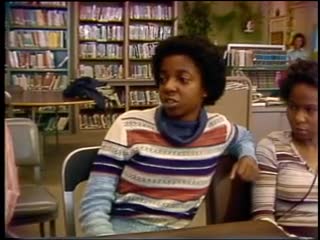
Description: South Boston High. Walking shot down corridor and dark stairs. In library, a group of black and white students discuss their experience in school since desegregation started four years ago. They attest to better educational programs and improved racial harmony now. “No fights.” They think police presence in the early years worsened tension.
Collection: Ten O'Clock News
Date Created: 06/08/1978