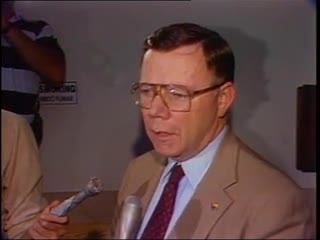
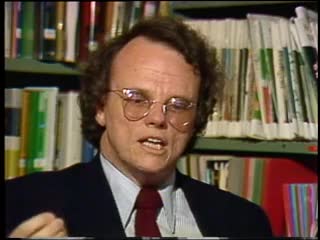
Description: Laval Wilson & Robert Schwartz announce reduced superintendent's staff and shift to school-based management. Decentralization. John O'Bryant, Peggy Davis-Mullen.School Committee hq 26 Court Street.
Collection: Ten O'Clock News
Date Created: 05/25/1989
Description: The Boston School Committee holds a meeting in the School Committee chambers. Members of the School Committee discuss school business. John O'Bryant (Boston School Committee) reports on the need for school repairs; Robert Spillane (Superintendent, Boston Public Schools) reports on staffing issues. Sharon Stevens (WGBH reporter) interviews Kathleen Kelly (President, Boston Teachers Union) about a proposed school choice plan. Kelly says that many parents support a school choice plan because the current system allows little flexibility. Kelly says that the school choice plan must be considered carefully to prevent a return to segregated schools. Stevens interviews O'Bryant about the proposed school choice plan. O'Bryant says that the plan promotes greater access to schools across the city; that the current system is archaic and inflexible. Stevens interviews Barbara Gray (parent) about the proposed school choice plan. Gray says that parents should be allowed to choose a school with programs suited to the needs of their children. Gray says that the schools need to be improved; that the Boston Public Schools are not truly integrated because there are few white students. Stevens has extended conversations with interviewees while cutaways are shot. Takes of Stevens doing standup about supporters of the school choice plan working on an official proposal for the end of the month. The audio quality on this tape is uneven.
1:00:12: Visual: A Boston School Committee meeting is held in the chambers of the Boston School Committee. School committee members Jean McGuire, John O'Bryant, Jean Sullivan McKeigue, Kevin McCluskey, and Rita Walsh Tomasini are seated at the front of the room. Robert Spillane (Superintendent, Boston Public Schools) sits at the front with the members of the School Committee. Community members and the press are seated in the audience. O'Bryant talks about the need for $40 million to make school repairs. He says that the mayor, the Boston City Council, and the community must be made aware of the money needed for repairs. Shots of the various committee members. McKeigue agrees that school repairs are needed. A vote is taken on approving a draft of a letter to the mayor and the Boston City Council. O'Bryant thanks Spillane for his report. O'Bryant asks Spillane a question about staffing. Spillane says that more staff is needed before instituting a certain program. Audio is muffled. Shots of Sharon Stevens (WGBH reporter); of members of the audience; of the stenographer; of the committee; of the audience. The committee members discuss school business. Audio remains muffled. Shot of the committee members from the perspective of the audience. 1:05:10: Visual: Spillane talks about setting objectives for the school Social Studies programs. Shots of the committee members; of the audience. Audio is muffled. The committee members take a vote. Committee members discuss school contract issues. Shot of Stevens; of Kathleen Kelly (President, Boston Teachers Union) speaking to another audience member; of audience members. 1:08:15: V: Stevens sets up an interview with Kelly. Stevens asks Kelly about a "freedom of choice" proposal supported by some African American parents. Kelly says that she has not yet seen the proposal; that many African American and white parents support a "freedom of choice" plan because the geocode system allows little flexibility; that parents are more interested in good education than racial statistics. Kelly says that a control mechanism must be put in place to prevent a return to segregated schools; that the plan must be given careful thought. Kelly says that the choice of educational programs is more important than the choice of school location. Stevens asks Kelly if busing is "almost dead." Kelly says that busing is no longer the only remedy for Boston schools; that busing can serve as a tool to further the goals of desegregation and educational quality. The crew takes cutaway shots of Stevens and Kelly. Stevens and Kelly speak informally. 1:12:36: V: Stevens sets up an interview with O'Bryant. Stevens asks for O'Bryant's opinion of the "freedom of choice" proposal. O'Bryant says that parents are trying to reform the rigid geocode system; that students have been denied access to schools because of the geocode system. O'Bryant mentions students who have been denied access to the Trotter School. O'Bryant says that the parents are asking for more accessibility to the schools; that the "freedom of choice" proposal has been made into a bigger issue than it should be. O'Bryant says that the geocode system assigns students to schools based upon their residence; that the geocode system is archaic and inflexible; that the geocode system must be addressed in the consent decrees put forth by the court; that leaving the geocode system in place would have "disastrous" consequences. Stevens asks O'Bryant about NAACP intervention in the court case, and NAACP opposition to the "freedom of choice" plan. O'Bryant says that there is a lack of communication between the NAACP and supporters of the plan; that supporters of the plan want greater access to the schools. Stevens asks if the "freedom of choice" plan could result in a return to segregated schools. O'Bryant says that schools in Boston are already segregated because white parents refuse to send their children to most schools located in African American communities; that African American parents want greater access to quality schools all over the city. The crew takes cutaway shots of Stevens and O'Bryant. O'Bryant says again that the "freedom of choice" plan does not represent a return to segregated schools. 1:16:13: V: Stevens sets up an interview with Barbara Gray (parent), who supports the "freedom of choice" plan. Gray says that the supporters of the plan want greater access to all of the schools; that supporters of the plan want an end to the rigid geocode system. Gray explains that the geocode system assigns children to schools according to address and race. Gray says that all of Boston schools need to have high standards; that the each of the schools should have different programs designed to suit specific needs; that students should be able to choose a school whose programs suit their needs. Gray says that education needs to be improved so that all of the schools are equally competitive and able to provide a good education. Stevens asks if the "freedom of choice" plan could result in a return to segregated schools. Gray says that she does not want to go back to segregated schools; that true integration does not exist in Boston because there are not enough white students in the school system; that white students might return to the system if the schools are reformed. The crew takes cutaway shots of Stevens and Gray. Gray says that parents want more control over the education of their children. 1:19:59: V: Stevens records the closing segment of the story from outside of the headquarters of the Boston School Committee. She reports that the supporters of the "freedom of choice" plan are working on an official proposal for the end of the month; that the Massachusetts State Board of Education will propose an end to court intervention in the Boston School System. Stevens does two more takes of the closing segment.
Collection: Ten O'Clock News
Date Created: 03/08/1982
Description: Parents question judgement and political motives of school committee in voting to close and consolidate nine schools. Judge will review validity of decision. Laval Wilson, Thomas O'Reilly.
Collection: Ten O'Clock News
Date Created: 08/14/1989
Description: Judge rules Boston School Committee cannot order school closings. Parents rejoice over injunction but still have questions about assignments.
Collection: Ten O'Clock News
Date Created: 08/22/1989
Description: South Boston High School exterior. Background comments of pedestrians talking to camera operator and reporter. Pam Bullard interviews headmaster Jerome Wynegar on what programs his school will offer, including core curriculum and vocational education. Wynegar says racial problems have been aggravated by outside agitators. He adds that the school is enrolled to capacity, and cannot accommodate students who wish to return after dropping out. He says that the school should make sure to listen to the suggestions of the students, and those students who dropped out, to try to improve the school. He commends the faculty. Additional comments from Wynegar as they shoot cutaways. Shots of graffiti painted on pavement, which reads “Stop Forced Busing.” Several takes of reporter voice over and standup.
Collection: Ten O'Clock News
Date Created: 08/17/1976
Description: Interview with headmaster Jerome Wynegar about changes at South Boston High School in last two years in four areas: administration, discipline, curriculum review, community relations. He sees improvement in students' ability to learn with fewer disruptions than in first years of busing. He discusses the school's attempt to prepare students for their futures. He says more research is needed into educational methods for a changing world; experiential learning should be emphasized over traditional lectures. He endorses alternative programs because attendance is encouraged. reel 1 of 2
Collection: Ten O'Clock News
Date Created: 06/01/1978
Description: Interview with headmaster Jerome Wynegar. Says there are more opportunities at South Boston High School than at any other school in the city. He is very sanguine about the integration of the student body, and the array in curriculum from basic skills to electives to vocational education. Compliments the administrative involvement of Joseph McDonough (community district superintendent). Says Boston School Department is notoriously bad in paying bills. reel 2 of 2
Collection: Ten O'Clock News
Date Created: 06/01/1978
Description: Pam Bullard interviews Kathleen Sullivan (Boston School Committee) about the quality of education in Boston. Sullivan says that she is frustrated because Boston schools have not improved since court-ordered desegregation began in 1974. Sullivan calls Arthur Garrity (federal judge) a "crazy judge." Sullivan says that the desegregation plans since 1974 have been disruptive. She says that neither African American nor white students have benefitted from school desegregation; that students should not be assigned to different schools each year. Sullivan and her assistant discuss Judge Garrity's latest order concerning the Boston schools. Bullard explains to Sullivan that she is putting together a piece which contrasts Sullivan's views on schools and court-ordered desegregation with the views of African American leader Melnea Cass
0:59:44: V: Pam Bullard interviews Kathleen Sullivan in her office. Bullard comments that Sullivan was elected to the School Committee because voters were impressed with her commitment to quality education and better schools. Bullard asks Sullivan how she would have fared if voters were less concerned with the state of the schools and more concerned with politics as usual. Sullivan says that she could have been re-elected. Sullivan says that parents are concerned about education; that a difficult economy coupled with the costs of school desegregation has made school improvement difficult. Sullivan says that the quality of education has not improved in the city since she was elected to the School Committee; that she feels frustrated in her efforts to improve the schools. 1:03:48: V: Bullard asks if it would damage Sullivan politically to admit that desegregation has improved Boston schools. Sullivan says that voters in Boston are beginning to accept desegregation as a fact; that the anti-busing movement has lost steam because people are tired; that voters would be happy to hear that schools have improved, even if the improvement was a direct result of desegregation and a "crazy judge on the scene." Sullivan says that there has been little improvement except in a few schools. Sullivan mentions that Roxbury High School, the Lewenberg School and the Curley School have seen improvement. Bullard asks why Sullivan never mentions the positive impact that desegregation has had on African American students, who now have access to an equal education. Sullivan says that she has been preoccupied with the budget this year; that she visited last year with African American students who had been assigned to three different schools in three years, and had not benefitted from the experience. Sullivan says that the school situation has begun to stabilize this year; that one can begin to talk about better education for African American students this year; that police presence in schools and community hostility to busing prevented a healthy school situation for African American students in 1974 and 1975; that she understands why African American parents might disagree with her because they wanted access to better schools for their children. Sullivan says that she hopes schools can be improved for all students; that she is worried because only 51,000 children attended Boston Public Schools last year, out of a school-age population of 117,000. Sullivan says that she taught African American students in Dorchester; that she thinks desegregation has been disruptive for those students; that the desegregation of Boston schools could have been beneficial for African American students and white students in 1974 and 1975 if it had been implemented differently. 1:10:34: V: An administrative assistant enters Sullivan's office to go over some papers with her. The assistant points out that Judge Garrity has ordered the School Committee to appoint a new Transitional Director of Program Development at South Boston High School. Sullivan and the assistant discuss Garrity's instructions. Sullivan and her assistant tell Bullard that Judge Garrity has approved 160 transfers out of 1,782 requests. Sullivan alludes to Garrity's heavy involvement in managing the Boston schools. 1:12:57: V: Bullard explains to Sullivan how she will edit the final piece. Shots of Sullivan's office. Bullard explains that she has also interviewed Melnea Cass (African American community leader) and wants the final piece to reflect the positions of the two women. Bullard says that both women are leaders, but that their positions on school desegregation reflect their ethnic heritage; that their positions are as far apart as the communities they represent. Sullivan points out that she has done a lot of work with African American students. Bullard says that Sullivan and Cass have a good working relationship because neither harbors strong racial prejudices; that both have friends of other races and backgrounds.
Collection: Ten O'Clock News
Date Created: 09/28/1976
Description: Mayoral candidates Mel King and Ray Flynn participate in a forum on education sponsored by the Citywide Education Coalition (CWEC) at English High School. Flynn talks about his experience in government and his commitment to the public schools. He notes his familiarity with the city and school budgets, and he discusses the importance of public education and public housing. King stresses the importance of early childhood education programs and a "child-centered" school system. King speaks of the need for the mayor to work together with the Boston School Committee. King says that the city must continue to demonstrate its support of integrated schools. King and Flynn respond to a question about requiring students to pass a standardized test in order to graduate. Tape 1 of 2.
1:00:05: Visual: Four members of the Citywide Education Coalition (CWEC) sit at a table on stage at English High School. A member of the CWEC welcomes mayoral candidates Ray Flynn and Mel King to the annual meeting of the CWEC. Flynn and King are seated at a table at the center of the stage. Shots of Flynn and King. The CWEC member says that the candidates and the audience will discuss the future of public education in Boston. 1:01:55: V: Flynn thanks the moderator and the CWEC. Flynn mentions his experience as a state legislator and a member of the Boston City Council. He says that he was a student in the Boston Public Schools. Flynn congratulates the CWEC for their commitment ot public education. Flynn stresses the importance of public education and a good school system. Flynn says that he has a Master's Degree in education from Harvard; that he is committed to education. Flynn says that he would visit a few public schools and a few public housing projects on his first day as mayor; that education and public housing will be major concerns for his administration. Flynn says that the mayor should be involved in public education; that politicians in Boston have distanced themselves from the public schools since desegregation. Flynn says that the mayor should serve as an ex-officio member of the Boston School Committee; that the mayor needs to be aware of the situation in the schools. Flynn says that he is familiar with the city and school budgets. Flynn says that fiscal stability and predictable student placements are important for the schools. The audience applauds. 1:07:56: V: King thanks the audience and the CWEC. King says that the students in the school system must be served from birth to graduation; that early childhood education programs are important. King says that resources must be allocated to support Head Start programs and other early childhood education programs. King says that "child-centered" school system must guarantee education for all students; that the school system must believe that all children can be educated. King says that the mayor must work with the Boston School Committee; that the members of the School Committee will be newly elected; that the mayor and the Boston School Committee must determine the problems and the needs of the school system. King says that the newly elected School Committee must be unified in support of integrated schools. Jump cut in videotape. King says that he would provide leadership on the issue of education; that he would work to create a good climate and to end divisiveness on the issue of education. King says that the Boston Public School System must demonstrate its commitment to integrated education. The audience applauds. 1:14:52: V: An audience member asks if students should pass a standardized test in order to graduate from high school. King says that standards need to be established in the early grades as well as upon graduation. King says that the school administration must be held responsible for the education of the students; that diagnostic testing and evaluation is needed at every grade level, not just upon graduation.
Collection: Ten O'Clock News
Date Created: 10/13/1983
Description: Mayoral candidates Ray Flynn and Mel King participate in a forum on education sponsored by the Citywide Education Coalition (CWEC) at English High School. Flynn says that students graduating from Boston public schools must be prepared to compete in the workplace. He adds that there must be a working relationship between parents, teachers, administrators, and the community. King speaks about the workings of the school administration and advocates the inclusion of parents in the process. King and Flynn respond to questions about how they would have handled school desegregation if they had been mayor at the time. Both candidates answer questions about the role of the mayor upon the court's withdrawal from its supervisory role over the school system and about the school budget. Audience members include John O'Bryant of the Boston School Committee. Tape 2 of 2.
1:00:00: Visual: Ray Flynn (candidate for mayor of Boston) speaks at a forum on education sponsored by the Citywide Education Coalition (CWEC) at English High School. The candidates' forum is held in conjuction with their annual meeting. Flynn says that students graduating from Boston public schools must be able to compete in the workplace. Long shot of candidates on stage from the back of the auditorium. Flynn says that there must be a working relationship between parents, teachers, administrators and the community. The audience applauds. 1:00:56: V: King speaks about the workings of the school administration. Jump cut in the videotape. Shots of John O'Bryant (Boston School Committee); of members of the audience. King says that parents must be included in the workings of the school system. Shot of the candidates on stage. An audience member asks what each candidate would have done about school desegregation if he had been mayor at the time. The audience member also asks about the role of the mayor when the court pulls withdraws from its supervisory role over the school system. King says that community control over schools is important; that community accountablility is an important aspect of community control; that members of the community must be held accountable for the state of neighborhood schools. King says that he had suggested a community approach to schools which could have prevented the kind of sweeping court order imposed by the federal court to accomplish school desegregation. King says that he would have tried to bring people together in support of school desegregation if he had been mayor at the time; that there were many people acting in opposition to the court order at the time of school desegregation. King says that he would provide leadership on the issue of quality, integrated education upon the withdrawal of the court. 1:05:08: V: Flynn responds to the same question about school desegregation. Flynn notes that the State Department of Education will continue to oversee the Boston Public School System after the withdrawal of the court. Flynn says that he will work with the State Department of Education to protect the Constitutional rights of public schoolchildren in Boston. Flynn says that political and moral leadership was absent during school desegregation in Boston. Flynn says that he would have defended the rights and the safety of Boston schoolchildren as mayor, even if he disagreed with the court order. Flynn notes that he was a state legislator at the time of school desegregation; that he was criticized at the time for standing up for his beliefs; that he was criticized for living in a certain community; that he acted responsibly on behalf of all of Boston's schoolchildren at the time. 1:07:15: V: An audience member asks about the school budget. Flynn says that it is important to educate children; that it is more expensive to remedy social problems resulting from poor education. Flynn says that he supported funding for Boston schools even when it was politically unpopular to do so; that he is committed to providing the necessary funds to assure a good school system. Flynn says that accountability is as important as funding; that the school system has too many administrators. King responds to the same question. King says that he is aware of the lack of resources available to teachers and students in the Boston Public School System; that the lack of resources is embarrassing for a school system with a large budget; that the school administrators must make a commitment to provide resources for students and teachers.
Collection: Ten O'Clock News
Date Created: 10/13/1983