Description: Hunter S. Thompson speaks at Somerville Theater to an audience full of adulation.
Collection: Ten O'Clock News
Date Created: 11/17/1989
Description: Hyde Park High School graduation. Students in caps and gowns. Valedictorian speaks. Proud parents.
Collection: Ten O'Clock News
Date Created: 06/14/1988
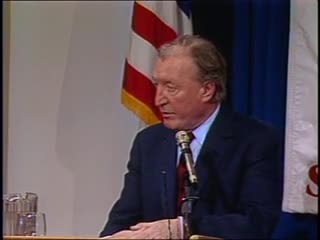
Description: Charles Haughey, prime minister of Ireland, visits Boston and speaks at Kennedy School. Protesters outside Ritz-Carlton.
Collection: Ten O'Clock News
Date Created: 04/22/1988
Description: Swearing in and inaugural address of John F. Kennedy.
Collection: Ten O'Clock News
Date Created: 01/20/1961
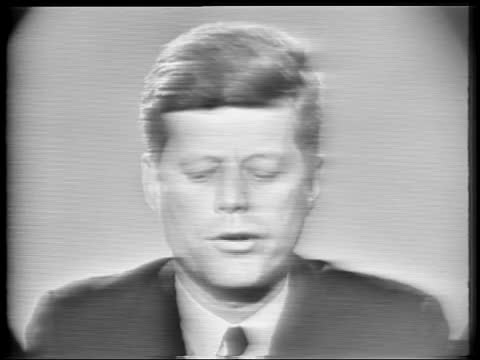
Description: John F. Kennedy's address on the nuclear test ban treaty. JFK signing the treaty (1963).
Collection: Ten O'Clock News
Date Created: 1963
Description: Clips of John F. Kennedy's 1960 presidential campaign against Richard Nixon. Nixon's concession speech.
Collection: Ten O'Clock News
Description: Marcus Jones reports that James Farmer (civil rights leader) spoke at Faneuil Hall during a ceremony to commemorate the death of Martin Luther King, Jr. (civil rights leader). Jones notes that Farmer was the head of the Congress for Racial Equality in the 1950s. Jones' report includes footage of Farmer addressing the audience at Faneuil Hall. Jones interviews Farmer about progress on civil rights issues in the US. Jones reports that Charles Yancey read a proclamation honoring King during the ceremony at Faneuil Hall. Jones' report is accompanied by footage of Yancey reading a proclamation at the ceremony and by footage of schoolchildren performing at the ceremony. Jones' report also includes footage of King during the civil rights movement. This tape includes additional footage from the ceremony at Faneuil Hall. This edition of the Ten O'Clock News also included the following item: Jesse Jackson (Democratic candidate for US President) has released position papers, detailing his stance on domestic issues
1:00:04: Visual: Black and white footage of Martin Luther King, Jr. (civil rights leader) delivering a speech. Black and white footage of a white man announcing the death of King to a group of students. Marcus Jones reports that today is the twentieth anniversary of King's death. Jones reports that James Farmer (civil rights leader) talked to an audience at a ceremony commemorating King's death at Faneuil Hall. V: Footage of Farmer addressing an audience at Fanueil Hall. Farmer talks about King's vision for the nation. Shots of the audience. Jones reports that Farmer was the head of the Congress for Racial Equality in the 1950s; that Farmer is now a visiting professor at Mary Washington College in Virginia. Jones says that Farmer believes that minorities have made great strides in the past twenty years. V: Footage of Farmer being interviewed by Jones at Faneuil Hall. Farmer says that there are plenty of things that need to change in the US; that some progress has been made by minorities. Jones reports that Charles Yancey (Boston City Council) read a city proclamation honoring King at the ceremony at Faneuil Hall. V: Footage of Yancey addressing the audience. Yancey says that King was once refused admittance to the Patrick T. Campbell Junior High School in Boston; that the school is now named for King. Jones reports that students from the Martin Luther King Middle School performed a song in honor of King. V: Footage of students from the King Middle School performing at Faneuil Hall. The audience applauds.
Collection: Ten O'Clock News
Date Created: 04/04/1988
Description: Christy George reports that Jesse Jackson spoke about leadership in a speech at the John F. Kennedy School of Government at Harvard University. George reports that Jackson is very active in this non-election year. George's report includes footage of Jackson walking a picket line with striking Eastern Airline employees and footage of Jackson visiting an Armenian earthquake zone. George talks about Jackson's activities since the 1988 election. George's report also features footage from Jackson's speech at Harvard. Jackson talks about voter cynicism in the 1988 election and the qualities of a good leader. Jackson says that the US must invest in itself in order to flourish. He explains a metaphorical term: "honeybee sense." George's report also includes footage from Jackson's 1988 presidential campaign. This edition of the Ten O'Clock News also included the following item: Lee Atwater visits Massachusetts for a Republican Party fundraiser
1:00:07: Visual: Footage of Jesse Jackson (African American political leader) as he enters an auditorium at the John F. Kennedy School of Goverment at Harvard University. The audience applauds for Jackson. Shot of a man in the crowd. Footage of Jackson addressing the audience. Jackson jokes about his speech being televised on C-Span. Jackson waves to his mother. Christy George reports that Jackson talked about the scarcity of good leaders in American politics during his speech at the Kennedy School of Government. V: Footage of Jackson delivering his speech. Jackson says that public cynicism won more voters than Bush did in the 1988 campaign. Jackson notes that 50% of the eligible voters did not vote; that 70% of voters expressed a desire for a different choice. Jackson says that Bush's campaign won while the country lost. Footage of Jackson at a campaign rally in New Hampshire on February 16, 1988. The crowd chants, "Win, Jesse, Win." George notes that Jackson travels the country regularly in non-election years. V: Shots of Jackson doing a television interview; of Jackson picketing with striking Eastern Airline employees. George reports that Jackson has walked with striking Eastern Airline employees across the nation; that Jackson turned a tour of an Armenian earthquake zone into a Soviet-American people's summit. V: Shot of a Soviet news anchor reading the news; of Jackson kissing a baby in Armenia. Footage of Jackson looking out of a window while riding on a bus in Armenia. Jackson speaks to the media, saying that human beings must care for one another. Footage of Jackson at a 1988 campaign rally. George calls Jackson a "perpetual candidate" and a "peripatetic preacher." V: Footage of Jackson speaking at the Kennedy School. Jackson says that he is a "liberal" who fights for change. Jackson says that pollsters and pundits are looking for a manufactured candidate. Jackson says that great leaders do not follow opinion polls; that great leaders mold public opinion. Jackson says that John F. Kennedy (former US President) was not following opinion polls when he reached out to Martin Luther King, Jr. (civil rights leader). Jackson says that Kennedy's actions were based on courage and principles. Jackson says that the US needs bold leadership to deal with the nation's "structural crisis." Jackson talks about "honeybee sense." Jackson says that honeybees know to drop pollen when they pick up nectar; that honeybees know the importance of keeping the flowers alive. Jackson says that the US needs to invest in itself in order to stay alive and flourish. The crowd rises to its feet and applauds for Jackson.
Collection: Ten O'Clock News
Date Created: 04/25/1989
Description: Marcus Jones reports that anti-war activists protested across the nation to rally public opinion against the use of force in the Persian Gulf, including in downtown Boston. Jesse Jackson visited MIT to speak out against going to war in the Middle East on the birthday of Martin Luther King, Jr. Jones notes that the MIT Initiative for Peace in the Middle East brought Jackson to the campus. Jackson says that the US must not rush to war on January 15. Interviews with MIT graduate students Corrie Lathan and Steve Penn, who oppose the war. Interview with Jesse Jackson, who says that the US and Iraq should negotiate because war is inevitable if talking is impossible. Jones' report includes footage from Inside Edition of Jackson in Iraq. Following the edited story is additional b-roll of anti-war demonstrations and of Jackson at MIT talking about Martin Luther King, Jr.
1:00:36: Visual: Footage of anti-war protesters on Winter Street in downtown Boston. The protesters carry signs protesting the Gulf War. They chant together, "We remember Vietnam. We won't go." Shot of two police officers standing in front of a building. Marcus Jones reports that a group of anti-war protesters demonstrated outside of the Army recruiting headquarters in Boston. V: Shot of a protesters carrying a sign reading, "U.S. Troops out of the Gulf." The protesters chant, "We won't fight for Texaco." Shot of a protester handing out leaflets. Jones reports that anti-war activists took to the streets across the country today; that the protesters are trying to rally public opinion against the use of force in the Persian Gulf. V: Shot of an older white woman wearing a sign around her neck. The sign reads, "Bring our troops home." Shot of two white children standing among the protesters. Jones reports that Jesse Jackson (African American political leader) visited MIT (Massachusetts Institute of Technology) tonight; that the members of the MIT Initiative for Peace in the Middle East brought Jackson to the campus. Jones reports that Jackson spoke out against going to war in the Middle East on the birthday of Martin Luther King Jr. (civil rights activist). V: Shots of Jackson greeting an MIT student; of Jackson greeting students as he walks to the podium. Shots of students in the audience. Footage of Jackson addressing the students. Jackson says that the US must not rush to war on January 15. Jackson says that efforts toward peace must be made on King's birthday. Footage of Corrie Lathan (MIT graduate student) being interviewed. Lathan says that she is opposed to the war; that the situation should be resolved in a non-violent manner. Footage of Steve Penn (MIT graduate student) being interviewed by Jones. Penn says that decision-makers in the US understand pressure; that the voice of the people must speak out against the war. Jones reports that Jackson's call for restraint may reflect a change in his thinking. Jones notes that Jackson met with Saddam Hussein (Iraqi leader) last year. Jones reports that Jackson said last year that war would be inevitable if talking proved impossible. V: Footage from Inside Edition of Jackson entering a building in Iraq; of Jackson speaking to Hussein. Jones questions whether Jackson has changed his position. V: Footage of Jackson speaking at MIT. Jones asks Jackson if he has changed his position. Jackson says that he has kept the same position. Jackson says that war is inevitable if talking is impossible. Jackson says that the US and Iraq should "talk"; that the two countries must choose negotiation over confrontation. The audience applauds for Jackson as he walks away from the podium.
Collection: Ten O'Clock News
Date Created: 01/14/1991
Description: John Hashimoto reports that Jesse Jackson visited Madison Park High School to talk to students. Hashimoto's report includes footage of Jackson's address to students in the school gymnasium. The students cheer enthusiastically as he approaches the podium. Jackson tells students that they must live with the consequences of their actions. He tells them that they can become whatever they want to be. He reprimands one student for talking during his speech. Jackson urges students to register to vote. He directs those who are not registered to a voter registration table in the gymnasium. Hashimoto reports on speculation that Jackson will run for the presidency in 1992. Hashimoto notes that Jackson could be elected senator if Washington DC becomes a state. Hashimoto reports that Jackson also spoke at the University of Massachusetts Boston. Hashimoto notes that Jackson addressed national and political issues in his address at UMass. Hashimoto's report features footage of Jackson's address at UMass. Hashimoto reports that Jackson is working to keep himself visible. Hashimoto calls Jackson a "perennial candidate" for elected office. The edited news story is followed by b-roll footage of Jackson and his entourage arriving at the high school, and the opening of the assembly including color guard and the end of the national anthem. Additional footage of Jackson's address. Byron Rishing, Bruce Bolling, and Charles Yancey sit behind Jackson during assembly. This edition of the Ten O'Clock News also included the following item: Francis "Mickey" Roache speaks to high school students on police stop-and-search policy
1:00:04: Visual: Footage of Jesse Jackson (African American political leader) holding up a child as the media photographs him. Jackson greets supporters and students at Madison Park High School in Roxbury. Shots of students in the audience. John Hashimoto reports that Jackson visited Madison Park High School to talk to students about reality, hope, and self-determination. V: Footage of Jackson addressing the students. Jackson asks students to stand if they know someone their age who is in jail because of drugs. Shots of students standing up in the audience. Footage of Jackson pointing to a student in the audience. Jackson tells the student that he will escort the student out of the auditorium if the student does not stop talking. Jackson tells the student to respect the student assembly. Footage of Jackson telling the students that they can be whatever they want to be. Jackson says that if Dan Quayle (US Vice-President) can be vice president, then the students can be whatever they want to be. The students applaud. Shots of students in the audience. Footage of Jackson telling the students that they must live with the consequences of their actions. Shots of the students rising to their feet to applaud for Jackson. Hashimoto reports that Jackson ended his talk by urging the students to vote. V: Footage of Jackson addressing the students. Jackson asks the students who are eligible to vote but who are not registered to come down to the voter registration table. Shots of students walking toward the table; of students registering to vote at the table. Hashimoto reports that many are wondering if Jackson will run for president in 1992. V: Footage of Jackson addressing the students. Jackson says that he will not talk about 1992. Jackson says that his priorities are to organize workers and to register voters. Shots of students lined up to register to vote. Hashimoto reports that Jackson sounds like a candidate; that Jackson is one of the backers of a bill to make Washington DC a state unto itself. Hashimoto notes that Washington DC would need 2 senators if it became a state; that Jackson could be a candidate for one of those two positions. V: Footage of Jackson, his entourage, and his supporters walking outside of a school building. Bruce Bolling (Boston City Council) walks with Jackson. Shot of Jackson entering a gymnasium at University of Massachusetts in Boston to the roaring applause of students. Jackson shakes hands with students near the podium. Shots of the audience as they applaud. Hashimoto reports that Jackson spoke at UMass Boston today; that he addressed national and political issues. V: Footage of Jackson speaking at UMass Boston. Jackson talks about the need to rebuild small towns in the US. Shots of Jackson addressing the audience at UMass Boston. Hashimoto reports that Jackson is working to keep himself visible. Hashimoto notes that Jackson's dominance as the nation's most visible African American leader is threatened by moderate politicians like Douglas Wilder (Governor of Virginia). V: Shot of Wilder exiting a voting booth. Hashimoto reports that Jackson will host his own television talk show in the fall. V: Shots of Jackson addressing the audience at UMass Boston. Footage of Jackson saying that it is time for mass action, mass education, mass demonstration; that it is time for the US to do the right thing. Hashimoto stands in the gymnasium at UMass Boston. Hashimoto reports that Jackson acts like a winner despite losing the Democratic nomination in 1988. Hashimoto says that many wonder if Jackson will ever become an elected official instead of a "galvanizing symbol." Hashimoto notes that Jackson is a perennial candidate for office, but has never won.
Collection: Ten O'Clock News
Date Created: 05/08/1990