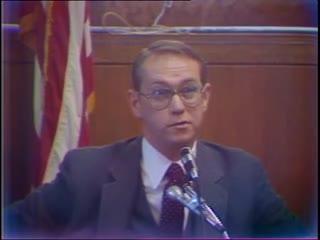
Description: Debra Stewart (witness) testifies during court proceedings in the criminal contempt trial of Michael Gaine (Hyde Park resident). Stewart says that Gaine urinated while facing the home of the Brooks family, made obscene gestures at the group outside of the home, and yelled Bertha Brooks's name loudly. Stephen Limon (Assistant Attorney General for the State of Massachusetts) calls Edgar Charles Brooks (witness) to testify. Brooks points out Gaine in the courtroom and says that Gaine slowed down as he walked by the Brooks home on the afternoon of August 22. Tape 2 of 5.
1:00:02: Visual: Court proceedings in the Michael Gaine criminal contempt trial. Debra Stewart (witness) continues to testify. Stewart indicates the location of the Brooks's home on the map of the Ross Field area of Hyde Park. Shot of Gaine. Stewart says that Michael Gaine (defendant) walked from Ross Field toward the Brooks' home; that Gaine unzipped his trousers and urinated while facing the Brooks's home; that Gaine made obscene gestures at the group outside of the Brooks's home. Stewart says that Gaine yelled Bertha Brooks's name loudly. 1:12:14: V: Richard Driscoll (attorney for the defendant) questions Stewart about the events on the afternoon of August 22. Driscoll questions Stewart about her relationship with Bertha and Charles Brooks. Driscoll questions Stewart about her previous statements. Driscoll points to the map while asking Stewart specific questions about her previous statements. Shots of the audience; of reporters in the audience. Stewart indicates the location of the entrance to Ross Field near the Brooks's home. Shots of the audience. 1:17:23: V: Shot of Gaine. Driscoll continues to ask Stewart to indicate locations on the map. Shot of a member of the audience. 1:18:11: V: Stephen Limon (Assistant Attorney General for the State of Massachusetts) calls Edgar Charles Brooks (witness) to testify. Limon asks Brooks questions about his work, education and family background. Limon asks Brooks about the events on the afternoon of August 22. Brooks points out Gaine in the courtroom. Brooks says that Gaine slowed down as he walked by his home on the afternoon of August 22.
Collection: Ten O'Clock News
Date Created: 09/02/1982
Description: Edgar Charles Brooks (witness) and Bertha Brooks (witness) testify in the criminal contempt trial of Michael Gaine (Hyde Park resident). Both witnesses say that Gaine urinated while facing the Brooks' home and that Gaine yelled Bertha Brooks's name loudly. Bertha Brooks says that Gaine stared at her and made obscene gestures, and that she called police. Tape 3 of 5.
1:00:05: Visual: Edgar Charles Brooks (witness) continues to testify in the criminal contempt trial of Michael Gaine (Hyde Park resident). Edgar Charles Brooks says that Gaine urinated while facing the Brooks's home; that Gaine yelled Bertha Brooks's name loudly; 1:02:43: V: Richard Driscoll (attorney for the defendant) questions Edgar Charles Brooks about his testimony. Driscoll shows Edgar Charles Brooks photographs of the area near Ross Field. 1:03:54: V: Bertha Brooks (witness) is sworn in. Stephen Limon (Assistant Attorney General for the State of Massachusetts) questions Bertha Brooks about her work and her family. Jump cut in videotape. Bertha Brooks says that Gaine urinated while facing her home; that Gaine continued to stare at the Brooks when he finished urinating. Bertha Brooks says that Gaine made obscene gestures at her and her family and guests. Jump cut in videotape. Bertha Brooks says that Gaine yelled her name loudly. Shots of James Lynch Jr. (Judge, Suffolk Superior Court). Bertha Brooks says that she called the police; that the police arrived 15 minutes after she called them.
Collection: Ten O'Clock News
Date Created: 09/02/1982
Description: Footage opens with judge announcing in court proceedings of trial regarding a restraining order violation filed by Bertha Brooks against Michael Gaine and David Gilligan. MacEachern describes actions leading to incident report against Michael Gaine about civil rights contempt of court -- violation of restraining order in Hyde Park. David Gilligan testifies. Defendant Michael Gaine, 18, also testifies, denies harassing residents. Reel 4 of 5.
1:00:02: Visual: Judge James Lynch, Jr. (Suffolk Superior Court) rules on a motion in the criminal contempt case of Michael Gaine. Richard Driscoll (attorney for the defendant) makes his opening statement. Driscoll begins his statement. Jump cut in videotape. Alan MacEachern (Boston Police Department) is sworn in as a witness. Driscoll asks MacEachern about the events on the afternoon of August 22. MacEachern says that Bertha Brooks told him that Michael Gaine (Hyde Park resident) was on Ross Field in violation of a restraining order; that MacEachern told Gaine to leave the field. MacEachern says that Bertha Brooks told him about the urinating incident when he took an incident report; that Bertha Brooks did not mention any obscene gestures made by Gaine. MacEachern says that he arrested Gaine after taking the incident report. Driscoll gives MacEachern a copy of his incident report. Stephen Limon (Assistant Attorney General for the State of Massachusetts) objects to Driscoll giving MacEachern the report. Driscoll questions MacEachern about what he was told by Bertha Brooks when he took the incident report. MacEachern looks at photographs of Ross Field provided by Driscoll. MacEachern says that Bertha Brooks told him that Gaines urinated 50 or 60 feet away from her property; that Bertha Brooks said that Gaines was directly in front of her house. The judge rules on an objection by Limon. 1:09:12: V: Limon questions a Hyde Park youth about his relationship with Gaine. The youth says that he knew about the restraining order; that he was with Gaine on Ross Field on August 22. 1:11:52: V: Gaine is sworn in as a witness. Driscoll asks Gaine about the events on the afternoon of August 22. Gaine says that he walked to Ross Field to join a group of friends on the afternoon of August 22. Gaine says that he walked over to the baseball diamond to urinate. Gaine indicates the spot where he urinated on a photograph provided by Driscoll. Gaine says that he did not make an obscene gesture; that he did not yell Bertha Brooks' name. Driscoll questions Gaine about his activities during the rest of the afternoon. Gaine says that the spot where he urinated was 197 feet from the Brooks' property. Gaine indicates the location of the Brooks' home on a photograph provided by Driscoll. Limon requests a five minute recess.
Collection: Ten O'Clock News
Date Created: 09/02/1982
Description: Michael Gaine (Hyde Park resident) testifies in his own criminal contempt trial. Gaine denies urinating in front of the Brooks family home. Gaine says that he understood the previous consent decree and knew that he was not supposed to go to Ross Field. Richard Driscoll (attorney for Gaine) asks Gaine if he intended to violate the consent decree. Gaine says no. In his closing arguments, Driscoll says that Gaine did not intentionally violate the consent decree. He says that the testimony of Bertha Brooks (witness) does not match the incident report filed by Alan MacEachern (Boston Police Department). Lynch rules that Gaine is guilty of intentionally violating the previous consent decree. Lynch charges Gaine with criminal contempt and sentences him to sixty days in the Charles Street jail. Gaine exits the courtroom. The Brooks family and their supporters exchange hugs in the courtroom. Tape 5 of 5
1:00:02: Visual: Michael Gaine (defendant) testifies in his criminal contempt trial. Stephen Limon (Assistant Attorney General for the State of Massachusetts) questions Gaine about the events on the afternoon of August 22. Limon asks Gaine where he urinated on the afternoon of August 22. Gaine denies urinating in front of the Brooks' home. Gaine says that he urinated inside the park. Limon asks Gaine if he understood the consent judgment issued by the court. Gaine says that he understood the consent judgment; that he understood that he was not supposed to congregate on Ross Field with other defendants. Limon finishes questioning Gaine. 1:05:36: V: Richard Driscoll (attorney for the defendant) asks Gaine if he had intended to violate the consent judgment. Gaine says no. Driscoll rests his case. Judge James Lynch, Jr. (Suffolk Superior Court) questions the attorneys about the length of their closing arguments. The lawyers agree to finish arguing the case that afternoon. Shots of Driscoll preparing for his closing arguments; of the audience; of witnesses, including Edgar Charles Brooks, Bertha Brooks, and Debra Stewart, entering the courtroom. 1:08:43: V: Driscoll makes his closing arguments. Driscoll reviews the charges against the defendant. Driscoll argues that the evidence does not show Gaine as violating the consent decree. Driscoll says that Gaine is guilty of urinating in a public place; that Bertha Brooks's testimony does not match the incident report taken by MacEachern; that the plaintiffs have an interest in seeing Gaine punished. Driscoll says that witnesses testified to seeing Gaine urinate; that the witnesses did not see Gaine make an obscene gesture or hear Gaine yell at the Brooks. Driscoll says that Gaine did not make obscene gestures or yell at the Brooks. 1:14:03: V: Lynch reviews the charges against Gaine. He reviews the consent judgment signed by Gaine. Lynch reminds listeners that the trial is a non-jury trial. He reviews the dual roles of the court in a non-jury trial. Lynch says that voluntary intoxication is not a defense for a criminal act. Lynch rules that Gaine is guilty of a willful violation of the consent judgment issued by the court on August 19. Lynch charges Gaine with criminal contempt. Driscoll asks for a few moments before the judge issues a sentence. Driscoll confers with Gaine. 1:18:09: Visual: Shots of the audience; of Bertha Brooks in the audience. Limon recommends that Gaine be sentenced to three months in county jail. Jump cut in videotape. Lynch says that he wants to show that "the law has teeth." Lynch says that violations which occur three or four days after a consent judgment has been issued are unacceptable. Lynch says that Gaine should have thought about the consequences of his actions. Lynch says that he would sentence Gaine to the Deer Island House of Corrections if it were possible under the current statute. Lynch sentences Gaine to 60 days in the Charles Street jail. Gaine and Driscoll stand for the sentencing of Gaine. Lynch denies Driscoll's motion for a stay of the jail sentence pending appeal. Gaine exits the courtroom as court is dismissed. The Brooks family and their supporters exchange hugs in the courtroom. Limon congratulates the Brooks. Limon, the Brooks, and their supporters exit the courtroom.
Collection: Ten O'Clock News
Date Created: 09/02/1982
Description: WOMAN TESTIFYING & DEFENDANTS IN PRATER TRIAL AT SUFFOLK SUPERIOR COURT
Collection: Ten O'Clock News
Date Created: 09/27/1982
Description: WBZ pool tape: Frank Walters, first day of Barry Locke Trial.
Collection: Ten O'Clock News
Date Created: 01/18/1982
Description: Christy George interviews Dorchester residents about the William Atkinson murder case. Reverend David Venator (United Church of Christ) says that the state could have filed more charges against the defendants; that violations of the civil rights of minorities have become commonplace. Venator says that the Dorchester community needs to deal with the racial prejudice which provoked the death of William Atkinson (Boston resident). Christy George (WGBH reporter) comments that Venator has condemned racial prejudice more severely than Francine Atkinson (William Atkinson's sister). Venator says that he can condemn racial prejudice because he is white; that he does not condone any kind of violence. Venator says that the Atkinson case is an example of a civil rights violation; that he has never experienced racial violence to that degree as a white man. A white male Dorchester resident says that Atkinson's death was not an isolated incident. The man notes that the Dorchester community has reacted strongly and quickly against Atkinson's death. The man says that the Dorchester community intends to see justice done in this case. George asks a white female Dorchester resident if she thinks that the media attention given to the Atkinson case helped bring about a more thorough investigation and the filing of stronger charges. The woman says that the media coverage is a result of the strong reaction against Atkinson's death by members of the Dorchester community. George comments that many white Dorchester residents are supporting the cause of William Atkinson. The woman says that Dorchester residents of all races are working together to fight racial violence and to make Dorchester a safer community. The tape includes footage of court proceedings in Suffolk Superior Court. George Hurd (Judge, Suffolk Superior Court) presides over the courtroom. The lawyers for the defendants identify themselves. The five defendants each plead not guilty to the charges against them. The charges are read out loud. John Kiernan (Assistant District Attorney) makes bail recommendations for the five defendants
0:00:32: Visual: Reverend David Venator (United Church of Christ) says that the state could have filed more charges against the defendants; that violations of the civil rights of minorities have become commonplace; that these violations are not always committed by the same individuals. Venator says that communities must face up to the disease of racial prejudice; that the Dorchester community needs to deal with the racial prejudice which provoked the death of William Atkinson (victim). Christy George (WGBH reporter) comments that Venator has condemned racial prejudice more severely than Francine Atkinson (William Atkinson's sister). Venator says that he can condemn racial prejudice because he is white; that he does not condone any kind of violence. Venator says that the Atkinson case is an example of a civil rights violation; that he has never experienced racial violence to that degree as a white man. A white male Dorchester resident says that Atkinson's death was not an isolated incident. The man wonders if there would have been arrests made in the case if the Dorchester community had not reacted strongly and quickly against Atkinson's death. The man says that the Dorchester community intends to see justice done in this case; that there has been harassment of some individuals involved in the Atkinson case. The man says that he hopes this case will call attention to the need for reform of the legal system. George asks a female Dorchester resident if she thinks that the media attention given to the Atkinson case helped bring about a more thorough investigation and the filing of stronger charges. The woman says that the media coverage is a result of the strong reaction against Atkinson's death by members of the Dorchester community. The woman says that members of the community want to see justice done in the Atkinson case. George comments that many white Dorchester residents are supporting the cause of William Atkinson. The woman says that Dorchester residents of all races are working together to fight racial violence and to make Dorchester a safer community. 0:07:06: V: Reporters and bystanders stand in a lobby. 0:07:13: V: Court proceedings in Suffolk Superior Court. Shots of Judge George Hurd (Suffolk Superior Court), the audience and the crowded courtroom. Hurd rules on a motion. 0:08:42: V: Court proceedings in the arraignments of Francis Devin, William Joyce, Paul MacGregor, Michael Nowacki and Edward Tuffo in the William Atkinson case. Hurd listens as the bailiff reads the names of the defendants. John Kiernan (Assistant District Attorney) speaks to the judge. Neil Connolly (attorney for MacGregor and Tuffo), Odin Anderson (attorney for Nowacki), Pamela Hattern (attorney for Devin) and George Donovan (attorney for Joyce) approach the podium to identify themselves. Audio is muffled. Devin, Joyce, MacGregor, Nowacki and Tuffo can be seen standing in the courtroom behind the lawyers. 0:11:06: V: MacGregor steps up to the microphone and pleads not guilty to five indictments. Nowacki steps up to the microphone and pleads not guilty to four indictments. Tuffo steps up to the microphone and pleads not guilty to four indictments. Devin steps up to the microphone and pleads not guilty to four indictments. Joyce steps up to the microphone and pleads not guilty to four indictments. Shot of all five defendants standing up in the courtroom. Kiernan makes bail recommendations for the defendants. Kiernan notes that Joyce is serving a suspended sentence for an incident in April of 1981. Donovan steps up to the microphone to confirm Kiernan's facts about Joyce. Kiernan makes recommendations on Joyce's bail.
Collection: Ten O'Clock News
Date Created: 03/31/1982