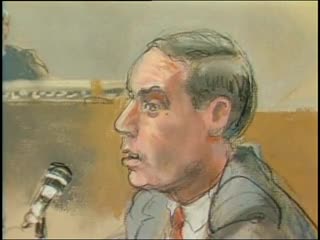
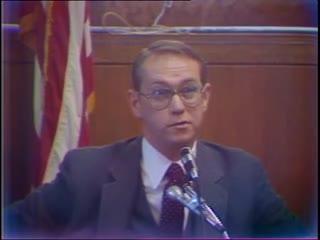
Description: INTERVIEW ABOUT VINCENT PIRO TRIAL, EXTERIORS OF COURTHOUSE
Collection: Ten O'Clock News
Date Created: 10/02/1984
Description: VISUALS OF Vincent PIRO TRIAL, CHAMBER SKETCHES OF PIRO, JUDGE, WITNESSES
Collection: Ten O'Clock News
Date Created: 05/02/1985
Description: Vincent PIRO IN COURT, COURTROOM VISUALS
Collection: Ten O'Clock News
Date Created: 10/10/1984
Description: JESSE WATERS ON TRIAL FOR BRIBING BOSTON POLICE TO IGNORE DRUG DEALS. corruption.
Collection: Ten O'Clock News
Date Created: 09/15/1986
Description: JESSE WATERS DRUGS / BRIBES TRIAL, STILL OF FRANK TARANTINO, COURTROOM SKETCHES. HOWARD JOHNSON'S RESTAURANT EXTERIOR
Collection: Ten O'Clock News
Date Created: 09/16/1986
Description: WBZ pool tape: Frank Walters, first day of Barry Locke Trial.
Collection: Ten O'Clock News
Date Created: 01/18/1982
Description: Christy George interviews Dorchester residents about the William Atkinson murder case. Reverend David Venator (United Church of Christ) says that the state could have filed more charges against the defendants; that violations of the civil rights of minorities have become commonplace. Venator says that the Dorchester community needs to deal with the racial prejudice which provoked the death of William Atkinson (Boston resident). Christy George (WGBH reporter) comments that Venator has condemned racial prejudice more severely than Francine Atkinson (William Atkinson's sister). Venator says that he can condemn racial prejudice because he is white; that he does not condone any kind of violence. Venator says that the Atkinson case is an example of a civil rights violation; that he has never experienced racial violence to that degree as a white man. A white male Dorchester resident says that Atkinson's death was not an isolated incident. The man notes that the Dorchester community has reacted strongly and quickly against Atkinson's death. The man says that the Dorchester community intends to see justice done in this case. George asks a white female Dorchester resident if she thinks that the media attention given to the Atkinson case helped bring about a more thorough investigation and the filing of stronger charges. The woman says that the media coverage is a result of the strong reaction against Atkinson's death by members of the Dorchester community. George comments that many white Dorchester residents are supporting the cause of William Atkinson. The woman says that Dorchester residents of all races are working together to fight racial violence and to make Dorchester a safer community. The tape includes footage of court proceedings in Suffolk Superior Court. George Hurd (Judge, Suffolk Superior Court) presides over the courtroom. The lawyers for the defendants identify themselves. The five defendants each plead not guilty to the charges against them. The charges are read out loud. John Kiernan (Assistant District Attorney) makes bail recommendations for the five defendants
0:00:32: Visual: Reverend David Venator (United Church of Christ) says that the state could have filed more charges against the defendants; that violations of the civil rights of minorities have become commonplace; that these violations are not always committed by the same individuals. Venator says that communities must face up to the disease of racial prejudice; that the Dorchester community needs to deal with the racial prejudice which provoked the death of William Atkinson (victim). Christy George (WGBH reporter) comments that Venator has condemned racial prejudice more severely than Francine Atkinson (William Atkinson's sister). Venator says that he can condemn racial prejudice because he is white; that he does not condone any kind of violence. Venator says that the Atkinson case is an example of a civil rights violation; that he has never experienced racial violence to that degree as a white man. A white male Dorchester resident says that Atkinson's death was not an isolated incident. The man wonders if there would have been arrests made in the case if the Dorchester community had not reacted strongly and quickly against Atkinson's death. The man says that the Dorchester community intends to see justice done in this case; that there has been harassment of some individuals involved in the Atkinson case. The man says that he hopes this case will call attention to the need for reform of the legal system. George asks a female Dorchester resident if she thinks that the media attention given to the Atkinson case helped bring about a more thorough investigation and the filing of stronger charges. The woman says that the media coverage is a result of the strong reaction against Atkinson's death by members of the Dorchester community. The woman says that members of the community want to see justice done in the Atkinson case. George comments that many white Dorchester residents are supporting the cause of William Atkinson. The woman says that Dorchester residents of all races are working together to fight racial violence and to make Dorchester a safer community. 0:07:06: V: Reporters and bystanders stand in a lobby. 0:07:13: V: Court proceedings in Suffolk Superior Court. Shots of Judge George Hurd (Suffolk Superior Court), the audience and the crowded courtroom. Hurd rules on a motion. 0:08:42: V: Court proceedings in the arraignments of Francis Devin, William Joyce, Paul MacGregor, Michael Nowacki and Edward Tuffo in the William Atkinson case. Hurd listens as the bailiff reads the names of the defendants. John Kiernan (Assistant District Attorney) speaks to the judge. Neil Connolly (attorney for MacGregor and Tuffo), Odin Anderson (attorney for Nowacki), Pamela Hattern (attorney for Devin) and George Donovan (attorney for Joyce) approach the podium to identify themselves. Audio is muffled. Devin, Joyce, MacGregor, Nowacki and Tuffo can be seen standing in the courtroom behind the lawyers. 0:11:06: V: MacGregor steps up to the microphone and pleads not guilty to five indictments. Nowacki steps up to the microphone and pleads not guilty to four indictments. Tuffo steps up to the microphone and pleads not guilty to four indictments. Devin steps up to the microphone and pleads not guilty to four indictments. Joyce steps up to the microphone and pleads not guilty to four indictments. Shot of all five defendants standing up in the courtroom. Kiernan makes bail recommendations for the defendants. Kiernan notes that Joyce is serving a suspended sentence for an incident in April of 1981. Donovan steps up to the microphone to confirm Kiernan's facts about Joyce. Kiernan makes recommendations on Joyce's bail.
Collection: Ten O'Clock News
Date Created: 03/31/1982
Description: Sharon Stevens interviews Willie Sanders (Boston resident), after his acquittal on rape and assault charges. Sanders discusses his bitterness at being wrongly accused and prosecuted for raping a white woman and compares his ordeal to the Scottsboro rape cases in 1932. Sanders says he met Clarence Norris (Scottsboro defendant); says that little has changed since that case; says that African Americans need to get organized to prevent the recurrence of these cases. Sanders describes his ordeal; accuses the police officers in District 14 of engineering the rape accusation; says that the officers involved in his case have been revealed as "devils." Sanders says that he is writing a book about his experience with the legal system and describes what he sees as a double standard within the legal system. Sanders talks about growing up in the South and discusses differences between the racial climates in the North and in the South. Sanders talks about the racism in the North; accuses the district attorney of racism; recounts instances of racism in the courtroom; and discusses inequities in the legal system.
0:00:23: Visual: Sharon Stevens interviews Willie Sanders (Boston resident) in an apartment. Sanders sits on a couch. Stevens asks if Sanders is angry at the system after his ordeal. Sanders says that he has every right to be bitter; that his case is not the first in which an African American man is wrongly convicted for the rape of a white woman. Sanders mentions the Scottsboro rape cases in 1932. Sanders says that African Americans need to get organized to prevent it from happening again. Stevens asks Sanders if he had been aware of the Scottsboro cases and other civil rights cases before the rape trial. Sanders says that he had been working hard to take care of his family before the rape trial. He says that he has met some good people while fighting the rape charge; that he met Clarence Norris (Scottsboro defendant); that little has changed since the Scottsboro cases in 1932. Sanders says that he has been given a lot of support. Sanders says that the police officers in District 14 engineered the rape accusation. Stevens remarks that Sanders has been quoted as referring to the officers involved in his case as "devils." Sanders describes being taken from his home by police officers, who told him he would only be gone for a few minutes. Sanders describes being held at the District 14 police station. He says that William Curry (Boston Police Department) was in charge of the rape investigation. Sanders says that he thought that the rape charge would be dropped. Sanders adds that he became very angry as the case progressed. Sanders says that his faith helped to see him through the ordeal; that the situation began to turn in his favor when he let go of his anger and forgave his persecutors. Sanders says that he began to smile at the trial because he knew his faith would see him through; that the district attorney mistook his smile for one of guilt. Sanders says that the officers involved in his case have been revealed as "devils." 0:09:56: V: Sanders says that he is writing a book about his experience with the legal system; that there is a double standard in the legal system; that the judges in the legal system are covering for the police officers. Sanders says that he and his lawyers raised a lot money for his defense; that the legal system only works for those with money. Sanders says that African Americans pay for their freedom in the US. He describes how difficult it was to find a good lawyer for his case. Stevens asks Sanders again about growing up in the South. Sanders says that African Americans in the South are better off than African Americans in the North; that African Americans in the South are united; that African Americans in the North need to organize themselves. Sanders says that he was not thinking about these issues before the rape trial. Sanders says that white people in the north are racist; that they assume that all African Americans are criminals. Sanders accuses the district attorney of being racist. Sanders recounts instances of racism in the courtroom. Sanders says that the legal system in Boston works against African Americans; that there are not enough African Americans serving jury duty. Sanders says that an African American suspect does not stand a chance when the judge, jurors, and victim are all white. Sanders says that he wants to keep working for civil rights causes. Sanders tells a story about how someone sent him a dollar in the mail to help with his legal expenses; that he knew that the person who sent the dollar was poor and had made a sacrifice for him. Sanders says that he and his family have learned a lot from this experience; that his son did a project in school based upon the experience. Sanders talks about being arrested on rape charges, even though he had an alibi. He says that the victim was not able to identify him as the rapist.
Collection: Ten O'Clock News
Date Created: 10/21/1980
Description: ILLARIO ZANNINO SENTENCED TO PRISON FOR GAMBLING+LOANSHARKING
Collection: Ten O'Clock News
Date Created: 03/12/1987