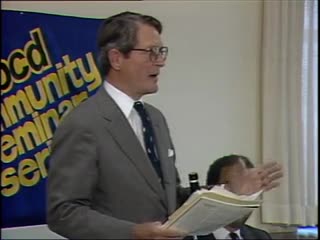
Description: ELLIOT RICHARDSON AT ABCD COMMUNITY PROGRAM MEETING ON POVERTY
Collection: Ten O'Clock News
Date Created: 04/30/1984
Description: Byron Rushing (State Representative) addresses a rent control demonstration outside Boston City Hall. He encourages tenants to fight for their rights, urges voters not to support anti-rent control candidates, and advocates a citywide referendum on the issue. Pat Burns (Catholic Connection) speaks about Sojourner House, a shelter for homeless families and the Catholic Connection's support for rent. Boston City Councilors Ray Flynn, Michael McCormack, Christopher Iannella and Maura Hennigan confer in the chambers of the Boston City Council. Boston City Councilors Frederick Langone, Albert "Dapper" O'Neil, Terence McDermott, Bruce Bolling , and Joseph Tierney are also present. The gallery of the chambers is filled with observers, many wearing pro-rent control buttons. Ianella calls the meeting to order and the clerk reads appropriation orders and requests submitted by Kevin White (Mayor, City of Boston) for the approval of the council. The council discusses and votes on orders from the mayor concerning the Public Works Department and the Public Facilities Commission. The clerk reads a request from the mayor concerning the financing of a bond for the Winthrop Printing Company. The Council conducts business on the chamber floor with Langone discussing a proposed law concerning the cleanliness of dumpsters in the city and about building affordable housing instead of high-priced condominiums. Sounds cuts out near the end and then comes back in.
1:00:04: Visual: Byron Rushing (State Representative) speaks into a microphone. He says that working class and poor people need to fight for their rights as tenants. The crowd claps. Rushing says that voters must vote against politicians who do not support rent control; that rent control must be brought to the ballot as a citywide referendum. The crowd claps. Shots of the crowd outside of City Hall. A white woman addresses the crowd, saying that it is not a good idea to classify tenants as elderly, disabled or low-income; that those classes of tenants will have difficulty finding apartments. Shots of two older men in the crowd. One of them is wearing a button which reads, "Rent Control: Continue and Strengthen it. Ban condominium conversion evictions." Shot of the button. Pat Burns (Catholic Connection) addresses the crowd. Burns talks about Sojourner House, which is a shelter for homeless families. Burns says that the Catholic Connection supports rent control in order to stop the increasing number of homeless families. Shot of a man holding a rent control sign reading, "No rent control plus no condo ban equals no housing." Shots of the crowd listening to Burns. Several crowd members are holding pro-rent control signs. 1:02:23: V: The white woman addresses the crowd as they move into the City Hall building. Shots of the crowd as they enter City Hall. One woman holds up a sign reading, "Landlords get the money. Tenants get the shaft." 1:03:33: V: Boston City Councilors Ray Flynn, Michael McCormack, Christopher Ianella and Maura Hennigan confer in the chambers of the Boston City Council. Frederick Langone (Boston City Council) confers with a woman on the floor of the chambers. Langone sits down in his chair, with his cigar in his mouth. The gallery of the chambers is filled with observers. Many observers wear pro-rent control buttons. Albert "Dapper" O'Neil (Boston City Council) joins the group of councilors. 1:05:51: V: Hennigan sits in her chair on the floor of the chambers. She flips through some papers on the table in front of her. Flynn sits down in his seat. Langone lights his cigar. Terence McDermott (Boston City Council) is sitting in his seat on the floor of the chamber. Albert "Dapper" O'Neil (Boston City Council) sits in his seat. The clerk calls the roll of city council members. Ianella brings the meeting to order. 1:08:28: V: The clerk reads appropriation orders and requests submitted by Kevin White (Mayor, City of Boston) for the approval of the council. The council discusses and votes on orders from the mayor concerning the Public Works Department and the Public Facilities Commission. Shots of McDermott; of McCormack; of Langone; of audience members in the Council gallery. The clerk calls the council roll for a vote on the order concerning the Public Facilities Commission. Shot of Bruce Bolling (Boston City Council). The clerk reads a request from the mayor concerning the financing of a bond for the Winthrop Printing Company. 1:12:03: V: Shots of audience members in the gallery; long shot of the floor of the Council Chamber from the gallery. Audio is muffled. Langone discusses a proposed law concerning the cleanliness of dumpsters in the city. More shots of audience members. 1:15:45: V: Councilors conduct business on the floor of the Chamber. Langone talks about housing. Shots of Christy George (WGBH reporter); of Bolling, Flynn and Hennigan; of Bolling; of Flynn; of Joseph Tierney (Boston City Council). The Council continues to conduct business. Langone talks about building affordable housing instead of high-priced condominiums.
Collection: Ten O'Clock News
Date Created: 12/15/1982
Description: Marcus Jones interviews Eugene Rivers of the African Peoples Pentecostal Church about his community work in the greater Roxbury neighborhood. Jones notes that Rivers is an outspoken critic of the religious establishment. He adds that Rivers spends a lot of time counseling troubled youth and acting as a legal advocate for them. Rivers talks about his work with neighborhood youth. Rivers says that many troubled teenagers come from disadvantaged socioeconomic backgrounds. Rivers talks about the need for churches to do more to reach out to young people. Rivers says that churches must provide alternatives for young people. Rivers talks about violence in the community and about his commitment to young people in the neighborhood. Jones notes that violence is a problem in the neighborhood. He adds that Rivers is committed to fighting the problem. Jones' report is accompanied by footage of Rivers talking to young people on the street and footage of Rivers' church van, damaged from gunfire.
1:00:06: Visual: Footage of Eugene Rivers (Pastor, African Peoples Pentecostal Church) talking to two young African American men in front of a courthouse. Marcus Jones reports that Rivers is not a social worker; that Rivers spends a lot of time counseling troubled youth. Jones reports that Rivers is the pastor of the African Peoples Pentecostal Church; that Rivers' church holds its meetings at the Freedom House in Roxbury. V: Footage of Rivers being interviewed by Jones. Jones asks how much of Rivers' time is taken up by troubled youth. Rivers says that his wife thinks that he spends too much time. Jones asks Rivers how often he is in the courthouse. Rivers says that he is in the courthouse three or four days per week. Rivers says that a large number of teenagers end up getting into trouble for legitimate reasons; that many these teenagers get into trouble stemming from their socio-economic backgrounds. Rivers says that he tries to make himself available to help these people. Shot of Rivers walking on a sidewalk with a young African American man. Jones reports that Rivers is an outspoken critic of the religious establishment. Jones reports that Rivers believes that religious leaders have failed the young people of Roxbury, Dorchester, and Mattapan. Jones notes that Rivers believes that religious organizations need to provide alternatives to drugs, gangs, and violence. V: Shot of a group of African American teenage boys standing in front of a house. Another group of African American teenage boys rides by on bicycles. Footage of Rivers being interviewed by Jones. Rivers says that churches are the premier institutions in the African American community. Rivers says that churches, including his own, are not doing enough to reach out to young people. Rivers says that the absence of the churches on the street is more conspicuous than the presence of drugs. Shot of Rivers walking on the street with another African American man. Rivers stops an African American teenage boy. Rivers starts talking to the boy. Footage of Rivers being interviewed by Jones. Rivers says that many young men are involved in illegal activities because no other form of activity was available to them. Rivers says that many young drug dealers never had adult role models; that many young drug dealers never had access to any kind of significant alternative. Shot of Rivers walking down the courthouse steps with another man. Jones reports that Rivers speaks from experience when he talks about role models. Jones reports that Rivers was a gang member and drug dealer in Philadelphia before he enrolled at Harvard University. Jones notes that Rivers is trying to make a difference on the streets of a neighborhood where gang violence is commonplace. V: Shot of bullet holes in the windshield of Rivers's van. Footage of Rivers counting the bullet holes on his van. Rivers points out the damage done to his van. Close-up shot of a bullet hole on the side of the van. Jones reports that gang members fired dozens of bullets into the home of Rivers's next-door nieghbor last month. Jones reports that many of the bullets hit Rivers's church van; that two bullets pierced the wall of his home. V: Shot of Rivers and Jones outside of Rivers's home. Shot of a bullet hole in the window of a home. Shots of the broken windows of the church van; of broken glass inside of the van. Shot of a bullet hole in the wall of Rivers's home. Footage of Rivers being interviewed by Jones outside of his home. Jones comments that Rivers's neighbors have moved out of their home. Rivers says that he feels a commitment toward the community; that he wants to make something happen here. Shot of Rivers and Jones framed by the broken window of the van. Jones reports that Rivers, his family and his congregation want to make the African American community aware of its responsibility to change things. Jones reports that Rivers wants the community to work at making improvements instead of blaming outsiders. V: Footage of Rivers being interviewed by Jones. Rivers says that kids will participate in legitimate acitivities if those activities are provided. Jones asks who will provide the activities. Rivers says that African American churches need to come up with alternatives for youth; that the churches should close shop if they fail to provide alternatives. Rivers says that African American churches should become employers, educators, advocates; that the churches should be in the courts and in the jails. Rivers says that the churches have failed to understand the meaning of the gospel if they fail to take up this challenge.
Collection: Ten O'Clock News
Date Created: 08/15/1990
Description: Carmen Fields reports that the infant mortality rate in Boston's African American community is three times the rate in white communities. Fields interviews Jeanne Taylor, PhD (Roxbury Comprehensive Health Center) and David Dolin (Executive Vice President, Beth Israel Hospital)) about the partnership between the two facilities and the rising infant mortality rate in Boston. Dolin says that the high infant mortality rate is a social problem involving health, education, housing, employment, and crime. He adds that advances must be made in all of those areas in order to combat the high infant mortality rate in Boston. Taylor talks about the role of community health centers and the benefits of relationships between community health centers and large hospitals. Taylor says that the infant mortality rate is only one indicator of distress in the African American community. Fields reports that the concept of linkage is being applied to health care through the partnerships between the large and small medical facilities. Fields's report includes footage of infants being cared for in the nursery of a health facility.
1:00:15: Visual: Footage of Jeanne Taylor, PhD (Roxbury Comprehensive Health Center) being interviewed by Carmen Fields. Taylor says that Roxbury Comprehensive Health Center has always been an independently licensed health center; that the health center is federally funded. Taylor says that Roxbury Comprehensive Health Center does not have a relationship with the city or the state. Taylor says that the health center has had informal relationships with hospitals in the past. Taylor says that hospitals provide a wealth of resources to health centers; that hospitals can provide specialists to health centers; that hospital residents can come to work in health centers. Fields reports that the infant mortality rate in Boston's African American community is three times the rate in white communities. Fields notes that the gap grew in 1989 and in 1990. Fields notes that the African American community is called a "death zone." V: Shots of an African American infant hooked up to breathing equipment; of a health care worker monitoring medical equipment in a hospital nursery; of a monitor on the medical equipment. Shot of the health care worker tending to an infant; of the infant hooked up to equipment. Footage of David Dolin (Executive Vice President, Beth Israel Hospital) being interviewed by Fields. Dolin suggests that there is no one to blame for the high infant mortality rate; that you cannot place blame on any one segment of the health care community. Dolin says that the problem may not be a health problem; that the problem is a social problem involving health, education, housing, the police department, and the mayor's staff. Fields reports that the concept of linkage is being applied to health care and the infant mortality rate. V: Footage of Taylor being interviewed by Fields. Taylor says that many hospitals have had limited interest in partnering with health care centers in the past; that many hospitals and health care centers had relationships of mistrust. Taylor says that the mistrust stems from the African American community. Taylor says that the health care profession has performed questionable research on African Americans; that African Americans have not been included in medical research in the past. Taylor says that hospitals are usually interested in partnering with health care centers for research purposes. Taylor says that the relationship of mistrust between hospitals and health care centers has changed. Footage of Dolin being interviewed by Fields. Dolin says that funding is coming from health care centers and hospitals; that there is little funding from the government. Dolin says that health care centers and hospitals are underfunded; that some areas get neglected. Dolin says that many factors affect maternal and infant health; that increased funds from hospitals and health care centers can be undermined by these other factors. Footage of Taylor being interviewed by Fields. Fields asks Taylor to explain linkage as it applies to community health centers. Taylor says that linkage promotes relationships between large medical facilities and smaller health care centers with limited resources. Taylor says that the health care centers can gain access to hospital amenities. Taylor says that health care centers can take advantage of hospital residents and hospital purchasing discounts for equipment and supplies. Taylor says that health care center physicians can admit patients to the partnering hospital; that the health care physicians can be on the faculty of these hospitals. Taylor says that physicians at health care centers need extra benefits because they do not make high salaries. Footage of Dolin being interviewed by Fields. Dolin says that hospitals have a responsibility to the local community. Dolin says that the best way to deliver care to the community is through the health care center. Dolin says that the hospitals need to provide their expertise and resources to aid the health care centers. Dolin says that he sees no disadvantages to the relationships between hospitals and health care centers. Footage of Taylor being interviewed by Fields. Fields asks what will happen if linkage is not adopted. Taylor says that costs will rise; that there will be a double standard in health care across the nation. Footage of Dolin being interviewed by Fields. Dolin says that the high infant mortality rate and other problems will not be solved if linkage is not adopted. Dolin says that there are other factors; that problems in the areas of crime, drugs, housing, and education must also be solved. Footage of Taylor being interviewed by Fields. Taylor says that the infant mortality rate in the African American community is only one indicator of the distress in that community. Taylor says that the major hospitals in Boston did not realize that the infant mortality rate was a problem until a major newspaper printed a story about it. Taylor says that the African American community has been neglected; that the neglect must stop.
Collection: Ten O'Clock News
Date Created: 01/28/1991
Description: PEOPLE EATING AT SALVATION ARMY SOUP KITCHEN. INTERVIEW ON FEEDING NEEDY. HUNGER, HOMELESS.
Collection: Ten O'Clock News
Date Created: 08/08/1983
Description: STREET PEOPLE SERVED FREE MEALS FROM VAN IN QUINCY
Collection: Ten O'Clock News
Date Created: 09/18/1984
Description: Shoshana Pakciarz of Project Bread says that one fourth of the state's children suffer from hunger. Brookline food pantry at St. Paul's Episcopal Church. Walk for Hunger.
Collection: Ten O'Clock News
Date Created: 05/16/1991
Description: While John Silber speaks to bankers on the state economy, many men wait in line for jackets at Salvation Army in Cambridge. Silber refers to filing his income tax return.
Collection: Ten O'Clock News
Date Created: 10/22/1990
Description: Meg Vaillancourt reports on a protest by Cambridge activists against plans proposed by MIT to develop a parcel of land near Central Square. Protesters accuse MIT and the developer of misleading the public by underestimating the size and scope of the project planned for the Simplex site. Bill Cavellini from the Simplex Steering Committee and Ken Campbell of MIT discuss the plans for the site. Vaillancourt reviews the plans for the site. The protesters differ with MIT over the amount of low-income housing to be built on the site and on the definition of low-income housing. Bill Noble from the Simplex Steering Committee criticizes MIT's definition of low-income housing. Cambridge activists and the homeless community are at odds with one another over the most effective form of protest against the development. At a protest, a scuffle breaks out between one of the activists and a homeless man. Community activist Mel King tries to make peace between the two sides. The Cambridge City Council will soon vote on the planned development. Following the edited story is additional b-roll footage of students on the campus of MIT in warm weather.
1:00:05: Visual: Footage of a group of protesters marching through a snowy lot near Central Square in Cambridge, chanting "We say no to MIT." Meg Vaillancourt reports that a small band of Cambridge activists are protesting the development of 27 acres of land owned by MIT (Massachusetts Institute of Technology); that MIT is working with Forest City Developers to build a multi-million dollar research and development complex; that the proposed site is known as the Simplex site. V: Shots of protesters standing near a sign for University Park at MIT; of the sign for University Park. Footage of a protest leader addressing the crowd of demonstrators. The protesters carry signs. Vaillancourt reports that the activists claim that developers deliberately misled the public; that the developers underestimated the size and scope of the project. V: Footage of Bill Cavellini (Simplex Steering Committee) saying that the developers told the public that they would build a $250 million development; that the developers will build a $500 million development. Cavellini tells Vaillancourt that the activists received documentation about the development from a confidential source. Cavellini says that Forest City Developers have been deceptive and have breached the public's trust. Footage of Ken Campbell (MIT) saying that the activists got hold of documents from October of 1987; that the Cambridge City Council approved the plan for the site in December of 1987; that the plan approved by the Council includes 400,000 square feet of housing. Shot of documents and information distributed by the opponents of the plan. Vaillancourt reports that the University Park Development Plan includes housing, a hotel and a 12-screen cinema; that a four- to six-screen theater had been discussed by the developer in public. V: Shot of a vacant lot in Cambridge, covered with snow; of a group of people standing outside of a house in Cambridge. Vaillancourt reports that opponents say that numerous zoning changes will be required to build the project, including the widening of streets and the removal of the city fire station in Central Square. V: Shot of a group of protesters; of a sign reading, "Cambridgeport has decided to stop MIT expansion." Vaillancourt says that MIT and the Simplex Steering Committee differ on how much low-income housing will be built on the site. V: Footage of Campbell saying that MIT has doubled the amount of affordable housing in the original proposal; that MIT is proposing 100 low-income units and 50 moderate-income units. Footage of Bill Noble (Simplex Steering Committee) saying that MIT's definition of low- and moderate-income is not accurate; that MIT is really proposing moderate- and middle-income units. Vaillancourt reports that there are many homeless people in the area; that activists and the homeless do not always agree on how to oppose the development. Vaillancourt says that the homeless do not think that the protesters are representing the interests of the homeless. V: Footage of a female protest leader addressing the demonstrators and the press. A scuffle breaks out between Cavellini and Carlos (homeless man). Footage of Carlos addressing the demonstrators. Carlos says that affordable housing is not the same thing as housing for the homeless. A female protester yells that Carlos does not represent the views of the community. A shouting match ensues. Vaillancourt reports that Mel King (community activist) tried to bring the two sides together. V: Footage of King addressing the crowd. King says that the two sides must unite to fight against the greed of MIT. Members of the crowd cheer. Vaillancourt reports that the Cambridge City Council will vote on MIT's proposal on Monday.
Collection: Ten O'Clock News
Date Created: 01/07/1988
Description: Food pantry operating in South End church provides bags of groceries to needy families. Hunger, poverty.
Collection: Ten O'Clock News
Date Created: 11/22/1988