Description: Herb Connolly's re-election to Governor's Council missed by 1 vote, his own. He lost to Robert Kennedy, who is trying to stop him from contesting result. Absentee ballot,legal papers,file boxes. Buick dealer.
Collection: Ten O'Clock News
Date Created: 10/12/1988
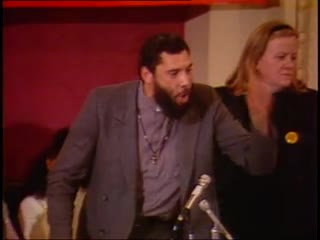
Description: Hotel and restaurant workers rally at Arlington Street Church to take strike vote. Rev. Graylan Ellis-Hagler. Domenic Bozzotto. Local 26.
Collection: Ten O'Clock News
Date Created: 11/16/1988
Description: Hull suffers from Proposition 2 1/2 cutbacks, especially in school budget. Residents vote on override at risk of raising taxes to support essential services.
Collection: Ten O'Clock News
Date Created: 06/27/1988
Description: Deborah Wang reports that Boston supporters of Jesse Jackson are undecided about whether to campaign for Michael Dukakis. The supporters recently met to discuss their role in the upcoming campaign. Jackson delegates Mel King, Saundra Graham, Juanita Wade, and Byron Rushing are among the leaders of the meeting. The leaders say that the Dukakis campaign should not take the votes of Jackson supporters for granted. There are some Jackson supporters who will not support Dukakis under any circumstances. Interview with Philip Stanley of the Dukakis campaign about the role of Jackson supporters in the Dukakis campaign. Stanley says that the Dukakis campaign has been meeting with Jackson supporters and that the campaign is taking no votes for granted. Interviews with Jackson supporters Darryl Heller, Trent Pettus and Myra McAdoo. All three supporters criticize the Dukakis campaign. Wang's report includes footage of Dukakis and Jackson at the 1988 Democratic National Convention and footage of Jackson embarking on a voter registration campaign. This edition of the Ten O'Clock News also included the following item: Adult entertainment at the Highland Tap
1:00:02: Visual: Footage from July 21, 1988 of the Democratic National Convention. Michael Dukakis (Democratic US Presidential nominee) and Kitty Dukakis (wife of Michael Dukakis) are congratulated by Jesse Jackson (African American political leader) and Jacqueline Jackson (wife of Jesse Jackson). They are surrounded by Democratic Party notables. Deborah Wang reports that Jackson ended his presidential campaign by endorsing the nomination of his rival Dukakis; that Jackson pledged to campaign for Dukakis in the fall. V: Footage of Jackson speaking at the Democratic Convention on July 18, 1988. Jackson is flanked by Dukakis and Lloyd Bentsen (Democratic US vice-presidential nominee). Jackson says that he is not seeking a job or a salary; that he wants to serve the nation. Shot of Jackson standing at the entrance to a campaign bus. Jackson waves to supporters. Supporters hang a sign on the side of the bus. The sign reads, "Rainbow voter registration campaign." Wang reports that Jackson supporters are undecided about whether to campaign for Dukakis; that Jackson supporters met last night in Roxbury about their role in the upcoming campaign. V: Shots of the audience at the meeting. Campaign leaders including Mel King (community activist and Jackson delegate), Saundra Graham (Jackson delegate), Byron Rushing (State Representative and Jackson delegate), and Juanita Wade (Jackson delegate) sit at a table at the front of the room. Footage of Wade saying that Jackson supporters will use the Republican threat to convince others to vote for Dukakis. Wang reports that Jackson supporters are unhappy with the Dukakis campaign. V: Footage of King saying that the Dukakis campaign has not been listening to Jackson supporters. King says that the Dukakis campaign should have addressed the role of Jackson supporters before now. Footage of Graham saying that Dukakis should be pursuing the 7 million votes represented by Jackson supporters. Shot of a life-size cut-out of Dukakis in the window of the Dukakis volunteer headquarters. Footage of Philip Stanley (State Director for the 1988 Dukakis campaign) being interviewed by Wang. Stanley says that he has met twice this week with the Jackson leadership; that the discussions are progressing. Stanley says that the Dukakis campaign is not taking anyone's vote for granted. Shots of volunteers working at the Dukakis volunteer headquarters. Wang reports that some Jackson supporters says that they will not work for Dukakis under any circumstances. V: Shot of Rushing addressing the audience at the meeting of Jackson supporters. Footage of Darryl Heller (Jackson supporter) saying that Dukakis made a mistake by choosing Bentsen as his running mate. Heller says that Bentsen does not believe in any of the same things as Jackson; that Bentsen is closer to Ronald Reagan (US President) than he is to Jackson. Heller says that it would be a violation of his conscience to vote for the Dukakis ticket. Footage of Trent Pettus (Jackson supporter) saying that he will not vote for Dukakis. Pettus says that Dukakis does not believe that gays and lesbians are fit to be foster parents. Pettus says that Dukakis advocates a discriminatory policy against gays and lesbians. Pettus adds that he will not vote for Dukakis. Footage of Myra McAdoo (Jackson supporter) saying that Dukakis needs to be ready to deal realistically with minority groups; that Jackson needs to receive a message from minority groups. Wang reports that some Jackson supporters will work to revive the Rainbow Coalition; that the supporters will work to get Rainbow candidates elected to state and local offices. V: Shots of Jackson supporters at the meeting in Roxbury. Footage of Jackson at the Democratic National Convention. Shots of delegates on the floor waving signs reading, "Jesse!" Wang notes that Jackson supporters will try to gain concessions from the Democratic Party. V: Footage of Rushing saying that he wants his constituents to be represented fairly by the chosen leader of the Democratic Party. Rushing says that Jackson supporters must barter their votes for fair representation. Rushing says that Jackson supporters must not be taken for granted by Dukakis. Wang stands in front of the Dukakis volunteer headquarters. Wang reports that Dukakis may not need to make peace with local Jackson supporters; that Dukakis is expected to win Massachusetts easily. Wang reports that Jackson supporters hope that Dukakis includes them in his campaign. Wang adds that Jackson supporters want Dukakis to make it clear that he does not take Jackson voters for granted.
Collection: Ten O'Clock News
Date Created: 08/25/1988
Description: Jerry Williams' ballot question to repeal seat belt law wins voter approval.
Collection: Ten O'Clock News
Date Created: 11/05/1986
Description: Republican John DeJong submits nomination papers to challenge Bulger in state senate race. Walks with dog through Back Bay. Voter registration sign. People enter McCormack building.
Collection: Ten O'Clock News
Date Created: 05/01/1990
Description: Marcus Jones reports on a referendum question concerning the incorporation of a new city made up of Boston's minority neighborhoods, which would be called Mandela, Massachusetts. Interview with Andrew Jones of the Greater Roxbury Incorporation Project about the proposal. Jones reports on the local and national controversy generated by the referendum question. Footage from a press conference with Mandela supporters and officials from East Palo Alto, California. Jones' report also features footage from an episode of the Phil Donahue Show. African American community leaders Andrew Jones, Mel King, Bruce Bolling, and Charles Stith debate the question with Donahue. Jones reports that the referendum is not expected to pass. Chuck Turner, a teacher, and Nathan Allen, the Executive Director of Lena Park Community Development, debate the question at tan Urban League Forum.
1:00:07: Visual: Shot of the referendum question concerning the incorporation of Mandela, Massachusetts on the 1986 election ballot. Marcus Jones reports that the referendum question on Mandela, Massachusetts has generated much publicity. V: Footage of Andrew Jones (Greater Roxbury Incorporation Project) saying that minority neighborhoods have a "colonial relationship with the city of Boston;" that the city of Boston has treated minority residents like "second-class citizens." Jones explains that the ballot question asks whether minority neighborhoods should break ties with the city of Boston in order to incorporate a new city. V: Shot of African American residents crossing under the elevated train tracks on Washington Street; of a map of the proposed border of the new city. Jones notes that the new city would encompass Roxbury, Mattapan, and parts of Dorchester, Jamaica Plain, the Fenway, South End and Columbia Point; that proposal supporters have chosen Mandela as the name for the new city. V: Shots of young African American men standing in front of Joe's Sub Shop; of a newspaper article with a headline reading, "Flynn says Roxbury secession would halt progress." The article includes a photo of Ray Flynn (Mayor of Boston) with Reverend Michael Thomas (Charles Street African Methodist Episcopal Church). Jones reports that Flynn (Mayor of Boston) is urging residents to vote against the proposal; that supporters of the proposal have brought in officials from East Palo Alto, California. Jones notes that East Palo Alto was formed by seceding from Palo Alto. V: Shot of proposal supporters at a press conference with officials from East Palo Alto. Campaign signs supporting the proposal read, "Vote yes on question 9. Land control, A new city. Mandela, Mass." Jones notes that the referendum is getting national exposure; that Phil Donahue (talk show host) broadcast his show live from WCVB today. V: Shot of the front page of The New York Times; of an article in The New York Times. Footage of the Phil Donahue Show (national TV talk show) from October 30, 1986. Donahue challenges supporters of the proposal, saying that the racial problems will worsen if minority neighborhoods secede from the city. African American community leaders Andrew Jones (Greater Roxbury Incorporation Project), Mel King (community activist), Bruce Bolling (President, Boston City Council), and Reverend Charles Stith (Union United Methodist Church) are guests on the show. Jones says that the issue behind the proposal is land control, not race. Bolling says that African American leaders and other leaders are poised to take control of city government; that the new leaders need to take advantage of the opportunity to bring the city of Boston together. Jones reports that African American community leaders debated the question at a Urban League Forum. V: Footage of Chuck Turner (teacher and community activist) saying that a victory for the referendum will force the Flynn administration to "open the books of the city." Turner talks about the large amount of land to be developed in minority neighborhoods. Footage of Nathan Allen (Executive Director, Lena Park Community Development) saying that the proposal for a new city is not financially feasible; that the new city would be incorporated with a deficit of $100 million; that community residents would be jeopordized by a large deficit. Jones stands at the back of the Urban League Forum. Jones reports that 71% of voters oppose the referendum, according to a poll.
Collection: Ten O'Clock News
Date Created: 10/30/1986
Description: Masconomet Regional High students lobby for Prop 2 1/2 override in Topsfield, Boxford, Middleton. Computer classroom. Toddlers on playground. Voters in booths. Houses, church, Town Hall in Boxford.
Collection: Ten O'Clock News
Date Created: 03/13/1990
Description: Mel King speaks at a press conference held on behalf of the Massachusetts Rainbow Coalition and the Massachusetts Jesse Jackson Committee. Committee members stand behind King as he reads an open letter from Jesse Jackson. Jackson's letter criticizes Ronald Reagan and urges voters to support Walter Mondale in the upcoming election. Domenic Bozzotto (labor leader) speaks at the press conference. Bozzotto denounces Reagan and says that the labor movement must support Mondale. May Louie (Rainbow Coalition leader) speaks at the press conference. Louie calls on all members of the Rainbow Coalition to support Mondale, even if they are not entirely comfortable with his candidacy. King answers questions from reporters. King talks about efforts by both committees to register new voters. Louie and King talk about the committees' efforts to win over voters in Massachusetts. King says that the Rainbow Coalition can work more successfully with Democratic leaders than with Reagan. King talks about the dissatisfaction of Jackson voters with the Democratic Party. King says that the Democratic Party has ignored Jackson's efforts to push for a more inclusive platform. King says that the Democratic Party needs "serious transformation." King says that the committees are struggling for the minds of the people. He adds that it is "immoral" not to vote against Reagan in the upcoming election. Several takes of reporter standup.
1:00:00: Visual: Mel King (political activist) sits at a table at a press conference. Other leaders of the Massachusetts Jesse Jackson Committee sit at the table with King. Supporters stand behind the table, in front of a banner for the Rainbow Coalition. King tells the media that he is speaking on behalf of the Massachusetts Jesse Jackson Committee and the Massachusetts Rainbow Coalition. King expresses his support for Jackson. King reads an open letter from Jackson about the importance of getting out the vote against Ronald Reagan (US President). Jackson's letter urges people to support Walter Mondale (candidate for US President) against Reagan. The letter denounces Reagan's record as president. Jackson's letter predicts that Reagan can be beat if "the victims of Reaganism" come out to vote for Mondale. Jackson writes that the people can effect change in society through political means. Jackson's letter urges people to help him build the Democratic Party into a Rainbow Coalition. King finishes reading the letter. The supporters applaud. 1:05:10: V: King hands the microphone to Domenic Bozzotto (labor leader). Bozzotto says that the Rainbow Coalition's purpose is to defeat Reagan and Reaganism. Bozzotto denounces Reaganism and its effect on working people and labor unions. Bozzotto says that the labor movement must join the Rainbow Coalition in order to support Mondale and to defeat Reagan. 1:06:12: V: May Louie (Rainbow Coalition leader) calls on all members of the Rainbow Coalition to fight Reagan and Reaganism. Louie admits that some members of the Coalition may not be entirely comfortable with Mondale's candidacy; that it is important to support Mondale in order to defeat Reagan. 1:06:53: V: King invites the reporters to ask questions. Shots of supporters standing behind King. A reporter asks how many votes Jackson received in the Massachusetts primary. Another reporter answers that Jackson received 33,000 votes. A reporter asks how many citizens the group would like to register to vote during its voter registration drive. King says that he does not have a specific numerical goal; that it is "immoral" for people not to vote when faced with the "danger" represented by Reagan's policies. King notes that many people have responded to the group's message by registering to vote. King adds that more than 1,000 people have been registered to vote in the South End during the past month. A reporter asks if King expects Jackson to visit Massachusetts. King says that the group is working to bring Jackson to Massachusetts; that Jackson is campaigning for Mondale in the South. 1:09:08: V: A reporter asks if the Rainbow Coalition expects to win over the voters who supported Gary Hart (US Senator) in the Democratic primary election. King says that the goal of the Coalition is to defeat Reagan; that the members of the Coalition can work with Democratic leaders more successfully than they can work with Reagan. Louie adds that the Massachusetts delegation to the Democratic Convention voted with Jackson supporters on some platform issues; that Massachusetts voters are receptive to the issues put forth by the Coalition. A reporter asks why this announcement was not made immediately after the Democratic convention. King says that the group is working for Jackson; that Jackson wrote the letter recently; that the group is following Jackson's instructions. King notes that the group is working hard to register voters; that the group will work to get out the vote in support of Mondale. King adds that the group will use the media and other strategies to publicize its message. 1:11:28: V: A reporter asks King how they will motivate voters to get to the polls on election day. Shots of the media and the audience. King says that the movement to defeat Reagan is the first of many steps in building up the Rainbow Coalition; that the Coalition will be more successful if Reagan is out of office. Shots of members of the Massachusetts Jesse Jackson Committee; of a sign reading, "For 50 years, we've belonged to the Democratic Party. Now it's time that the Democratic Party belonged to us." A reporter asks King about the committee's slogan about the committee's slogan, "For 50 years, we've belonged to the Democratic Party. Now it's time that the Democratic Party belonged to us." King says that Jackson's goal is to "remake" the Democratic Party into a "rainbow" party of "peace, jobs and justice." King notes that the labor movement has seen the importance of joining with Jackson to defeat Reagan; that Reagan's policies are anti-union. A reporter comments that the slogan expresses a sense of "dissatisfaction" with the Democratic Party. King says that the reporter is right. The committee members applaud. King notes that the Rainbow Coalition is "critical" of Mondale and the Democratic Party; that the Democratic Party has failed to consider Jackson's efforts to push for a more inclusive platform. King adds that he is an independent. King says that Jackson's leadership is important; that Jackson is trying to push the Democratic Party to represent the needs of a broader cross section of people. King says that the Democratic Party "needs serious transformation." King adds that people who have been "locked out" of the Democratic Party need to support Jackson in order to transform the Party. Bozzotto says that Jackson has laid out a blueprint for a Democratic victory in November. Bozzotto adds that Jackson has brought voters back to the Democratic Party. 1:16:13: V: King says that the Jackson Committee is "struggling for people's minds." Jackson says that people in the US and across the world are "dying daily" as a result of Reagan's policies; that it is "immoral" for citizens of the US not to come out to vote against Reagan. King says that the "soul" of the nation is at stake. King talks about the responsibility of citizens to vote in November in order to rid the world of the "menace" posed by the Reagan administration. King closes the press conference. The Jackson Committee members applaud. King and the Committee members rise from their seats. 1:18:06: V: Meg Vaillancourt stands under the banner reading, "For 50 years, we've belonged to the Democratic Party. Now it's time that the Democratic Party belonged to us." Vaillancourt reports that the Massachusetts Women's Political Caucus is trying to convince some Republicans to vote Democratic this year; that some Democrats are talking about their plans to reform the Party from within. Vaillancourt does several takes of her comments for the news story.
Collection: Ten O'Clock News
Date Created: 10/01/1984
Description: Political scientist Ralph Whitehead on voting patterns & party affiliations of "new collar" workers (middle income, usually not college educated) & the presidential candidates' respective appeal to them.
Collection: Ten O'Clock News
Date Created: 09/07/1988