Description:
Pam Bullard interviews Kathleen Sullivan (Boston School Committee) about the quality of education in Boston. Sullivan says that she is frustrated because Boston schools have not improved since court-ordered desegregation began in 1974. Sullivan calls Arthur Garrity (federal judge) a "crazy judge." Sullivan says that the desegregation plans since 1974 have been disruptive. She says that neither African American nor white students have benefitted from school desegregation; that students should not be assigned to different schools each year. Sullivan and her assistant discuss Judge Garrity's latest order concerning the Boston schools. Bullard explains to Sullivan that she is putting together a piece which contrasts Sullivan's views on schools and court-ordered desegregation with the views of African American leader Melnea Cass
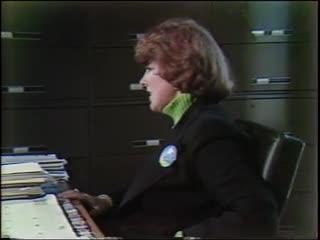
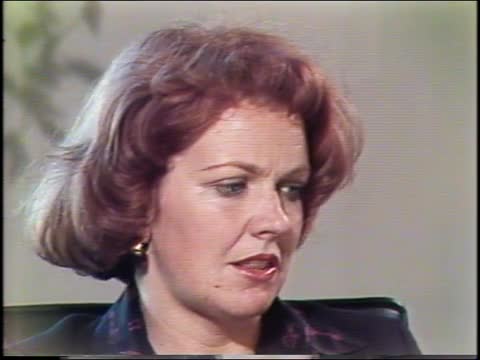
0:59:44: V: Pam Bullard interviews Kathleen Sullivan in her office. Bullard comments that Sullivan was elected to the School Committee because voters were impressed with her commitment to quality education and better schools. Bullard asks Sullivan how she would have fared if voters were less concerned with the state of the schools and more concerned with politics as usual. Sullivan says that she could have been re-elected. Sullivan says that parents are concerned about education; that a difficult economy coupled with the costs of school desegregation has made school improvement difficult. Sullivan says that the quality of education has not improved in the city since she was elected to the School Committee; that she feels frustrated in her efforts to improve the schools.
1:03:48: V: Bullard asks if it would damage Sullivan politically to admit that desegregation has improved Boston schools. Sullivan says that voters in Boston are beginning to accept desegregation as a fact; that the anti-busing movement has lost steam because people are tired; that voters would be happy to hear that schools have improved, even if the improvement was a direct result of desegregation and a "crazy judge on the scene." Sullivan says that there has been little improvement except in a few schools. Sullivan mentions that Roxbury High School, the Lewenberg School and the Curley School have seen improvement. Bullard asks why Sullivan never mentions the positive impact that desegregation has had on African American students, who now have access to an equal education. Sullivan says that she has been preoccupied with the budget this year; that she visited last year with African American students who had been assigned to three different schools in three years, and had not benefitted from the experience. Sullivan says that the school situation has begun to stabilize this year; that one can begin to talk about better education for African American students this year; that police presence in schools and community hostility to busing prevented a healthy school situation for African American students in 1974 and 1975; that she understands why African American parents might disagree with her because they wanted access to better schools for their children. Sullivan says that she hopes schools can be improved for all students; that she is worried because only 51,000 children attended Boston Public Schools last year, out of a school-age population of 117,000. Sullivan says that she taught African American students in Dorchester; that she thinks desegregation has been disruptive for those students; that the desegregation of Boston schools could have been beneficial for African American students and white students in 1974 and 1975 if it had been implemented differently.
1:10:34: V: An administrative assistant enters Sullivan's office to go over some papers with her. The assistant points out that Judge Garrity has ordered the School Committee to appoint a new Transitional Director of Program Development at South Boston High School. Sullivan and the assistant discuss Garrity's instructions. Sullivan and her assistant tell Bullard that Judge Garrity has approved 160 transfers out of 1,782 requests. Sullivan alludes to Garrity's heavy involvement in managing the Boston schools.
1:12:57: V: Bullard explains to Sullivan how she will edit the final piece. Shots of Sullivan's office. Bullard explains that she has also interviewed Melnea Cass (African American community leader) and wants the final piece to reflect the positions of the two women. Bullard says that both women are leaders, but that their positions on school desegregation reflect their ethnic heritage; that their positions are as far apart as the communities they represent. Sullivan points out that she has done a lot of work with African American students. Bullard says that Sullivan and Cass have a good working relationship because neither harbors strong racial prejudices; that both have friends of other races and backgrounds.
Date Created:
09/28/1976