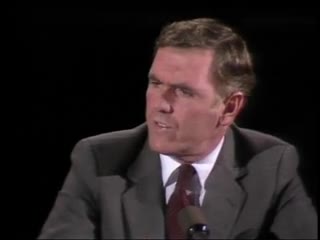
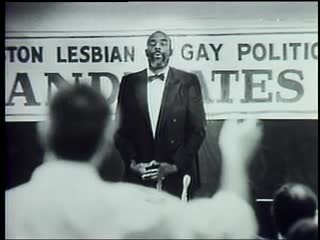
Description: DEBATE AMONG 8 BOSTON MAYORAL CANDIDATES (REEL 2). Ray Flynn, David Finnegan, Michael Gelber, Lawrence DiCara, Fred Langone, Eloise Linger, Dennis Kearney, Mel King.
Collection: Ten O'Clock News
Date Created: 10/02/1983
Description: Seven Harvard Law School professors endorse George McGovern for president. Richard Parker introduces McGovern who speaks to small audience about his candidacy and the invasion of Grenada. Duncan Kennedy, David Kennedy, Elizabeth Bartholet, Daniel Tarullo, Lewis Sargentich, Gerald Frug.
Collection: Ten O'Clock News
Date Created: 10/06/1983
Description: Gail Harris interviews Mel King (candidate for mayor). King discusses his reasons for running for mayor and talks about the issues he considers most important to the city's residents. King answers questions about how he would deal with the city's leaders, the city's power brokers and "the Vault." King talks about the importance of education and training. Harris and King discuss the changes in King's image and manner of dress. King notes the diversity within the African American community; he dismisses the idea of any one candidate receiving 100% of the vote in the African American community. King gives his opinion of Mel Miller (publisher of the The Bay State Banner), who is opposed to King's candidacy. King says that there is no Boston neighborhood in which he feels uncomfortable. King and Harris discuss how to keep racial issues out of the campaign; Harris and King discuss his boycott of an earlier campaign debate because it excluded some candidates. King talks about his goals for the city as mayor. After the interview, while shooting cutaways, King tells Harris about his book, Chain of Change. King talks about his hobbies and about the importance of organizing and empowering people. King gives his opinion of Kevin White (Mayor, City of Boston).
0:59:57: Visual: Gail Harris interviews Mel King (candidate for mayor). Harris asks King why he is running for mayor. King says that he has lived his whole life in Boston; that he understands the importance of public service; that it is important for the city to take care of its neediest citizens. King says that affordable housing, employment, health care, and education are important issues to many in the city. King says that some residents of Boston are living in unacceptable conditions; that families are living in overcrowded apartments; that some residents are isolated from the mainstream; that homelessness is a problem in the city. Harris asks King how he would deal with the city's leaders and power brokers and "The Vault." King says that he has worked with a cross-section of people in the city over the course of his career; that he worked with the Chamber of Commerce and the Chandler School to develop a training and placement program for women. King says that people are resources; that training can provide skilled workers for big corporations. King says that training is important; that school failure leads to street crime and juvenile delinquency; that lack of education and unemployment are at the root of most social problems. 1:06:20: V: Harris comments that King has changed his look; that he no longer wears a dashiki. King says that he has not changed his position on the issues; that his clothing is not relevant to his ideas. Harris asks if it is possible to get 100% of the vote in the African American community. She notes that the African American community is very diverse. King agrees that the African American community is very diverse. He says that he resents those who say that he needs to get 100% of the African American vote; that no white candidate is assumed to need 100% of the white vote. King says that a racism leads voters to look at the color of his skin instead of his record and his position on the issues. Harris asks what King thinks of Mel Miller (publisher of the The Bay State Banner), who says that the African American community should offer their support to a strong candidate who can support them after becoming mayor. King says that no one pays a lot of attention to Miller; that Miller is opposed to the ERA. King says that African Americans need to fight for what they want and support one another; that Miller has a negative view of white people; that Miller's influence is destructive to the African American community. Harris asks King if there are any parts of the city in which he feels uncomfortable. King says that there is no part of the city in which he is uncomfortable; that he wants to bring the city together; that he wants to reach out to people who disagree with him on the issues. King says that people must be brought together around common issues like employment and improvements to the schools and the city. Harris asks how King would prevent racial issues from entering the campaign, especially if he found himself in a runoff with David Finnegan (candidate for mayor) or Ray Flynn (candidate for mayor). King says that his previous campaigns for public office have always focused on issues; that the diversity of his campaign workers has earned his campaign the nickname of "the rainbow campaign." 1:14:21: V: Harris asks King if he regrets boycotting an earlier campaign debate because two other candidates were not invited to participate. King says that he has no regrets; that candidates must practice the "politics of inclusion." King notes that it is hypocritical for a candidate to promote equal access for all, and then to take part in a public forum which excludes the voices of some. Harris asks him about what he could accomplish as mayor. King says that he could affect real change in the city; that he would concentrate on reducing crime and fighting drugs; that he would appoint a new police commissioner to work with the community and to root out problems in the police force. King says that Joseph Jordan (Police Commissioner, City of Boston) learned about the problems on Sonoma Street by watching television; that the city needs a commissioner who can mobilize the force to fight crime; that Jordan allowed the mayor to use the police force as a political tool in the debates on Proposition 2 1/2 and the Tregor Bill. King says that he would investigate corruption through an audit of the city's programs; that the government needs to make sure that good services are being provided. King notes that the city government must spend the citizen's tax dollars wisely. King says that new resources must be spent for improvements at Boston City Hospital; that some employees at the hospital qualify for public assistance because their salaries are so low. Harris asks King if he would campaign for mayor even if he knew there was no chance of victory. King says that he has many forums through which to promote his ideas; that he has published a book recently. King says that he would not run if he didn't think he could win; that he would not want to waste his own time and valuable time and money of others; that he thinks he can win and effect real change in the city. 1:20:55: V: Harris thanks King and closes the interview. The crew takes cutaway shots of Harris and King. King tells Harris about his book, Chain of Change. King talks about his hobbies. King talks about the importance of organizing and empowering people. He talks about organizing tenants through the Symphony Tenants Organizing Project. Harris tells King about her impressions of Boston politics. She mentions Kevin White (Mayor of Boston) and Clarence Jones (former Deputy Mayor of Boston). King says that he did not support White in 1975 or 1979; that White has taken the African American vote for granted; that White has not delivered services to the African American community.
Collection: Ten O'Clock News
Date Created: 09/19/1983
Description: B+W visuals of Mel King through his various roles in public life. Photos from The Boston Globe.
Collection: Ten O'Clock News
Date Created: 11/02/1983
Description: Barney Frank (US Representative) and Mel King (candidate for mayor of Boston) shake hands in front of the Massachusetts State House. Frank has endorsed King for mayor of Boston. Christy George interviews King in front of the State House. King talks about the current policies of the White administration and White's recent appointments to the Boston Redevelopment Authority (BRA). King says that his administration would eliminate the BRA in order to consolidate city development under a community development office. King criticizes White for making mayoral appointments without regard for his successor. King adds that the current police commissioner must be forced to resign. King says that the Boston City Council should not approve White's new housing proposal. He adds that the City Council should wait until the next mayor is elected before making new policy.
1:00:05: Visual: Mel King stands in front of the State House with his supporters and talks to the media about his candidacy for mayor. He talks about the "politics of inclusion." A reporter asks King how he feels about being "Barney Frank's second choice." King says that Barney Frank (US Representative) makes good choices; that he is glad to be one of Frank's choices. Mel King thanks the media. He shakes hands with Frank. Frank and King speak to one another. 1:01:12: V: Christy George sets up an interview with King. George asks King if Kevin White (Mayor, City of Boston) is consolidating power. She also asks him about mayoral appointments to city jobs. King says that political patronage is unfortunate; that White has not considered his appointments from the viewpoint of his successor. King says that the police commissioner must be asked to resign; that the new administration must work around the commissioner if he refuses to resign. George comments that the business community is wary of King and Ray Flynn (candidate for mayor of Boston). She asks if White is making appointments to the Boston Redevelopment Authority (BRA) before the mayoral elections in order to satisfy the business community. King says that the new administration must take a balanced approach to development; that the needs of the whole city must be considered. King says that his administration would consolidate the development functions of the city; that his administration would work to eliminate the BRA board as it is now; that a community development office would oversee development in the neighborhoods and in the downtown area. George notes that White's appointments to the BRA are not unusual for a mayor leaving office. King says that these candidates will be "holdovers"; that "holdover" appointments should only be allowed for a minimum period of time; that these appointments undermine public confidence in government. George asks King about White's plans to create a Neighborhood Housing Trust. King says that he hopes that the Boston City Council will not approve the program until a new mayor has been elected. King says that he will lobby the council not to approve the program. George ends the interview.
Collection: Ten O'Clock News
Date Created: 10/21/1983
Description: Campaigners hold Mel King for Mayor signs in English, Chinese, and Spanish, and sell t-shirts and caps outside Concord Baptist Church in South End. King gets out of limousine with Jesse Jackson. Inside they shake hands and raise linked arms before Rainbow Coalition press conference. King introduces Jackson as “country preacher.” Jackson recounts 20 years of progress in America toward freedom and equality. He commends King for his efforts to leverage power of black people, and endorses him for mayor of Boston. King presents Jackson with a copy of King's book, Chain of Change. Jackson takes questions about the role of minorities in the Democratic Party and his potential campaign for the 1984 Democratic presidential nomination. reel 1 of 2.
1:00:04: Visual: Campaign workers for Mel King (candidate for Mayor of Boston), many of them white, hold campaign signs and sell T-shirts and buttons outside of the Concord Baptist Church in the South End. A campaign worker models his own King T-shirt, which has a campaign slogan in English, Spanish and Chinese. He helps customers find sizes among the multicolored shirts, which are displayed on a table. An Asian woman arrives with a King campaign sign in Chinese. Shot of Mel King baseball caps displayed along a fence. More campaign workers arrive with signs. Shot of the church, with campaign workers standing on the sidewalk and in the street. A truck mounted with two speakers drives along the street. The driver speaks into a microphone, alerting passersby to the arrival of Jesse Jackson (African American political leader). 1:04:11: V: A limousine pulls up outside of the church. King and Jackson exit the limousine and stand in the street. The crowd applauds and cheers, "We want Mel." 1:05:04: V: Jackson and King stand before the media in a room set up for a press conference. They shake hands and raise linked arms. King and Jackson sit down at a table at the front of the room. King gets up and stands at a podium. He welcomes the audience and introduces Jesse Jackson. King commends Jackson's struggle for equality on behalf of minorities and the disenfranchised. King refers to Jackson as a "country preacher." 1:08:10: V: Jackson stands at the podium. He talks about the civil rights movement and the struggle for equal access for all minorities. Jackson says that no one must be denied access or participation because of their race, sex, or religion. Jackson talks about the need for equal protection under the law. Jackson says that voting irregularities must be eliminated; that the Voting Rights Act must be enforced. Jackson says that King has a good combination of experience, integrity, and intelligence; that Massachusetts is ready for a change. Jackson congratulates King on the organization of a Rainbow Coalition in Massachusetts. King presents Jackson with a copy of his book, Chain of Change. Jacson and King and King's supporters raise linked arms while the crowd cheers. 1:14:09: V: Shot of an African American man in the audience. Jackson and King take questions from the audience. An audience member asks Jackson about the possibility of his running for president as an independent candidate, or of his supporting an independent candidate. Jackson says that it is too soon to answer the audience members questions; that the Democratic Party reflects its membership. Jackson says that there must be reciprocal voting within the Democratic Party; that white voters must vote for minority candidates if minority candidates vote for white candidates; that there must be integrated slates of candidates. Jackson says that voting irregularities can be used to keep people from the polls; that voting irregularities must be eliminated. Jackson says that he has two objectives: to achieve parity and to fight Reagan. Jackson adds that a King victory in Boston accomplishes both of his objectives. The audience applauds. Another audience member asks Jackson if he will run for president. Jackson says that he is considering a campaign for the Democratic Party nomination. An audience member asks Jackson about Boston's reputation as a racist city. Jackson says that the United States is "schizophrenic" on the question of race. Jackson reviews some high and low moments concerning race and the African American community in Boston. Jackson says that King's candidacy is a "high moment." An audience member asks a question about voter turnout.
Collection: Ten O'Clock News
Date Created: 10/06/1983
Description: Jesse Jackson (African American political leader) speaks at a campaign rally on behalf of Mel King (candidate for mayor of Boston) at the Concord Baptist Church in the South End. Jackson endorses King's candidacy. King answers a question about the role of newly registered voters in his campaign. The audience cheers for the two men and chants "Win Mel win," and "Run Jesse run." Tape 2 of 2.
1:00:00: Visual: Jesse Jackson (African-American political leader) speaks at a campaign rally on behalf of Mel King (candidate for mayor of Boston). Jackson says that Boston voters have an opportunity to vote for a Rainbow Coalition candidate for mayor. Shots of audience members. A reporter asks if newly registered voters will make a difference in the mayoral election. Mel King says that new voters and old voters will vote for him if they want an accessible and caring city. Shot of Charles Stith (Union United Methodist Church) and Dr. Alvin Poussaint (Harvard University) standing in the audience. A moderator thanks the audience. Shot of Gail Harris (WGBH reporter) in the audience. 1:01:18: V: An audience in a church cheers for Jackson and King. Jackson and King are at the front of the church. Shots of the members of the audience as they cheer and clap. The audience chants, "Win, Mel, Win" and "Run, Jesse, Run." Shot of a sign hanging on the front of the church balcony. The sign reads, "Mel King is the key in 1983." The audience applauds for a speaker.
Collection: Ten O'Clock News
Date Created: 10/06/1983
Description: Mel King (candidate for mayor of Boston) attends a meeting of the Tent City Corporation, chaired by Joan Tighe (chairwoman, Tent City Corporation), regarding the development of the Tent City site. Tighe says that the group will work to maintain affordable housing units at the site and to scale down a proposed plan for a parking garage on the site. Crowd sings happy birthday to Tinghe. Christy George interviews King about his position on housing issues and those of his opponents Ray Flynn (candidate for mayor of Boston) and David Finnegan (candidate for mayor of Boston). King criticizes condominium conversions and talks about the need for a strong rent control program. King discusses the link between employment and housing, and says that the community needs more low- and moderate-income housing units. King notes that the federal government is not aware of the housing crisis across the nation; he adds that the federal government needs a better housing policy.
1:00:04: Visual: Mel King (candidate for mayor of Boston) enters a room where a meeting about the Tent City Development is being held. White and African American attendees sit on either side of a long table. King greets a few of the attendees, then sits down near a window at the side of the room. Joan Tighe (chairwoman, Tent City Corporation) reviews the goals of the Tent City Corporation. Tighe says that the Tent City Corporation aims to be the sole developer of the Tent City site; that they will work with the mayor to maintain affordable housing units at the site; that they will work to scale down a proposed plan for a parking garage. The meeting is adjourned. Meeting members tidy up the room. King greets the attendees. Meeting members and King sing "Happy Birthday" to Tighe. King continues to greet attendees. 1:05:22: V: Christy George interviews King. She asks him about his position on housing and about the positions of his opponents Ray Flynn (candidate for mayor of Boston) and David Finnegan (candidate for mayor of Boston). King talks about the need for a strong rent control program and criticizes condominium conversions. King says that new public housing must be built. King says that there is a link between jobs and housing; that people need employment in order to afford housing. King says that the city and the voters must lobby the federal government for a better housing policy. George asks about the differences between King's position and the positions of Flynn and Finnegan. King says that housing must be community-based; that the community needs low- and moderate-income housing. King says that there are other housing issues besides rent control and condominium conversion; that public housing must be protected and improved; that the city must work to provide more housing. King says that he would like to investigate the possibility of a city-wide housing and finance program. King adds that the federal government needs to be aware of the housing crisis across the nation; that the nation needs a good federal housing program. George comments that there are differences between King's position and Finnegan's position. She asks about the differences between King's position and Flynn's position. King says that he has been involved with groups like the Tent City Corporation, who have worked to provide housing. King notes that Flynn has not advocated for a federal approach to the housing crisis. King talks about the need for a tenant equity program in Boston. George thanks King and closes the interview. The crew takes cutaway shots of George and King. George and King speak informally.
Collection: Ten O'Clock News
Date Created: 09/19/1983
Description: Mel King (candidate for mayor of Boston), accompanied by 15 supporters of all ages, greets and talks with residents in a housing project. King walks through the streets with children and adult supporters. The children hold campaign signs and chant "Vote for Mel King" and "Mel King for mayor." A campaign truck voices support for King. King greets drivers in their cars.
1:00:06: V: Mel King (candidate for mayor of Boston) walks across a parking lot and continues down a street. King is surrounded by 15 supporters of all ages. Supporters on the street hold campaign signs for King. A campaign truck drives slowly down the street; the driver voices support for King over the loudspeaker. King enters the front door of an apartment in a housing project. His supporters wait for him outside. King exits the project and crosses the street to the housing project on the other side. King walks through the project, shaking hands with passersby and greeting people. King encourages people to come out of their houses to talk to him. A man comes out to his front stoop to talk to King. King continues to walk through the project, greeting people. 1:03:25: V: King greets and shakes hands with four young African American men. King continues to walk through the projects, followed by his supporters. He greets two older women. 1:04:15: V: King approaches the Shawmut Variety store. His young supporters chant, "Vote for Mel King." King greets people as he passes them in the street. King greets drivers as they sit in their car at a red light. He gestures to his young supporters to stay on the sidewalk. King continues to greet drivers in their cars as they pass by on the street. His young supporters chant, "Mel King for mayor."
Collection: Ten O'Clock News
Date Created: 11/01/1983
Description: Christopher Lydon interviews Mel King (candidate for mayor of Boston) in King's home. King talks about the benefits of growing up in a diverse neighborhood and about his own childhood in Boston. Lydon asks King about his philosophy of government. King says that the government must serve those who are most in need; he adds that the government should take an active role in issues of poverty, education, the environment, and women's issues. King talks about the interconnectedness of different issues and problems. Lydon asks whether there is an ideology behind King's politics. King says that he tries to take a realistic approach to government. King believes that love and change are the two fundamentals of life. Lydon asks how King rates himself as an administrator. King says that he is a good administrator who tries to identify problems and work together with people to find solutions. The tape includes shots of the exterior of King's home.
1:00:01: V: Shots of the exterior of the King home in the South End. 1:01:10: V: Christopher Lydon sets up an interview with Mel King (candidate for mayor of Boston) in King's home. Lydon asks King about his political formation on the streets where he grew up. King talks about growing up in the diverse "New York streets" neighborhood of Boston. King says that he grew up with an appreciation for other cultures. Lydon and the camera crew discuss the set-up of the shot. King continues to talk about his experiences growing up on Seneca Street. King says that diverse urban neighborhoods provide a model for cooperation among groups of different backgrounds. King talks about the benefits of growing up with people of different cultures and ethnicities. 1:05:41: V: Lydon asks King about his philosophy of government. King says that government must serve those who are most in need; that all of society benefits when the neediest are served. King says that government must serve society's needs in the areas of poverty, education, the environment, and women's issues. King says that government must serve the needs of all people. He uses the example of access for the disabled. King says that all of society is guaranteed access when access is granted to the disabled. King says that problems in Boston's neighborhoods cannot be ignored; that these problems must be solved before they spread to other areas. King says that problems in one neighborhood affect every resident of the city. King stresses the connections between people and problems. He gives an example of the local problems caused by the oil crisis in the 1970s. 1:11:46: V: Lydon asks if there is an ideology behind King's politics. King says that his approach to government is realistic; that there is no "pure" form of government. King says that he has tried to address the realities of his life as an African American man living in Boston; that he has tried to address the realities and needs of his community and his city. King says that there are essential needs which must be met; that he has tried to look at the forces impacting the needs of people and communities. King says that love and change are the two fundamentals of life. 1:15:35: V: Lydon asks King to rate himself as an administrator. King says that he tries to identify problems; that he gathers people together to find creative solutions; that he works with people to implement solutions; that he tries to evaluate the solution to find out if it works. King talks about using this approach as director of the Urban League of Boston. King says that he is using this approach to solve problems in his current job at MIT (Massachusetts Institute of Technology). King says that a city government must deliver services efficiently on a fixed budget. King notes that Joseph Jordan (Police Commissioner, City of Boston) has provided ineffective leadership for the Boston Police Department. King says that it is important to appoint good administrators for city programs. King notes that he has proven experience as a good administrator.
Collection: Ten O'Clock News
Date Created: 11/07/1983