Description:
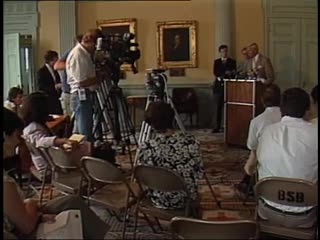
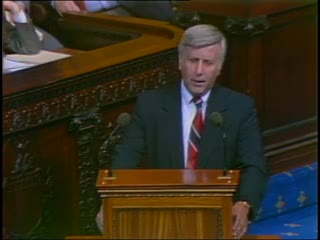
Christy George reports that the Reverend Allan Boesak, an anti-apartheid activist, received an award at Harvard University. He gives a speech at the university in which he urges western countries to place economic sanctions on the South African government. He criticizes Ronald Reagan and other western leaders for supporting the South African government. Boesak, at a press conference after the awards ceremony, praises Dukakis for imposing sanction and and urges George Bush to impose sanctions on South Africa. Boesak talks about the effectiveness of sanctions. George's report includes footage of Bush talking about South Africa and footage of apartheid South Africa. Following the edited story is additional footage of Boesak's press conference at Harvard.
1:00:00: Visual: Footage of Dr. Allan Boesak (anti-apartheid activist) preaching at Memorial Church at Harvard University. Boesak says that the lives of many South African blacks could have been saved if Ronald Reagan (US President) and other Western leaders had divested from South Africa in 1985. Footage of South African police brutally arresting South African blacks. Christy George reports that Boesak is one of the few South African church leaders who would dare to blame Reagan for the deaths of South African children. V: Footage of Boesak at Harvard. Boesak accuses Reagan, Margaret Thatcher (Prime Minister of Great Britain), and Helmut Kohl (Chancellor of Germany) of supporting the South African government. Boesak says that these leaders refused to impose sanctions on the apartheid government. George reports that Boesak is outspoken; that Boesak received an award from Harvard University today; that Boesak chided Harvard for investing in South Africa. V: Shots of Memorial Church at Harvard University; of Boesak receiving an award from a Harvard official. George notes that Boesak praised Michael Dukakis (Governor of Massachusetts) for imposing sanctions against South Africa; that Boesak begged George Bush (US President-elect) to do the same. V: Footage of Bush on October 25, 1988. Bush says that the South African government is racist; that the US needs to stay engaged; that the US needs to use its "moral influence" to change the South African government. Footage of Boesak at a press conference at Harvard University. Boesak says that he hopes Bush will follow the example of Massachusetts; that the US should divest from South Africa. Boesak says that he wishes Dukakis had been elected president. Boesak says that Bush has talked about his commitment to civil rights; that Bush needs to act on his commitment. Footage of South African blacks running from police on January 10, 1988. George reports that Boesak says that the South African government is redoubling its efforts to enforce apartheid laws. V: Footage of Boesak saying that he his tired of lame excuses from western governments. Boesak says that western leaders are lying when they talk about their concern for South African blacks. Boesak talks about the US government's commitment to sanctions against Cuba, Libya, Argentina and Nicaragua. George reports that Boesak says that sanctions are effective; that war has become too expensive for the South African government. George reports that Boesak points to the end of wars in Namibia and Angola as proof of the effectiveness of sanctions. V: Footage of Africans celebrating in the streets; of Africans marching in the street; of African soldiers watching a plane taxi on a runway. Footage of Boesak at a press conference. Boesak talks about sanctions. Boesak says that the South African government should be cut off from oil and from access to the international money market. Boesak says that no South African blacks would be hurt if air links to and from South African were cut off. Boesak says that he and Desmond Tutu (South African anti-apartheid leader) are the only two South African blacks who fly anywhere.
1:00:00: Visual: Footage of Dr. Allan Boesak (anti-apartheid activist) preaching at Memorial Church at Harvard University. Boesak says that the lives of many South African blacks could have been saved if Ronald Reagan (US President) and other Western leaders had divested from South Africa in 1985. Footage of South African police brutally arresting South African blacks. Christy George reports that Boesak is one of the few South African church leaders who would dare to blame Reagan for the deaths of South African children. V: Footage of Boesak at Harvard. Boesak accuses Reagan, Margaret Thatcher (Prime Minister of Great Britain), and Helmut Kohl (Chancellor of Germany) of supporting the South African government. Boesak says that these leaders refused to impose sanctions on the apartheid government. George reports that Boesak is outspoken; that Boesak received an award from Harvard University today; that Boesak chided Harvard for investing in South Africa. V: Shots of Memorial Church at Harvard University; of Boesak receiving an award from a Harvard official. George notes that Boesak praised Michael Dukakis (Governor of Massachusetts) for imposing sanctions against South Africa; that Boesak begged George Bush (US President-elect) to do the same. V: Footage of Bush on October 25, 1988. Bush says that the South African government is racist; that the US needs to stay engaged; that the US needs to use its "moral influence" to change the South African government. Footage of Boesak at a press conference at Harvard University. Boesak says that he hopes Bush will follow the example of Massachusetts; that the US should divest from South Africa. Boesak says that he wishes Dukakis had been elected president. Boesak says that Bush has talked about his commitment to civil rights; that Bush needs to act on his commitment. Footage of South African blacks running from police on January 10, 1988. George reports that Boesak says that the South African government is redoubling its efforts to enforce apartheid laws. V: Footage of Boesak saying that he his tired of lame excuses from western governments. Boesak says that western leaders are lying when they talk about their concern for South African blacks. Boesak talks about the US government's commitment to sanctions against Cuba, Libya, Argentina and Nicaragua. George reports that Boesak says that sanctions are effective; that war has become too expensive for the South African government. George reports that Boesak points to the end of wars in Namibia and Angola as proof of the effectiveness of sanctions. V: Footage of Africans celebrating in the streets; of Africans marching in the street; of African soldiers watching a plane taxi on a runway. Footage of Boesak at a press conference. Boesak talks about sanctions. Boesak says that the South African government should be cut off from oil and from access to the international money market. Boesak says that no South African blacks would be hurt if air links to and from South African were cut off. Boesak says that he and Desmond Tutu (South African anti-apartheid leader) are the only two South African blacks who fly anywhere.
Collection:
Ten O'Clock News
Date Created:
01/17/1989