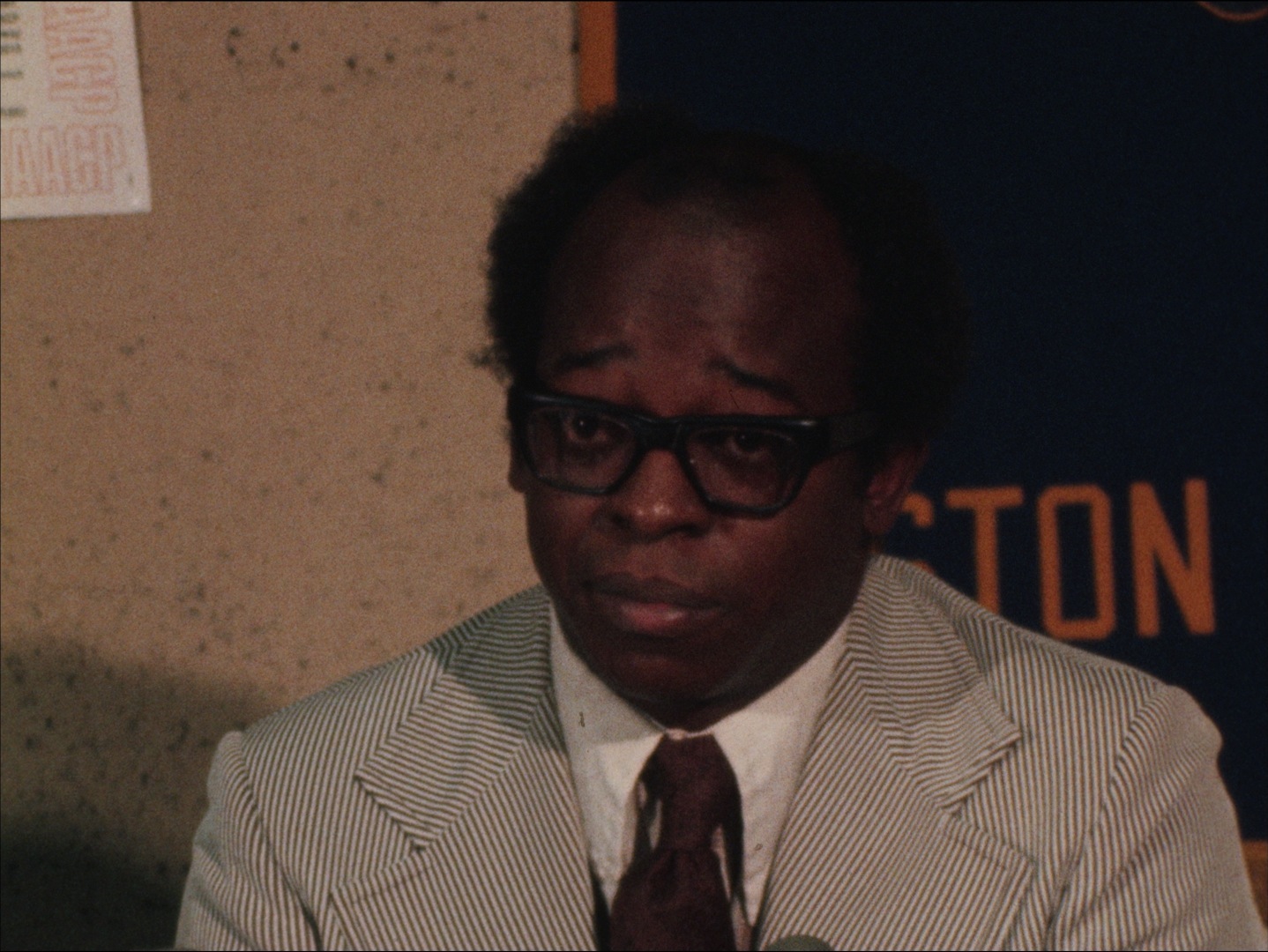
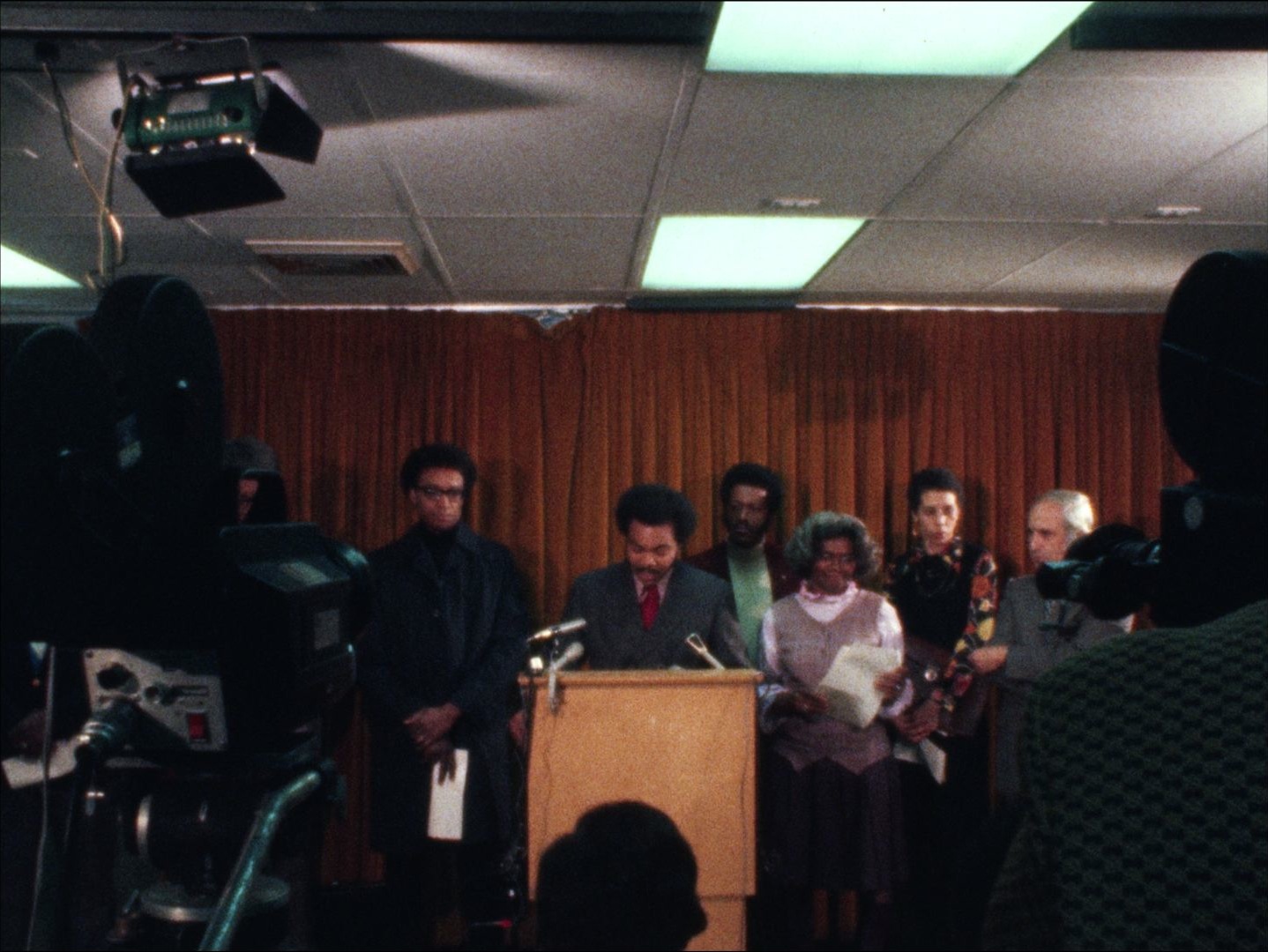
Description: Low quality sound at the beginning of the video. Judge Arthur Garrity speaks at a community meeting, calling for better communication among organizations involved in the school desegregation process. He takes questions about the role of the Citywide Coordinating Council (CCC) and the organization of community forums to invite feedback on schools. Garrity talks about setting up hearings about the school desegregation plan for the 1976-77 school year. Audience members express confusion at the roles of the CCC and the Citywide Parents Advisory Council (CPAC). Garrity explains the role of the Racial Ethnic Parents Councils, set up through the CPAC. Garrity reads a letter about problems which need to be resolved at the Blackstone Elementary School. Hubie Jones (African American community activist) sits beside Garrity at the meeting
1:00:00: Audio on tape is muffled. Visual: Arthur Garrity (federal judge) speaks before a biracial community meeting about Boston schools and court-ordered desegregation. Garrity speaks about the importance of good communication between the organizations involved in the schools. He says that the parents on the Citywide Parents Advisory Council (CPAC) are interested in working with the Citywide Coordinating Council (CCC) in organizing meetings about the schools. Garrity closes his talk by saying that he is offering suggestions, not directives. Hubert Jones (African American community activist) informally thanks Garrity. Garrity sits down in a chair next to Jones. 1:02:43: V: Garrity takes questions from audience members. Garrity responds to a question, saying that he will consult with all of the lawyers involved in the school desegregation case before putting anything into the court order; that he will schedule a series of hearings for the 1976-77 school year. Garrity says that the hearings might be held in late February or early March. A meeting member asks Garrity to comment on the group's idea to hold community forums in the neighborhoods, so that parents can give suggestions and air their grievances. Garrity agrees that the community hearings are a good idea. He suggests that a few members of the CCC and the CPAC should be present at the forums; that these members should be well informed in order to combat inaccurate information and false rumors; that members should feel free to ask him for the statistics and facts before going to the hearings. A meeting member asks Garrity if the CCC should have an attorney present for the court hearings. Garrity says that the CCC is not a party to the lawsuit; that the CCC might be seen as a distraction in the court. The member asks how the CCC can get feedback from the court. Garrity says that he is looking for constructive proposals for changes in the desegregation plan; that he hopes the community forums will provide these constructive proposals for change. Garrity adds that he receives other reports which do not call for action. A meeting member asks how Garrity would define the role of the CCC. Garrity says that he appreciates the efforts of CCC mediators in diffusing the tense situation in South Boston; that the most important function of the CCC is to monitor how the desegregation plan is carried out across the city. 1:13:41: V: A meeting member tells Garrity that members of the community see the CCC as a council which can take action and solve problems. Garrity responds that the CCC can publicize information and draw attention to problems. Garrity reads a letter that he received about problems at the Blackstone School. Garrity says that he hopes the CCC can delegate members to investigate problems at the schools in order to get them resolved. Garrity says that he would like the CCC to help solve these problems; that he would rather not try to resolve problems at individual schools through the court order. An audience member says that there is some confusion regarding the roles of the CCC and the CPAC. Garrity says that the Racial Ethnic Parents Councils under the CPAC exist to promote communication on racial issues in the schools; that the councils have also taken action on educational issues in the schools. Garrity notes that the CPAC has no staff or resources; that the CCC can support the CPAC and the Racial Ethnic Parents Councils. Garrity refers to a decision by the US Court of Appeals regarding the schools.
Collection: Ten O'Clock News
Date Created: 01/14/1976
Description: Steve Pearlstein (journalist) speaks at a Town Meeting on Race and Class at the John F. Kennedy Library. The meeting is held in honor of the release of J. Anthony Lukas' novel, Common Ground. The novel is about the busing crisis in Boston. Pearlstein sums up the issues discusses at the forum. Dr. Laval Wilson (Superintendent, Boston Public Schools) addresses the audience. Wilson says that issues of race and class can be mediated through the public schools. He adds that public education is a means of upward mobility for poor students. Wilson says that the city of Boston must commit itself to providing quality education in the schools. He says that parents, institutions of higher education, the business community, and social agencies need to join him in the effort to improve the Boston Public Schools. John Cullinane (Chairman, John F. Kennedy Library Foundation) gives closing remarks and ends the meeting. Panelists at the meeting include Jack Beatty (Senior Editor, Atlantic Monthly), Thomas Brown (Professor, University of Massachusetts), Marie Clarke (parent and member of the Home and School Association), Moe Gillen (Charlestown community activist), Father Michael Groden (Archdiocese of Boston), Robert Kiley (former Deputy Mayor of Boston), Theodore Landsmark (attorney), Sandra Lynch (former general counsel to the State Department of Education), Kim Marshall (Director of Curriuculum, Boston Public Schools), Reverend Charles Stith (Union United Methodist Church) and Thomas Winship (former editor, Boston Globe). Tape 8 of 8
1:00:03: Visual: Steve Pearlstein (journalist) addresses a Town Meeting on Race and Class at the John F. Kennedy Library. The town meeting is held in honor of the release of the book, Common Ground by J. Anthony Lukas (author). Pearlstein speaks from a podium. Panelists are assembled at tables on either side of the podium. Panelists include Jack Beatty (Senior Editor, The Atlantic Monthly), Thomas Brown (Professor, University of Massachusetts), Marie Clarke (parent and member of the Home and School Association), Moe Gillen (Charlestown community activist), Father Michael Groden (Archdiocese of Boston), Robert Kiley (former Deputy Mayor of Boston), Theodore Landsmark (attorney), Sandra Lynch (former general counsel to the State Department of Education), Kim Marshall (Director of Curriuculum, Boston Public Schools), Reverend Charles Stith (Union United Methodist Church), and Thomas Winship (former Editor, The Boston Globe). Pearlstein says that he is honored to be at the gathering with an audience of great intelligence and experience. Pearlstein sums up the issues discussed at the gathering. Pearlstein says that class issues were not given consideration during the busing crisis; that Arthur Garrity (federal judge) made the city of Boston face up to race issues; that many suffered during the busing crisis. Pearlstein refers to audience comments about dialogue between the opposing sides and the role of Kevin White (former Mayor of Boston). Pearlstein refers to Lynch's presentation. Pearlstein notes that Lynch's role as an attorney in the case was to deny that the Commonwealth of Massachusetts had any responsibility in the city of Boston's segregated school. Pearlstein notes that the Twymon children are very well behaved. Visual: Shots of the Twymon family in the audience. Pearlstein refers to comments by Joan Diver (member of the Diver family portrayed in Common Ground) and Elvira Pixie Palladino (member of the Boston School Committee). Pearlstein notes that the gathering disagreed on the role of Arthur Garrity (federal judge) and on changes in the city's racial climate. Pearlstein refers to comments by Gerard Doherty (Charlestown resident) and Lukas. Shots of Lukas; of the audience. Pearlstein talks about the viability of a metropolitan busing solution. Pearlstein says that suburbanites do not seem concerned about the state of Boston's schools. The audience applauds. Shots of the podium and the panelists from the back of the room. 1:06:42: V: Martin Nolan (The Boston Globe) introduces Dr. Laval Wilson (Superintendent, Boston Public Schools). Wilson approaches the podium. Wilson says that he is pleased to be in Boston. Wilson reads a quote from Isaiah. Wilson says that the past must inform the future; that Boston residents must accept their differences and move forward. Wilson says that he would like to work with diverse groups from the community to benefit Boston's schoolchildren. Wilson quotes Jack Beatty, who writes about class and race issues in his review of Common Ground. Wilson says that class and race issues can be mediated through the public schools; that quality education can provide upward mobility for poor youngsters. Wilson says that the city's public policy must reflect its commitment to quality education for schoolchildren. Wilson says that he wants to focus the city's attention on education. Wilson says that society must take responsibility for its schools and for the education of its children. Wilson notes that students are graduating from US high schools with poor literacy skills. Wilson quotes from the study, "A Nation at Risk," which reports on the state of education in the US. The report warns of "a rising tide of mediocrity" in US schools. Wilson says that society must demand quality education for the students; that the students are the future leaders of the society. Wilson compares hiring practices by the Boston business community to a "donut." Wilson says that corporations hire workers from the communities outside of Boston, instead of from within the city. Wilson says that he wants to improve the education in Boston Public Schools; that parents, institutions of higher education, the business community, and social agencies need to join in that effort. Wilson says that the school system must help students to learn. Wilson asks for the cooperation of the audience in this effort. The audience applauds. 1:17:26: V: Shots of audience members including Eric Van Loon (attorney for the plaintiffs, Morgan v. Hennigan) and Jim Conway (Charlestown resident). Nolan addresses the audience. He thanks the John F. Kennedy Library and introduces John Cullinane (Chairman, John F. Kennedy Library Foundation). Shots of the panelists. Cullinane thanks Mark Roosevelt (Executive Director, John F. Kennedy Library) for organizing the evening's events. Cullinane compliments Lukas on his book. Cullinane says that he is the son of poor Irish immigrants; that all parents want their children to succeed in life. Cullinane talks about how education is the first priority for many parents. Cullinane says that he wishes the book had talked more about each parent's commitment to education above all else. Shots of Lukas; of the audience. Cullinane talks about how race and class are issues all over the world. Cullinane thanks the audience and invites them for cocktails and refreshments afterwards. The audience applauds. Audience members rise and prepare to exit the auditorium.
Collection: Ten O'Clock News
Date Created: 09/28/1985
Description: Thomas Winship (former editor, Boston Globe) speaks at a Town Meeting on Race and Class at the John F. Kennedy Library. The meeting is held in honor of the release of J. Anthony Lukas's novel, Common Ground. The novel is about the busing crisis in Boston. Winship says that Boston is no longer portrayed as a racist city in the national media. He notes that the city is dedicated to healing its wounds. Martin Nolan organizes a discussion among audience members and panelists. Gerard Doherty (former State Representative) says that Irish Americans were fighting for their children's right to a good education. He adds that there were no racial problems in Charlestown before the busing crisis. Ron Formisano (Professor, Clark University) says that he is disappointed at the absence of the McGoff family and other members of the anti-busing movement. Nolan says that many leaders of the anti-busing movement declined invitations to attend the forum. Paul Grogan (Liaison to the Business Community for the Flynn administration) asks Lukas to comment on the leadership of Kevin White (former Mayor of Boston) and Arthur Garrity (federal judge). Lukas responds to Formisano, saying that the absence of the McGoff family is troubling. He says that he invited many members of the anti-busing movement to the forum. Lukas comments on White's career as mayor. He says that White was most effective in the early years of his tenure. He notes that White became less attentive to racial issues over the years, though he was effective in other areas. Lukas compliment's Garrity's courage and integrity. Lukas speculates as to whether a metropolitan solution to busing would have worked. He says that the court order should have tried to address class issues. Rachel Twymon (member of the Twymon family portrayed in Common Ground) speaks to the audience. She says that children cannot be expected to attend school together until their parents can gather to discuss issues peacefully. Joan Diver (member of the Diver family portrayed in Common Ground) addresses the meeting. She compliments Lukas on his novel and says that his novel allowed her to understand different people's perspectives on the busing crisis. Panelists at the meeting include Jack Beatty (Senior Editor, Atlantic Monthly), Thomas Brown (Professor, University of Massachusetts), Marie Clarke (parent and member of the Home and School Association), Moe Gillen (Charlestown community activist), Father Michael Groden (Archdiocese of Boston), Robert Kiley (former Deputy Mayor of Boston), Theodore Landsmark (attorney), Sandra Lynch (former general counsel to the State Department of Education), Kim Marshall (Director of Curriculum, Boston Public Schools), Reverend Charles Stith (Union United Methodist Church), and Winship. Tape 7 of 8
1:00:00: Visual: Thomas Winship (former editor, The Boston Globe) addresses a Town Meeting on Race and Class at the John F. Kennedy Library. The town meeting is held in honor of the release of the book, Common Ground by J. Anthony Lukas (author). Winship speaks as a member of a panel including Jack Beatty (Senior Editor, The Atlantic Monthly), Thomas Brown (Professor, University of Massachusetts), Marie Clarke (parent and member of the Home and School Association), Moe Gillen (Charlestown community activist), Father Michael Groden (Archdiocese of Boston), Robert Kiley (former Deputy Mayor of Boston), Theodore Landsmark (attorney), Sandra Lynch (former general counsel to the State Department of Education), Kim Marshall (Director of Curriculum, Boston Public Schools) and Reverend Charles Stith (Union United Methodist Church). Winship says that Boston is no longer portrayed as a "racist city" by the national media; that Boston is now seen as a city dedicated to healing its wounds. Winship says that "the court order made the city face the music, and the melody gets better and better as each day goes by." The audience applauds. 1:00:52: V: Martin Nolan (The Boston Globe) invites questions from the audience. Gerard Doherty (former State Representative from Charlestown) refers to the comments of Elvira Pixie Palladino (former member, Boston School Committee) about respect and the comments of Paul Parks (former State Secretary for Education) about listening to others. Doherty says that Lukas's book neglected to mention the great commitment to education on the part of most Irish Americans. Doherty notes that there were no racial problems in Charlestown before "forced busing"; that Irish Americans were fighting for their children's right to a good education. Doherty says that Irish Americans felt as if the right to education was being denied to their children through forced busing. Doherty says that Charlestown residents support equal rights for all; that Charlestown residents want a good education for their children in neighborhood schools; that education is "the way out" for most Charlestown residents. The audience applauds. 1:04:17: V: Ron Formisano (Professor, Clark University) introduces himself and says that he is working on a book about the anti-busing movement. He comments that the absence of the McGoff family (family portrayed in Common Ground) at today's gathering is symbolic of the "historic alliance" in Boston between white protestants and African Americans. Formisano says that the absence of the McGoff family is unfortunate; that neighborhood leaders are also absent from today's gathering. Formisano points out that Ray Flynn (Mayor of Boston) is the only person present who was involved in "strenuous opposition" to the court order. Formisano asks if the leaders of the anti-busing movement were invited to the gathering. Nolan says that members and leaders of the anti-busing movement were invited to the gathering; that most declined to accept the invitation. Nolan says that Formisano is welcome to look over the list of invitees. 1:07:33: V: Paul Grogan (Liaison to the Business Community for the Flynn administration) asks if Lukas is disappointed in the leadership of Kevin White (former Mayor of Boston) and Arthur Garrity (federal judge) during the busing crisis. Grogan asks how each man could have responded differently to the situation. Lukas approaches the podium. He says that he is happy to respond to Grogan's question and to Formisano's question. Lukas says that he is honored to have a distinguished panel and audience gather to discuss his book; that the absence of the McGoff family is "a blight on the evening." Lukas says that he had wanted all three families to rise as one after he introduced them. Lukas notes that the McGoffs accepted his invitation; that he does not know why they are not here. Lukas says that three or four dozen people from Charlestown were invited to the gathering; that he does not know how many are here. Lukas says that his intention was to bring all Bostonians together; that he did not intend to host a gathering of "Harvard professors and government officials." Lukas expresses his regret that the effort was "partially unsuccessful." Lukas says that Grogan's question is difficult. Lukas notes that one of the panelists talked about "heroes and villains"; that he hopes that the search for "heroes and villains" is in vain. Lukas says, "heroes and villains make good fairytales but bad history." Lukas says that he believes that people can transcend their history. Lukas says that Lisa McGoff (member of the McGoff family portrayed in Common Ground) is one of the people in the book whose actions are heroic; that Lisa McGoff learned to transcend her past. 1:13:09: V: Lukas says that he sees no one in the book as either a hero or a villain. Lukas says, "Kevin White will go down in history as a better mayor than he is presently perceived to have been, but not so good a mayor as he thinks he was." The audience laughs and claps for Lukas. Lukas says that White was a good mayor for the first two or three years; that White was less effective when he pursued his ambitions to be a national politician. Lukas says that White became less committed to race issues during the course of his tenure. Lukas says that he hopes that he gave full coverage in the book to the racism and race issues which led to the busing crisis. Lukas compliments panelist Sandra Lynch on her "deeply moving" presentation on racism in Boston. Lukas says that White was not committed to issues of racial justice; that White was effective in other areas. Lukas says that "history will treat Arthur Garrity much better than Boston has treated him." Lukas adds that Garrity was a "scapegoat"; that Garrity truly had no other course than to order busing as a remedy. Lukas says that he admires Garrity's tenacity, integrity and courage; that Garrity is not a "risk-taker." Lukas says that he wishes that Garrity had tried a metropolitan busing plan. Lukas notes that the anti-busing movement would have seen him as more understanding of their position. Lukas says that there is a slim chance that a metropolitan plan might have worked. Lynch, who is sitting on the panel, indicates that it would not have been legally possible. The audience laughs. Lukas says that the class issue needed to be addressed; that an effort to metropolitanize busing would have addressed the class issue, even if the effort failed. Lukas expresses his great respect for Garrity, despite his criticism. The audience applauds. 1:17:52: V: Nolan introduces Rachel Twymon (member of the Twymon family portrayed in Common Ground). Twymon says that there has been something left "unsaid." Twymon notes that Garrity enforced the law; that people are often "very lonely" when they take an unpopular stand, even if it is right. Twymon says that adults cannot expect their children to go to school together if the adults cannot gather to discuss the issues peacefully. The audience applauds. Joan Diver (member of the Diver family portrayed in Common Ground). Diver says that Lukas' book allowed her to "get into the heads" of other people. Diver talks about how she read and began to understand the perspective of each family. Diver says that the families were victims who experienced great pain; that the families were also "victimizers" who were fighting to protect their ideals, families or property. Diver says that Lukas' book is like "a window to the sky"; that the book provides understanding and wisdom which might lead readers to a "common ground." Shot of Joan and Colin Diver.
Collection: Ten O'Clock News
Date Created: 09/28/1985
Description: Mayor Kevin White exchanges banter with journalist, and goes on to deliver statement on increasing Boston property tax (one-time levy at $16.40) to finance the $27.5 million deficit caused by court ordered desegregation, at Judge Arthur Garrity's request. City treasurer Jim Young elaborates on choosing assessment method over borrowing. Mayor White takes questions from reporters. White accuses school committee of mismanagement in busing effort. He also comments that the teachers will have to work knowing they are in a debt situation.
0:00:30: Visual: Members of the press wait for Kevin White (Mayor, City of Boston) to arrive at press conference at City Hall. Walt Sanders (WBZ) and Gary Griffith (WGBH) are among the reporters. White arrives, begins reading his statement and is interrupted by a knock on the door. He jokes lightheartedly about the interruption. 0:01:53: V: White reads a statement about the school deficit caused by desegregation and school mismanagement. He says that an additional $16.40 will be added to property taxes this year; that Boston's property tax is already the highest in the nation; that Judge Garrity has ordered the city to find new revenue sources to fund the court-ordered desegregation. White says that he is submitting three pieces of legislation to the city council: an appropriation order for $10 million to cover the costs of police overtime; an appropriation order for $17.5 million to keep the schools operating for the remainder of the term; legislation to raise new revenue through the property tax. White says that he is faced with an unpleasant task; that this tax levy is the most efficient way to raise funds; that the tax will be levied only once. White says that he hopes Garrity acts to overhaul the city's school system, personnel, and management; that mismanagement of the school system has caused the deficit. 0:06:50: V: James Young (Treasurer, City of Boston) explains that the taxpayers must pay for the expenditures of the city government; that a tax levy is the most prudent and cost-effective way to raise revenues. Young says that borrowing money to cover the deficit is not a financially sound course of action; that the appropriation orders will allow the city to continue paying for the police and schools; that the tax levy will cover the appropriations; that the tax levy is related to a home rule petition to be brought before the state legislature. 0:08:26: V: White takes questions from reporters. White says that he does not know how quickly the city council will respond; that the tax levy is the most responsible way to cover the deficit. A reporter asks if a lengthy review of the legislation by the city council will allow enough time for the money to be raised. White says that he does not know how long the city council will take to make a decision on the legislation; that he did his best to respond expeditiously to the request by Judge Garrity. A reporter brings up other suggestions of ways to fund the deficit. White says that there are only a few rational and responsible ways to raise the funds; that the tax levy is the easiest, fairest, and cheapest way to cover the deficit. White says that extra police overtime is directly related to the desegregation order and should be covered along with the school deficit; that the taxes will be levied only to cover expenses resulting from the court order; that the deficit does not reflect any of the busing costs from the previous year. 0:12:19: V: A reporter asks about a rumored $8 million surplus in the budget. Young refutes those numbers and says there is no surplus. White says that money needs to be allocated in order to cover the next School Department payroll on June 1; that presently there is no more money to cover School Department payroll; that payroll will be owed to employees if the hours are worked. Young admits that there will be short-term borrowing to cover the deficit until the tax is levied; that he does not know how much will be borrowed; that $5.5 million is needed to cover payroll in 2 weeks. White says that he will not comment on speculation that some city residents will not pay the tax. A reporter accuses White of waiting until the last possible moment to raise the funds. White says that he notified all parties of the shortfall six months ago; that Judge Garrity did not consider the shortfall to be an emergency situation; that he warned the School Committee to make cuts; that neither the court nor the School Committee responded to his warnings. White accuses the School Committee of "total mismanagement" of the desegregation process. White says that some people have profited from school desegregation; that the city absorbed the costs of desegregation without comment last year; that the school deficit must be brought to the attention of the taxpayers. 0:19:03: V: White says that he does not want to close the city schools; that he refuses to borrow money to cover the costs of mismanagement of the school system. White admits that school teachers are going to work with the knowledge that there is no money for payroll; that the management of the schools must be overhauled next year. White says that he is responding to a request from the court to cover the deficit.
Collection: Ten O'Clock News
Date Created: 05/17/1976
Description: Stanley Forman's Herald American photographs of Theodore Landsmark being attacked on City Hall plaza by Joseph Rakes and teenage boys from South Boston. Sen. Bill Owens addresses crowd, withdrawing vote of confidence for Kevin White's ability to ease Boston's racial tension and saying that Boston is not a safe city for people of color. Report of the reactions of Robert DiGrazia (police commissioner), Mayor Kevin White, and James Kelly (head of Home and School Association of South Boston).
1:00:17: Steve Nevas reads the news the set of The Ten O'Clock News. Behind Nevas is a photo of Ted Landsmark, after he was attacked at City Hall Plaza. Nevas reports that Boston police have identified four of the men who attacked Landsmark; that one of the youths from South Boston has been arrested for assault and battery; that police have issued a warrant for Joseph Rakes and two others involved in the attack yesterday. Nevas reports that the Massachusetts House of Representatives has passed a resolution condemning the attack; that Governor Michael Dukakis has issued a similar statement. 1:00:57: Pam Bullard reports that a group of white youths attacked Theodore Landsmark (attorney) as he passed through City Hall Plaza on his way to a meeting at City Hall yesterday. Bullard reports that the youths were at City Hall Plaza to protest busing with a group of 250 South Boston and Charlestown students. Visual: Still photographs of the attack on Landsmark at City Hall Plaza by Stanley Forman of the Boston Herald American. Bullard reports that the students involved in the protest were demanding an end to school desegregation; that several people were harassed by the youths at City Hall Plaza; that Landsmark suffered a broken nose and facial lacerations. Bullard reports that the African American community gathered today at City Hall Plaza; that African American leaders condemned police for failing to respond effectively to the attack; that leaders condemned the city's leadership for encouraging the growing violence. V: Footage of a crowd of African Americans and whites gathered at City Hall Plaza. State Senator William Owens addresses the crowd, saying that people of color are not safe in Boston; that people of color from other parts of the nation should stay away from Boston; that people of color must unite against the climate of racism in the city; that people of color in Boston should ask for federal protection because the city has failed to protect them. Bullard reports that African American leaders have accused Kevin White (Mayor, City of Boston) of encouraging violence by tolerating disruptions in the schools; that African American leaders have condemned the use of City Hall for anti-busing rallies. V: Footage of Owens saying that he is withdrawing his support of White. Bullard reports that African American leaders appear united in the belief that White and Robert DiGrazia (Police Commissioner, City of Boston) have broke their promises to the African American community. V: Footage of White on September 3, 1975, saying that no breach of public safety will be tolerated by the city. Footage of DiGrazia on February 16, 1976, saying that violent behavior will not be tolerated; that those participating in violent behavior will be arrested and prosecuted. Bullard reports that White and DiGrazia say that they have not broken any promises; that DiGrazia is confident that Landsmark's attackers will be apprehended; that White had no comment on calls for his resignation by the African American community. Bullard reports that James Kelly (South Boston Home and School Association) blamed the violence on the liberal press. Bullard comments that the racial tension in Boston is worse than it has been in several months; that little effort is being made to ease the tension in the city.
Collection: Ten O'Clock News
Date Created: 04/06/1976
Description: "Leader:"Bradford Annex - Taibbi #9907 9/12/74"; After parents busing their kids complained about conditions at the William Bradford Annex school in Dorchester there have been updates to the school, but improvements are still needed. Footage of children in the classroom interacting with teachers and arriving at and leaving the school.; Internal and external footage of the William Bradford Annex school. Teachers preparing classrooms and workers fixing the floor; lockers. Reporter voiceover about the children arriving at school. Mike Taibbi reporter standup about the condition of the Dorchester school. Interview with principal Jack Daniels about the improved condition of the school. B-roll of white kids getting off of busses and walking into school; children eating lunch and joking around; closeup of school lunch; children answer questions about the lunch, teachers, and how they feel about the school; children and parents outside the school; black children walking down the street, one girl has a kitten; Pauline Agassizi Shaw School school; man delivers milk to the school; teacher teaching french to a classroom that is half empty; "We care for kids" sign; children in the hallway between classes; cooking food in the school kitchen; kids get on busses; reporter outtakes; police on the sidewalk while kids walk by."
Collection: WCVB Collection
Date Created: 09/12/1974
Description: The Massachusetts Legislature Joint Committee on Education, including Mel King and Joseph Timilty, holds a hearing on racial imbalance. Board with student statistics in Boston versus the suburbs. Mr. Parks addresses hearing on the differences between urban and suburban communities on school integration. Boston School Committee Chairman John Kerrigan addresses the hearing on racial isolation. Woman addresses the hearing about costs of busing. B-roll of audience at the hearing. Mix of silent and sound.
Collection: WCVB Collection
Date Created: 04/08/1974
Description: "Leader: "P2 Education N/C #7203 2/3/74"; News conference by the City Wide Educational Coalition on the plan for school integration. They urge anyone with questions about the redistricting plan to contact them and state that they will be an information center for anything related to the busing plan."
Collection: WCVB Collection
Date Created: 02/03/1974
Description: Boston Police Department press conference with Police Commissioner Robert DiGrazia, Superintendent Joseph Jordan, Deputy Superintendent Lawrence Quinlan, Captain Morris Allen, and Captain Fred Conley. Steve Dunleavy (spokesperson for DiGrazia) is the moderator. The speakers are seated at a table featuring an array of street weapons used against police in a riot in South Boston on the previous day. Press conference includes police department videotapes of a riot in South Boston on the previous day and of an unruly crowd at a Citywide Coordinating Council (CCC) meeting at English High School. DiGrazia announces that violence and disruptions of public order will no longer be tolerated by police.
0:00:16: Visual: Shot of bottles, baseball bats, pipes, bricks and other weapons lying on table. Some have exhibit tags attached to them. Microphones are also set up on the table for a press conference. Shot of a police map of the city of Boston. 0:03:31: V: Robert DiGrazia (Police Commissioner, City of Boston) and others sit down at the table displaying the weapons. Steve Dunleavy (spokesperson for DiGrazia) introduces the police officials on the panel: Captain Morris Allen, Superintendent Joseph Jordan, DiGrazia, Deputy Superintendent Lawrence Quinlan, Captain Fred Conley. Dunleavy announces that a short videotape will be shown. 0:05:02: V: A videotape plays on a television screen. The videotape shows a large crowd on a city street. Police officers in riot gear are stationed on the street. Dunleavy points out the weapons used by the crowd, and that the crowd has thrown tear gas at the police. The videotape shows a cloud of tear gas in the police ranks. Rioting crowd charges police, throwing bricks and other objects. Dunleavy says that the street on the videotape is East 6th Street in South Boston. V: The videotape shows crowd throwing rocks and other objects. The crowd retreats, still throwing objects, as police advance. Dunleavy announces that the next videotape was shot at English High School last Thursday at a meeting of the Citywide Coordinating Council (CCC). V: The videotape shows a noisy crowd seated in an auditorium. Members of the CCC are seated on stage. The crowd chants and claps its hands, disrupting the meeting. Arthur Gartland (CCC) threatens to call in the police to establish order. Shot of members of press watching videotape on the television. 0:14:03: V: Shot of DiGrazia. Dunleavy shows photos of the aftermath of violence yesterday in South Boston, including photo of a police cruiser with rear window missing. He says that the weapons on the table were used against police in South Boston yesterday. DiGrazia says that a demonstration in South Boston turned violent yesterday; that citizens of Boston have a legitimate right to stage demonstrations against busing; that the actions of some are denying the rights of others; that the governor's wife was denied her right to speak at Faneuil Hall; that a US Senator has been harassed and threatened; that a presidential candidate was denied the right to speak out last week; that parents are prevented from holding meetings. DiGrazia says that there is a conspiracy against public order in Boston; that the police will no longer be tolerant of those disrupting the rights of others. DiGrazia says that the police will protect the rights of anti-busers and pro-busers alike; that arrests will be made and violators of the law will be prosecuted. 0:18:44: V: Reporters ask questions to DiGrazia and other police officers. DiGrazia says that a small number of people in the city are using the busing issue as an excuse to pursue vandalism and mayhem. DiGrazia says that the police department took a low visibility approach to busing in 1974; that they acted more forcefully in 1975; that they have been attempting to let people demonstrate against the law; that they will be more forceful from now on. A reporter asks if there is evidence of a conspiracy against the police. DiGrazia replies that the weapons on the table are evidence of a conspiracy; that police were letting the demonstration proceed until they were attacked by the crowd.
Collection: Ten O'Clock News
Date Created: 02/16/1976
Description: Participants in the Procession Against Violence are assembled on City Hall Plaza. WGBH camera crew records the gathering from a rooftop above City Hall Plaza. Thomas O'Neill, Jr. (Lieutenant Governor of Massachusetts), Edward Kennedy (US Senator), Joseph Kennedy, Edward Brooke (US Senator) Michael Dukakis (Governor of Massachusetts), Kitty Dukakis, Kevin White (Mayor, City of Boston), Kathryn White and Ann Landers (advice columnist) are visible in the front of the crowd. Robert Golledge (Vicar, Old North Church) introduces the speakers. Humberto Cardinal Medeiros (Archdiocese of Boston) and Michael Haynes (Twelfth Street Baptist Church) lead the crowd in prayer. John Colburn (Episcopal Archdiocese), Roland Gittelsohn (Temple Israel), Michael Germinal Rivas (Chaplain, Boston University), and John Zanetos (Greek Orthodox Cathedral) are heard addressing the crowd. Paula Lyons (aide to Mayor Kevin White) leads the crowd in singing "God Bless America." Crowd breaks up and departs among marching band accompaniment. Tape 2 of 3
0:58:14: Visual: A crowd is assembled at City Hall Plaza for the Procession Against Violence. John Colburn (Episcopal Archdiocese) leads a prayer. Shot of the crowd. Thomas O'Neill (Lieutenant Governor of Massachusetts), Edward Kennedy (US Senator), Edward Brooke (US Senator), Michael Dukakis (Governor of Massachusetts) and Kitty Dukakis are visible. Kevin White (Mayor, City of Boston), Kathryn White, and Ann Landers (advice columnist) are visible. Reverend Robert Golledge (Vicar, Old North Church) introduces Rabbi Roland Gittelsohn (Temple Israel). Gittelsohn addresses the crowd and condemns violence. Shots of crowds at City Hall Plaza. Marchers continue to stream into the plaza. 1:00:54: V: Michael Haynes (Twelfth Street Baptist Church) leads the crowd in prayer for peace. Overhead shot of massive crowd filling the plaza; of O'Neill, Joseph Kennedy, Edward Kennedy, Brooke, Michael Dukakis and Kitty Dukakis. 1:03:06: V: Golledge leads the crowd in the "Our Father." Shots of crowd; of Kennedy and Brooke. Golledge introduces Humberto Cardinal Medeiros (Archdiocese of Boston), who leads the crowd in prayer. The crowd applauds for Medeiros. Golledge introduces Reverend Michael Germinal Rivas (chaplain, Boston University). Rivas leads a prayer. Shots of the crowd. 1:06:32: V: Reverend John Zanetos (Greek Orthodox Cathedral) addresses the crowd. Shots of crowd; of Kevin White and Kathryn White. Golledge introduces Paula Lyons (aide to Mayor Kevin White). Lyons leads the crowd in singing"God Bless America". Shots of O'Neill, Joseph Kennedy, Edward Kennedy, and Brooke; of crowd in the plaza. Crowd slowly breaks up. Edward Kennedy and Joseph Kennedy make their way out with the crowd. Michael Dukakis and Edward Kennedy shake hands with White. Edward Brooke makes his way out of the plaza. The crowd breaks up and leaves the plaza. The marching band plays.
Collection: Ten O'Clock News
Date Created: 04/23/1976