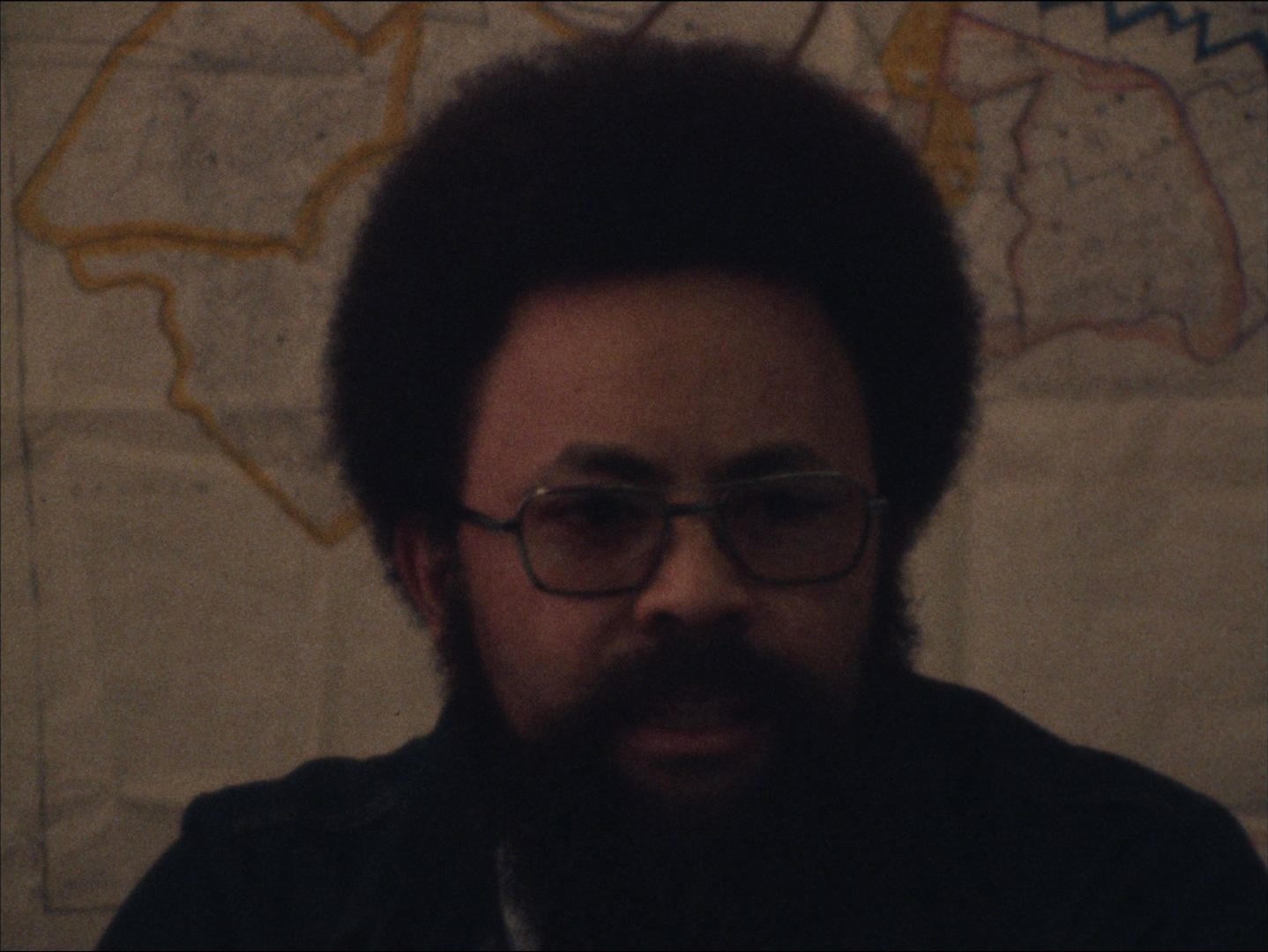
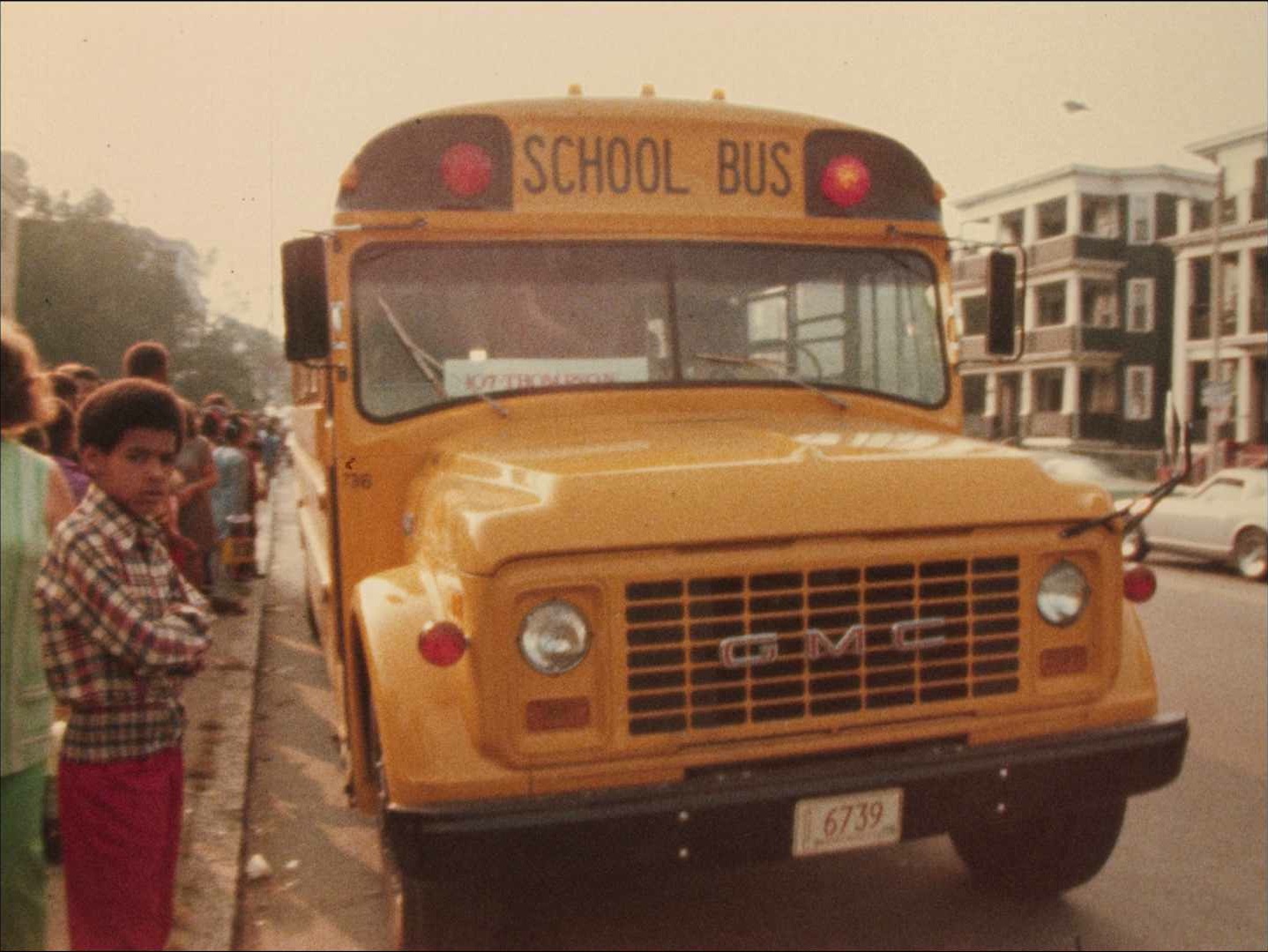
Description: Silent footage of African American children entering school and in a classroom, with mostly African American children and white teachers. A Mattapan family sits around the kitchen table, parents helping son with math homework. Father and mother speak about the changes caused by court ordered busing and their efforts with parent groups in the community. Reporter reasks questions for cutaway edits. Gerald Ford speech, image goes in and out while audio plays. Interview with man about how busing will affect his daughter and his efforts to keep the Lowell School open. Exteriors of a house, neighborhood environs, and closeup on Colorado St. sign. Footage of a young African American girl walking to school. More b-roll of classroom scenes. Students exiting Phineas Bates School building. Construction site (possibly where new school complex will be built). Closeup on Livermore St. sign and Charles Logue School sign. Mix of silent and sound.
Collection: WCVB Collection
Date Created: 03/15/1974
Description: Martin Nolan (Boston Globe) opens a Town Meeting on Race and Class at the John F. Kennedy Library. The meeting is held in honor of the release of J. Anthony Lukas's novel, Common Ground. The novel is about the busing crisis in Boston. Nolan talks about the novel. Ray Flynn (Mayor of Boston) addresses the meeting. Flynn says that the novel is the first piece of journalism to report accurately on the busing crisis. Flynn says that he is pleased that the novel touches on class issues as related to school desegregation in Boston. Flynn talks about the poor institutional leadership that led to the deterioration of the Boston Public School System. He adds that parents were never consulted during the school desegregation process. Mark Roosevelt (Executive Director, John F. Kennedy Library) addresses the audience and compliments Lukas on his book. Lukas addresses the meeting. Lukas mentions the name of each family member portrayed in the novel. He asks them all to stand. He expresses his sadness at the absence of the McGoff family (family portrayed in Common Ground) from the meeting. Lukas notes each family's connection to John F. Kennedy (former US President). Panelists at the meeting include Jack Beatty (Senior Editor, Atlantic Monthly), Thomas Brown (Professor, University of Massachusetts), Marie Clarke (parent and member of the Home and School Association), Moe Gillen (Charlestown community activist), Father Michael Groden (Archdiocese of Boston), Robert Kiley (former Deputy Mayor of Boston), Theodore Landsmark (attorney), Sandra Lynch (former general counsel to the State Department of Education), Kim Marshall (Director of Curriculum, Boston Public Schools), Reverend Charles Stith (Union United Methodist Church), and Thomas Winship (former editor, Boston Globe). Tape 1 of 8
0:59:58: Visual: A man addresses a Town Meeting on Race and Class at the John F. Kennedy Library. The town meeting is held in honor of the book Common Ground by J. Anthony Lukas (author). The man speaks from a podium. Panelists are assembled at tables on either side of the podium. Panelists include Jack Beatty (Senior Editor, The Atlantic Monthly), Thomas Brown (Professor, University of Massachusetts), Marie Clarke (parent and member of the Home and School Association), Moe Gillen (Charlestown community activist), Father Michael Groden (Archdiocese of Boston), Robert Kiley (former Deputy Mayor of Boston), Theodore Landsmark (attorney), Sandra Lynch (former general counsel to the State Department of Education), Kim Marshall (Director of Curriculum, Boston Public Schools), Reverend Charles Stith (Union United Methodist Church), and Thomas Winship (former editor, The Boston Globe). The man introduces Martin Nolan (The Boston Globe). Nolan reads from a glowing review of Common Ground, written by Robert B. Parker (author) for the Chicago Tribune. Nolan praises the book. He talks about the book's attention to the people it portrays. Nolan says that the book is not about the "movers and the shakers," but it is about "the moved and the shaken." Nolan jokes that everyone in the audience is a minor character in the book. Nolan introduces Ray Flynn (Mayor of Boston). Nolan says that Flynn is always searching for common ground among the residents of Boston. The audience applauds. 1:03:39: V: Flynn says that he is honored to address the audience. Flynn says that Lukas' book is the first piece of journalism to report accurately on the "real Boston." Flynn notes the complexity issues portrayed in the book. Flynn says that the vast majority of Bostonians occupied a "middle ground" during the busing crisis. Flynn says that Lukas listened to the residents of Boston who lived through the busing crisis; that Lukas found the common ground among these people. Flynn says that there are more issues that unite people than there are issues which divide people. Flynn says that people are looking for the same opportunities in education and training. Flynn adds that people in Boston are still struggling under the weight of social and economic injustice. Flynn talks about the need to give "poor people" an opportunity to receive a good education. Flynn says that he is pleased that Lukas's book tackles the issues of class. Flynn says that the deterioration of the school system in Boston was a result of poor institutional leadership. Flynn adds that no one individual or organization was responsible for the lack of leadership; that it reflects poorly on everyone in the city. Flynn says that the institutional responses to problems in education were unsatisfactory to parents and schoolchildren. Flynn adds that the schools needed to be desegregated and reformed. Flynn says that parents of schoolchildren were never consulted during the desegregation process. Flynn says that the busing crisis divided people along class lines; that education became a secondary concern. Flynn adds that "a wall of legal paper clouded the city of Boston." Flynn says that parents were powerless to effect change in the desegregation process. Flynn talks about his respect for the people in the audience and on the panel at the town meeting. Flynn cautions the audience and panelists at the town meeting not to spend the day rehashing the history of the busing crisis. Flynn says that the city of Boston must move forward and continue to find its "common ground." The audience applauds. 1:11:28: V: Nolan runs through the program for the town meeting. Nolan notes that two panelists are missing; that there are audience members in a second theater; that those audience members will be included in the discussion period. Nolan adds that each panelists will speak about Lukas' book. Nolan paraphrases Flynn in urging the panelists to focus on how the city of Boston can reach "common ground." Nolan introduces Mark Roosevelt (Executive Director, John F. Kennedy Library). Roosevelt introduces J. Anthony Lukas. Roosevelt thanks the audience and the panelists. Roosevelt thanks Lukas for his contribution to the city of Boston. Roosevelt says that Lukas's book has helped Boston residents to understand their differences and to see their city more clearly. The audience applauds. 1:14:51: V: Lukas thanks Roosevelt for making the town meeting possible. Lukas talks about his roots in New York City. Lukas says that his "heart is in Massachusetts." Lukas says that many audience members helped him with the book. He thanks those people. Lukas makes special mention of the families portrayed in the book. Lukas says that he sees the families as "collaborators" on the book, not as "subjects." Lukas talks about the candor, generosity and courage of the families who allowed themselves to be portrayed in the book. Lukas mentions each family member by name, and then invites them to stand as one. Lukas expresses his sadness that no member of the McGoff family is present. Lukas mentions the names of Rachel Twymon, Rachel Twymon (daughter), Michael Twymon, Cassandra Twymon, Wayne Twymon, Valerie Twymon, Reverend George Walker, Hasan Sharif, Joan Diver, Colin Diver, Brad Diver, Ned Diver, George McKechnie, Ethleen Diver, Norman McKechnie, Judy McKechnie. The audience applauds for the family members when they stand up. 1:18:44: V: Lukas notes that it is fitting that the town meeting be held at the JFK Library. Lukas adds that all three families were "charter members" of the Kennedy Coalition twenty-five years ago. Lukas says that Alice McGoff can remember seeing John F. Kennedy (former US President) march in the Bunker Hill Day Parade in 1946. Lukas talks about McGoff's enduring allegiance to Kennedy. Lukas says that Rachel Twymon used to listen to Martin Luther King (African American civil rights leader) when he preached at the Twelfth Baptist Church in Roxbury. Lukas talks about Twymon's respect for the connection between King and Kennedy. Lukas notes that Joan Diver attended Kennedy's inauguration in 1960.
Collection: Ten O'Clock News
Date Created: 09/28/1985
Description: Judy Stoia interviews James Kelly (South Boston Information Center) about resistance to busing and his decision not to attend the Procession Against Violence. Kelly says that he has appealed to African American parents to put pressure on the NAACP to stop busing. Kelly says that many African American parents agree that "forced busing is the problem." Following interview is silent footage of helicopter and security detail among rooftops of City Hall Plaza. A WGBH camera crew overlooks City Hall Plaza and records the Procession Against Violence. Thomas O'Neill, Jr. (Lieutenant Governor of Massachusetts), Kitty Dukakis, Michael Dukakis (Governor of Massachusetts), Kathryn White, Kevin White (Mayor, City of Boston), Charles Barry (State Secretary of Public Safety), Dr. Charles Glenn (Massachusetts State Department of Education), Ann Landers (advice columnist), Joseph Kennedy, Edward Kennedy (US Senator), and Edward Brooke (US Senator) are among those at the front of the procession. Footage includes overhead shots of the crowd and audio of hecklers jeering at White and Kennedy. Reverend Robert Golledge and John Colburn address the crowd. Tape 1 of 3.
1:00:15: Visual: Judy Stoia sets up an interview with James Kelly (South Boston Information Center) near City Hall Plaza. Stoia asks Kelly about a message he delivered to African American parents. Kelly says that he urged African American parents to use their influence with the NAACP to stop forced busing; that both white and African Americans know that "forced busing is the problem"; that African American parents have encouraged the South Boston Information Center to continue the fight against busing. Kelly says that he made the plea to African American parents in order to help restore sanity to the city. Kelly says that he will not participate in today's Procession Against Violence because it will do nothing to remedy forced busing; that the mayor, state officials and "the liberals" need to take a stand against forced busing. Stoia probes Kelly's motives in boycotting the march. Kelly says that his statement to African American parents will be more effective than a march around the city by "the liberal establishment." Kelly says that white parents want a good education for their children in neighborhood schools; that the "liberal establishment" and the media need to realize that "good education for all kids" is more important than "quality integrated education." Kelly says that he hopes white parents and African American parents can work together to solve some of the problems in the city. Stoia thanks Kelly. The crew takes some cutaway shots of Stoia asking questions. 1:05:09: V: A small crowd begins to gather for the procession against violence at City Hall Plaza. A few people look down on the plaza from rooftops. Helicopters circle above City Hall Plaza. A crowd mills about on the plaza. A small crowd is gathered around some seating. A marching band plays. 1:07:44: V: Groups of people walk toward City Hall Plaza. Police officers are visible. One officer directs traffic. The music of a marching band is audible, then it stops. Marchers begin to fill the street, moving toward the plaza. Four men in uniform lead the march, carrying an American flag and a Massachusetts state flag. A crowd of people stream into the plaza. A woman yells, "Kevin, stop forced busing." A man yells, "Hey, you hypocrite." Thomas O'Neill (Lieutenant Governor of Massachusetts), Michael Dukakis (Governor of Massachusetts), Kitty Dukakis, Kathryn White, Kevin White (Mayor, City of Boston), Charles Barry (State Secretary of Public Safety), Dr. Charles Glenn (Massachusetts State Department of Education) and Ann Landers (advice columnist) are among those visible at the front of the marchers. Some of the crowd jeers. A man yells, "Kennedy, you faker." The officials at the front of the march greet Elma Lewis and others informally as they proceed to the front of the plaza. A woman yells, "Stop forced busing. A large crowd continues to stream into the plaza. Shots of the assembled crowd. The WGBH crew tries to locate and identify public figures. A helicopter circles overhead. 1:15:25: V: A marching band begins to play. The stream of marchers continues into the plaza. Shots of assembled crowd. A woman yells, "Stop forced busing. A voice is heard addressing the crowd, calling for "a peaceful community in Boston." Shot of the crowd. O'Neill, Joseph Kennedy, Edward Kennedy (US Senator) and Edward Brooke (US Senator) are visible. Audio is difficult to hear. Reverend Robert Golledge (Vicar, Old North Church) addresses the crowd from the podium. Golledge introduces the band from the St. William's School in Dorchester. Assembled in front of the podium, the band strikes up the national anthem. Shots of the media photographing the event; of the crowd filling the plaza; of officials at the front of the crowd. John Colburn (Episcopal Archdiocese) leads the crowd in prayer.
Collection: Ten O'Clock News
Date Created: 04/23/1976
Description: Steve Nevas interviews George Wallace about his campaign for the Democratic presidential nomination. Nevas asks Wallace if he expects to do well with anti-busing voters in Massachusetts. Wallace comments on his chances in the Massachusetts primary, his relationship with the Democratic Party establishment and his role at the Democratic convention. He describes his feelings towards other Democratic perspective candidates Hubert Humphrey and Edward Kennedy. Wallace says that he has never campaigned much in Massachusetts; that he is happy to have the opportunity to present his ideas to the Massachusetts voters. Wallace denounces the "expansion" of the federal government, and calls busing a social experiment. Wallace gives his opinions on the political positions of Ralph Nader (consumer advocate) and Ronald Reagan (Governor of California). He talks about his previous campaigns for the presidential nomination.
15:33:22: Visual: Steve Nevas sets up an interview with George Wallace (Governor, State of Alabama) on his campaign for the presidency of the United States. Wallace is seated in a wheelchair. Nevas asks Wallace to comment on predictions that he will win the Massachusetts primary; that voters who are against busing will vote for him. Wallace says that he would be surprised if he won the Massachusetts primary. He says that too much time and money has been spent on busing in Boston; that busing is a "social experiment"; that the government needs to focus on unemployment and inflation. Wallace says that he did not campaign in Massachusetts in 1972; that he has not had a lot of contact with Massachusetts voters. Nevas again brings up the predictions that Wallace will win the state. Wallace says that his ideas have been distorted through propoganda; that many voters in Massachusetts have misunderstood his ideas. Wallace says that winning the Massachusetts primary would be a great victory for him. Nevas asks Wallace about the candidacy of Ronald Reagan (Governor, State of California). Wallace says that he is not familiar with the details of Reagan's plan to cut $90 billion from the federal budget; that he agrees with Reagan on increased state control over government spending; that the people of Massachusetts should have more control over how school money is spent. Nevas asks Wallace about Ralph Nader (consumer advocate) and his proposal that large corporations be chartered by the federal government. Wallace says that he does not support any idea giving the federal government more authority; that he believes in the enforcement of anti-trust laws. Wallace adds that the federal government already has too much authority; that the people of Massachusetts had no recourse when federal judges ordered forced busing; that state governments should have more authority in most matters. 15:38:25: V: Nevas remarks that a poll showed Wallace in second place after Sargent Shriver (presidential candidate) in Massachusetts. Wallace says again that he does not expect to do well in Massachusetts. Wallace adds that government attention has been focused on busing; that busing is a "social experiment"; that the voters of Massachusetts are concerned about other issues. Wallace says that he is campaigning in Massachusetts because it has an early primary election; that voters in the northeast have been unfamiliar with his ideas until now. Nevas asks Wallace if he would support Hubert Humphrey (US Senator) or Edward Kennedy (US Senator) as the Democratic nominee for president. Wallace says that Kennedy has never declared his candidacy; that Humphrey is not campaigning. Wallace notes that the national Democratic Party does not support his candidacy for president; that the Democratic Party is organizing a strategy to defeat his candidacy; that the Democratic Party is out of touch with working people. Wallace adds that there is a conspiracy against him in the Democratic Party. Nevas asks about the possibility of Wallace running for president as a third party candidate. Wallace says that many Democratic nominees are adopting his positions against busing and big government; that his positions are compatible with the platform of the national Democratic Party. Wallace says that he will work to ensure that his positions are represented at the Democratic convention in New York City over the summer. Wallace notes that many leaders are paying attention to his positions; that his ideas represent those of the working people of the nation. Wallace says that he is not at all interested in the vice-presidency. He adds that the other candidates have already stated that they will not offer him the vice-presidential nomination. 15:45:25: V: Nevas asks him if he would disclose his full medical report if the other candidates did so. Wallace responds that a medical writer for the New York Times has examined his medical report and given him a clean bill of health; that his confinement to a wheelchair does not affect his ability to be president. Nevas asks Wallace to comment on the movement for an uncommitted slate of delegates within the Democratic Party. Wallace says that some of the uncommitted delegates could pledge their votes to him. Nevas asks Wallace if he is in favor of streamlining the presidential campaign process. Wallace says that the state primaries could be consolidated into regional primaries. Nevas states that Wallace has run for president more than once. Wallace responds that he ran for president once in 1968; that he ran in three primaries in 1964 in order to make a statement against the left-wing politics of the other Democratic candidates; that he was shot in 1972 and did not finish the campaign. Nevas asks Wallace why he is seeking the presidency. Wallace says that he wants the working people of the nation to be represented in the government. Wallace notes that he has been warning people about the expanding reach of the federal government; that the people of Massachusetts experienced this kind of intrusive governmental intervention during the busing crisis. Nevas says that many people see him as a segregationist. Wallace says that he is not against people of color; that African Americans in Alabama have voted for him overwhelmingly; that he is against big government, not people. Wallace says that he grew up during a time when the segregation of races was accepted as the best solution; that segregation was sanctioned by the courts back then. Wallace adds that segregation is illegal now and it is no longer an issue. Nevas closes the interview. The camera crew takes cutaway shots of Nevas questioning Wallace. Wallace asks Nevas if he would be surprised if Wallace did well in the Massachusetts primary election. Nevas says that he would not be surprised if Wallace did well. Wallace says that he has not conducted any polls of Massachusetts voters. Wallace says that he expects to do well in Michigan and Pennsylvania; that it is hard to predict how voters will react to him. Wallace notes that people in Massachusetts made fun of his ideas years ago; that now Massachusetts voters take him seriously.
Collection: Ten O'Clock News
Date Created: 01/27/1976
Description: W. Arthur Garrity (federal judge) speaks at a meeting of the Citywide Educational Coalition (CWEC). Jane Margulis (CWEC) introduces Garrity. Laval Wilson (Superintendent, Boston Public Schools), Sidney Smith (Headmaster, English High School), and Ellen Guiney (CWEC) sit on stage. Garrity talks about his efforts to wrap up the school desegregation case. He says that there are a few lingering matters to be handled before he withdraws. Garrity thanks the CWEC for providing factual and reliable information about school desegregation. Garrity talks about a "sea of misinformation" surrounding school desegregation. He refutes rumors that he was involved in hiring teachers and buying supplies. Garrity compliments John Coakley (Boston School Department) on his career in the Boston School Department; he mentions Coakley's integrity and dedication to his job. Garrity sums up the challenges facing the Boston Public Schools; he says that school integration is an ongoing process. Reel 1
0:59:59: Visual: Arthur Garrity (federal judge) speaks at English High School at the annual meeting of the Citywide Education Coalition (CWEC). Garrity is at the end of his involvement in the Boston school desegregation case. Jane Margulis (CWEC) introduces Garrity. Garrity sits on stage, with a group of officials including Laval Wilson (Superintendent of Boston Public Schools), Sidney Smith (Headmaster, English High School), and Ellen Guiney (CWEC). Margulis tells a few anecdotes as she introduces Garrity. Garrity shakes her hand and kisses her on the cheek as he approaches the podium. 1:02:17: V: Garrity thanks Margulis. Garrity tells a story about how he and Margulis spoke at a seminar about school desegregation in Virginia. Garrity says that members of the audience were so impressed with Margulis that she received a job offer on the spot from a school system in Texas. Garrity says that he has not come to talk about the final court orders that he handed down on September 3. Garrity reads from the canon of judicial conduct, which instructs a judge not to comment publicly on court proceedings. Garrity reminds the audience that the court case is not entirely over; that the Boston Teacher's Union has filed an appeal of the court orders issued on September 3. Garrity says that he has extended the time period in which other appeals may be filed. Garrity adds that there is another court hearing on Friday to discuss support services for the Boston Latin School. Garrity talks about a motion filed by the city of Boston to modify one of the court orders dealing with emergency school repairs. 1:07:57: V: Garrity says that he has come to thank the Citywide Education Coalition (CWEC). Garrity commends the CWEC for gathering and disseminating factual information since the beginning of desegregation. Garrity says that there was "a sea of misinformation" during that time period. Garrity cites an article from The New York Times written on September 6. The article says that Garrity was involved in hiring teachers and buying supplies. Garrity says that it is "laughable" to think that he was involved in those areas of the school system. Garrity notes that he was only involved in the hiring of one person; that he helped to hire Jerome Wynegar (Headmaster, South Boston High School). Garrity says that he wanted to acknowledge the debt owed to the CWEC by the court. Garrity adds that he wanted to meet Laval Wilson; that Wilson has a good reputation as a school administrator. Garrity says that he wanted to be present to honor John Coakley (Boston School Department). Garrity says that the Boston school desegregation case "is nothing else if not a hundred stories." Garrity talks about referring to one of the school desegregation plans filed in court as "the Coakley plan," because it was written by Coakley. He adds that a friend counseled him to stop calling it the "Coakley plan" so as not to ruin Coakley's future in the Boston School Department. Garrity says that he had recently written a a memo connected to one of the court orders, in which he commended Coakley's conscientious job performance. Garrity talks about Coakley's integrity and dedication to his job. Garrity says that there never would have been a student assignment system without Coakley. 1:12:56: V: Garrity says that school desegregation is an ongoing process. Garrity talks about the many tasks facing the Boston Public School System. Garrity talks about differences between the city of Boston and the state over the budget for facilities and school repair. Garrity talks about the need to determine which schools will get money to improve facilities. Garrity talks about the question of the Latin Schools. Garrity notes that the Boston Globe recently printed a letter from Robert Dentler (Dean of Education, Boston University) on the subject of the Latin Schools. Garrity denies charges printed in the newspapers that he vetoed a plan to improve the Latin Schools. Garrity adds that no plan has been filed to improve the Latin Schools. Garrity says that critics have misread the court orders; that planning must be undertaken for the Latin Schools. Garrity talks about the challenges involved in plans to improve vocational and occupational education. Garrity notes that the Boston School Committee faces some deadlines in its plans to improve vocational education. Garrity stresses that there is much work remaining to be done in the schools; that "the challenges of the future are greater than the challenges of the past." Garrity commends Rita Walsh-Tomasini (Boston School Committee) for advocating the formation of a committee to work with parents' organizations in the schools.
Collection: Ten O'Clock News
Date Created: 09/23/1985
Description: "Leader: "P1 Metco Sidebar #7007 - 14 Jan 74"; Silent footage of children getting off a bus at John Eliot School. Children play in the snow. Bob Windsor reporter standup about 10 kids who are bussed to Pollard Junior High School in Needham from Boston. Interview with a couple of the children who are bussed. Interview with a woman about Metco and critiques of the busing plan and the need to integrate staff as well as students. B-roll of children getting on busses, busses drive away, interview b-roll. Outtakes include more b-roll, more student interviews, and reporter outtakes."
Collection: WCVB Collection
Date Created: 01/14/1974
Description: Christy George reports that City Councilor James Kelly objects to an interfaith, interracial prayer service to be held in South Boston because he fears that the meeting could be seen as an endorsement of the city's plan to integrate South Boston housing projects. Kelly has called for the meeting to be moved to another location. Interview with Father Thomas McDonnell of St. Augustine's Church in South Boston and Reverend John Borders of the Morningstar Baptist Church. McDonnell and Borders say that South Boston is not a racist neighborhood. Interview with Jim Kelly. George quotes Kelly as saying that he opposes forced busing, racial quotas, and forced housing. Community leaders have met with Mayor Ray Flynn to discuss the peaceful integration of public housing projects, and hold a press conference. Doris Bunte of the Boston Housing Authority, Charles Stith of the Union United Methodist Church, John O'Bryant of the Boston School Committee, and Don Muhammad of the Nation of Islam, Roxbury speak at the press conference. George reports that Bernard Cardinal Law (Archdiocese of Boston) endorses the meeting. George notes that Flynn is pushing for housing integration over the objections of South Boston residents. Footage of Flynn at a community meeting in South Boston and footage of anti-busing activity in South Boston in 1977.
1:00:05: Visual: Footage of Father Thomas McDonnell (St. Augustine's Church in South Boston) and Reverend John M. Borders, III (Morningstar Baptist Church in Mattapan) sitting together for an interview in South Boston. McDonnell says that both men believe in the power of prayer. Christy George reports that religious leaders want to hold an interfaith, interracial prayer meeting at St. Monica's Church in South Boston; that James Kelly (Boston City Council) has taken out a half-page advertisement in the South Boston Tribune; that the ad calls on the Catholic Church to move the prayer meeting to another location. George reports that Kelly fears that the prayer meeting could be seen as an endorsement of the city's plan to desegregate public housing projects in South Boston. V: Shot of the exterior of St. Monica's Church; of Kelly's advertisement in the South Boston Tribune; of a statue in front of the church. Footage of McDonnell saying that racism is a moral issue. Borders says that prayer is a means to change the people's hearts. Footage of police arresting two women on G Street in South Boston on May 12, 1977. Shots of police cruisers escorting school buses along a city street; of a housing project in South Boston. Shots of a sign for the Old Colony Housing Project; of a white woman and children in front of a housing project building. George notes that South Boston became a battleground during school desegregation. George reports that Ray Flynn (Mayor of Boston) has announced that the public housing projects in South Boston will be integrated; that Flynn alienated many South Boston voters by pushing for public housing integration. V: Shot of Flynn approaching the stage at a community meeting in South Boston on January 12, 1988. The crowd jeers and boos as Flynn walks on to the stage. Shot of audience members seated at long tables. Footage of Kelly at the community meeting. Kelly says that South Boston residents will serve time for civil rights violations if the public housing projects are integrated. The crowd applauds Kelly. George reports that community leaders met with Flynn today to talk about peaceful desegregation of the projects; that attendees at the meeting expressed thinly disguised scorn for Kelly. V: Shot of Doris Bunte (Boston Housing Authority) speaking at a press conference. Charles Stith (Union United Methodist Church) and two other African American community leaders stand behind her. Footage of John O'Bryant (Boston School Committee) at a press conference. A reporter asks him if Kelly's name was mentioned in the meeting with Flynn. O'Bryant replies, "Who's he?" George reports that Kelly believes that affirmative action is reverse racism. George quotes Kelly as saying that "assigning the needy to public housing based on race is morally and legally wrong." V: Shot of Kelly at his desk. A quote from Kelly is written out in text on-screen. Footage of Kelly saying that supporters of equal opportunity must oppose forced busing, racial quotas, and forced housing. Footage of Stith saying that there are some elected officials who insist on keeping the city divided; that religious leaders are making an effort to unite the city. Footage of Minister Don Muhammad (Nation of Islam, Roxbury) saying that not all Irish residents are racist; that African Americans in Roxbury are not all drug addicts. George reports that Bernard Cardinal Law (Archdiocese of Boston) endorsed the prayer meeting. George quotes Law as saying that publicity "could lead to the erroneous impression that racial discrimination is a problem of geography, which it is not. . . . Racial discrimination is a problem of the human heart." V: Shot of Law addressing an audience. A quote from Law is written out in text on-screen. George reports that one of the goals of the prayer meeting is to debunk the myth of South Boston as a racist neighborhood. V: Shot of a white family walking in front of St. Monica's Church. Footage of Borders saying that Kelly does not represent the views of all South Bostonians. Borders says that he had no problems in South Boston when he drove to today's interview at the church. George reports that religious leaders say that the prayer meeting is not about politics; that the controversy surrounding the meeting has become political despite the efforts of religious leaders.
Collection: Ten O'Clock News
Date Created: 05/20/1988
Description: Police officers and members of the media are gathered on G Street in front of South Boston High School. Graffiti written in large white letters on the pavement of G Street reads, "Go home, Jerome. You failed." (Graffiti refers to South Boston High School headmaster Jerome Wynegar.) Police are stationed along G Street. A small crowd on the steps of a house jeers at police. News crews with ENG cameras and microphones approach. The crowd refuses to disperse. Police officers in riot helmets assemble in front of the house. Four women and two men are put into police vans. Two of the women struggle with the police, and one man is dragged into the van. The crowd retreats into the house on G Street. James Kelly (South Boston Information Center) talks to a woman about the conflict between the crowd and police. Joseph Jordan (Police Commissioner, City of Boston) confers with police officials outside of South Boston High School.
0:00:24: Visual: Exterior of South Boston High School. Shots of the front of the building; of the school name carved into the stone at the top of the building. Police officers and media are gathered on the sidewalk in front of the school. A fading green shamrock is painted on the pavement of the school yard. Police officers confer about logistics. Boston Police Department vehicles are parked in the school yard. A Boston Police Department truck pulls in front of the of the high school. 0:02:23: V: Police officers are stationed along G Street. Close-up shot of the Boston Police Department insignia on a police officer's uniform. A crowd of white residents is gathered on the on the steps of a house on G Street, not far from the school. White teenagers are gathered outside of the Hill Stop Delicatessen on G Street, near the school. A police officer directs traffic along G Street. A group of police officers are gathered on G Street, near the crowd on the steps of the house. A police officer exits a car parked in the school yard of the high school. A Boston Police Department truck passes by the high school with its lights flashing. The truck pulls to the side of G Street, near the house where the crowd has gathered. Members of the media follow the truck down the street. A police officer gestures to the truck to pull up closer. A woman sits on the hood of a car, surrounded by police officers. 0:05:15: V: The crowd gathered on the steps of the house yells and makes gestures at the police officers. The woman sitting on the car speaks angrily to the police officers. She refuses to move from the car and says that she is not creating a scene. Police officers try to disperse the crowd of media gathered on the street. The crowd on the steps of the house is heard jeering at police. Graffiti written in large white letters on the pavement in the middle of G Street reads, "Go home Jerome. You failed." (Graffiti refers to South Boston High School Headmaster, Jerome Wynegar.) A crowd of onlookers gathers outside of the delicatessen, across the street from the crowd. Police and the media remain in the street. The crowd on the steps of the house begins to sing. 0:06:48: V: A second Boston Police Department truck exits the school yard of South Boston High School and pulls up behind the first truck on G Street. A group of helmeted police officers walks down G Street from the school. The police officers spread out across the street as they walk toward the house where the crowd has gathered. The police instruct onlookers to move down the street, away from the scene. Police officers and officials watch as the helmeted officers disperse the crowd of onlookers. Police officers stand in front of the small crowd assembled on the steps of the house. The police put the woman who had been sitting on the hood of the car into the police truck. The crowd cheers for the woman. One man yells, "Where is the civil rights commission?" A woman runs from the crowd to stop police from putting a second woman into the police truck. Police force both women into the truck, and hold the doors closed. The women inside the truck beat on the doors from the inside. The crowd jeers at police. A young man yells, "Three girls!" 0:10:11: V: A police officer walks down G Street from the high school. Other police officers remain in front of the crowd on the steps of the house. The crowd and the police exchange remarks. The crowd refuses to go indoors. A man is led by police into the second police truck. Police drag a second man from the crowd into the police truck. A police officer pushes the crowd from the steps into the house as another woman is led to the truck by police officers. The woman says, "This is a violation of civil rights." 0:12:11: V: Most of the crowd on the steps has disappeared into the house on G Street. Members of the crowd look out of the window at the action on the street. James Kelly (South Boston Information Center) stands on the steps of the house, listening to a woman describe the conflict between the crowd and the police. The police truck drives slowly down G Street. Police line the sides of the street. A group of police officers confers in the middle of G Street. The media observes the police and the dwindling crowd from the sidewalks. There are still a few people gathered on the steps of the house on G Street. Shot of a quiet side street. Residents sit outside of their houses, enjoying the sun. 0:14:19: V: Joseph Jordan (Police Commissioner, City of Boston) confers with officers outside of South Boston High School. Shot of the exterior of South Boston High School. A few youth are gathered on the steps.
Collection: Ten O'Clock News
Date Created: 05/12/1977
Description: Footage of people addressing the Massachusetts legislature Racial Imbalance Hearing. School Committee President John Kerrigan speaks against forced busing and "snob zoning." He blames Governor Sargent and Senators Ted Kennedy and Ed Brooke, and also comments on the flip of Mayor Kevin White's support. Louise Day Hicks speaks against the Racial Imbalance Law. State Rep. Royal Bolling, Sr. speaks against the procedure of having separate hearings for proponents and opponents, and gets in an argument with the Committee Chairman. Kevin White speaks in favor of integration, but against forced busing. B-roll of audience at the hearing. Mix of sound and silent.
Collection: WCVB Collection
Date Created: 04/03/1974
Description: Boston Police Department press conference with Police Commissioner Robert DiGrazia, Superintendent Joseph Jordan, Deputy Superintendent Lawrence Quinlan, Captain Morris Allen, and Captain Fred Conley. Steve Dunleavy (spokesperson for DiGrazia) is the moderator. The speakers are seated at a table featuring an array of street weapons used against police in a riot in South Boston on the previous day. DiGrazia says that violence and disruptions of public order will no longer be tolerated. He says that the police department is actively investigating participants in the violence at the previous day's demonstration in South Boston. DiGrazia says that the police are gathering evidence against the South Boston Marshals and others for engaging in violent actions. DiGrazia notes that the demonstrators in South Boston knowingly violated the restrictions of their parade permit. Some drop out in the middle of the video. Reel 2 of 2.
1:00:03: Visual: Press conference with Robert DiGrazia (Police Commissioner, City of Boston), Captain Morris Allen, Superintendent Joseph Jordan, Deputy Superintendent Lawrence Quinlan, and Captain Fred Conley. Steve Dunleavy (spokesperson for DiGrazia) is the moderator. DiGrazia and the police officers sit at a table displaying bottles, rocks, pipes and bricks which were used against police in a demonstration in South Boston the day before. DiGrazia takes questions from reporters. A reporter comments that one anti-busing organization has decided to take to the streets. DiGrazia replied that statements like that will be considered conspiratorial and could be used against the organization in court. DiGrazia says that the police will use whatever force is necessary to keep order. DiGrazia says that the police department has been working with the state police and the MDC police since 1974; that the Boston police will continue to rely on those police forces for support. DiGrazia says that he is compiling facts and evidence to be presented before a grand jury; that the police will arrest those who participate in violence or who violate the civil rights of others. DiGrazia says that a parade permit was granted to demonstrators in South Boston yesterday; that the demonstrators knowingly violated the permit when they marched up to the high school to confront police. 1:02:52: V: A reporter asks DiGrazia if the police department has the support of the mayor. DiGrazia says that the mayor supports police efforts to enforce the law and protect the community. DiGrazia says that he is concerned with the lack of prosecutions of those violating the court order; that he was pleased when the US Justice Department began investigating cases in 1975; that he is particularly dismayed at the lack of prosecutions in the South Boston District Court. DiGrazia says that he does not know where the demonstrators in South Boston procured tear gas. DiGrazia says that the police is now taking a more forceful approach against disruptors of public order. A reporter asks if past policies of tolerance were a mistake. DiGrazia says that they began with a low visibility policy in September of 1974; that the policy worked in all areas of the city except South Boston; that in 1975, they changed tactics and were more forceful; that the police have been tolerant of demonstrations up until now; that they will no longer tolerate violence during demonstrations. DiGrazia says that expenses are not an issue when city residents are injured and property is damaged; that the money will be made available to the police to deal with these problems. 1:06:02: V: A reporter asks DiGrazia about how the police handled demonstrators at the Citywide Coordinating Council (CCC) meeting. Shot of weapons on table. DiGrazia says that police tried to take their cues from Arthur Gartland (CCC), who ran the meeting; that from now on, police will act when they think it is necessary. DiGrazia says that he has not been in contact with Judge Garrity about the change in police deparment tactics. Dunleavy adds that a list will be made available of the 80 police officers injured in yesterday's demonstration in South Boston; that 13 arrests were made at the demonstration. DiGrazia says that the police department's new policy on demonstrations will not affect the way police handle their duties in and around the schools. DiGrazia says that he will not station more police in South Boston permanently; that he will send more officers there if it is necessary. A reporter comments that demonstrators were using radios to monitor police activity. A reporter asks if police department will change radio frequencies to avoid being monitored. DiGrazia says that police department may explore other means of communications in order to avoid radios altogether. 1:09:24: V: DiGrazia invites the reporters to question the other officers who were all present at the demonstration in South Boston on the previous day. A reporter asks if it is a small group of people who are actively participating in violence. DiGrazia replies that he has seen demonstrations with as few as 150 people; that 1,000 people were present at yesterday's demonstration; that there is a group of 300-400 "hoods" who are leading the violence; that the police department is gathering evidence on the participation of the South Boston Marshals in violent acts. DiGrazia says that the police department is actively investigating actions connected to yesterday's demonstration; that he will not put a time limit on the investigation. DiGrazia thanks the media and leaves. 1:10:41: V: DiGrazia exits. Members of the media talk among themselves. Jordan talks to members of the press informally. 1:12:07: V: Judy Stoia stands next to map of South Boston. Allen refers to the map as he charts out the course of the previous day's demonstration. Allen says that one group of marchers began at the Broadway MBTA station and proceeded up West Broadway to Perkins square; that the other group of marchers began at the Andrews MBTA station and marched up Dorchester Avenue to Perkins Square;that the marchers were supposed to proceed to the Dorchester Heights Monument. Allen says that the marchers chose to march up East Broadway to G Street, heading toward the front of the high school; that there were over 2,000 marchers gathered in Perkins Square. Stoia and crew prepare to leave.
Collection: Ten O'Clock News
Date Created: 02/16/1976