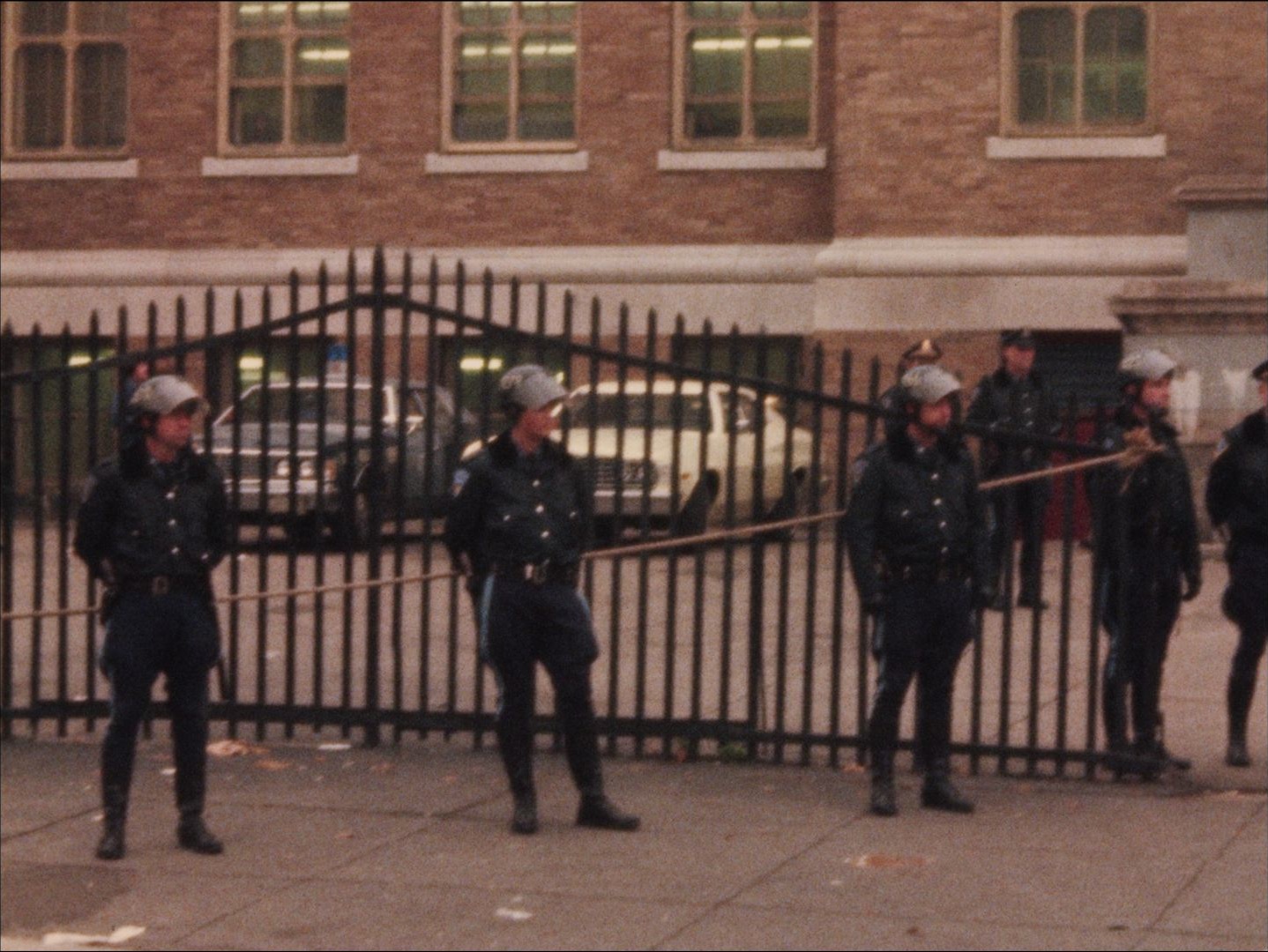
Description: Police lined up outside Charlestown High. Teachers gathered at the front of the school. Black students get off bus. Person on the street interviews with students boycotting school in busing protest. They discuss the purpose of their boycott. Some fiercely defend sovereignty of sports teams, make racist comments.
1:00:04: Visual: Police are lined up in the street in front of Charlestown High School on the first day of school. Graffiti on the front of the school is painted over. The media is gathered behind a fence across the street from the school. 1:01:30: V: A police car approaches slowly, escorting a school bus. The school bus pulls up to the front of the school. African American students exit the bus and enter the school. White students watch the action on the street from an upper window of the school. Police officers on motorcycles wait alongside the bus. The bus pulls away, followed by motorcycles. Shot of the bus circling Monument Square; of two police motorcycles circling Monument Square; of police stationed in Monument Square. 1:05:48: V: Crowds of people, including school-aged kids, are assembled outside of the Bunker Hill Housing Project on Bunker Hill Street. Cars pass by slowly. Shots of the top of the Bunker Hill Monument, visible over a building. 1:08:14: V: A group of white youth are gathered near a fence on Bunker Hill Street. A voice yells, "No busing." The group waves at the camera. Judy Stoia approaches the group and brings some members over to the camera for an interview. Two males convince a girl named Patty to join the interview. She is reluctant. They are joined by an older man. The older man says that he has six grandchildren who are being bused out of Charlestown. One of the males (Mike) says he plans to boycott school all year; that Charlestown has been quiet "because we are not racists." The older man says that he has spoken to some African American residents of the Dudley Street Housing Project; that they were "good people." Members of the group say that crowds of anti-busers will stay in the street until the end of the schoolday. Mike says that a total boycott of the school could stop busing; that anti-busing demonstrations in Charlestown may turn violent. Another male says that demonstrators in Charlestown will be peaceful. The group is reluctant to talk further and begins to move away from the camera. Stoia asks them how they feel about dropping out of sports programs because of the boycott. Members of the group say that they can play sports among themselves; that they do not mind African American students being bused into Charlestown; that they resent Charlestown students being bused out; that "townies" must stick together. 1:13:20: V: A group of young white male students are gathered in the street. A reporter asks them about sports in Charlestown. One student says that you can't go to sports practice if you have missed school. A second student says that Charlestown sports teams should not have to admit players from outside of Charlestown; that players from outside of Charlestown will be given a hard time in practice until they quit. Members of the group say that Charlestown students who are assigned to schools outside of Charlestown are boycotting school; that buses leaving Charlestown are empty. Another student says that there are no cops on the field for sports practices; that Charlestown players will be rough on outsiders during sports practices. Members of the group say that Charlestown sports teams do not need players from outside of Charlestown. The group says that Charlestown students were turned away from Charlestown High School this morning because they were late. Several members of the group use racist language. One student says that tardy students were turned away unless they had a note from their parents; that African American students on buses were let in to school. Several of the group say that they had been planning to take over the school this morning. One student shows his Charlestown High School identity card to the reporter.
Collection: Evening Compass, The
Date Created: 09/08/1975
Description: Judy Stoia interviews Gloria Conway (Editor, Charlestown Patriot), Dennis Kearney (State Representative) and Mon O'Shea (Associate Dean, Bunker Hill Community College) on the steps of the Bunker Hill Monument. They talk about youth violence, racism and the anti-busing movement in Charlestown. Conway says that racist graffiti in the neighborhood represents the actions of only a few people. Kearney recounts seeing a crowd of people, of which a few taunted a bus of African American students, while they others in the crowd were abhorred. Conway says that the Charlestown anti-busing movement is committed to non-violence. Sound cuts out at the very end. Tape 2 of 3.
0:00:55: Visual: Shot of police officers and residents lined up beside an ice cream truck. Judy Stoia sets up an interview with Dennis Kearney (State Representative), Gloria Conway (Editor, Charlestown Patriot) and Mon O'Shea (Associate Dean, Bunker Hill Community College) on the steps of the Bunker Hill Monument. 0:01:10: V: O'Shea and Conway speak about youth violence and gangs in Charlestown. O'Shea talks about younger kids being caught up in the aggression. Stoia asks about racism in Charlestown. Conway says that racist graffiti is the work of a few people and does not represent the community. Kearney says that many residents are disgusted by racial slurs directed at schoolchildren. Conway says that local anti-busing protestors have condemned violence and that marches in Charlestown have been peaceful. 0:04:19: V: Stoia talks about the perception of Charlestown as a violent community. O'Shea responds that violence is a problem in many cities. Audio cuts out.
Collection: Evening Compass, The
Date Created: 09/10/1975
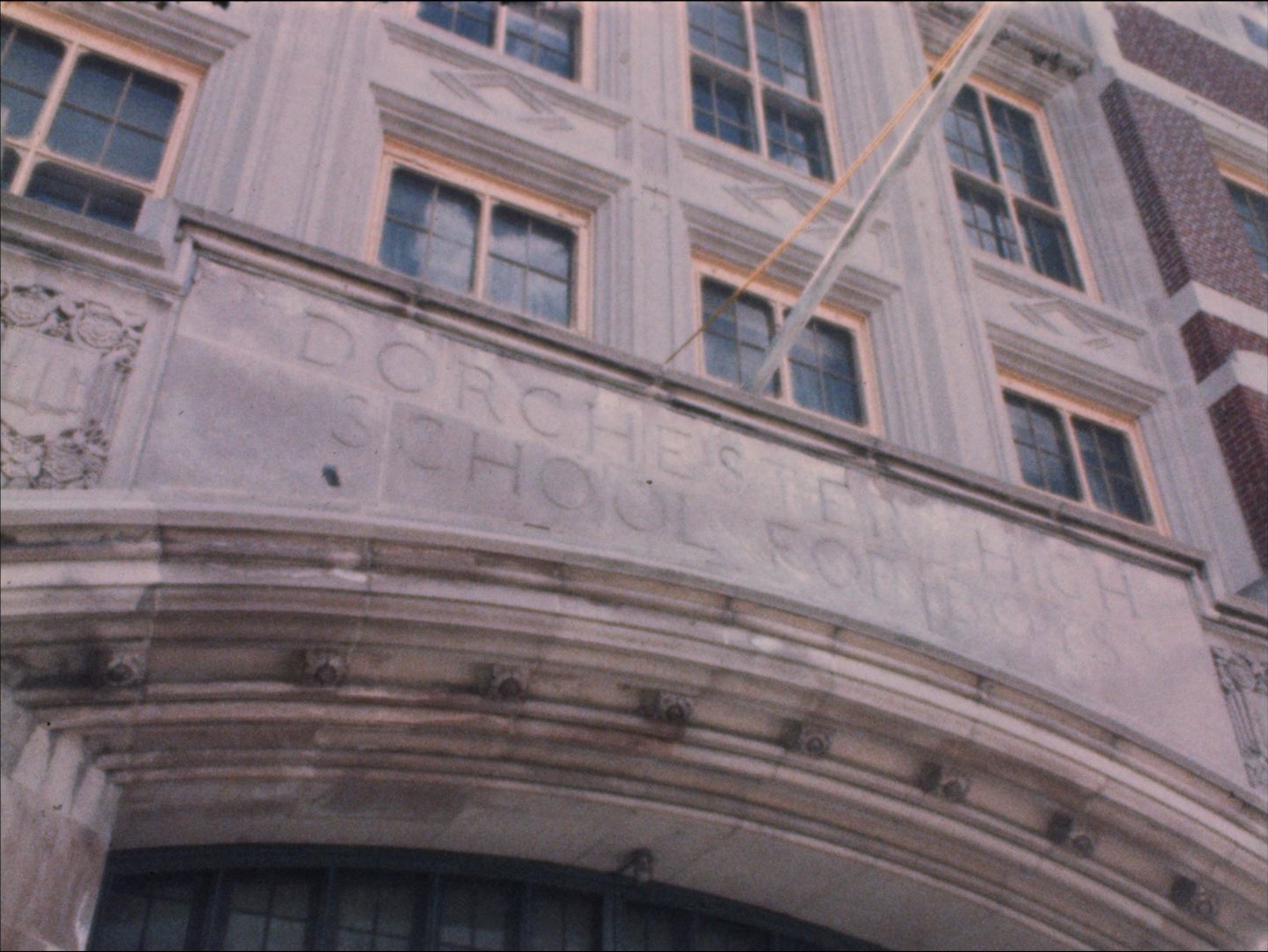
Description: Leader: P1 Police Busing Prep #9321 7/11/74; Silent footage of a street with traffic; the front of school including South Boston and Dorchester High Schools; street signs; more footage of streets around Boston; Mary McKay reporter standup. Interview with a police officer. More b-roll footage of the schools and streets. Reporter outtakes.
Collection: WCVB Collection
Date Created: 07/11/1974
Description: Police, including Captain Bill MacDonald (Boston Police Department) disperse a crowd in Monument Square in Charlestown after an anti-busing demonstration. A crowd is gathered in front of Bunker Hill Housing Project. Police and US Marshals are stationed across the street from the crowd. The police maneuver in the street. The crowd jeers at police and at least one bottle is thrown. The crowd retreats into the housing project. Police move up Bunker Hill Street. Robert DiGrazia (Police Commissioner, City of Boston) is present.
0:58:19: Visual: A large crowd of mostly students is gathered along a street in Monument Square. Police are stationed in the street, monitoring the crowd. Captain Bill MacDonald (Boston Police Department) addresses the crowd through a bullhorn, telling them to go home. Crowd begins to disperse, chanting periodically. An MDC Police vehicle is visible. 1:01:02: V: A Boston Police truck with officers seated in back drives past Charlestown High School and stops. MacDonald issues instructions to them through a bullhorn. Police officers exit from the back of the truck and gather in front of the high school. MacDonald issues more instructions through a bullhorn. Robert DiGrazia (Police Commissioner, City of Boston) confers with an officer across from the school. 1:02:37: V: The crowd disperses, moving along Bunker Hill Street. Shot of Concord Street and the intersection of Concord and Bunker Hill Streets. DiGrazia walks down Concord Street. Residents watch the action on the street from their windows. Graffiti on Concord Street marks a boundary of 100 yards from the high school: "100 yds. - Freedom Ends Here." Shot up Concord Street to High School. 1:03:45: V: Police are assembled at the intersection of Concord and Bunker Hill Streets. A crowd is gathered outside of the Bunker Hill Housing Project on Bunker Hill Street. Shots of crowd outside housing project; of police assembled in street. 1:05:25: V: The crowd cheers as police march back up Concord Street toward the high school. Members of the press, including Gary Griffith (reporter), follow the police up Concord Street. The crowd in front of the housing project moves into the street. A voice yells into a bullhorn, "Ok kids, it's your neighborhood." The crowd mills about in front of housing project. 1:07:08: V: A few police officers walk down Concord Street toward the housing project. A large crowd is still gathered in front of the housing project. A group of US Marshals walk down Concord Street. DiGrazia surveys the scene from the top of Concord Street. Voices can be heard taunting the police. DiGrazia walks down Concord Street toward the housing project. A woman walks her father back to his house, so that he won't get hurt "when the bottles start." 1:09:06: V: The large crowd in front of the housing project cheers loudly. Shot of a US Marshal walking away from the crowd. Noise of a bottle breaking against the pavement. Police on Concord Street watch the crowd in front of the housing project. The noise of a helicopter is audible. MacDonald shouts instructions through a bullhorn to police. Two US Marshals in riot helmets walk down Concord Street. A group of police march in formation from Monument Square down Concord Street. DiGrazia stands with a group of officers at the end of Concord Street, across from the housing project. A helicopter circles overhead. The crowd thins as people move into the housing project. MacDonald advances toward a crowd of youth, turning the corner onto Bunker Hill Street. DiGrazia and a group of officers and US Marshals follow MacDonald. MacDonald shouts into the bullhorn. A group of police officers exit the housing project and take a right as they continue to walk up Bunker Hill Street. Cars pass slowly on Bunker Hill Street. Small groups of people are gathered on the sidewalks. Police officers and the media walk in the street. 1:13:49: V: Three US Marshals in riot helmets confer on Bunker Hill Street. Police officers walk up the street. The media are gathered on a street corner. Two officers stand at the side of the street. One officer adjusts his riot helmet.
Collection: Ten O'Clock News
Date Created: 09/08/1976
Description: Judy Stoia interviews Dennis Kearney (State Representative), Gloria Conway (Editor, Charlestown Patriot) and Mon O'Shea (Associate Dean, Bunker Hill Community College) on the steps of the Bunker Hill Monument. They talk about the anti-busing movement in Charlestown. O'Shea says that the media have portrayed Charlestown as a violent community; that the Charlestown anti-busing movement is working for public safety and rumor control. Conway discusses the damage the media can cause by reporting unverified rumors. Paul deGive interviews Conway on police presence in Charlestown and about violent youth in Charlestown. Conway says that police officers in Charlestown allowed a peaceful demonstration to proceed today; that residents need to vent their frustrations. Conway discusses the ways local and national media interact with the people involved in the busing situation, while they shoot cutaways. Tape 3 of 3
1:00:01: Visual: Judy Stoia interviews Dennis Kearney (State Representative), Gloria Conway (Editor, Charlestown Patriot) and Mon O'Shea (Associate Dean, Bunker Hill Community College) on the steps of the Bunker Hill Monument. 1:00:34: V: Stoia asks about the image of Charlestown as a violent community. O'Shea says that Charlestown's image is created by the media; that he does not condone violence; that anti-busing leaders in Charlestown have worked for public safety and the establishment of a rumor control center. Conway talks about the importance of the rumor control center. 1:03:16: V: Stoia winds up the interview. Two police officers descend steps beside them. The group talks informally. Stoia explains the editing process. Stoia compares anti-busing resistance in South Boston to resistance in Charlestown. The crew takes extra cutaway shots of the group. Conway talks about her work at The Patriot. Shots of area around Bunker Hill Monument. 1:07:39: V: The crew sets up Paul deGive's interview with Conway. DeGive asks about possible removal of TPF from Charlestown. Conway says that some police presence is necessary; that she will not speculate on numbers; that tension in the community has diminished; that the police were effective today because they allowed a peaceful demonstration to proceed; that peaceful demonstrations allow residents to vent their frustration; that many police deployed on Bunker Hill Street today were local officers known to the community; that the MDC Police officers have tried to work with the community. DeGive asks about violent youth gangs. Conway says that it is not unusual for youth to be out in the streets in Charlestown; that she cannot identify the element that needs to be controlled by the police. DeGive rephrases his question about potential violence of Charlestown youth. Conway says that there are a few leaders making trouble, but many kids are caught up in the events. 1:14:33: V: The crew sets up cutaway shots of Conway and deGive. DeGive and Conway talk informally. Conway comments on local and national media coverage of busing. Conway comments on TPF action against female residents of Charlestown. The crew wraps up the shoot.
Collection: Evening Compass, The
Date Created: 09/10/1975
Description: 11 B+W wire service photos of South Boston residents opposing busing. Helmet bearing legend "Southie is my home town." Man with loudspeaker in car. Van with sign flipped upside down "Boston Under Siege." "Forced busing? Never!" under three-leaf clover. South Boston Information Center and Home School Association storefront.
Collection: Ten O'Clock News
Date Created: 05/17/1979
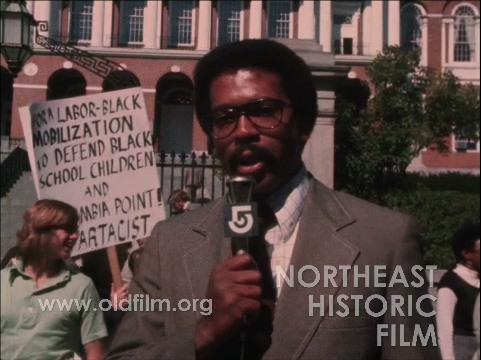
Description: "Leader: "P2 Pro-busing Demo #10074 9-30-74"; Woman speaks to crowd about enforcing laws. Reporter standup in front of the state house. Footage of the crowd. Outtakes: More of the woman speaking about desegregation of schools. Interview with the speaker. More footage of people in the crowd. Reporter outtakes. Black Community Caucus for Equal Education."
Collection: WCVB Collection
Date Created: 09/30/1974
Description: "Leader: " P1 Model Cities Busing #9853 9/4/74"; Silent b-roll of a meeting with mostly non-white attendees about busing. Some women speak about the need for parents from the different communities to band together and communicate. One woman argues that the kids that go to the schools in Southie have more opportunities than those that graduate from Roxbury. A police officer states that this is the law and kids will be bussed. "
Collection: WCVB Collection
Date Created: 09/04/1974
Description: "Leader: "P1 Busing Tale of Two Cities Tease 9/6/74"; Two men playing drums on a hill overlooking San Francisco. Footage of San Francisco including people on a crowded street, residential neighborhoods, a street car, the Golden Gate Bridge, and aerial shots of the skyline and streets. Sound bites from parents and administrators in California followed by interviews with parents and students in Boston and people speaking an an anti-busing event. Mayor Kevin White speaking with parents. More footage of parents discussing Freedom schools in the Chinese neighborhoods in San Francisco. Footage of schools in Boston and more interviews with kids. Interviews with California parents and kids about violence during the beginning of busing. Reel 2 of 2. See Acc. 2394.00637"
Collection: WCVB Collection
Date Created: 09/06/1974
Description: "; School Committee member discusses the Garrity decision on racial imbalance and school busing and the possibility of appealing the decision, followed by b-roll footage of the committee meeting."
Collection: WCVB Collection
Date Created: 06/24/1974