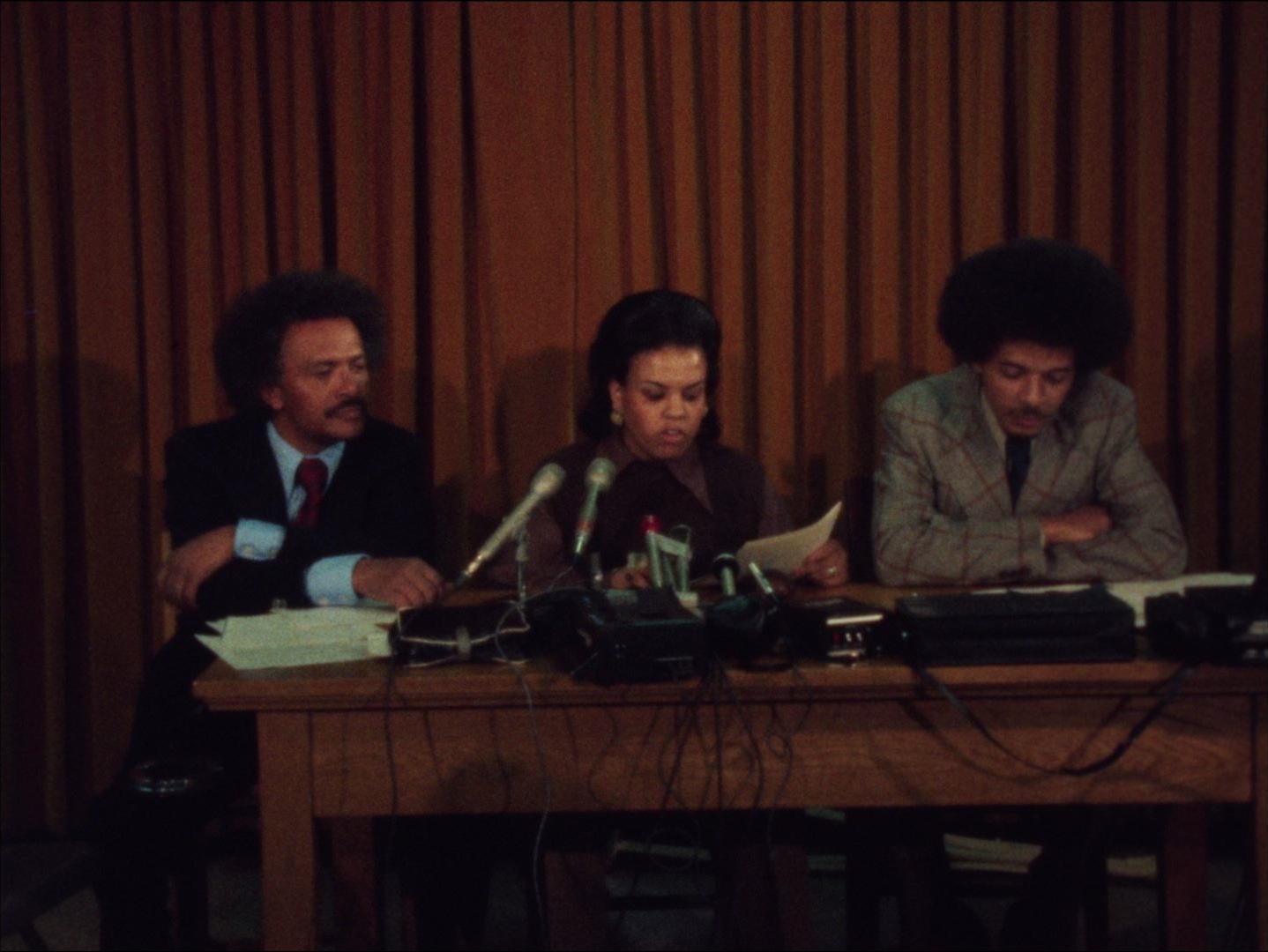
Description: State Senator Jack Backman opens a press conference in support of Mel King (Boston mayoral candidate) in front of the State House. Other participants include Byron Rushing (State Representative from the South End), Mary Jane Gibson (State Representative from Belmont), Susan Schur (State Representative from Newton), Mary Goode (former State Representative from Roxbury), and Barney Frank (US Congressman). Frank voices his support for King's candidacy and discusses the reasons for his endorsement, specifically, Frank talks about King's views on economic development and about his leadership abilities. Frank says that King is a creative leader who will bring "enlightened policy" to the city. Various reporters point out that Frank endorsed Dennis Kearney (candidate for mayor of Boston) in the primary elections. King arrives, shakes hands with Frank, thanks endorsers, and asserts that his administration will focus on employment, education, and the youth of the city.
1:00:10: Visual: Shot of a Mel King campaign sign. Jack Backman (State Senator) opens a press conference in front of the State House. He notes that Mel King (candidate for mayor of Boston) has not yet arrived. He voices his support for King. He introduces Byron Rushing (State Representative from the South End), Mary Jane Gibson (State Representative from Belmont), Susan Schur (State Representative from Newton), Mary Goode (former State Representative from Roxbury). Bachman lists off some state representatives who are due to arrive shortly at the press conference. Shots of Schur; of Rushing. Bachman introduces Barney Frank (US Congressman). 1:02:33: V: Frank says that he will support King for mayor of Boston; that he served with King for eight years in the legislature. Frank says that King is an advocate for enlightened policy for the city of Boston. Frank talks about King's ideas for economic development programs; about the Community Development Corporation. Frank says that King's ideas for development are in tune with the needs of city residents; that King is sensitive to the problems of displacement and the needs of area residents. Frank says that King can speak effectively on behalf of a diverse group of people; that King was an effective and respected legislator. Frank says that King will make an excellent mayor. A reporter asks Frank about his previous endorsements for mayor. Frank says that he is not always good at picking the winning candidate; that he speaks out on behalf of candidates who have good ideas and programs. A reporter notes that Frank endorsed Dennis Kearney (State Representative) in the primary election. He asks Frank how Kearney would have been a better mayor than King. Frank says that he endorsed Kearney in the primary because he thought Kearney was a good candidate with a good chance of winning. Frank says that Kearney and King take similar positions on the issues. Shot of King supporters standing behind Frank. Shot of Christy George (WGBH reporter). Audio is muffled. 1:07:45: V: Frank says that the many of the candidates in the race had similar positions on the issues; that King has helped shape the debate on the issues; that King was one of the first people to talk about the adverse effects of development on the elderly and the poor. Frank says that King is responsible for focusing the attention of the city on the management of economic development in a compassionate and effective manner. Frank says that he respects Ray Flynn (candidate for mayor of Boston); that King is more creative, thoughtful and consistent candidate; that King has proven himself to be an effective leader. Frank refuses to speculate on who he would have endorsed if King were not in the race. Frank says that he is endorsing a candidate because he is an elected official with an opinion; that he does not know what effect his endorsement has on a candidate's chances. A reporter asks Frank about the differences between King and Flynn. Frank says that the differences between the candidates stem from their past records; that King has proven himself to be a consistent and effective leader on economic issues for many years; that King has the capacity to stay with these issues. Frank notes that he does not agree with King on a mayor's role in foreign policy. A reporter asks Frank if King needs to highlight the issues on which he differs from Flynn. Frank says that King has stuck with the same issues for ten years; that his leadership has brought attention to these issues. Frank says that this has been a good mayoral campaign; that it has focused on issues. 1:13:15: V: Frank jokes with the reporters about his endorsement bringing in the voters from Brookline and Newton. A reporter asks Frank how King can get white liberal voters to support him instead of Flynn. Frank says that King can win voter support by focusing on the issues; that his positions on economic development may win over voters from traditionally "conservative" neighborhoods. A reporter asks Frank about his campaign advice for King. Frank says that King is doing the right thing by focusing on the issues; that King has proven his ability to be a leader on the issues. 1:16:32: V: King's supporters clap as he arrives at the State House. King and Frank shake hands. King thanks Frank and the assembled state representatives for their endorsements and support. King says that his administration will make the city open and accessible; that his administration will focus on employment, education, and the youth of the city.
Collection: Ten O'Clock News
Date Created: 10/21/1983
Description: Silent footage of Boston City Council chambers during a meeting. City Councilors Albert "Dapper" O'Neil, J.M. Connolly, Frederick C. Langone, Louise Day Hicks address the meeting about court-ordered busing. Stenographer records the meeting. Massachusetts State Representative Ray Flynn sits in the audience. Mix of silent and sound.
Collection: WCVB Collection
Date Created: 03/04/1974
Description: Marcus Jones reports that the Greater Roxbury Incorporation Project (GRIP) has put forth a plan to create a new city from Boston's minority neighborhoods. Jones notes that the new municipality would be named Mandela, in honor of jailed South African leader Nelson Mandela. Jones reports that African American community leaders are divided in their support for the referendum question on Mandela, Massachusetts. Jones adds that the referendum question will be on the ballot in the fall. Jones' report includes footage from a press conference in front of the Massachusetts State House with Andrew Jones (GRIP), Byron Rushing (State Representative) and Royal Bolling, Jr. (Mandela supporter). Rushing and Jones speak out in favor of Mandela. Jones report also includes footage of Royal Bolling, Sr. (state senator) speaking out against Mandela. Jones reports that Ray Flynn (Mayor of Boston) is opposed to the creation of Mandela. Jones speculates about the probable boundaries of the proposed city. Jones interviews people on the street about their support of Mandela. Jones' report includes footage of the elevated train tracks along Washington Street in Roxbury. A rap song about Mandela, Massachusetts accompanies parts of the story.
1:00:35: Visual: Shots of a group of African-American residents standing at the side of a street; of an orange line train passing on the elevated tracks along Washington Street. Audio of a rap song promoting Mandela, Massachusetts. Marcus Jones reports that leaders of Boston's African American and Latino communities are promoting the idea of Mandela, Massachusetts; that community leaders hope the referendum question on Mandela, Massachusetts will win votes on the ballot in the fall. V: Shot of Andrew Jones (Greater Roxbury Incorporation Project) Byron Rushing (State Representative) and Royal Bolling, Jr. (Mandela supporter) at a press conference outside of the Massachusetts State House. Shot of a cameraman at the press conference. Footage of Young speaking at the press conference. Young says that the referendum question will allow voters in certain ward and precincts to consider the formation of an independent city. Jones reports that the plan has been put forth by the Greater Roxbury Incorporation Project (GRIP); that the plan would carve a new municipality out of the neighborhoods of Roxbury, Dorchester, Mattapan, Jamaica Plain, the South End, and Columbia Point. Jones reports that the new city would be named in honor of jailed South African leader Nelson Mandela. Jones notes that many developers consider these neighborhoods to be the next frontier of development in Boston. V: Shots of neighborhoods within the limits of the proposed city. Shot of a newspaper article with a headline reading, "Black effort to secede from Boston." Jones stands on the median strip of Massachusetts Avenue in Boston. The Boston skyline is visible behind him. Jones reports that no formal boundary lines have yet been drawn. Jones speculates that one of the bridges on Massachusetts Avenue is a likely boundary line. Jones notes that Boston is on one side, along with the Massachusetts General Hospital, the Prudential building and the Boston Public Library. Jones notes that Mandela would lie on the other side of the bridge; that Mandela would include Boston City Hospital, the Orange Line and Franklin Park. V: Shots of Massachusetts Avenue in both directions. Shot of Washington Street in Roxbury. The elevated train tracks are visible. Shot of Boston City Hall. Audio of a rap song promoting Mandela, Massachusetts. Jones reports that Ray Flynn (Mayor of Boston) is opposed to the plan. Jones notes that some African American community leaders are opposed to the plan because they think that minorities are on the verge of gaining some political clout in the city of Boston. V: Shot of Flynn. Footage of Royal Bolling, Sr. (State Senator) being interviewed. Bolling says that people of color should not settle for a piece of the pie when the whole pie is within reach. Footage of Byron Rushing (State Representative) at the press conference in front of the State House. Rushing says that there are a few African Americans who lie to blame everything on city hall; that those people are in fact blaming their problems on white people. Rushing says that those people will not be able to continue blaming white people in Mandela. Shot of a political cartoon about Mandela. Audio of the rap song plays in the background. Footage of an African American man being interviewed on the street. The man says that the neighborhoods are interwoven into the fabric of the city of Boston; that the secession movement could be counterproductive. Footage of another African American man being interviewed while in his car. The man says that Mandela is a terrible idea. Footage of an African American woman being interviewed. The woman says that she would vote in favor of Mandela. Jones reports that the referendum question is still only a possiblility. Jones notes that petition signatures must be approved; that voting boundaries need to be established. V: Shot of an orange line train riding along the elevated tracks on Washington Street. Shot of a map of the districts within Mandela. Shots of a group of African Americans standing on a street corner. Audio of the rap song promoting Mandela, Massachusetts plays in the background.
Collection: Ten O'Clock News
Date Created: 07/03/1986
Description: Christopher Lydon introduces a report on "the five Bostons," which includes analysis of voter turnout and voting habits in the various neighborhoods of Boston. The neighborhoods include Italian Boston, black Boston, liberal Boston, Irish East and Irish West. The report analyzes voter support for mayoral candidates in each neighborhood and includes interviews with voters in each neighborhood. Lydon notes that Italian Boston includes East Boston and the North End. Lydon talks about the remote location of East Boston. His report includes interviews with Anna De Fronzo (East Boston community activist) and George DiLorenzo (former State Representative). Lydon reports that Kevin White (Mayor of Boston) has a lot of support in East Boston; that Dennis Kearney (candidate for mayor of Boston) is a favorite in the neighborhood. Lydon explains that liberal Boston is a mix of wealthy residents, students, blue-collar families and young professionals; that voter turnout is often low. Lydon interviews John Winthrop Sears (former candidate for governor of Massachusetts), Thomas Vallely (State Representative) and Veronica Smith (Allston community activist). Lydon notes that the support of voters in liberal Boston is split among a several candidates. Lydon reports on a renewal of political activity in black Boston, and notes that there is a high percentage of newly registered voters in the African American neighborhoods. The report includes interviews with Charles Stith (Union United Methodist Church) and Kay Gibbs (South End political activist). Stith and Gibbs talk about the candidacy of Mel King (candidate for mayor of Boston) as well as opposition to King's candidacy, led by Mel Miller (publisher, The Bay State Banner). Lydon reports that Irish East has the highest voter turnout in the city. He interviews Thomas Driscoll (South Boston political consultant) and Paul White (State Representative) for the report. Lydon notes that the support of voters in Irish East is split between Ray Flynn (candidate for mayor of Boston) and David Finnegan (candidate for mayor of Boston). Lydon reports that Irish West is a residential neighborhood with many middle-class residents. The report includes interviews with Richard Sinnott (Hyde Park Tribune), Joseph Timilty (State Senator), and Maura Hennigan (Boston City Council). Lydon notes that the support of Irish West voters is split between Flynn and Finnegan; that King may receive the votes of Latino residents. Lydon reports that White is a West Roxbury native, but never had the full support of neighborhood residents.
1:00:09: The logos of The Ten O'Clock News underwriters New England Telephone and Shawmut Brokerage Services are displayed. Opening credits for The Ten O'Clock News. Christopher Lydon introduces a report on "The Five Bostons." 1:00:58: Anna De Fronzo (East Boston community activist) compares East Boston's remote location to that of Siberia. Visual: Shot of a map of Boston with East Boston highlighted in yellow. Lydon reports that the Italian population of Boston lives in the North End and East Boston. V: Shots of three older men sitting near a wall; of a yard with a Virgin Mary statue in East Boston; of the Boston skyline viewed from a street in East Boston. Lydon reports that "Italian" Boston has 8% of the city's registered voters; that "Italian" Boston has good voting habits and could account for 10% of the votes in the mayoral race. Lydon reports that there is no political issue to rally the residents of East Boston this year; that controversy over school desegregation and airport expansion have died down. V: Shots of older women in East Boston; of Logan airport as viewed from East Boston; of streets in East Boston. Lydon reports that Italian American candidates have always found favor in East Boston; that Dennis Kearney (candidate for mayor of Boston) is a resident of Eagle Hill and has a lot of support in East Boston. V: Shot of Kearney campaign sign. Footage of East Boston residents voicing their support for Kearney. Lydon reports that there are residents of ethnicities other than Italian; that many East Boston residents will vote for one of their own. Lydon reports that Eloise Linger (Socialist candidate for mayor of Boston) has more supporters in East Boston than Lawrence DiCara (candidate for mayor of Boston); that Linger lives in East Boston while DiCara lives in Dorchester. V: Footage of De Fronzo saying that Italian Americans are apt to vote for candidates of other nationalities. Lydon stands on an East Boston street with the Boston skyline visible. He reports that Kevin White (Mayor, City of Boston) gained support in East Boston when he supported action by the anti-airport movement; that East Boston received attention from the White administration in return for their support of White. V: Traveling shot of an East Boston street. Footage of George DiLorenzo (Former State Representative from East Boston) talking about the great number of jobs given to East Boston residents by White. DiLorenzo says that White appointed three city commissioners from East Boston; that other mayors did not give key positions to East Bostonians. DiLorenzo says that the White political organization in East Boston was the strongest political organization that he has ever seen; that John "Dee Dee" Coviello (East Boston political organizer) is responsible for uniting the community behind White. Footage of De Fronzo saying that she does not think any of the candidates will garner the kind of support that White had in East Boston; that some of the candidates will ignore East Boston if elected mayor. 1:05:57: V: Footage of Lydon interviewing John Winthrop Sears (former Republican candidate for governor of Massachusetts). Sears says that his part of Boston is progressive and not afraid of change. Shot of a map of Boston with "liberal" Boston highlighted in blue. Shots of a street in the Back Bay; of Kenmore Square; of an upscale apartment building. Lydon says that "liberal" Boston stretches from Chinatown through Beacon Hill and the Back Bay to Kenmore Square and Cleveland Circle. Lydon reports that "liberal" Boston is multi-ethnic; with many single residents including students and the elderly. Lydon stands on a leafy street lined with brownstones. He reports that "liberal" Boston is made up of white precincts which do not vote according to racial lines; that "liberal" Boston never supported Louise Day Hicks (former Boston City Councilwoman). Lydon reports that "liberal" Boston usually has a large population with a poor voter turnout. V: Footage of Lydon interviewing residents about their voting habits. Most residents do not vote or have not yet registered to vote. Footage of Sears talking about residents of "liberal" Boston who vote in other states. Sears says that the inheritance laws in Massachusetts have driven wealthy voters to declare a primary residence elsewhere. Footage of Thomas Vallely (State Representative from the Back Bay) saying that the Back Bay community is made up of wealthy residents; that his constituents voted for Proposition 2 1/2; that the Back Bay has a vibrant gay community; that his constituents seem more concerned with national politics than local politics. Shot of a resident at DeLuca's Market in Beacon Hill. Lydon stands on the corner of Commonwealth and Harvard Avenues in Allston. Lydon reports that there are blue-collar families, students and the elderly in Allston; that young professionals are moving into the area. Lydon reports that Thomas Gallagher (State Representative) came to Allston as an out-of-state student; that he beat a local politician for the office of state representative. V: Footage of Veronica Smith (Allston community activist) saying that Gallagher is popular with the students and young professionals. Smith says that she cannot predict which mayoral candidate is the most popular in Allston. Footage of Sears saying that DiCara is popular among many voters now that Robert Kiley (former Deputy Mayor of Boston) has dropped out of the race. Footage of Vallely analyzing his constituents response to the candidacies of Ray Flynn (candidate for mayor of Boston), Mel King (candidate for mayor of Boston), and David Finnegan (candidate for mayor of Boston). Lydon reports that "liberal" Boston will lose a mayor when White leaves office. V: Footage of White walking his dog in the Boston Public Gardens. Footage of Vallely saying that White was a "friend" to the community. Footage of Sears saying that White's presence in the neighborhood will be missed; that White is tired after a long political career. 1:12:46: V: Footage of Reverend Charles Stith (Union United Methodist Church) talking about a renewal in African American political activity in Boston and around the nation. Shot of a map of Boston with "black" Boston colored in pink. Lydon reports that "black" Boston comprises 20% of the city; that "black" Boston has spread from Mission Hill to Mattapan and Dorchester. V: Shots of a train on elevated tracks along Washington Street; of White campaigning in African American neighborhoods. Lydon says that "black" Boston had been a cornerstone of White's coalition during his four mayoral campaigns. Lydon reports from a street corner in "black" Boston. A train passes by on the elevated tracks behind him. Lydon reports that "black" Boston usually has a low voter turnout; that "black" Boston has high percentage of newly registered voters this year. Lydon says that the percentage of African American registered voters is now slightly higher than the percentage of white registered voters. V: Footage of African American residents voicing their support for Mel King. Shots of African American residents getting on an MBTA bus; of a Bay State Banner editorial endorsing David Finnegan. Lydon reports that Bruce Wall (African American minister) and Mel Miller (publisher, The Bay State Banner) have not supported King's candidacy. V: Footage of Stith talking about Miller's endorsement of Finnegan. Stith says that most voters are supporting King. Footage of Kay Gibbs (South End political activist) saying that African American voters believe in King's candidacy; that African American mayors have been elected in city's across the nation; that Miller has been discredited because he is a Finnegan supporter who has never supported an African American candidate for any city office. Lydon reports that King is not well rooted in African American church life; that many African Americans were turned off by his wardrobe. V: Shots of King; of a religious service in an African American church; of African American churchgoers outside of a church. Footage of Gibbs saying that middle-class African Americans had reservations about King at first; that all African American voters are now confident in King's ability to represent the African American community. Gibbs says that King does not think like a middle-class candidate; that he sees himself as a "champion of the underdog." Lydon reports that the African American community has undergone a change in its thinking about political candidates. V: Footage of Stith saying that increased voter turnout and political participation establishes the African American community as a political entity; that the African American community benefits from King's campaign even if he loses. 1:19:01: V: Footage of "Irish East" voters voicing their support for Flynn and Finnegan. Lydon reports that "Irish East" includes Charlestown, South Boston and parts of Dorchester. V: Shots of streets in South Boston and Dorchester. Lydon reports that "Irish East" has the highest voter turnout in the city; that "Irish East" has 1/8th of the city's population and 1/5th of the city's registered voters; that it will account for 1/4th of the voter turnout in the mayoral primary. V: Traveling shot of the Boston skyline. Lydon reports from a street in South Boston. Boston Harbor is visible behind him. Lydon reviews the voting patterns of "Irish East" in recent presidential and gubernatorial elections. Lydon says that "Irish East" often votes for losing candidates like George McGovern (presidential candidate in 1972), Gerald Ford (presidential candidate in 1976) and Ed King (Massachusetts gubernatorial candidate in 1982). Lydon reports that "Irish East" has voted for unsuccessful mayoral candidates like Joe Powers, Louise Day Hicks and Joseph Timilty. Lydon reports that "Irish East" has two of their own as candidates for mayor this year. V: Footage of "Irish East" voters voicing support for Flynn and Finnegan. Footage of Thomas Driscoll (South Boston political consultant) saying that there might be confusion between the "old" Flynn and the "new" Flynn; that Flynn is now a progressive candidate; that the "old" Flynn was an anti-busing, anti-abortion candidate. Footage of Paul White (State Representative from Dorchester) saying that Finnegan has a lot of support in the Dorchester community. White talks about Finnegan's connections to St. Ann's parish. Shots of South Boston. Footage of Driscoll talking about strong neighborhood connections in South Boston. Driscoll predicts that Flynn will get 60% - 75% of the vote in South Boston. Lydon reports from the corner of Adams Street and Gallivan Boulevard in Dorchester. Lydon says that "Irish East" has been out of political favor for a long time; that they now have two strong mayoral candidates. V: Footage of White talking about how Dorchester would benefit from having a Dorchester native as mayor of Boston. White says that Dorchester would claim Finnegan as a native son, even though he now lives in West Roxbury. 1:25:08: V: Footage of Richard Sinnott (Hyde Park Tribune) talking about the neighborhoods of Roslindale and West Roxbury. Shot of a map of Boston with "Irish West" colored in green. Lydon reports that the "Irish West" neighborhoods include the"city suburbs" west of the orange line; that a majority of the residents are Irish American; that there are also Polish, Greek and Lebanese residents. V: Shot of Casa Beirut restaurant. Traveling shot of a residential street in "Irish West." Lydon reports that most residents own their own homes in "Irish West"; that Brighton is included in "Irish West." Lydon notes that "Irish West" traditionally has a very high voter turnout. V: Shots of residents boarding an MBTA bus; of residents walking on a street. Lydon reports that many "Irish West" voters are civil servants, police officers, and teachers; that politics are important to these voters. V: Footage of Sinnott saying that the community benefits from good city services; that "Irish West" voters are not concerned with "linkage"; that displacement and housing for the elderly are important issues in the community. Footage of Joseph Timilty (State Senator) saying that property values declined during the busing crisis; that property values have risen again. Lydon reports that the Forest Hills area has some Latino voters and "new gentry"; that some of these voters may vote for Mel King. V: Shots of urban streets; of Latino children playing on a sidewalk. Lydon reports from a street in front of a church in "Irish West." Lydon notes that most "Irish West" voters support either Ray Flynn or David Finnegan; that Finnegan seems to be the favorite in "Irish West." Lydon notes that Finnegan moved from Dorchester to West Roxbury to raise his family; that Finnegan has connections in "Irish East" and "Irish West." Lydon notes that most of Boston's Irish mayors have come from "Irish West." Lydon mentions former Boston mayors White, John Collins, Maurice Tobin and James Michael Curley. V: Footage of Maura Hennigan (Boston City Council) saying that Curley's legacy lives on in Jamaica Plain. Footage of "Irish West" voters voicing support for Finnegan and Flynn. A few voters voice support for Mel King and Dennis Kearney. Footage of Sinnott saying that White never had the full support of the "Irish West" community; that White was a good mayor. Lydon reports from a park. A football team practices on a field behind him. Lydon says that White was a West Roxbury native; that White always had to fight for votes in "Irish West"; that residents have mixed feelings about White. V: Footage of Timilty saying that White will be remembered fondly with the passage of time. Footage of Sinnott saying that White was "a working mayor as well as a dancing mayor." 1:30:29: V: Footage of city residents voicing support for the candidate of their choice. Closing credits roll. The logos of The Ten O'Clock News underwriters New England Telephone ,and Shawmut Brokerage Services are displayed.
Collection: Ten O'Clock News
Date Created: 10/10/1983
Description: Reel 2 of 1983 Boston Mayoral Debate, held at Simmons College. Candidates are Larry DiCara, Ray Flynn, Robert Kiley, Dennis Kearney, David Finnegan and Mel King. The moderator is professor Carroll Miles. Journalists on the panel are Andy Hiller, Michael Rezendes, William Robinson, J. Jordan. Robert Kiley finishes his opening remarks. Mel King, Fred Langone and Eloise Linger maker their opening remarks. Robert Kiley talks about restoring the faith of residents in city government and making the city government work efficiently. He talks about the need to eliminate corruption, the need to establish sound fiscal management and the need to reduce crime. Kiley says that the Boston Public School System must be reformed. Mel King discusses his professional experience and long history of work within the community. King talks about the importance of crime prevention and the need to work with community youth. King states his intention to change the climate of fear in the city. King mentions his proposals for addressing unemployment in the city, including the "Boston jobs for Boston people" program. Fred Langone talks about his years of service to the city and his experience in dealing with the city's finances. Langone condemns the fiscal mismanagement of the present administration. Linger addresses US government foreign policy, school desegregation and racism, women's rights and the anti-abortion referendum. Linger talks about the housing shortage and other social problems. She advocates less spending on defense and more spending on housing and other social issues.
0:59:20: Robert Kiley (candidate for mayor) speaks at a mayoral debate at Simmons College. Kiley talks about restoring the faith of residents in city government; about making city government work efficiently. Kiley says that corrupt practices must be eliminated from city government; that sound fiscal management must be established. Kiley notes that crime must be reduced; that the school system needs reform; that the Boston Public School System has the highest dropout rate and absentee rate of any urban school system in the nation. Kiley says that he has the background, skills and experience to govern the city; that he has proven experience in government; that he has tackled difficult problems in the city like school desegregation and reform of the MBTA. Kiley says that the next mayor must adopt a system of government based on merit and professionalism. Kiley proposes that all candidates make a voluntary pledge not to accept contributions from city or county employees. Kiley notes that he has made a financial disclosure statement. He proposes that all candidates do the same. Kiley adds that the city needs a mayor with a sense of integrity, decency and a commitment to justice. The audience applauds. 1:03:55: Carroll Miles (professor, Simmons College) introduces Mel King (candidate for mayor). King says that he has been working in the Boston community for thirty years; that he is currently teaching at MIT (Massachusetts Institute of Technology); that he served as a state representative for ten years. King says that crime prevention is important; that he would put people on the streets to work with community youth; that he wants to change the climate of fear in the city. King says that he campaigned for mayor in 1979; that he advocated a "Boston jobs for Boston people program during that campaign; that the program guaranteed 50% of Boston jobs for Boston residents. King notes the high unemployment rates in East Boston, Charlestown, South Boston, Roxbury. King says that 85% of the jobs in Boston are now held by non-residents; that the Occupational Resource Center should serve as a training center for unskilled Boston workers; that this program would make a difference in the lives of city residents. The audience applauds. 1:08:55: Miles introduces Frederick Langone (candidate for mayor). Langone says that the present administration has had deficits exceeding $25 million per year; that the deficits persisted despite relief from the state government; that the state government has assumed welfare costs, half of the MBTA budget and the full costs of running the Suffolk County Court. Langone reminds voters that he was able to expose the fiscal mismanagement and extravagances of the present administration. Langone talks about his knowledge and experience in dealing with the city finances. Langone decries the sale of the Soren Water Commission. Langone talked about his involvement in resolving disputes about the Tregor Bill. Langone says that he was the first to speak out against the present proposal to defer tax breaks for real estate owners. Langone says that he has served the city for twenty years; that he has the courage to defend his positions. Langone notes that there is a movement to depress the Central Artery. He reminds voters that he made a suggestion to depress the Central Artery thirty years ago. Langone closes by saying that he has a strong record of service to the city. The audience applauds. Visual: Shot of Langone and Eloise Linger (mayoral candidate, Socialist Workers Party). 1:14:10: Miles introduces Linger. Linger says that she is familiar with the problems of working people; that she is a working mother employed as a stitcher in the garment industry; that she recently went off unemployment. Linger addresses US government foreign policy. She accuses the federal government of dragging the nation into a "new Vietnam" in Central America. She says that the "war machine" of the federal government puts a drain on resources; that these resources could be used to remedy social problems. Linger says that racism exists in Boston at the highest levels; that she is opposed to attempts to roll back gains made in school desegregation. Linger proposes to extend busing for school integration and to hire more teachers for the schools. Linger says that the present city administration has encouraged racist violence through its failure to publicly condemn the killers of William Atkinson. Linger says that there is growing opposition to women's rights at the highest levels; that she is opposed to the pending anti-abortion referendum; that opposition to women's rights at the highest levels encourages rapists and other violent attacks on women. Linger says that a government of working people could solve the problem of unemployment; that "the rich rule and rob Boston." Linger advocates less spending on defense and more spending on housing and other social issues. Linger advocates putting people to work to build affordable housing, public transportation, public health care clinics and new schools. Linger says that the elimination of the Pentagon budget could pay for needed programs. Linger says that banks, corporations and insurance companies in Boston enjoy huge tax breaks at the expense of working people; that the working people of the city have a right to know where the money is. Linger closes by urging everyone to attend the demonstration against US policy in Central American on May 14, and to attend her campaign rally on May 7 in Kenmore Square. Linger holds up a flyer for the campaign rally. The audience applauds.
Collection: Ten O'Clock News
Date Created: 04/25/1983
Description: Hope Kelly reports that the Tent City Housing Complex in the South End will soon open. She notes that the housing complex is named for the protests that began on the site twenty years before. Kelly reviews the history of the Tent City site. Kelly's report includes photos of the protests at the Tent City site in the 1960s. Kelly interviews Betty Meredith (Executive Director, Tent City Corporation) and Michael Kane (Chairman, Tent City Corporation) outside of the housing complex. Kane and Meredith talk about the struggle by South End residents to get the housing complex built. Kane says that affordable housing was not a priority in this part of the city until now. Kelly interviews Mel King (community activist) about the Tent City site. Kelly reports that Copley Place was developed while the Tent City site was ignored. Kelly's report includes a time-lapse arrangement of shots documenting the construction of Copley Place. Kelly reports that 75% of the units in the housing complex are low- and moderate-income units. Kelly interviews Sophie Iglesias (Marketing Director) and Florcie Versailles (Tent City resident) about the housing complex..,
1:00:19: Visual: Shots from the window of a building on Copley Place. Shots of the high-rise buildings near Copley Place; of the South End. Hope Kelly reports on the long-standing controversy surrounding the Tent City site in the South End. V: Footage of Betty Meredith (Executive Director, Tent City Corporation) sitting outside of the Tent City Housing Development. Meredith says that she knew that South End residents would have to fight to get the housing development built. Shot of a man approaching the entrance to the Tent City Development with balloons in his hand. Shots of the exterior of the Tent City Housing Complex. Kelly reports that the Tent City Housing Complex will open tomorrow; that the housing complex is named for the protests that began on the site twenty years ago. Kelly reports that the city of Boston sold a parcel of land in the South End to William Fitzgerald (former Fire Commissioner of the City of Boston) in the 1960s; that Fitzgerald tore down the buildings on the land to make a parking lot. Kelly reports that the buildings on the land had been the homes and residences of many African American South End residents. Kelly notes that the Boston Redevelopment Authority (BRA) had promised to replace the buildings in 1965; that South End residents began to protest on the site in 1968 because nothing had been built. V: Shots of South End residents protesting on the Tent City site; of a protest sign on the Tent City site reading, "People, not cars. This is a place where homes should be." Shots of graffiti on a building reading, "BRA, go away." Shots of police officers on the Tent City site; of tents erected to house the protesters; of Mel King (community activist) being arrested by police on the Tent City site. Footage of Mel King in the South End. King says that the protesters did not believe that the city should allow people to be displaced in order to build parking lots. Kelly reports that Meredith was one of the original Tent City protesters; that Michael Kane (Chairman, Tent City Corporation) joined the protest in the 1970s because nothing had been built. V: Footage of Kelly interviewing Meredith and Kane outside of the development. Footage of Kane saying that the protesters had to block the city from building market-rate housing and a 1400-car parking garage on the site. Kelly reports that the city developed the Copley Place area while ignoring the Tent City site. V: Shot of the Tent City site in the early 1980s. A time-lapse arrangement of shots shows the construction of buildings on Copley Place. Footage of Meredith saying that the protesters had to wait a long time for the development to be built because they did not have the money to develop the land themselves. Footage of Kane saying that affordable housing was not a priority in this part of the city during the 1970s. Kelly reports that Kane and Meredith give Ray Flynn (Mayor of Boston) credit for the development of the Tent City site. V: Shots of the exterior of the Tent City Housing Complex. Kelly reports that there are 369 units in the Tent City development; that 75% of the units are low- and moderate-income units; that 25% of the units are market rate. V: Footage of Sophie Iglesias (Marketing Director) standing in an apartment in the Tent City Housing Complex. Iglesias says that this one-bedroom apartment has a market rate of $1,000 per month. Shots of the exterior of the housing complex. Kelly reports that low- and moderate-income renters will pay one-third of their income; that some renters will pay as little as $200 per month. V: Footage of Iglesias saying that people are not fully aware of the great need for affordable housing in the city of Boston. Footage of Meredith saying that over 6,000 people applied for the low- and moderate-income units. Kelly reports that priority is given to former South End residents who have been displaced. V: Footage of Kelly interviewing Florcie Versailles (Tent City resident). Versailles says that she would not be able to afford to live in Tent City without help from the government. Shot of Versailles in the lobby of the housing developement. Versailles pushes a child in a stroller. Footage of Meredith saying that the housing development took a long time to build; that the development will be a nice place for people to live.
Collection: Ten O'Clock News
Date Created: 04/29/1988
Description: A compilation of three Evening Compass shows from 1974-75. Evening Compass newscast from September 12, 1974. Paul deGive reports on the first day of school at the Rochambeau Elementary School. He reports that some parents, including Barbara King (local resident), are keeping their children out of school for fear of violence. Judy Stoia reports on the peaceful opening of the Martin Luther King School. Greg Pilkington and Diane Dumanoski report on their experiences riding buses with students to and from South Boston High School and Hyde Park High School. The bus Pilkington rode on was stoned in South Boston. Pilkington and Dumanoski report on the reactions of students. Joe Klein reports on the first day of school for a Hyde Park student, bused to the Lewenberg School in Mattapan. Klein reports that the student says that he will return to school tomorrow. Evening Compass newscast from December 12, 1974. Stoia reports on a violent mob gathered outside South Boston High School after the stabbing of a white student by an African American student. Stoia reports on clashes between the crowd and police. Pilkington reports from the Bayside Mall, where African American students arrived on buses after being trapped for several hours in South Boston High School. The students and their parents are angry and frightened. Peggy Murrell reports on the reactions of Thomas Atkins (President, NAACP) and Mel King (State Representative) to the violence at South Boston High School. Murrell reports that Atkins and King say that schools should be shut down if the safety of African American students cannot be guaranteed. Pam Bullard reports that the plaintiffs in the Boston school desegregation case (Morgan v. Hennigan) will demand that the federal court increase safety measures for African American students in South Boston. She also reports on a pending deadline for the Boston School Committee to file a school desegregation plan for 1975. Bullard notes that the School Committee risks being held in contempt of court if it does not file a plan. Evening Compass special from March 14, 1975. Pam Bullard reviews the major events concerning the desegregation of Boston schools in 1974. Her report includes footage and still photos of key figures and events in the busing crisis. Judy Stoia reports on an alternative school in Hyde Park, created by white parents to avoid busing, and on an alternative school for African American students. White parents at the alternative school in Hyde Park say that African American students are welcome to attend their school. Baumeister reports on Raymond Flynn, the only mayoral candidate to campaign on an antibusing platform. Baumeister also analyzes busing coverage by The Boston Globe and The Boston Herald American. Bullard reports on the school desegregation plan for the 1975-76 school year. Her report includes comments by Peter Ingeneri (Area Superintendent, Dearborn District) and Isaac Graves (Manager, Roxbury Little City Hall. She reports on segregation among Boston school faculty and administrators, and on plans to integrate school faculty in 1975. End credits reflect personnel working on all Evening Compass shows for the weeks of December 12, 1974 and March 14, 1975. Produced and directed by Charles C. Stuart.
0:00:15: Ed Baumeister introduces Paul deGive's report on the first day of school at the Rochambeau Elementary School in Dorchester. DeGive reports that the opening was peaceful; that a rumored white boycott failed to materialize; that buses were empty; that the absentee rate was 50% for both white and African American students. Degive comments that many parents were present at the opening. DeGive reports on an interview with Barbara King (local resident) who was present to observe the opening but did not send her daughter to the school for fear of violence. The nearby Murphy school also opened without incident. The attendance rate at the Murphy was estimated at two-thirds. 0:02:50: Baumeister introduces Judy Stoia's report on the Martin Luther King School. Stoia reports on the peaceful opening of the Martin Luther King School, which had been an African American school the previous year: the attendance rate was 50%; 130 white students attended, out of a possible 634; many parents kept their children at home because the King school was expected to be a trouble spot. 0:04:25: Baumeister talks to reporters Greg Pilkington and Diane Dumanoski. Pilkington spent the day with African American students who were bused into South Boston. Pilkington describes the students' reactions to their arrival at South Boston High School and their departure on buses which were stoned by an angry crowd. Diane Dumanoski describes a peaceful bus ride to Hyde Park High School with just one white student on the bus. Pilkington remarks on the low attendance at South Boston High School and describes the teachers as tense and ambivalent about busing. Dumanoski describes hostility from some white students at Hyde Park High School. 0:11:46: Baumeister reports on statistics: 47,000 students out of possible 70,000 attended Boston schools; police made 6 arrests; buses made 450 runs. Joe Klein reports on the first day of school for Jimmy Glavin, a Hyde Park student bused to the Lewenberg school in Mattapan. Visual: Report is a montage of still photographs. Shots of a photo of Claire O'Malley (bus monitor); of Glavin waiting for the bus; of Glavin on the bus. Klein reports that Glavin was the only student at the first stop; that the bus made several stops; that some parents refused to put their children on the bus. Klein reports that children of non-local parents in Coast Guard housing attended school. V: Shots of photographs of students and parents at various bus stops. Shots of photographs of students boarding the bus. Klein reports that the Lewenberg school was quiet; that the nearby Thompson School was quiet; that there were few white students in attendance at the Thompson School. Klein reports that the white students left the Lewenberg School on buses in the afternoon. Klein notes that Glavin says that he will return to school the next day. V: Shots of photographs of students in classrooms. Shots of photographs of students exiting the school and boarding buses; of Glavin exiting the bus. Baumeister ends the show. 0:16:17: Baumeister introduces the show. (Opening credits are cut.) Judy Stoia reports on violence at South Boston High School, where an African American student stabbed a white student. Stoia reports that an angry crowd of 1500 people had assembled outside of the high school by 1:00pm. Stoia reports that Louise Day Hicks (Boston City Council) tried to calm the crowd. V: Shots of photographs of huge crowds assembled on G Street, in front of the school; of helmeted police officers keeping the crowd at bay. Shot of a photograph of Hicks. Footage of Hicks assuring the crowd that the assault will be investigated. William Bulger (State Senator) stands beside Hicks. Hicks pleads with the crowd to let African American students return home safely. The crowd boos Hicks. Stoia reports that the crowd was hostile to police; that police units from the Tactical Patrol Force (TPF), the MDC Police Department and the Massachusetts State Police Department were outnumbered by the crowd; that the crowd threw bricks and bottles at police. Stoia reports that the crowd angrily stoned school buses headed toward the school. V: Shots of photographs of the huge crowd; of a TPF unit; of an MDC police officer on a motorcycle; of mounted police on the street. Shots of photographs of a police car with a broken window; of arrests being made. Shots of photographs of the crowd; of stoned school buses. Stoia reports that the buses were decoys and that African American students had escaped through a side door and were bused to safety. V: Shots of photographs of a side entrance of South Boston High School. 0:21:06: Pilkington reports on atmosphere at the Bayside Mall, where buses arrived with African American students who had been trapped in South Boston High School. Pilkington reports that students and parents were frightened and angry. V: Footage of buses and police officers in the mall parking lot. Angry groups of African American students speak directly to the camera about their experiences in South Boston. One student comments on the angry and violent parents in the South Boston crowd. An angry African American woman says that white children go to school peacefully at the McCormack school in her neighborhood, but that African American students cannot go safely to South Boston. She says that Kevin White (Mayor, City of Boston) is not doing his job. A man shouts into a bullhorn that there is no school on Thursday or Friday. Pilkington reports that the anger of the African American community seems to be directed at the city, the police, and the Boston School Committee for not controlling the situation in South Boston. 0:22:55: Peggy Murrell reports on the reaction of Thomas Atkins (President, NAACP) and Mel King (State Representative) to the violence at South Boston High School. She says that both leaders are determined to continue with school desegregation; that both are concerned for the safety of African American students in the schools. She quotes Atkins as saying that schools should be shut down and students should be reassigned if the safety of African American students cannot be guaranteed. Murrell reports that King agrees with Atkins about shutting down the schools if safety cannot be assured; that King says African American students will continue to attend school despite the violence. V: Shots of photographs of Atkins and of King. Murrell quotes King's condemnation of the violence at South Boston High School. Murell reports that Atkins charged the South Boston Home and School Association with holding a racist rally inside the high school and with encouraging a school boycott by white students. Murell says that Virginia Sheehy (South Boston Home and School Association) denies the charges. Murell reports that Sheehy says that white students should be able to hold meetings in school just like African American students do. State Senator William Owens (Chairman of the Emergency Committee Against Racism in Education) agrees that schools should be shut down if a peaceful solution cannot be found, and says that a march against racism planned for Saturday will proceed. 0:26:52: Pam Bullard reports on a special hearing before Judge Garrity planned for the next day: the African American plaintiffs in the desegregation case (Morgan v. Hennigan) have called the hearing to demand the following: the presence of state police and the national guard in South Boston; a ban on parents in schools; a ban on gatherings of more than five people in South Boston; a ban on the use of all racial epithets. Bullard reports that Eric Van Loon (attorney for the plaintiffs) says that South Boston will not escape desegregation. Bullard notes that the Boston School Committee is under court order to file a second phase desegregation plan on the following Monday; that the new plan will desegregate schools city-wide and will allow parents to choose between flexible and traditional educational programs. V: Footage of John Coakley (Boston School Department) talking about the differences between the traditional and flexible program choices under the new plan. Coakley says that the new plan allows parents to choose programs, but not specific schools. Bullard reports that the Boston School Committee has repeatedly refused to endorse any form of desegregation; that the committee risks being held in contempt of court if they do not approve a plan to submit to the court. Bullard reports on speculation that William Leary (Superintendent, Boston Public Schools) will submit the plan without the approval of the School Committee, to avoid being held in contempt of court. 0:31:56: Baumeister comments on the silence of both Mayor Kevin White and Governor Frank Sargent regarding the violence in South Boston. V: Footage of White on September 12, 1974, condemning violence and promising that it would not be tolerated. Credits roll. 0:34:14: Evening Compass special: The Compass Weekly: A Delicate Balance. Pam Bullard's report sums up the events concerning the desegregation of schools in Boston during the 1974 school year. V: Report includes footage of antibusing demonstrations at City Hall Plaza in August and September of 1974; of William Reid (Headmaster, South Boston High School) reporting low attendance figures on September 13, 1974; of white students and black students discussing forced busing outside of Hyde Park High School; of a car on the street with two KKK signs displayed; of Kevin White addressing the busing issue on October 8, 1974; of Gerald Ford stating his opposition to forced busing on October 9, 1974; of national guardsmen on October 16, 1974; of students discussing their feelings about busing; of William Leary (Superintendent, Boston School Department) announcing the reopening of South Boston High School on January 7, 1974. Report also includes footage of children in classrooms, antibusing protests, school buses escorted by police, police in South Boston, and still photos of important figures in the busing controversy. 0:45:27: Stoia reports on alternative schools set up in Hyde Park by parents opposed to forced busing. Stoia reports that some teachers are accredited and are paid from the students' fees; that the curriculum is similar to public school curriculum and classes are smaller. V: Footage of a teacher and students in an alternative classroom. Footage of Henry Lodge (Hyde Park parent) being interviewed by Stoia. Lodge talks about the good education provided by the alternative schools; about parents' need to escape from forced busing and inferior public schools. Stoia reports that 125 white students attend alternative schools in Hyde Park and South Boston; that organizers plan to open Hyde Park Academy, which will have its own building to accommodate 500 students; that these schools are open to African Americans, but are mostly white. Stoia reports on an alternative school for African American students. V: Footage of African American teacher and students in an alternative classroom. Stoia reports that African American parents do not want to send their children into a hostile environment. Stoia remarks that parents are looking for "quality education," which is a term often heard in the desegregation debate. V: Footage of Thomas Atkins (President of the NAACP) calling on leaders to stop politicizing the school desegregation process. 0:49:22: Baumeister comments that many Boston residents are opposed to busing but that Raymond Flynn is the only mayoral candidate opposed to busing. Baumeister reports that Flynn campaigns on the busing issue and is the only antibusing politician to run for mayor. V: Shots of still photographs of candidates White, Thomas Eisenstadt, and Flynn. Shots of photographs of busing opponents Louise Day Hicks, William Bulger (State Senator), Avi Nelson (radio talk show host). Baumeister reports on media coverage of busing by The Boston Globe and The Boston Herald American. Baumeister reports that both papers urged compliance with the court order and played down any violence resulting from desegregation; that the Globe is especially distrusted by the antibusing movement; that antibusing leaders have set up their own information centers; that television stations have largely escaped the anti-media feeling of the anti-busers; that a large media presence will exacerbate the tense situation. V: Shots of front-page busing coverage in The Boston Globe and The Boston Herald American. Footage of William Reid (Headmaster, South Boston High School) on September 15, 1974. Reid tells the media to stop filming and photographing his students. 0:54:15: Bullard reports on the peaceful integration of some schools and on the next phase of school desegregation in Boston, which will include schools in Charlestown, East Boston, and Roxbury. V: Footage of Peter Ingeneri (Area Superintendent, Dearborn District) on November 21, 1974. Ingeneri talks about larger social problems which will make school desegregation difficult in Roxbury. Footage of Isaac Graves (Manager, Roxbury Little City Hall) on January 9, 1975. Graves talks about African American commitment to better schools and integration. Footage of Chris Mitchell (student) on January 9, 1975. Mitchell talks about how important it is to graduate from high school. Report also includes footage of students boarding buses; of students in integrated classrooms; of African American schoolchildren; of buses transporting schoolchildren. Bullard reports on a Supreme Court ruling which dealt a blow to the antibusing movement's plan to include the suburbs in desegregation. Bullard reads statistics regarding the segregation of Boston school teachers and administrators. She reports on the plan to integrate teachers and administrators and to hire more African Americans in the school system. Bullard reports on the budget for police and security required to desegregate Boston's schools; on expectations for more resistance to busing in the next school year; on efforts to reverse or stop the court order. V: Credits roll over footage of African American students boarding buses.
Collection: Evening Compass, The
Date Created: 09/12/1974
Description: Compilation of Christopher Lydon stories. Christopher Lydon interviews Bill Lee (pitcher, Montreal Expos) at Fenway Park. Lee discusses the possibility of a baseball strike. Lee talks about unions and his feelings about baseball. Lee says that he is no longer "addicted" to baseball. Three essays by Robert J. Lurtsema about the coming of summer, the coming of fall and barnacles. Lydon reports on the upcoming preliminary elections for the Boston City Council. Lydon analyzes voting patterns in various districts and the political networks of some candidates. Lydon notes that there has been little voter interest in the campaign. The report includes interviews with and profiles of candidates Maureen Craven Slade, Craig Lankhorst, and Stephen Michaels. Lydon reports from the Boston Celtics' practice court in Brookline. Lydon interviews Ernie DiGregorio (basketball player) and Nate "Tiny" Archibald for the report. Lydon's second report on the upcoming preliminary elections for Boston City Council includes footage from interviews with several candidates including Maura Hennigan, James Kelly, David Scondras, Charles Yancey, Ed McNamara, and Michael McCormack. The candidates talk about voter anger and apathy, the city's fiscal crisis, the need for better city services and the policies of Kevin White (Mayor of Boston). Lydon interviews Donald Woods (South African journalist) about South Africa. Woods criticizes the US veto of the United Nations condemnation of the South African invasion of Angola. Woods says that the white minority in South Africa must negotiate with the black majority in order to avoid a civil war. Woods compares the political situations in South Africa to that of Northern Ireland.
1:00:04: Christopher Lydon interviews Bill Lee (pitcher, Montreal Expos) at Fenway Park. Lee says that he is happy to come back to Fenway Park to play a game. V: Shots of Montreal Expos practicing at Fenway Park. Lee says that he is disappointed to see changes at Fenway Park. He criticizes the disappearance of the bleacher seats, the installation of plastic seats and the increase in advertising at the park. Lydon asks Lee about the baseball strike. Lee says that the players had to strike to maintain the status quo; that unions in the US are being pushed out of existance by a "conservative" government; that he fears the advent of an Orwellian future in this country. Lee says that the issue of uncompensated free agency was not important to him; that he does not believe in free agency. Lee talks about the concept of free agency. He says that the baseball system is destined to fail because it is based on a "false foundation." Lee digresses, talking about the fact that Fenway Park is built on a landfill. Lee says that he is no longer "addicted" to baseball; that he does not need to play at the professional level; that he is playing professional baseball because his "old lady" wants him to. Lee says that the season has been exciting so far. He digresses again, talking about raising fish on an Indian reservation in Bellingham. Lee says that the US needs to give land back to Native Americans. Lydon and Lee shake hands as the interview ends. 1:04:27: Robert J. Lurtsema's essay on beach plums and the coming of summer. Segment is accompanied by shots of beach plums; of trees; of a deserted dirt road lined with bushes and trees. 1:06:59: Robert J. Lurtsema's essay on the coming of fall and the need to adapt a slower tempo as the year draws to a close. Segment is accompanied by shots of trees and the landscape in a small park. 1:09:51: Robert J. Lurtsema's essay on barnacles, which cover the rocks along the coast. Segment is accompanied by shots of barnacles-covered rocks along the ocean shore; of a marsh at sunset. 1:13:02: Christopher Lydon stands outside of Boston City Hall. Lydon reports that the preliminary elections for City Council seats are ignored by voters in non-mayoral election years; that six out of seven residents did not vote in the preliminary City Council elections four years ago. Lydon reports that City Council candidates represent areas of the city with a politically active electorate. V: Shot of a map of Boston. South Boston, Dorchester, and West Roxbury are highlighted in red. Lydon reports that some sections of South Boston, Dorchester, and West Roxbury had voter turnouts as high as 30% four years ago. V: Shot of the same map of Boston. Areas around South Boston, Dorchester, Hyde Park, and West Roxbury are highlighted in yellow. Lydon reports that neighborhoods with high percentages of white families and homeowners have higher voter turnouts; that these voters have often supported candidates like Louise Day Hicks (former Boston City Councilwoman) and Joseph Timilty (former mayoral candidate). Lydon reports that East Boston, the Back Bay, Allston/Brighton, the South End, Mattapan, and Roxbury usually have low voter turnouts. Lydon reports that City Councillors Rosemarie Sansone, John Sears, and Lawrence DiCara will not seek reelection this year; that the three councillors are popular with younger, progressive voters. Lydon reports that the young, progressive voters tend to live along the waterfront and in the West End, Chinatown, Beacon Hill and the Back Bay. V: Shots of DiCara, Sansone and Sears. Shot of the highlighted map of Boston with the waterfront, the West End, Chinatown, Beacon Hill, and a few other neighborhoods highlighted in green. Lydon says that progressive voters like a polished candidate. Lydon reports that there has been little interest in the campaign; that there have been few advertisements and little media attention. Lydon says that a good political organization is crucial to the candidates. V: Shots of candidates meeting with voters. Lydon says that "house party politics" is at the heart of the campaign; that Kevin White (mayor, City of Boston) has the best organized political network in the city; that his support will help the "Kevin seven" candidates. Lydon reports that police officers have a network which may help Ed McNamara (City Council candidate); that fire fighters may organize to help Joe Maher (City Council candidate). Lydon says that roots in a politically active neighborhood, a good political network, a polished image, and a recognized name are all assets in the race for a City Council seat. V: Shot of signs for City Council candidates Brian Hickey, Frederick Langone, and Ray Flynn. Lydon reports that Maureen Craven Slade (candidate, Boston City Council) was not endorsed by The Boston Globe or by White; that she has a very well-connected family. Lydon reports that Craven Slade uses her maiden name. Lydon reviews the political careers of her father, mother, brother and cousin. Lydon notes that her mother was a legendary City Councilwoman in the 1960s. V: Footage of Lydon interviewing Craven Slade. Craven Slade says that she has 60 first cousins in her political organization. Footage of Craven Slade saying that many voters remember her mother; that many of her mother's former supporters have formed a political network promoting her candidacy. Lydon reports that Craig Lankhorst (candidate, Boston City Council) is a progressive candidate who has been endorsed by the Boston Globe; that his support is strong in "non-voting" neighborhoods. V: Footage of Lankhorst saying that he is campaigning city-wide; that he has connections in Brighton and in African American neighborhoods. Lankhorst says that he is also concentrating on Ward 16 and West Roxbury; that he needs all of his supporters in the "non-voting" neighborhoods to get out to the polls. Lydon reports that Stephen Michaels (candidate, Boston City Council) has roots in West Roxbury, a polished image and support from White. V: Footage of Lydon interviewing Michaels. Michaels says that he was a community activist in West Roxbury; that he has family and friends in Dorchester and South Boston; that he has an endorsement in the Beacon Hill District. Michaels says that it is impossible to campaign city-wide in the primary. Lydon reports that Michaels's surname has been shortened from a longer Polish name; that the Polish clubs all know about his Polish background. 1:20:41: Lydon reports on Press Day at the Boston Celtics' practice court in Brookline. V: Shots of Celtics' players shooting baskets while the press stands around the court; of Robert Parish (player, Boston Celtics). Footage of Ernie DiGregorio (basketball player) talking to Lydon about Channel 2. Shot of Larry Bird (player, Boston Celtics) talking to a reporter. Lydon reports that DiGregorio was a star at Providence College; that DiGregorio is trying out for a spot on the Celtics' team. V: Footage of DiGregorio saying that he will make the team if he is good enough; that he feels no pressure. Footage of Nate "Tiny" Archibald (player, Boston Celtics) saying that DiGregorio will have to learn how to run the plays out on the court. Lydon reports that DiGregorio will have to compete with Archibald for playing time. Lydon jokes about being taller than Archibald. He humorously speculates about his potential for a career in basketball. 1:22:28: Lydon reports that eighteen candidates are running for nine seats on the Boston City Council; that the candidates have been campaigning across the city. V: Shots of Raymond Flynn (candidate, Boston City Council) walking to church with his family; of Lydon interviewing Maura Hennigan (candidate, Boston City Council) in front of the Park Plaza Hotel; of a campaign sign for Charles Yancey; of Lydon interviewing James Kelly (candidate, Boston City Council) in South Boston. Lydon says that the candidates have reported apathy and anger among the voters. V: Footage of Craig Lankhorst (Boston City Council candidate) saying that city residents who have been affected by cuts in the city budget and city services are upset; that residents who have been unaffected by cuts seem to be cynical and apathetic. Footage of Hennigan saying that voters talk about wanting change, but vote for the same candidates over and over. Footage of Kelly saying that voters feel like the City Council has no influence; that Kevin White (Mayor, City of Boston) holds all of the power. Footage of David Scondras (Boston City Council candidate) saying that voters are frustrated; that they do not understand where the city's money is going. Lydon says that the City Council elections have been overshadowed by controversy between the White and the state over the Tregor Bill. V: Footage of Charles Yancey (Boston City Council candidate) with campaign signs; of a Boston Fire Department station. Lydon says that City Council candidates have ignored the mayor's warning of a money crisis; that the candidates are campaigning for better services to city residents. V: Footage of Scondras saying that the city has not collected $60 million in back taxes; that the Tregor Bill exists to pay off a few wealthy interests who can be put off; that the city has not been managed efficiently. Scondras says that emergency money marked for city services must be used for those services. Footage of Kelly saying that White has a history of hiding the true financial figures; that he is not sure if there is a fiscal crisis. Footage of Hennigan saying that the voters have confused the Tregor Bill and Proposition 2 1/2; that the city is facing a fiscal crisis. Footage of Yancey saying that the city is facing a budget crunch due to Proposition 2 1/2; that some of the cuts in services were not necessary; that there is excess spending elsewhere in the administration. Lydon reports that Ed McNamara (candidate, Boston City Council) is a former FBI employee and former police commissioner. V: Footage of McNamara campaigning outside of a Roche Brothers' supermarket. He says that the city is faced by a cash shortage; that the city is not faced with a fiscal crisis. Lydon reports that none of the six incumbent City Councillors support White; that City Council resistance to White's policies will continue no matter who is elected. V: Shots of City Council members in the City Council chambers. Footage of McNamara saying that the voters' mandate is "anti-administration." Footage of Hennigan saying that voters want police officers and fire fighters back on the street; that voters want the City Council to make Proposition 2 1/2 work; that voters want the council to stand up to the mayor on issues instead of politics. Footage of Michael McCormack (candidate, Boston City Council) saying that voters want city services restored; that voters want the council to control the mayor's spending. Footage of Kelly saying that voters want the City Council to work with the mayor when he is right and oppose the mayor when he is wrong. Kelly notes that the mayor is rarely right. 1:27:25: Christopher Lydon interviews Donald Woods (South African anti-apartheid activist). Woods talks about the US veto of the United Nations condemnation the South African invasion of Angola. Woods says that the US veto encourages the white minority to believe that the US condones their actions; that the US veto allows the Soviet Union to pose as a friend of the black South Africans. Woods says that it is possible to avoid a civil war in South Africa only if western governments put pressure on the white minority. Woods says that the white minority must negotiate with black South Africans to allow the drafting of a democratic constitution. Lydon asks Woods about parallels between South Africa and Northern Ireland. Woods says that Northern Ireland and South Africa are similar in the tactics used by the minority to control the majority. Woods says that there will be no peace in Ireland until the British pull out of the country. Lydon comments that the minority in both countries are well armed and resistant to pressure. Woods says that there are "myths" surrounding the minorities in both countries; that Ian Paisley (leader of the Democratic Unionist Party of Ireland) may be full of "hot air;" that the Protestants in Northern Ireland must realize that they are Irish and must learn to live in Ireland; that South African whites must realize that they live on a black continent.
Collection: Ten O'Clock News
Date Created: 11/01/1981
Description: Gail Harris and Meg Vaillancourt host a Ten O'Clock News broadcast. Harris reads the headlines. Eileen Jones reports that Laval Wilson (Superintendent, Boston Public Schools) has announced to the Boston School Committee that $1.2 million must be cut from the school budget. Jones notes that school administrators and staff will be affected by the cuts. Jones adds that the Boston School Committee has voted in favor of appointing a school official to oversee negotiations with the school bus drivers' union, with the goal of signing a contract before the beginning of school. Jones' report includes footage of Jim Barrett (President, Bus Drivers Union) and footage of Wilson and school committee members at a school committee meeting. Harris reports that Grace Romero (Boston School Committee) has been indicted for violating state election laws. The report includes footage of Romero speaking to the media. Vaillancourt reports on opposition by the Boston Police Detectives Union to a decision by Francis "Mickey" Roache (Commissioner, Boston Police Department) to reassign thirty detectives to street patrol duty. Vaillancourt's report includes footage from interviews with Michael Muse (attorney, Boston Police Detectives Union) and Dan Mahoney (President, Boston Police Detectives Union). James Robbins reports that the Reverend Allan Boesak (South African anti-apartheid leader) was detained by South African security forces after giving a speech at Capetown University. Robbins notes that Boesak had planned to lead a march on Pollsmoor Prison the next day. Vaillancourt reports that the US State Department has lodged a protest concerning the arrest of Boesak. Vaillancourt's report is accompanied by footage of Charles Redman (Spokesman for the US State Department) at a press conference. Tug Yourgrau interviews Janet Levine (South African journalist) about Nelson Mandela (jailed ANC leader). Levine talks about Mandela's arrest, his leadership, his opposition to apartheid and his wife, Winnie Mandela. The interview is accompanied by still photographs and footage of Nelson and Winnie Mandela. Vaillancourt reports on an army coup in Nigeria. Her report is accompanied by footage of Muhammadu Buhari (leader of Nigeria) delivering a speech. Harris reports that British Airways has grounded several jets due to possible engine problems. Her report is accompanied by footage of an exploded jet on a runway in Manchester, England. Vaillancourt reports that the Pentagon has canceled the production of an airgun designed to hit Soviet helicopters because it did not work properly. Her report is accompanied by shots of military weaponry and footage of Casper Weinberger (US Secretary of Defense) at a press conference. Harris reports on a decline in the US poverty rate and on a fine imposed on Crocker National Bank in San Francisco for a failure to report currency transactions. Vaillancourt reports on the racketeering trial of Gennaro Angiulo (alleged Mafia boss). The report is accompanied by court drawings of the trial. Harris reports on the ground-breaking ceremony for Roxbury Community College. The report includes footage of Bruce Bolling (Boston City Council) speaking at the ceremony. Harris interviews in-studio guest Brunetta Wolfman (President, Roxbury Community College) about the college. Wolfman talks about the new campus and the need to provide education and training to urban populations. Wolfman talks about a divide between the educated and uneducated populations in Massachusetts
1:00:06: Meg Vaillancourt introduces The Ten O'Clock News. 1:02:11: WGBH promotion for the evening newscast. The logos of The Ten O'Clock News underwriters Shawmut Bank, New England Telephone, and The Nimrod Press are displayed. Gail Harris introduces the show. Harris talks about an upcoming story about the groundbreaking for Roxbury Community College. 1:03:20: Meg Vaillancourt reads the headlines. Vaillancourt reports that the Reverend Allan Boesak (black South African leader) has been placed under house arrest by the South African government. Vaillancourt reports that Casper Weinberger (US Secretary of Defense) has canceled a new air defense gun because the weapon is not worth the cost of development. 1:03:38: Harris reads the headlines. Harris reports that the US poverty rate declined last year for the first time in ten years; that the auto insurance industry in Massachusetts wants to increase rates next year by at least 12%. Harris reports that the Boston School Committee has been forced to cut its budget by $1 million; that the Committee has cut two dozen administrative jobs; that the Committee has not cut any teaching jobs. Harris introduces a report by Eileen Jones. 1:04:06: Eileen Jones reports that tenured teachers and programs were spared by the Boston School Committee; that administrators and staff were subject to budget cuts by the committee. Visual: Shot of a white female teacher in a classroom with elementary school students. Jones reports that Dr. Laval Wilson (Superintendent, Boston Public Schools) announced that $1.2 million must be cut from the school budget; that that school administrators and staff will be hit hard by the cuts. V: Shots of Wilson, and School Committee members Kevin McCluskey and John Nucci at a Boston School Committee meeting; of a cameraman at the meeting; of the members of the School Committee at the front of the School Committee chambers. Jones reports that the jobs of thirteen administrators and seven members of the technical support staff will be eliminated. Jones reports that administration will be cut by 20% on the School Site Management Project; that the jobs of two members of the support staff for the School Site Management Project will be cut; that consultants will be eliminated from the School Site Management Project. V: On-screen text details the specific budget cuts. Jones reports that the mayor and the Boston City Council have forced the school budget cuts; that the Boston School Department will receive $5 to $7 million dollars less than they asked for in their initial budget. V: Shots of audience members at a School Committee meeting; of an audience member taking notes; of a stenographer's hands as she transcribes the meeting; of School Committee members Jean McGuire and John O'Bryant at the meeting; of Wilson at the meeting; of the members of the media at the meeting. Jones reports that Wilson and Ray Flynn (Mayor of Boston) made an agreement; that Wilson has agreed to eliminate $1.2 million from the budget; that Flynn has agreed to ask for $2.5 million in additional money for the schools. V: Shots of Shirley Owens Hicks (Boston School Committee); of Joseph Casper (Boston School Committee). Footage of John Grady (Boston School Committee) speaking at the meeting. Grady says that Flynn may not fight hard for additional money for the schools; that the City Council may not grant additional money. Grady says that Flynn should not determine the school budget. Footage of Wilson speaking at the meeting. Wilson says that he and Flynn made an agreement; that they will both do their best to stand by the agreement. Jones reports that the School Committee must also sign a contract with their bus drivers; that the contract needs to be signed before school begins in eight days. V: Shots of yellow school buses lined up on a street. Footage of Jim Barrett (President, Bus Drivers Union) speaking at a meeting. Barrett says that Wilson needs to appoint an overseer to negotiations with the bus company. Footage of Casper speaking at a meeting. Casper says that someone needs to take the lead on this issue. Casper says that Wilson should appoint a top official in the School Department to oversee contract negotiations with National Bus Service, Transcom, the Bus Drivers Union, and the Boston School Department. Casper says that an agreement must be reached before school starts. Jones reports that the School Committee voted in favor of cutting $1.2 million from the budget; that the Committee voted in favor of appointing a school official to oversee negotiations with the bus drivers. V: Shot of School Committee members at a meeting. Jones stands in front of the Boston School Committee headquarters. Jones reports that some administrators and staff may be bumped down to teaching positions instead of losing their jobs; that previsionary teachers will lose their jobs instead. Jones reports that the bus drivers are pleased to have a school official involved in negotiations; that the bus drivers want the school official to be able to give immediate approval of an agreement. 1:07:19: Harris reports that Grace Romero (Boston School Committee) has been indicted on four counts of violating state election laws; that Romero has been accused of perjury and filing false nomination papers; that Romero will appear in Suffolk Superior Court on Thursday. V: Footage of Romero speaking to the media. Romero says that she did not ask for a birth certificate or drivers license when asking voters to sign her nomination papers; that her volunteers only ask people if they are registered voters. She says that she filed the papers properly. Harris says that Romero could be sentenced to a year in prison or a $1,000 fine if found guilty of filing false nomination papers; that Romero could be sentenced to up to twenty years in prison and a $1,000 fine if found guilty of perjury. Harris notes that Romero's name will remain on the ballot in September. 1:08:18: Vaillancourt reports that Francis "Mickey" Roache (Commissioner, Boston Police Department) has recently decided to reassign city detectives to neighborhood patrol work; that members of the Boston Police Detectives Union have called the decision unfair and illegal. V: Shots of members of the Boston Police Detectives Union outside of their headquarters. Vaillancourt reports that the members of the union oppose the reassignment of thirty detectives. V: Footage of Michael Muse (attorney, Boston Police Detectives Union) being interviewed outside of the union headquarters. Muse says that the union will ask the State Labor Relations Commission to rule on the issue. Muse says that the city has violated the state's collective bargaining law by refusing to meet and confer with the union before transferring the detectives. Vaillancourt reports that 30 plainclothes investigators have been assigned to uniformed patrol duty. V: Shots of detective union members entering their headquarters; of a uniformed police officer walking down a street. Footage of Dan Mahoney (President, Boston Police Detectives Union) being interviewed. Mahoney says that the union was not consulted before the detectives were transferred. Vaillancourt reports that the union believes that the transfer is an unfair labor practice. V: Shot of union members outside of union headquarters. Footage of Mahoney saying that morale has never been worse. Vaillancourt reports that Roache transferred the detectives in order to increase police visibility and to decrease crime. V: Shot of Roache standing at a podium. Vaillancourt reports that the union believes that the transfers will have the opposite effect. V: Footage of Muse being interviewed. Muse says that visibility does not reduce crime; that successful investigations deter crime. Muse says that patrolling officers cannot deter crime. Shots of union members outside of union headquarters. Vaillancourt reports that Roache says that he is willing to discuss the issue. Vaillancourt reports that the State Labor Relations Board is expected to rule on the case within a few days. 1:10:23: Winning lottery numbers for Massachusetts, New Hampshire, and Rhode Island are displayed. 1:10:39: Harris reports that the South African government announced that it will suspend trade in krugerrands for a month; that the South African government is trying to stop the flight of capital from the country. Harris notes that the value of one krugerrand has decreased to thirty-five cents; that one krugerrand was valued at one dollar a three years ago. Harris reports that a march to Pollsmoor Prison is planned for tomorrow by apartheid opponents in South Africa. Harris notes that Nelson Mandela (black South African leader) has been held at the prison for over twenty years. Harris notes that Reverend Allan Boesak (black South African leader) will not lead the march as planned. Harris reports that Boesak was detained by South African Security Forces after giving a speech today. 1:11:30: James Robbins reports that Boesak was arrested after giving a speech to students at the University of Capetown. V: Shots of students outside of a building at the University of Capetown; of a sign advertising a mass meeting with Boesak as speaker. Shot of a banner reading, "Stop the call-up." Shot of Boesak walking on a campus. Robbins reports that Boesak is involved in an effort to mobilize 20,000 people; that Boesak had planned to lead the people in a march on Pollsmoor prison tomorrow. Robbins notes that the march is a plea for the release of Mandela. V: Footage of Boesak addressing an audience. Boesak talks about his vision for the future. Shot of Boesak leaving a mass meeting. Robbins reports that Boesak's car was stopped at a roadblock after leaving the university. Robbins notes that Boesak had time to tell a companion that he had been arrested under Section 29 of the Internal Security Act. V: Shots of Boesak walking with members of the media. Shot of Boesak speaking to another man as he walks. Robbins notes that the act allows for indefinite detention without trial; that Boesak's wife does not know where he is being held. V: Shot of Dorothy Boesak (wife of Allan Boesak). Robbins reports that South African police raided another university where Boesak was due to speak; that twenty-one students were arrested. Robbins notes that these arrests are an attempt to thwart the march on Pollsmoor Prison. V: Shots of a group of black South Africans watching police activity in the distance; of a broken door at a university; of a student attempting to repair a broken door. Robbins reports that P.W. Botha (South African President) has warned that his government has greater powers in reserve. V: Shot of a military vehicle. Shot of Botha exiting a vehicle. Footage of Botha at a press conference. Botha says that the South African government has not yet used all of the forces at its disposal to fight opponents. Botha says that he will take further steps if necessary. Robbins notes that the marchers had planned to assemble at the Athlone Stadium; that the government has closed all access routes to the stadium. V: Shots of armed South African Security Force members; of the exterior of the Athlone Stadium. 1:13:10: Vaillancourt reports that Ronald Reagan called the South African government "reformist" earlier this week. Vaillancourt notes that Reagan says that the South African government has eliminated segregation in hotels and restaurants. Vaillancourt reports that the US State Department has lodged a protest concerning the arrest of Boesak. V: Footage of Charles Redman (Spokesman, US State Department) speaking at a press conference. Redman says that the US State Department has formally protested the arrest of Boesak; that the detention of Boesak and others will exacerbate the current situation in South Africa. 1:13:40: Harris reports that Mandela is the head of the African National Congress (ANC); that the ANC is the largest black national organization. Harris notes that Mandela has been in jail since 1964; that Mandela is still present in the minds of black and white South Africans. 1:14:04: Janet Levine (South African journalist and opposition politician) is interviewed by Tug Yourgrau. Levine says that Mandela was jailed in 1964 for being the leader of the ANC; that Mandela has been waiting in prison for the unrest which is enveloping South Africa at the present. Yourgrau asks Levine about Mandela's past. V: Shots of a black and white photo of Mandela as a young man; of a young Nelson Mandela speaking into a microphone. Levine says that Mandela was a practicing lawyer in Johannesburg; that Mandela was a lieutenant of Chief Albert Luthuli (Nobel Peace Prize winner). Levine says that Mandela is an articulate, charismatic man. Levine says that Mandela was arrested in a white suburb of Johannesburg called Rivonia; that Mandela was put on trial for treason. V: Black and white footage from the South African Embassy. The footage shows South Africans gathered outside of a government building. Levine says that Mandela conducted his own defense; that he gave a stirring speech. Levine says that Mandela's speech marks the point when the ANC turned from nonviolence to violence. Levine says that Mandela said in the speech that passive resistance and nonviolent struggle was no longer an option. V: Shot of a newspaper articles with a photo of Mandela. The headline reads, "Mandela's Defence." Black and white footage from South African Essay. Shots of a crowd gathered in South Africa. Shots of members of the South African Security Forces. Shot of an African-American man standing at the front of a crowd. The man makes gestures with his hands. Yourgrau asks how Mandela is seen by different groups in South Africa. Levine says that Mandela represents "black terror" to the Afrikaaners. Levine says that black South Africans across the political spectrum see Mandela as their greatest leader. V: Shot of a black and white photo of black South Africans demonstrating for Mandela's release. Yourgrau remarks that Mandela recently said that he would prefer communism to apartheid; that Mandela recently said that he will not renounce violence as a means to fight against apartheid. Yourgrau says that these comments could undermine Mandela's support in the US. Levine says that apartheid is linked with capitalism in the minds of many black South Africans. Levine says that it is absurd for the South African government to make nonviolence a condition of Mandela's release. Levine says that the South African government has created the violent atmosphere within the country. Yourgrau asks about Winnie Mandela (wife of Nelson Mandela) and the "Mandela legend." Levine says that the "Mandela legend" is strong in South Africa. Levine says that Winnie Mandela is strikingly beautiful; that she is committed to Nelson Mandela and to the ANC. Levine says that there is a mystique surrounding the Mandela family. V: Shot of a black and white photo of Nelson and Winnie Mandela on their wedding day. Black and white footage of Winnie Mandela speaking. Color footage of Winnie Mandela giving an interview. Levine says that Zinzi Mandela (daughter of Nelson and Winnie Mandela) is a leader of the anti-apartheid movement; that people stop Zinzi Mandela on the street to talk to her about her father. Yourgrau comments that Winnie Mandela has said that it may be too late to negotiate the release of Nelson Mandela. Levine says that the tide has turned in favor of black South Africans; that the government must now negotiate with Nelson Mandela about the future of the country. 1:17:58: Vaillancourt reads the international headlines. Vaillancourt reports that there was an army coup in Nigeria today; that the government of Muhammadu Buhari (leader of Nigeria) was overthrown by army officers. Vaillancourt notes that Buhari was accused of abusing power and failing to revive the economy. V: Shots of soldiers on a street in Nigeria; of Buhari making a speech. Shots of Nigerians at a street market. Vaillancourt reports that Nigeria has now had six coups since declaring independence from Great Britain in 1960. Vaillancourt notes that the US State Department says that there is no indication of danger to Americans in Nigeria. 1:18:22: Stock report: the Dow Jones is listed at 1322.47 and the volume is listed at 82,140,000. 1:19:49: Harris reports that British aviation officials have ordered the grounding of several jets due to possible engine problems; that the jets have engines similar to the one which blew up in Manchester, England, last week. Harris notes that the explosion killed 54 people. Harris reports that British Airways found extensive cracking in the precautionary checks of the engines of the grounded jets. V: Shots of firefighters surrounding the remains of an exploded jet on a runway in Manchester, England. Harris reports that planes owned by four other airlines are being investigated; that some have been ordered to fly back to Great Britain with no passengers on board. V: Shot of a jet airliner in the sky. Harris reports that the Jose Napoleon Duarte (El Salvadoran president) says that arrests have been made for the murders of four marines and two American businessmen in June; that three guerillas have been arrested and a fourth is dead. Harris notes that the six Americans were killed in a cafe massacre in San Salvador; that a rebel group claimed responsibility for the attack. 1:20:34: Vaillancourt reports that the Pentagon canceled an air gun designed to hit Soviet helicopters because the weapon did not work properly. Vaillancourt reports that the weapon is called "The Sergeant York System;" that the weapon has been in production since 1981; that the weapon has cost the army $1.8 billion dollars. Vaillancourt reports that the targeting mechanism is inaccurate; that the gun mistakenly aimed at the exhaust fan of a latrine during a test. V: Shots of military weapons. Shot of a targeting system on a military weapon. Shot of a helicopter caught in the crosshairs of a weapon. Vaillancourt reports that the army had hoped to acquire 618 Sergeant York guns at a cost of $3 billion. V: Footage of Casper Weinberger (US Secretary of Defense) at a press conference. Weinberger says that the army needs air defense capability; that the army had invested time and money in the weapon. Weinberger says that the weapon will not perform as needed; that he has canceled the weapon. 1:21:41: Harris reports that the US poverty rate declined last year for the first time in ten years. Harris says that Ronald Reagan (US President) credits a low inflation rate and an economic recovery for the decline. Harris notes that the US Conference of Mayors says that the poverty rate remains high. Harris reports that the Crocker National Bank of San Francisco has agreed to pay a $2.25 million fine for a failure to report currency transactions. Harris notes that the Bank of Boston paid $500,000 for the same transgression earlier this year. Harris reports that the violations were uncovered during a routine audit of Crocker National Bank; that the bank did not intentionally launder money. Harris notes that $4 billion in unreported funds may have come from drug transactions. 1:22:38: Vaillancourt reports that Gennaro Angiulo (alleged Mafia boss) and his three brothers are on trial for racketeering; that government attorneys asked permission to present testimony from an FBI expert on the Mafia. Vaillancourt reports that defense attorneys objected to the testimony. Vaillancourt notes that defense attorneys say that there can be no expert on an organization which does not exist. Vaillancourt reports that David Nelson (federal judge) allowed the testimony; that Nelson will not allow the jury to hear testimony until the expert is questioned by attorneys in order to test his knowledge. Vaillancourt reports that today's trial session was cut short; that one juror complained of family problems. Vaillancourt notes that another juror was dismissed and replaced by an alternate. V: Shots of court room drawings of the Angiulo trial by Betty Wiberg (artist). 1:23:31: Vaillancourt reports on the weather. 1:24:41: Harris reports that there was a large crowd at the groundbreaking for Roxbury Community College today. Harris reports that Roxbury Community College was established in 1973; that money for the construction of a campus has been elusive. V: Shots of people gathered for the groundbreaking ceremony at Roxbury Community College. Shots of architectural drawings of the new campus. Harris reports that the Southwest Corridor of Roxbury will house a four-building college; that the construction of the campus will cost $40 million; that the project is expected to be completed by the fall of 1987. Harris reports that 1500 students are expected to enroll. V: Footage of the groundbreaking ceremony. Shots of Michael Dukakis (Governor of Massachusetts) and Ray Flynn (Mayor of Boston) seated next to one another in the audience. Shot of Mel King (community leader) in the audience. Footage of Bruce Bolling (Boston City Council) addressing the audience at the ceremony. Bolling says that Roxbury Community College now has a permanent home. Bolling says that a home for the school was needed; that the students at the college will need homes in Roxbury. Bolling says that Roxbury Community College will no longer be a "dream deferred." Shots of the audience; of Shirley Owens Hicks (State Representative) in the audience. Bolling says that he wants to make sure that Roxbury residents can afford to continue living in Roxbury. A banner with the seal of Roxbury Community College hangs from the podium where Bolling speaks. 1:26:12: Harris introduces Brunetta Wolfman (President, Roxbury Community College) as the in-studio guest. Harris notes that Wolfman was appointed in 1983; that the college is presently located on Huntington Avenue. Harris asks Wolfman if the new campus is the deliverance on a promise made fifteen years ago. Harris asks if the new campus is really needed. Wolfman says that people began pushing for a campus for Roxbury Community College twenty years ago. Wolfman notes that funds for a campus were approved by the State legislature in 1980. Wolfman says that there were groundbreakings with no commitment of funds in the 1970s. Wolfman says that the funds have been allocated and the contractor selected for this site. Wolfman says that construction is ready to begin. Wolfman says that the idea of open admission in higher education is a new one in Massachusetts; that there are a lot of private colleges in Massachusetts. Wolfman says that open-admission community colleges have a longer history in California and New York City. Harris asks why it took so long for Roxbury Community College to find a permanent home. Harris asks if politics or racism played a role. Wolfman says that both politics and racism played into the issue. Wolfman says that there is a lack of recognition of the need to provide higher education to the urban population. Wolfman says that there are a lot of poor people in Boston; that poor people need education and training in order to enter the mainstream workforce. Wolfman says that one out of every four adults in Boston is illiterate. Wolfman says that the needs of these people need to be addressed through illiteracy programs, GED programs and college-level programs. Wolfman says that Bostonians like to think of themselves as highly educated. Wolfman says that the population is split between highly educated people and uneducated people. Wolfman says that this split is economically and socially dangerous. Harris notes that some community colleges are having a hard time attracting students; that Bunker Hill Community College is running television advertisements. Wolfman says that Roxbury Community College has not had trouble filling seats at its Huntington Avenue location; that the college is stable and easily accessible. Wolfman says that poor people are reluctant to take out student loans. Wolfman notes that funding for higher education has moved from grants to loans. Wolfman says that the debt incurred by students is a problem for many. Harris closes the interview. 1:30:53: Report on baseball scores. The Red Sox beat Cleveland, 6 - 2. 1:31:10: Vaillancourt and Harris close the newscast. End credits roll. The logos of The Ten O'Clock News</i . underwriters Shawmut Bank, New England Telephone, and The Nimrod Press are displayed.
Collection: Ten O'Clock News
Date Created: 08/27/1985
Description: As the roster deadline approaches, more Patriots players leave the strike and join Tony Collins back on the team. Raymond Claiborne, Sean Farrell, Ron Wooten, and Darrel Holmes return to Sullivan Stadium. Interviews with some of the players, and with Holmes' agent. Interview with Patriots coach Raymond Berry. Also discussed is strike leader Gene Upshaw's claims that they are having trouble negotiating because he is black.
Collection: Ten O'Clock News
Date Created: 10/02/1987