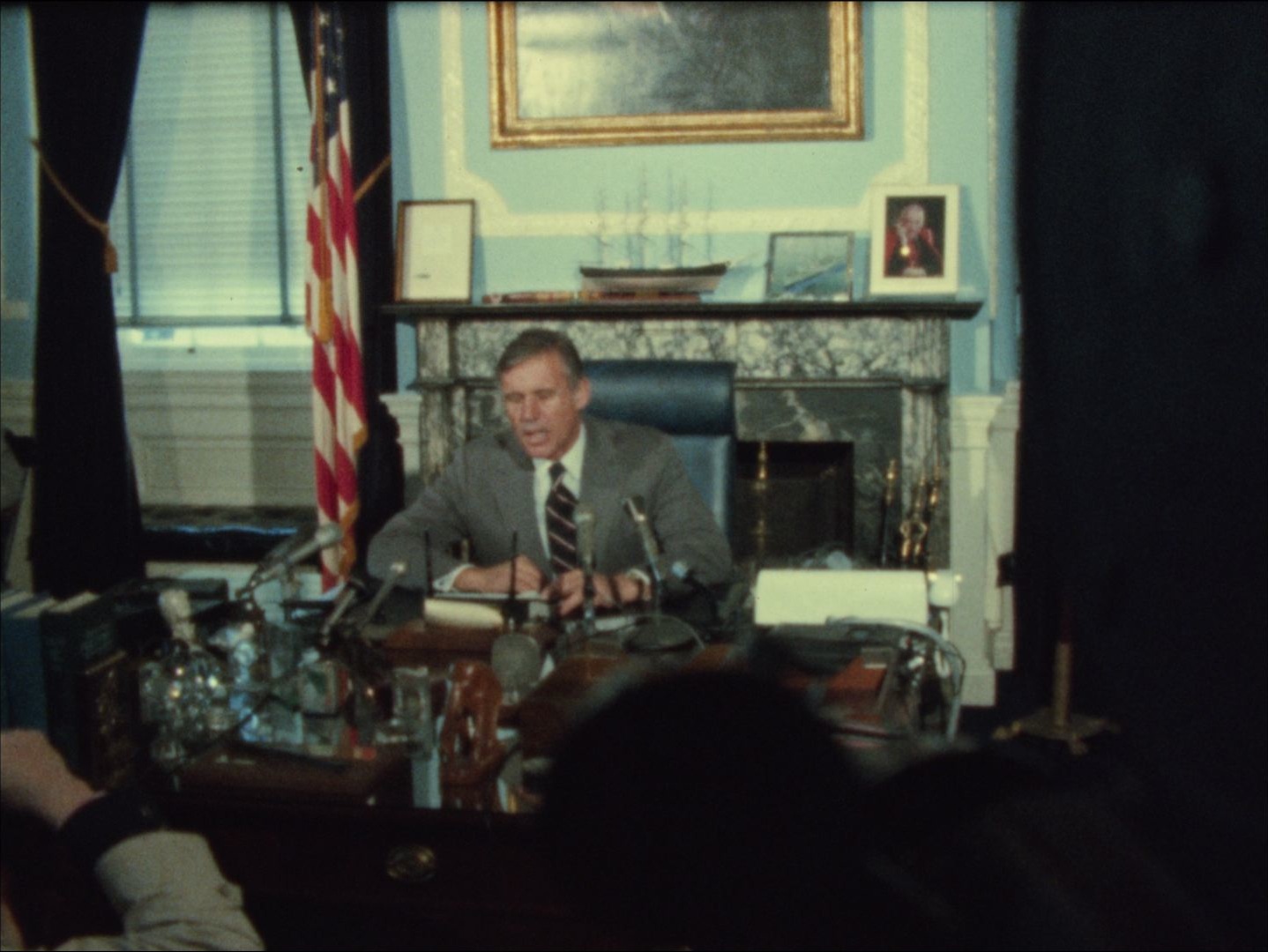
Description: William Weld outraged at William Bulger's habit of giving jobs to associates and his use of intimidation. Dukakis muses over South Boston drug arrests. Harshbarger and Shannon debate 75 State Street case.
Collection: Ten O'Clock News
Date Created: 08/13/1990
Description: Interview with Albert "Dapper" O'Neil during his run for Suffolk County sheriff. He accuses his oppenent of corruption and complains that no Boston newspapers will report the negative allegations he has made against his opponent. He discusses his plan to make the sheriff's department more visible and says "I'm a law and order man." He discusses his plan for the Charles St. Jail. He defends the office of the sheriff in the face of claims that the state should take over its responsibilities. He accuses the current sheriff of patronage and speaks against it in his campaign. He expresses his conservatism against the liberalism of the current sheriff., which includes his position against furloughs and halfway houses. He explains how he got the nickname "Dapper." He explains why he thinks former mayor and governor James Curley is the greatest man that ever lived. Video dropout in the middle of the video.
Collection: Ten O'Clock News
Date Created: 09/07/1978
Description: Roger Goodrich interviews Elliot Richardson, Massachusetts Attorney General, on the Frederick Wiseman film, Titicut Follies. He explains his objection film based on it's lack of regard for individual rights and privacy. He talks about the situation under former Attorney General Ed Brooke during which the film was made with the understanding that those individuals not able to give consent would not be featured. Cutaways of reporter asking questions. Footage of the Massachusetts Superior Court hearings on the film. A man who worked at Bridgewater State Hospital, where Titicut Follies was filmed, answers many questions. He mentions that his deputy forbade the cameras from going anywhere near Albert DeSalvo, the alleged Boston Strangler. Corrections Commissioner Gavin also answers questions. Outtakes of reporter standup. Silent courtroom scenes. Exteriors of the Massachusetts State House. Silent footage of Frederick Wiseman in the courtroom, talking to reporter Bill Harrington.
Collection: WHDH
Date Created: 10/18/1967
Description: William Sullivan holds press conference in his Jamaica Plain home to announce the Boston School Committee candidacy of his daughter Jean Sullivan McKeigue. He talks about educational attainment of wife Mary Malone Sullivan and their six children. Introduces daughter Kathleen Sullivan Alioto who introduces her sister Jean. Joseph Alioto sits behind smiling. Much press attention is focused on the Aliotos' respective political plans; they decline to be specific. William Sullivan turns away questions about the Patriots.
Collection: Ten O'Clock News
Date Created: 03/19/1979
Description: Clash between white and Hispanic residents in Lawrence. Gerald Ford visits Boston to endorse Elliot Richardson for Senate. Interview with film director James Ivory and actor Madeleine Potter on Henry James' “The Bostonians” starring Christopher Reeve and Vanessa Redgrave (clip). Artist Maggie Sherman's fanciful plaster face masks of residents of Montgomery, Vermont exhibited at Children's Museum. Anchors Lydon and Bennett.
Collection: Ten O'Clock News
Date Created: 08/10/1984
Description: Hope Kelly reports that Superintendent Laval Wilson proposed a set of reforms to improve the Boston Public Schools in the beginning of his tenure as superintendent. Kelly reviews Wilson's proposals for school reforms and notes that the programs were backed by the Boston School Committee. Kelly's report includes footage of Wilson in 1985 and footage of Wilson announcing his school reform package. The Boston School Committee has recently cut Wilson's budget by $8.5 million. Kelly reviews the budget cuts. Interviews with John Nucci (Boston School Committee), Sam Tyler (Boston Municipal Research Bureau), and Ellen Guiney (Educational Advisor to Mayor Flynn) about the budget cuts. Kelly reviews the budget figures for municipal spending on education from 1984 to 1989 and budget figures for overall city spending from 1986 to 1988. Kelly notes that the city's spending on education has greatly increased from 1984. She notes that critics believe that the School Department is not spending its money wisely. Kelly reports that the city will need to curb its spending in the next few years due to the absence of budget surpluses. Kelly's report is accompanied by footage of students in the Boston Public Schools.
1:00:19: Visual: Footage of Dr. Laval Wilson (Superintendent, Boston Public Schools) being interviewed by the Boston School Committee for the position of superintendent of schools on July 19, 1985. Wilson says that his goal is to convince the members of the Boston School Committee that he is the best candidate for the position. Hope Kelly reports that Wilson took over the Boston Public School System at a time when the average graduating senior reads at a seventh-grade level. Kelly notes that the average drop-out rate is 43%. V: Shots of high school students outside of a high school; of students descending a stairs in a school building. Kelly notes that Wilson approached the job with determination. V: Footage of Wilson saying that his goal is to lift the educational level of the students coming out of the Boston public school system. On-screen text and visuals detail the specifics of Wilson's proposed educational programs. Kelly reports that Wilson proposed a set of reforms called the Boston Education Plan. Kelly notes that Wilson proposed a $3.1 million dollar program for after-school remedial reading; that Wilson proposed a $1.3 million program to standardize remedial reading programs city-wide. Kelly notes that the School Committee backed Wilson's programs when he arrived. Kelly reports that the School Committee cut Wilson's budget by $8.5 million on Wednesday. V: On-screen text detail the specifics of the budget cuts. Kelly reports that Wilson proposed a budget of $364.6 million; that the School Committee cut his budget to $355.9 million; that Ray Flynn (Mayor of Boston) has refused to spend more than $350.0 million on the school budget. V: Shot of Flynn talking to reporters. Footage of John Nucci (President, Boston School Committee) saying that the city administration does not understand the impact of its cuts to the school budget. Kelly reports that Sam Tyler (Boston Municipal Research Bureau) runs an agency which monitors city spending. V: Footage of Tyler being interviewed by Kelly. Tyler says that city officials were thinking about the future when they asked the School Department to keep its spending to within $350 million. Tyler says that the superintendent cannot introduce new programs and expect them all to be funded. Footage of Ellen Guiney (Flynn's Education Advisor) being interviewed by Kelly. Guiney says that $350 million is what the city can afford to spend on education. On-screen text and visuals detail the city of Boston's spending on education from 1984 to 1989. Kelly reports that the city has increased its spending on schools from $245 million in 1984 to $341.1 million in 1989. V: Footage of Guiney says that some city officials in other departments think that the School Department already receives too much money. Kelly reports that some critics wonder if the School Department is spending its money wisely. V: Shot of two elementary-school students in front of a computer terminal. Footage of Tyler saying that the school system has improved. Kelly reports that Nucci points to a 1% decrease in the drop-out rate. Kelly notes that Guiney points to improved teacher salaries and more teachers; that Guiney admits that there have been few actual performance gains by students. V: Shot of Nucci; of Guiney; of a white male teacher in a classroom. Footage of Guiney saying that she would have liked to have seen greater improvements in the last five years. Shot of an African American girl coloring a picture in a classroom. Kelly reports that spending by the city has risen overall in the past five years. V: On-screen text compares the rise in city spending to the rise in school spending from 1986 to 1988. Kelly reports that city spending has risen 34% since 1986; that school spending has risen 23% since 1986. Kelly stands in front of the offices of the Boston School Committee. Kelly reports that the city had surpluses from 1986 to 1988; that it is less certain that surpluses will exist in future city budgets. V: Footage of Tyler saying that the city needs to put a brake on its spending. Shot of elementary school students entering a classroom.
Collection: Ten O'Clock News
Date Created: 05/06/1988
Description: Compilation of footage on multiple women's rights protests. Women bundled up sitting outside the Harvard building (888 Memorial Drive) they took over and renamed the "Boston Women's Center." A group of young men walk to the building with signs reading "Liberate Women Not Buildings. A man speaks as a representative of the Harvard Republican Club for Equality and Economic, Political, and Social Opportunities for Women, and he criticizes the women's methods of protest because they include breaking the law. The women make noise over his speech, and some of the women shout responses. The men picket in front on the building. Further exchanges between the two groups. Women hold a press conference three days after the takeover where they discuss their demands and the support of the women in the community. Another press conference on March 14, a week after the takeover. Women move out of the building. They hang a new banner on the outside of the building. People gather to watch the women moving out. Harvard police patrol the outside of the building and break open the front door. Interview with a man in the crowd. Press conference held by Boston College students on their petition demanding Ann Flynn be reinstated as Dean of Women and the sit in of Boston College students in administration offices. Another young man at the press conference also addresses the issue of military recruiting on college campuses. They discuss the involvement of Father Seavey Joyce, President of Boston College. Students gathered at a rally.
Collection: WHDH
Date Created: 03/1971
Description: Meg Vaillancourt interviews Sterling Anderson of the Association of Community Organizations for Reform Now (ACORN) outside of the Dudley Branch Library about the lack of affordable housing in the Roxbury, Dorchester, and Mattapan areas. Anderson says that the city is not doing enough to provide affordable housing for low-income residents. Anderson questions the city's definition of low-income. He adds that most residents do not make enough money to meet the city's definition of low-income. Anderson and a group of ACORN protesters march to the offices of the Boston Redevelopment Authority on Washington Street in Dudley Square. Anderson and the protesters enter the office and confront Ricardo Millet of the Boston Redevelopment Authority (BRA) about the city's affordable housing policies. The protesters read a list of demands including that 70% of all new developments in the area must target low and moderate-income residents. The protesters demand information on all new planned developments in the Roxbury/Dorchester/Mattapan neighborhoods. Millet discusses the city's affordable housing policy with the protesters. He gives them handouts including a list of planned developments in the area. Millet says that the BRA is trying to provide affordable housing despite a lack of subsidies from the federal government.
1:00:14: Visual: A fire engine pulls out onto Washington Street. Elevated train tracks are visible. An African American firefighter operates the rear of the truck. Cars pull to the side of a congested street to let another fire engine pass. 1:01:22: V: Meg Vaillancourt sets up an interview with Sterling Anderson (ACORN). Vaillancourt asks about the march organized by ACORN (Association of Community Organizations for Reform Now) to protest the affordable housing policies of the Boston Redevelopment Authority (BRA). Anderson says that redevelopment in the areas of Roxbury, Dorchester, and Mattapan is not geared toward the current residents of those areas; that ACORN is trying to put pressure on the mayor and the BRA to include housing for current residents. Anderson says that most of the residents of those areas do not make more than $13,000 per year; that one-bedroom apartments are selling for $18,000 in one of the new developments. Anderson says that Ray Flynn (mayor of Boston) deserves credit for developing housing; that these efforts are insignificant if the residents of these areas cannot live in the new housing. Anderson talks about how poor people have been thrown out of areas like the South End. Anderson says that the residents need housing, not shelters; that the city needs to commit itself to affordable housing. Anderson says that the city defines low income as a salary of $18,000 to $23,000 per year; that the city defines a moderate income as an income of $23,000 per year. Anderson says that he defines low income as under $13,000; that he defines moderate income as $13,000 to $24,000 per year. Vaillancourt asks if the city is really serving its lower income residents. Anderson says that the city is not serving those residents; that a lot of people cannot afford housing; that the city is pushing low-income residents out of the areas of Roxbury, Dorchester, and Mattapan. Vaillancourt asks if race is the issue. Anderson says that it is an economic issue; that the low-income residents of Roxbury are African American; that there are low-income whites with the same problems in South Boston, Chelsea, and East Boston. Vaillancourt asks if Anderson doubts Flynn's commitment to the neighborhoods. Anderson says that he respects Flynn; that Flynn needs to understand that low-income residents are committed to fighting for affordable housing; that he needs to help these people. Anderson says that he cannot afford to give up on the fight for affordable housing; that he will have no place to live in five years if he does not put up a struggle. Anderson says that shelters are not the answer to the housing problem; that poor people do not want to live in shelters. Anderson says that there are some people who benefit from shelters; that the majority of people with low incomes are intelligent and hard-working. Anderson says that he hears the same statistics from the city at every meeting on affordable housing; that the city needs to make a commitment because working people cannot afford housing right now. The crew takes cutaway shots of Vaillancourt and Anderson. Anderson says that the BRA says the same thing at every meeting; that public housing advocates are always pushing for more low-income housing. Anderson says that 70% of the housing in the areas of Roxbury, Dorchester, and Mattapan needs to be for low- and moderate-income people. Anderson says that people in these areas have no place to live, despite the BRA's commitment to affordable housing; that developments in these areas should be priced at $35,000 instead of $65,000. 1:08:18: V: Housing protesters gather on the sidewalk on Washington Street, outside of the BRA's Dudley Office. The elevated train tracks are visible. The protesters chant, "We want housing. We won't wait. 2, 4, 6, 8." The protesters gather behind a banner reading, "ACORN." Shot of the BRA sign above the entrance to the office. The protesters march slowly into the BRA offices. The protesters chant, "What do we want? Housing. When do we want it? Now." The majority of the protesters are African American. The protesters file into the building. 1:10:48: V: The housing protesters enter a large room swith chairs set up for a meeting. The protesters chant, "2, 4, 6, 8. We want housing. We won't wait." The protesters stand at the side of the room, holding protest signs and chanting. Shot of a sign reading, "Third notice: Please be advised that you are required to build affordable housing." Shots of individual protesters. Ricardo Millet (BRA) sits in one of the chairs in the meeting room. He watches the protesters with interest. Millet invites the protesters to sit down. Anderson says that the protesters will remain standing. Anderson addresses Millet. Anderson says that there is a housing shortage in the areas of Roxbury, Dorchester, and Mattapan; that the BRA housing policy is ineffective; that residents of these areas need housing that they can afford. Anderson says that the newly developed housing target people with incomes of at least $23,000 per year; that most residents make less than $13,000 per year. Anderson says that the BRA and the city of Boston need to make a commitment to low-income housing; that 70% of the new development needs to target low-income residents. Anderson demands information on new developments planned for the Roxbury, Dorchester, and Mattapan areas. Anderson says that the BRA has not been forthcoming with that information; that the BRA needs to work with developers work with developers who have committed to building low-income housing. 1:14:34: V: An African American woman addresses Millet. She reads a list of ACORN demands: the cessation of development on Fountain Hill by June 15 unless the development is 70% affordable to those with low- and moderate-incomes; 70% of all new housing must target low- and moderate-income residents; that ACORN wants information on plans for new development in the area. Another protester says that the 70% quota applies to housing in the Roxbury, Dorchester, and Mattapan areas; that many residents of these areas make less than $13,000 per year; that an average income is more than $26,000 per year. The protester says that the voices of the poor must be heard. The protesters applaud. Anderson asks for a map of planned developments in the Roxbury/Mattapan area. Anderson says that the protesters will not allow new developments to be built if they cannot live in them. Millet stands to face the protesters. He listens as Anderson speaks. 1:16:10: V: Millet addresses the protesters. He invites the protesters to sit down and to discuss the issues with him. Anderson says that the protesters have been sitting in meetings for months; that the protesters want a list of the planned developments in the area. Millet says that he has never been asked for a list of the planned developments before now. Millet offers to provide the protesters with a list of projects currently undertaken by the BRA. Millet gives copies of a handout to the protesters. Millet notes that the BRA, under the Flynn administration, has approved 912 units of housing. Millet adds that the handout includes a list of approved projects as well as their locations, developers and affordablility. Shot of the printed handout. Millet says that 60% of the units in the approved developments are affordable to low- and moderate-income people. Shot of statistic on the handout reading, "60.4% of units below market rate." Anderson asks Millet to define low- and moderate-income. Millet says that the BRA will work with the protesters on the issue of low-income housing; that the BRA and the city want to respond to the needs of low-income people. Millet notes that it is hard to achieve these goals because the federal government has stopped subsidizing housing. Millet adds that the city has done well to achieve a 60% affordability rate in its new projects. Millet gives out copies of another handout. Millet explains that the handout covers the BRA's and the city's positions on affordable housing; that the handout describes the problem of affordable housing. Millet notes that the city is aware of the housing shortage. Anderson says that he gets the same responses every time he meets with the city and the BRA about housing; that no one is responding to their concerns. Shot of the crowd of protesters. Millet says that he has met with ACORN representatives in the past; that the BRA agrees with ACORN on the need to provide affordable housing; that the BRA is trying to achieve these goals without subsidies from the federal government. Millet stresses the fact that the BRA is committed to achieving these goals; that the BRA is trying their best to build affordable housing; that the BRA's achievement of a 60% affordabliltiy rate is remarkable.
Collection: Ten O'Clock News
Date Created: 05/28/1986
Description: Christy George reports that the campaigns of Jesse Jackson and Michael Dukakis have different agendas for the upcoming Democratic convention. She notes that Jackson may not support Dukakis's choice of running mate because he would like to be named as Dukakis's running mate. George reports that Jackson has threatened to have floor fights on all platform issues that he does not win, and to present his speech outside of the convention if he feels slighted by the party. George speculates on whether the delegates for each candidate will unite at the convention. Interview with Dukakis delegate Raymond Jordan and Jackson delegate Saundra Graham about their views of the convention. Jordan says that he is working to unite all Democrats behind Dukakis. Graham says that Dukakis must accommodate Jackson's platform to win his delegates. George's report includes footage of Dukakis and Sen. Lloyd Bentsen at a press conference and footage of Dukakis campaigning. George's report also features footage of Jackson and footage of Sen. Dianne Feinstein at the 1984 Democratic National Convention. This edition of the Ten O'Clock News also included the following item: An African American family moves into the McCormack housing project
1:00:07: Visual: Footage of Raymond Jordan (Dukakis delegate) being interviewed by Christy George. Jordan says that he is working to unite all Democrats behind the nomination of Michael Dukakis (Democratic US Presidential candidate). Footage of Saundra Graham (Jackson delegate) saying that Jesse Jackson (Democratic US Presidential candidate) has broken the barrier which had kept people of color from running for elected offices. George reports that the Jackson campaign and the Dukakis campaign have different agendas for the Democratic Convention in Atlanta next week. V: C-Span footage from the 1984 Democratic National Convention. Dianne Feinstein (US Senator) urges the members of the Democratic Party to put aside their differences in order to work for their goals. Shot of Democratic leaders including Jackson shaking hands at the the Convention. Shots of construction workers preparing the set and stage for the 1988 Democratic National Convention. George reports that Jackson may not support Dukakis's choice of running mate; that Jackson wants to be Dukakis's running mate. V: Shot of Dukakis and Lloyd Bentsen (US Senator) at a press conference. Footage of Jordan saying that Dukakis supporters are going to the convention to support Dukakis. Footage of Graham saying that Dukakis needs to accomodate Jackson supporters. George reports that Jackson is threatening floor fights on all 13 platform issues that he does not win. V: Shot of Jackson speaking from a podium. Footage of Jordan saying that Dukakis has done everything he can to accomodate Jackson on the platform issues. Footage of Graham saying that she is going to the convention to fight for the issues which are important to her and her constituents. George reports that Jackson is threatening to give his speech outside of the convention hall if he feels mistreated by the Democratic Party leadership. V: C-Span footage of Jackson addressing the 1984 Democratic Convention. Shot of the audience. Footage of Jordan saying that Jackson's attitude is "political posturing." Jordan says that no one knows what Jackson's real motives are. Footage of Graham saying that Dukakis is acting unreasonably; that Dukakis is trying to control the convention rules and the party platform. George speculates as to whether Jackson supporters and Dukakis supporters will unite at the convention. V: Shots of Dukakis standing at the shore of a lake; of Jackson addressing a small crowd; of the convention set being constructed in the Atlanta convention center. Footage of Graham saying that Jackson needs to urge his supporters to support Dukakis as the Democratic nominee. Footage of Jordan saying that Jackson supporters and Dukakis supporters both want the Democratic nominee to win the presidency. George notes that the convention could be boring if both sides unite immediately behind one candidate and one platform.
Collection: Ten O'Clock News
Date Created: 07/11/1988
Description: Reporter Christopher Lydon talks about presidential campaign. Reporter Gail Harris reports on President Ronald Reagan's press conference about an environmental report; footage of Lieutenant Governor John Kerry, David Bartley, and Congressman James Shannon (all candidates for US Senate) commenting on acid rain. Bartley says Kerry and Shannon are not doing enough about acid rain. Harris reports on new seat belt and air bag regulations. Lydon presents mobster Raymond Patriarca obituary, compares Patriarca to "The Godfather." Harris reports on new technology for detecting cancer. Footage of South Norfolk Council for Children representative Cathy Wheeler telling story of "Angie." Reporter Meg Vaillancourt gives stats for residential programs for youth with mental health issues. Footage of New Bedford Council for Children representative Jean Peterson talking about budget. Philip Johnston, human services secretary talks about state of children's mental healthcare. Dr. Eli Newberger (of Children's Hospital) testifies on state funding of mental health support services for children. Dr. Michael Jellinek (Chief of Child Psychology at Mass. General Hospital) talks about budget. Vaillancourt talks about growing difficulty of mental health over time. Charles Fried (Harvard Law School) and Anthony Lewis (New York Times) studio interview on Supreme Court at term's end: apparently conservative trend and states' rights inclination in recent decisions. Broadcast ends with international news: OPEC; Libyan bombing; dock worker strike in Great Britain; correspondent in England talks about economic situation of British Pound Sterling.
Collection: Ten O'Clock News
Date Created: 07/11/1984