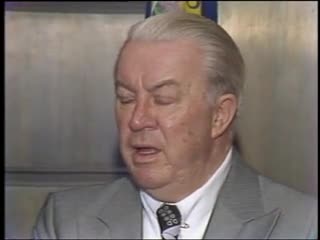
Description: Hope Kelly reports that Reverend Graylan Hagler of the Church of the United Community has announced his candidacy for mayor of Boston. He says that it is time for a change in the city of Boston. His supporters cheer. Kelly reviews Hagler's credentials and career. She notes that Hagler has a confrontational style and is experienced in the art of political theater. Kelly reviews Hagler's recent political activities. Kelly's report includes footage of Hagler addressing striking hotel and restaurant workers in November of 1988 and footage of Hagler with unemployed construction workers at a press conference at a Roxbury construction site in December of 1990. Kelly's report also includes footage of Hagler denouncing racism on the part of city officials at a press conference in the wake of the Carol Stuart murder case. Kelly's report includes footage from an interview with Hagler in March of 1991. He says that he is seeking justice and equity in the city.
1:00:11: Visual: Footage of the Reverend Graylan Ellis-Hagler (Church of the United Community) announcing his candidacy for mayor of Boston. Ellis-Hagler says that it is time for change. The audience applauds. Shots of Ellis-Hagler supporters cheering. Hope Kelly reports that Ellis-Hagler's announcement was a rousing reminder that many residents of the city are ready for a change. V: Footage of Ellis-Hagler speaking to supporters. Ellis-Hagler says, "no more business as usual" and "no more disrespect." Kelly reports that Ellis-Hagler is a minister; that Ellis-Hagler was born in Baltimore and graduated from Oberlin College. Kelly reports that Ellis-Hagler listed many reasons why Ray Flynn (Mayor of Boston) should not be re-elected. V: Shots of Ellis-Hagler as he addresses the crowd. Shots of the audience. Footage of Ellis-Hagler addressing supporters. Ellis-Hagler says that streets in some neighborhoods have more trash-filled lots than houses. Ellis-Hagler says that the city is ready for a change. The audience applauds. Kelly reports that Ellis-Hagler says that his constituents are the ones who live on streets with vacant lots. Kelly reports that Ellis-Hagler believes that the city needs to hire more of its own residents instead of bringing in workers from outside. V: Footage of Ellis-Hagler addressing supporters. Ellis-Hagler says that many workers in the city come from towns outside of the city. Ellis-Hagler says that the city is ready for change. The audience applauds. Shot of Chuck Turner (teacher) holding up Ellis-Hagler's arm as he sits down after his speech. Kelly reports that Ellis-Hagler is experienced in the art of political theater; that Ellis-Hagler does not give in or give up quickly. V: Footage of Ellis-Hagler speaking to striking hotel and restaurant workers in November of 1988. Ellis-Hagler embraces Domenic Bozzotto (union leader). Footage of Ellis-Hagler at a press conference at a construction site in Dudley Square in December of 1990. Unemployed African-American construction workers stand behind him. Ellis-Hagler says that the workers will not "go away with crumbs." Shots of the construction site. Kelly reports that Ellis-Hagler was arrested twice last winter at the construction site of a new Post Office facility in Dudley Square. Kelly reports that Ellis-Hagler was supporting the cause of unemployed construction workers in his community. V: Footage of Ellis-Hagler being interviewed on March 13, 1991. Ellis-Hagler says that people must buck the system in order to stand up for their dignity and rights. Footage of Ellis-Hagler at a press conference about the Carol Stuart murder case in January of 1990. Ellis-Hagler compares the actions of city officials and the media to the actions of the Ku Klux Klan. Ellis-Hagler says that the African American and Latino communities have been "raped" by the police and the media. Shot of an audience member at the press conference holding a sign reading, "What do Boston and South Africa have in common? Stopping and detaining men because of the color of their skin." Kelly reports that Ellis-Hagler excoriated the police, the media, and the mayor after the murder of Carol Stuart (Reading resident). Kelly notes that Ellis-Hagler's style is confrontational. V: Footage of Ellis-Hagler being interviewed on March 13, 1991. Ellis-Hagler says that he has a desire to seek justice and equity in the city. Ellis-Hagler says that he wants the voices of all of the people to be heard. Kelly stands outside of a church. Kelly reports that Flynn' s campaign is following the actions of Ellis-Hagler; that Ellis-Hagler is short on money, but long on mission. V: Footage of Ellis-Hagler addressing his supporters. Ellis-Hagler says that he and his supporters will win. The audience applauds. Ellis-Hagler steps back from the microphone and greets Elizabeth Ellis-Hagler (wife of Graylan Ellis-Hagler). Another man speaks into the microphone.
Collection: Ten O'Clock News
Date Created: 05/01/1991
Description: Thomas Brown (Professor, University of Massachusetts) addresses a Town Meeting on Race and Class at the John F. Kennedy Library. The meeting is held in honor of the release of J. Anthony Lukas's novel, Common Ground. The novel is about the busing crisis in Boston. Brown says that Lukas' novel brings perspective to the busing crisis. Brown commends Lukas on his exhaustive research into the history of each family portrayed in the novel. Brown talks briefly about the history of each family. He notes that Lukas's novel depicts the richness and struggle of everyday life. Marie Clark (parent and member of the Home and School Association) addresses the panel. Clark says that she speaks from the perspective of a parent who lived through the busing crisis. Clark says that she supports school integration, but opposed the court order. She adds that the court order was disruptive and too broad in scope. She urges audience members to support the Boston Public School system. She notes that the school system has improved as a result of desegregation. Moe Gillen (Charlestown community activist) addresses the meeting. Gillen says that he remains opposed to busing. He adds that the federal court usurped the rights of the parents of Boston's schoolchildren. Gillen notes that the anti-busing movement was committed to protesting by legal and moral means. He says that he is glad to live in a society where protest and opposition to the law is allowed. Father Michael Groden (Archdiocese of Boston) addresses the audience. Groden says that the court orders did not allow for genuine input from parents. He says that a parents' movement could have overcome issues of race and class during the busing crisis. Groden talks about the need for grassroots leadership within the city and the need for a network of human connections across the city's neighborhoods. Panelists at the meeting include Jack Beatty (Senior Editor, Atlantic Monthly), Brown, Clarke, Gillen (Charlestown community activist), Groden, Robert Kiley (former Deputy Mayor of Boston), Theodore Landsmark (attorney), Sandra Lynch (former general counsel to the State Department of Education), Kim Marshall (Director of Curriculum, Boston Public Schools), Reverend Charles Stith (Union United Methodist Church), and Thomas Winship (former editor, Boston Globe). Tape 3 of 8
1:00:01: Visual: Martin Nolan (The Boston Globe) addresses a Town Meeting on Race and Class at the John F. Kennedy Library. The town meeting is held in honor of the release of the book, Common Ground by J. Anthony Lukas (author). Nolan speaks from a podium. Panelists are assembled at tables on either side of the podium. Panelists include Jack Beatty (Senior Editor, The Atlantic Monthly), Thomas Brown (Professor, University of Massachusetts), Marie Clarke (parent and member of the Home and School Association), Moe Gillen (Charlestown community activist), Father Michael Groden (Archdiocese of Boston), Robert Kiley (former Deputy Mayor of Boston), Theodore Landsmark (attorney), Sandra Lynch (former general counsel to the State Department of Education), Kim Marshall (Director of Curriculum, Boston Public Schools), Reverend Charles Stith (Union United Methodist Church), and Thomas Winship (former editor, The Boston Globe). Nolan introduces Thomas Brown. Brown says that he is a historian; that many of the other panelists were participants in the busing crisis. Brown says that comments that Lukas focused on the history of the McGoff, Twymon, and Diver families, which were each portrayed in the book. Brown commends Lukas for his exhaustive research into the history of each family. Brown notes that Lukas probably uncovered facts which were previously unknown to each family. Brown talks about the way in whick Lukas shows how past history affects the contemporary events portrayed in the book. Brown says that Lukas's book brings needed perspective to the busing crisis. Brown says that the Diver family emerges from the violence of the colonial struggle in Boston; that the McGoff family is informed by the violent past of nineteenth- and twentieth-century Ireland; that the Twymon family emerges from the violent past of slavery. Brown says that the recent struggles of each family pale in comparison to the hardships and struggles of their past family histories. Brown notes that the trouble endured by the families during the busing crisis has been accompanied by social progress and change. Brown says that previous speakers have suggested that a common ground existed in the coalition which was formed around John F. Kennedy (former US President) in 1960. Brown suggests that Lukas' book is also "common ground." Brown says that Common Ground is a "loving" book which moves readers to tears; that it details the richness and struggles of everyday life. Brown says that readers can take away the love put into the book by Lukas; that the readers of the book can find "common ground." The audience applauds. 1:08:30: V: Nolan introduces Marie Clark. Clark says that she brings the perspective of a parent who lived through the busing crisis. Clark says that she was one among many parents who supported integration, but opposed the plan put forth by Arthur Garrity (federal judge). Clark says that the plan was disruptive and too broad in scope. Clark says that she objected to the disruption of schools which were already integrated; that she objected to African American students being bused to a new school at the start of each year; that she objected to students being denied access to programs because of racial quotas. Clarke says that wrongs were committed by people on both sides of the issue; that Boston has emerged from the busing crisis as a stronger city. Clarke says that the Boston Public Schools have improved as a result of desegregation; that "common ground" can be found in the children of Boston who attend the public schools. Clarke adds that the Boston Public School System needs the support of parents, the business community and suburbanites. Clarke says that the future of the city depends upon a strong school system. The audience applauds. 1:11:42: V: Nolan introduces Moe Gillen. Gillen says that many in the audience are familiar with his opinions on the busing crisis. Gillen says that "common ground" can be found in Lukas' book; that the book brings people together; that the book shows the "common heritage" of Boston residents. Gillen notes that Ray Flynn (Mayor of Boston) and Dennis Kearney (Suffolk County Sheriff) are in the audience; that Flynn and Kearney were representatives of the anti-busing movement. Gillen says that many in the anti-busing movement were committed to protesting the court orders in a "legal, moral way." Gillen praises anti-busing mothers for their commitment to their families; that many anti-busing parents set a good example for their children. Gillen says that he remains "adamently opposed to a government that takes and usurps the rights of parents." Gillen says that hindsight shows that the court orders were not successful. Gillen says that the busing crisis showed the strength of US society; that opponents to busing did not resort to "violence and anarchy," even though their "personal values" were at stake. Gillen says that he is thankful to live in the US instead of "some banana republic." Gillen invites audience members to address the issues during the discussion. The audience applauds. 1:16:08: V: Nolan introduces Father Michael Groden. Nolan talks about Groden's work as an advocate for the city's working lobstermen and his work on school issues during the busing crisis. Groden says that he wrote a letter to Garrity as he was completing his first term as director of the Citywide Coordinating Council (CCC); that he wrote to Garrity about the "parent movement" withing the city schools. Groden says that he did not think the system allowed for genuine and enduring input from parents. Groden notes that a "common ground" presented itself through the opportunity for parents to come together and effect changes in the schools. Groden says that the opportunity to bring parents together was not fully exploited; that a parents' movement would have overcome issues of race and class. Groden says that a parents' movement needs to be organized in order to build connections in and across the neighborhoods of the city. Groden says that the roles of civic and religious leaders are discussed in Lukas's book. Groden says that the city was focused on "elitist" leadership instead of grassroots leadership. Groden notes that grassroots political and religious leadership is much more effective than "moral imperatives." Groden says that moral courage is born of faith and of a healthy set of relationships with others. Groden adds that Lukas' book benefits from Lukas' ability to communicate effectively with others. Groden says that Ray Flynn (mayor of Boston) has set the right tone for the city since his inauguration; that Flynn has "lived across the lines of color and, to some extent, class." Groden adds that "moral imperatives and gospel mandates" are clear in their message. Groden concludes by saying that "common ground" can only be found in a new "set of human connections." The audience applauds.
Collection: Ten O'Clock News
Date Created: 09/28/1985
Description: Carmen Fields interviews Frank Hector (World War II veteran) and Ralph Cooper (Vietnam veteran) about their experiences in the military. Hector talks about the accomplishments of African American soldiers and war veterans. Hector says that the military is a good experience for young African Americans. Cooper talks about the disproportionate numbers of African American soldiers in the front lines and the lack of services for veterans of color. Hector and Cooper talk about their opinions of Colin Powell (Head, US Joint Chiefs of Staff). Field's report is accompanied by footage of Powell and soldiers during the Persian Gulf War. Fields reports that many African Americans join the military to escape the high unemployment rate in the African American community. Field's report is accompanied by footage of Reverend Michael Haynes leading a church service at Roxbury's Twelfth Baptist Church. Relatives of soldiers in the Persian Gulf War stand in front of the altar to pray for the soldiers. Fields interviews Haynes. Haynes says that African American soldiers must be granted equal rights and privileges when they return home from the war. Fields' report is accompanied by footage from interviews with people on the street about African American soldiers in the Persian Gulf War.
Collection: Ten O'Clock News
Date Created: 01/21/1991
Description: Sound dropout in the beginning of the video. Boston City Council meeting on the Boston School budget. City Councilor reads communications from Mayor White to the City Council. Boston schools superintendent Marion Fahey testifies to City Council about school budget deficit. Accompanying Fahey are Paul Kennedy, Associate Superintendant in charge of personnel and John McGran, member of the superintendent's office on budgetary matters. Councilors Louise Day Hicks, Albert "Dapper" O'Neil, Larry DiCara are among those on the panel questioning Fahey. Mayor White and Superintendent Fahey both address the effect of Judge Arthur Garrity's 1975 court order on the Boston School Department budget. Video goes black in the middle for a few second, but audio continues.
Collection: Ten O'Clock News
Date Created: 05/20/1976
Description: Story on the changes in the way women are voting, and the way they voted specifically in the 1984 presidential election. Interviews with women voters about the Mondale-Ferraro ticket. One woman says “If Godzilla were running against Reagan, I would have voted Godzilla." Interview with Rep. Susan Schur on the way the voters decided who to vote for in the 1984 presidential election, especially women voters. Footage from Bush/Ferraro vice-presidential debate. Interview with man on contemporary women's voting practices. Examination of women's voting in Massachusetts specifically, including for both Mondale/Ferraro, and for John Kerry in the Senate. Footage of many campaign rallies, including for Gary Hart, Mondale, Ferraro, Kerry, and Reagan. Massachusetts Republicans applaud Reagan, who embraces Dapper O'Neil on City Hall Plaza.
Collection: Ten O'Clock News
Date Created: 11/08/1984
Description: Thomas Winship (former editor, Boston Globe) speaks at a Town Meeting on Race and Class at the John F. Kennedy Library. The meeting is held in honor of the release of J. Anthony Lukas's novel, Common Ground. The novel is about the busing crisis in Boston. Winship says that Boston is no longer portrayed as a racist city in the national media. He notes that the city is dedicated to healing its wounds. Martin Nolan organizes a discussion among audience members and panelists. Gerard Doherty (former State Representative) says that Irish Americans were fighting for their children's right to a good education. He adds that there were no racial problems in Charlestown before the busing crisis. Ron Formisano (Professor, Clark University) says that he is disappointed at the absence of the McGoff family and other members of the anti-busing movement. Nolan says that many leaders of the anti-busing movement declined invitations to attend the forum. Paul Grogan (Liaison to the Business Community for the Flynn administration) asks Lukas to comment on the leadership of Kevin White (former Mayor of Boston) and Arthur Garrity (federal judge). Lukas responds to Formisano, saying that the absence of the McGoff family is troubling. He says that he invited many members of the anti-busing movement to the forum. Lukas comments on White's career as mayor. He says that White was most effective in the early years of his tenure. He notes that White became less attentive to racial issues over the years, though he was effective in other areas. Lukas compliment's Garrity's courage and integrity. Lukas speculates as to whether a metropolitan solution to busing would have worked. He says that the court order should have tried to address class issues. Rachel Twymon (member of the Twymon family portrayed in Common Ground) speaks to the audience. She says that children cannot be expected to attend school together until their parents can gather to discuss issues peacefully. Joan Diver (member of the Diver family portrayed in Common Ground) addresses the meeting. She compliments Lukas on his novel and says that his novel allowed her to understand different people's perspectives on the busing crisis. Panelists at the meeting include Jack Beatty (Senior Editor, Atlantic Monthly), Thomas Brown (Professor, University of Massachusetts), Marie Clarke (parent and member of the Home and School Association), Moe Gillen (Charlestown community activist), Father Michael Groden (Archdiocese of Boston), Robert Kiley (former Deputy Mayor of Boston), Theodore Landsmark (attorney), Sandra Lynch (former general counsel to the State Department of Education), Kim Marshall (Director of Curriculum, Boston Public Schools), Reverend Charles Stith (Union United Methodist Church), and Winship. Tape 7 of 8
1:00:00: Visual: Thomas Winship (former editor, The Boston Globe) addresses a Town Meeting on Race and Class at the John F. Kennedy Library. The town meeting is held in honor of the release of the book, Common Ground by J. Anthony Lukas (author). Winship speaks as a member of a panel including Jack Beatty (Senior Editor, The Atlantic Monthly), Thomas Brown (Professor, University of Massachusetts), Marie Clarke (parent and member of the Home and School Association), Moe Gillen (Charlestown community activist), Father Michael Groden (Archdiocese of Boston), Robert Kiley (former Deputy Mayor of Boston), Theodore Landsmark (attorney), Sandra Lynch (former general counsel to the State Department of Education), Kim Marshall (Director of Curriculum, Boston Public Schools) and Reverend Charles Stith (Union United Methodist Church). Winship says that Boston is no longer portrayed as a "racist city" by the national media; that Boston is now seen as a city dedicated to healing its wounds. Winship says that "the court order made the city face the music, and the melody gets better and better as each day goes by." The audience applauds. 1:00:52: V: Martin Nolan (The Boston Globe) invites questions from the audience. Gerard Doherty (former State Representative from Charlestown) refers to the comments of Elvira Pixie Palladino (former member, Boston School Committee) about respect and the comments of Paul Parks (former State Secretary for Education) about listening to others. Doherty says that Lukas's book neglected to mention the great commitment to education on the part of most Irish Americans. Doherty notes that there were no racial problems in Charlestown before "forced busing"; that Irish Americans were fighting for their children's right to a good education. Doherty says that Irish Americans felt as if the right to education was being denied to their children through forced busing. Doherty says that Charlestown residents support equal rights for all; that Charlestown residents want a good education for their children in neighborhood schools; that education is "the way out" for most Charlestown residents. The audience applauds. 1:04:17: V: Ron Formisano (Professor, Clark University) introduces himself and says that he is working on a book about the anti-busing movement. He comments that the absence of the McGoff family (family portrayed in Common Ground) at today's gathering is symbolic of the "historic alliance" in Boston between white protestants and African Americans. Formisano says that the absence of the McGoff family is unfortunate; that neighborhood leaders are also absent from today's gathering. Formisano points out that Ray Flynn (Mayor of Boston) is the only person present who was involved in "strenuous opposition" to the court order. Formisano asks if the leaders of the anti-busing movement were invited to the gathering. Nolan says that members and leaders of the anti-busing movement were invited to the gathering; that most declined to accept the invitation. Nolan says that Formisano is welcome to look over the list of invitees. 1:07:33: V: Paul Grogan (Liaison to the Business Community for the Flynn administration) asks if Lukas is disappointed in the leadership of Kevin White (former Mayor of Boston) and Arthur Garrity (federal judge) during the busing crisis. Grogan asks how each man could have responded differently to the situation. Lukas approaches the podium. He says that he is happy to respond to Grogan's question and to Formisano's question. Lukas says that he is honored to have a distinguished panel and audience gather to discuss his book; that the absence of the McGoff family is "a blight on the evening." Lukas says that he had wanted all three families to rise as one after he introduced them. Lukas notes that the McGoffs accepted his invitation; that he does not know why they are not here. Lukas says that three or four dozen people from Charlestown were invited to the gathering; that he does not know how many are here. Lukas says that his intention was to bring all Bostonians together; that he did not intend to host a gathering of "Harvard professors and government officials." Lukas expresses his regret that the effort was "partially unsuccessful." Lukas says that Grogan's question is difficult. Lukas notes that one of the panelists talked about "heroes and villains"; that he hopes that the search for "heroes and villains" is in vain. Lukas says, "heroes and villains make good fairytales but bad history." Lukas says that he believes that people can transcend their history. Lukas says that Lisa McGoff (member of the McGoff family portrayed in Common Ground) is one of the people in the book whose actions are heroic; that Lisa McGoff learned to transcend her past. 1:13:09: V: Lukas says that he sees no one in the book as either a hero or a villain. Lukas says, "Kevin White will go down in history as a better mayor than he is presently perceived to have been, but not so good a mayor as he thinks he was." The audience laughs and claps for Lukas. Lukas says that White was a good mayor for the first two or three years; that White was less effective when he pursued his ambitions to be a national politician. Lukas says that White became less committed to race issues during the course of his tenure. Lukas says that he hopes that he gave full coverage in the book to the racism and race issues which led to the busing crisis. Lukas compliments panelist Sandra Lynch on her "deeply moving" presentation on racism in Boston. Lukas says that White was not committed to issues of racial justice; that White was effective in other areas. Lukas says that "history will treat Arthur Garrity much better than Boston has treated him." Lukas adds that Garrity was a "scapegoat"; that Garrity truly had no other course than to order busing as a remedy. Lukas says that he admires Garrity's tenacity, integrity and courage; that Garrity is not a "risk-taker." Lukas says that he wishes that Garrity had tried a metropolitan busing plan. Lukas notes that the anti-busing movement would have seen him as more understanding of their position. Lukas says that there is a slim chance that a metropolitan plan might have worked. Lynch, who is sitting on the panel, indicates that it would not have been legally possible. The audience laughs. Lukas says that the class issue needed to be addressed; that an effort to metropolitanize busing would have addressed the class issue, even if the effort failed. Lukas expresses his great respect for Garrity, despite his criticism. The audience applauds. 1:17:52: V: Nolan introduces Rachel Twymon (member of the Twymon family portrayed in Common Ground). Twymon says that there has been something left "unsaid." Twymon notes that Garrity enforced the law; that people are often "very lonely" when they take an unpopular stand, even if it is right. Twymon says that adults cannot expect their children to go to school together if the adults cannot gather to discuss the issues peacefully. The audience applauds. Joan Diver (member of the Diver family portrayed in Common Ground). Diver says that Lukas' book allowed her to "get into the heads" of other people. Diver talks about how she read and began to understand the perspective of each family. Diver says that the families were victims who experienced great pain; that the families were also "victimizers" who were fighting to protect their ideals, families or property. Diver says that Lukas' book is like "a window to the sky"; that the book provides understanding and wisdom which might lead readers to a "common ground." Shot of Joan and Colin Diver.
Collection: Ten O'Clock News
Date Created: 09/28/1985
Description: Carmen Fields reports that the play Les Blancs, by playwright Lorraine Hansberry will be produced by the Huntington Theater Company. The play is set in a fictitious African nation struggling for independence. Interview with Hansberry's ex-husband Robert Nemiroff, who is overseeing the production of the play. He talks about Hansberry and her work. Nemiroff says that Hansberry's play foreshadows the revolutionary changes that would take place in Africa in the 1960s. He says that much of her work revolved around the relationship between the oppressed and their oppressors. Fields reviews Hansberry's career. She notes that Nemiroff is gathering materials for a Hansberry Library Collection. Fields report includes footage from the WNET production of Les Blancs and footage from the 1961 film A Raisin in the Sun. Fields report includes footage and photographs of Hansberry and shots of advertisements for Hansberry's plays. This edition of the Ten O'Clock News also included the following items: African American school committee members criticize Flynn's school choice plan
1:00:13: Visual: Footage from the Huntington Theatre production of the play, Les Blancs. Carmen Fields reports that Les Blancs is set in a fictitious African country; that Les Blancs was written by Lorraine Hansberry (playwright). V: Black and white shot of Hansberry. Shot of a black and white photo of Hansberry. Footage of Robert Nemiroff (production advisor) saying that Hansberry foresaw the revolutionary changes which took place in Africa in the 1960s. Shot of a black and white photo of Hansberry. Shot of the cover of a book of plays by Hansberry. Fields reports that Hansberry wrote Les Blancs in 1960; that only a few African nations were independent in 1960. Fields notes that Hansberry plays often deal with the changing relationships between the oppressors and the oppressed. Fields adds that Al Freeman Jr. (actor) and Roy Scheider (actor) starred in the Broadway production of Les Blancs. V: Footage from WNET of Les Blancs. Footage of Nemiroff being interviewed by Fields. Nemiroff says that Hansberry did not believe that race issues were the ultimate source of world conflict. Nemiroff says that Hansberry believed that the ultimate struggle was between the oppressed and the oppressors. Footage from the 1961 film, A Raisin in the Sun. Shot of an advertisement for A Raisin in the Sun. The advertisement notes that A Raisin in the Sun won Best Play of the year from the Drama Critics' Circle in 1959. Fields reports that the Hansberry's work often revolves around the choices made by ordinary people; that Hansberry wrote A Raisin in the Sun and The Sign in Sidney Brustein's Window. V: Shot of a poster for The Sign in Sidney Brustein's Window. Fields reports that Hansberry died in 1965 at age 34. V: Shot of Hansberry. Shot of a black and white photo of Hansberry and Nemiroff. Fields reports that Nemiroff was married to Hansberry when she died; that Nemiroff is advising the production of Les Blancs at the Huntington Theatre. Fields notes that Nemiroff is gathering materials for a Hansberry Library Collection. V: Footage of the Huntington Theatre production of Les Blancs. Shot of a room with Hansberry's writing materials. Footage of Nemiroff saying that there are no villains in Hansberry's plays; that each character in a Hansberry play has his or her own motives. Nemiroff says that Hansberry had great respect for the potential of every human being. Fields reports that Hansberry described her work as "dramatic realism." V: Black and white footage of Hansberry. Hansberry talks about realism in her work.
Collection: Ten O'Clock News
Date Created: 01/16/1989
Description: Barney Frank (US Representative) and Mel King (candidate for mayor of Boston) shake hands in front of the Massachusetts State House. Frank has endorsed King for mayor of Boston. Christy George interviews King in front of the State House. King talks about the current policies of the White administration and White's recent appointments to the Boston Redevelopment Authority (BRA). King says that his administration would eliminate the BRA in order to consolidate city development under a community development office. King criticizes White for making mayoral appointments without regard for his successor. King adds that the current police commissioner must be forced to resign. King says that the Boston City Council should not approve White's new housing proposal. He adds that the City Council should wait until the next mayor is elected before making new policy.
1:00:05: Visual: Mel King stands in front of the State House with his supporters and talks to the media about his candidacy for mayor. He talks about the "politics of inclusion." A reporter asks King how he feels about being "Barney Frank's second choice." King says that Barney Frank (US Representative) makes good choices; that he is glad to be one of Frank's choices. Mel King thanks the media. He shakes hands with Frank. Frank and King speak to one another. 1:01:12: V: Christy George sets up an interview with King. George asks King if Kevin White (Mayor, City of Boston) is consolidating power. She also asks him about mayoral appointments to city jobs. King says that political patronage is unfortunate; that White has not considered his appointments from the viewpoint of his successor. King says that the police commissioner must be asked to resign; that the new administration must work around the commissioner if he refuses to resign. George comments that the business community is wary of King and Ray Flynn (candidate for mayor of Boston). She asks if White is making appointments to the Boston Redevelopment Authority (BRA) before the mayoral elections in order to satisfy the business community. King says that the new administration must take a balanced approach to development; that the needs of the whole city must be considered. King says that his administration would consolidate the development functions of the city; that his administration would work to eliminate the BRA board as it is now; that a community development office would oversee development in the neighborhoods and in the downtown area. George notes that White's appointments to the BRA are not unusual for a mayor leaving office. King says that these candidates will be "holdovers"; that "holdover" appointments should only be allowed for a minimum period of time; that these appointments undermine public confidence in government. George asks King about White's plans to create a Neighborhood Housing Trust. King says that he hopes that the Boston City Council will not approve the program until a new mayor has been elected. King says that he will lobby the council not to approve the program. George ends the interview.
Collection: Ten O'Clock News
Date Created: 10/21/1983
Description: Deborah Wang reports that the Boston Police Department and the District Attorney's Office keep the money confiscated from drug arrests. Neighborhood groups want the money to go back into the community to fund drug education, drug treatment, and crime watch efforts. Interview with Bill Good of the Boston Police Department. Good says that the Police Department needs the money to keep its "operational edge" over drug traffickers. Interview with City Councilor Charles Yancey, who says that community residents are the most valuable asset in the war against drugs. Press conference at City Hall, where Yancey, Ben Haith (Roxbury Multi-Service Center) and Louis Elisa (NAACP) talk about the need to return confiscated drug money to the community. City Councilor Dapper O'Neil arrives at the press conference. O'Neil and State Rep. Byron Rushing confront each other on the issue. Wang reports that the city budget is tight and various groups are fighting over small amounts of money. Wang's report is accompanied by footage of police officers making a drug arrest.
1:00:01: Visual: Footage of a police cruiser stopped behind a red sports car. A white police officer searches an African American man. Shot of a plastic bag containing drugs. Deborah Wang reports that 7,500 people were arrested by police on drug-related charges last year; that police have confiscated weapons, drugs, and money from drug arrests. V: Footage of Bill Good (Boston Police Department) saying that approximately $990,000 has been forfeited to the Police Department through drug arrests. Shots of police officers searching the trunk of a red sports car. Shot of a police officer searching a handbag. Wang reports that the Boston Police Department has gone to court to obtain the money; that the Police Department has split the money with the District Attorney's office. Wang reports that the Police Department uses the money to pay informants, to buy drugs for deals, and to conduct police investigations. V: Footage of Good saying that the money is essential to the Police Department; that the money represents an "operational edge" for drug investigators. Good says that the money can be used at the discretion of drug investigators. Wang reports that some city officials see other uses for the money. V: Footage of Charles Yancey (Boston City Council) being interviewed by Wang. Yancey says that the city needs to fight an effective war against drugs. Yancey says that community residents are the city's most valuable allies in the war against drugs. Wang reports that neighborhood groups want the money to go back into the community; that the groups want the money to fund drug education, drug treatment, and crime watch efforts. V: Footage of Yancey at a press conference at City Hall. A group of neighborhood activists including Byron Rushing (State Representative) are with Yancey at the press conference. Shot of Ben Haith (Roxbury Multi-Service Center) speaking at the press conference. Footage of Louis Elisa (NAACP) speaking at the press conference. Elisa says that funding is needing to fight the war on drugs; that the confiscated money belongs to the community. Elisa says that the confiscated money comes from Charlestown, South Boston, Roxbury and Dorchester; that the confiscated money should go back to the communities to fund anti-drug initiatives. Footage of Good being interviewed by Wang. Good says that the neighborhood groups have good intentions. Good says that it is a mistake to take the money from the Police Department. Good says that the confiscated money funds the day-to-day operations of the Police Department's anti-drug effort. Shots of three police officers conferring near a police cruiser; of a police officer searching a handbag. Wang reports that the Boston City Council has the support to pass a bill requiring the confiscated money go back to the neighborhoods. Wang notes that Dapper O'Neil (Boston City Council) is opposed to the initiative; that O'Neil "crashed" the press conference at City Hall today. V: Footage of Rushing and O'Neil confronting one another over the issue. O'Neil says that Rushing is trying "to shake people down" for money. Rushing walks away from O'Neil. Yancey and David Scondras (Boston City Council) look on. O'Neil has an exchange with another neighborhood activist. Yancey addresses the media from a microphone. Wang reports that the dispute revolves around a relatively small amount of money; that the money represents less than one percent of the police budget. Wang notes that the city budget is tight; that money is hard to come by.
Collection: Ten O'Clock News
Date Created: 08/01/1989
Description: Christy George reports on a controversy within the Massachusetts State Democratic Party. She notes that Democratic candidate for governor John Silber compared the party's "15-percent rule" to the rules used by white supremacists to keep African Americans from voting in the South. Party delegates reacted strongly to Silber's comments. Democratic State Committee members Margaret Xifaris, James Roosevelt, Raymond Jordan, Virginia Lee, and Alex Rodriguez respond at a press conference, and defend the committee. George reports that the rule in question requires a candidate to have the support of 15% of the delegates in order to be listed on the ballot for the primary election. George notes that Silber has the support of only 8% of the delegates. George's report includes footage of Silber and candidate Evelyn Murphy appearing on WBZ-TV. Silber insists that he did not call the state party racist. Murphy condemns Silber's comments. Chairman of the Massachusetts Democratic Party, Chester Atkins, and Chairman of the National Democratic Party, Ron Brown, issued a statement in which they called Silber's comment "outrageous." George speculates that Silber's comment may alienate delegates but may also result in an increase in voter support.
1:00:11: Visual: Footage of Margaret Xifaris (Democratic State Committee) speaking at a press conference. Members of the Democratic State Committee stand behind her. Xifaris says that John Silber (Democratic candidate for governor of Massachusetts) has "blown it." Shot of an African American female member of the Committee. Christy George reports that some members of the Massachusetts Democratic Party "went ballistic" today. George reports that Silber criticized the party in The Boston Herald newpaper today; that Silber compared the party's "15 percent rule" to rules used by white supremacists to keep African Americans from voting in the south. V: Shots of James Roosevelt (Democratic State Committee) speaking at the press conference. Roosevelt holds up a copy of The Boston Herald with a headline reading, "Silber: Dem rules a sham." Shots of members of the Democratic Party at the press conference, including Alex Rodriguez (Democratic State Committee). George reports that Silber says that he was criticizing the rule; that members of the Committee have responded as if they had been called racist. V: Footage of Representative Raymond Jordan (Democratic State Committee) speaking at the press conference. Jordan says that a number of members of the Committee have been working hard to improve the process. Jordan says that Silber's comments are "outrageous." George reports that Silber repeated his criticism during an interview on WBZ this evening. V: Footage from WBZ of Silber and Evelyn Murphy (Democratic candidate for governor of Massachusetts) being interviewed. Silber says that he did not call the Democratic State Committee racist. Silber says that the Democratic State Committee wants to be inclusionary. Silber says that there should be a parallel between what the Democratic voters want and what the Democratic delegates want. Murphy tells Silber that he has suggested that the Massachusetts Democratic Party is racist. Murphy tells Silber that he should apologize to the party. Silber says that Murphy's comments are "trivial and absurd." Silber says that the Massachusetts Democratic Party has instituted a rule which was once used by racists to be exclusionary. George reports that polls show Silber with the support of 8% of the delegates to the state convention; that Silber needs the support of 15% of delegates to get on the ballot for the primary elections. George reports that the Democratic State Committee believes that their rules make the party more open to all. V: Footage of Roosevelt speaking at the press conference. Roosevelt says that the party's rules force candidates to communicate with delegates and voters. Roosevelt says that the party's rules discourage candidates from channeling all of their energy toward fundraisers and advertising. Footage of Virginia Lee (Democratic State Committee) speaking at the press conference. Lee says that immigrants and new citizens have no trouble understanding how the caucuses work; that Silber should be able to understand how they work. V: Footage from WBZ of Silber and Murphy being interviewed. Silber says that Democratic State Party should make changes; that the voters should be able to speak at the state convention. George reports that Chester Atkins (Chairman, Massachusetts Democratic Party) has agreed that Silber should be on the ballot. George reports that Atkins had offered to help Silber win the support of 15% of the delegates. George notes that Atkins and Ron Brown (Chairman, National Democratic Party) have issued a statement which calls Silber's comments "outrageous." George quotes a statement from Brown and Atkins: "It is to be expected that some candidates who are ahead or behind in delegate polls will try to "spin" the preconvention story their way. . . but this is going too far." V: The quote from Brown and Atkins appears written in text on-screen. The quote is accompanied by photos of Atkins and Brown. Footage of Alex Rodriguez (Democratic State Committee) speaking at the press conference. Rodriguez says that Silber's comments are "unconscionable." Rodriguez says that Silber needs to receive the support of 15% of the delegates. George reports that Silber is either very clever or "self-destructive." George reports that Silber's comments have alienated the delegates who may have supported him. George notes that Silber's outrageous comments often result in an increase in voter support in polls. George adds that Silber claims that his poll numbers will help him win the support of 15% of the delegates.
Collection: Ten O'Clock News
Date Created: 05/24/1990