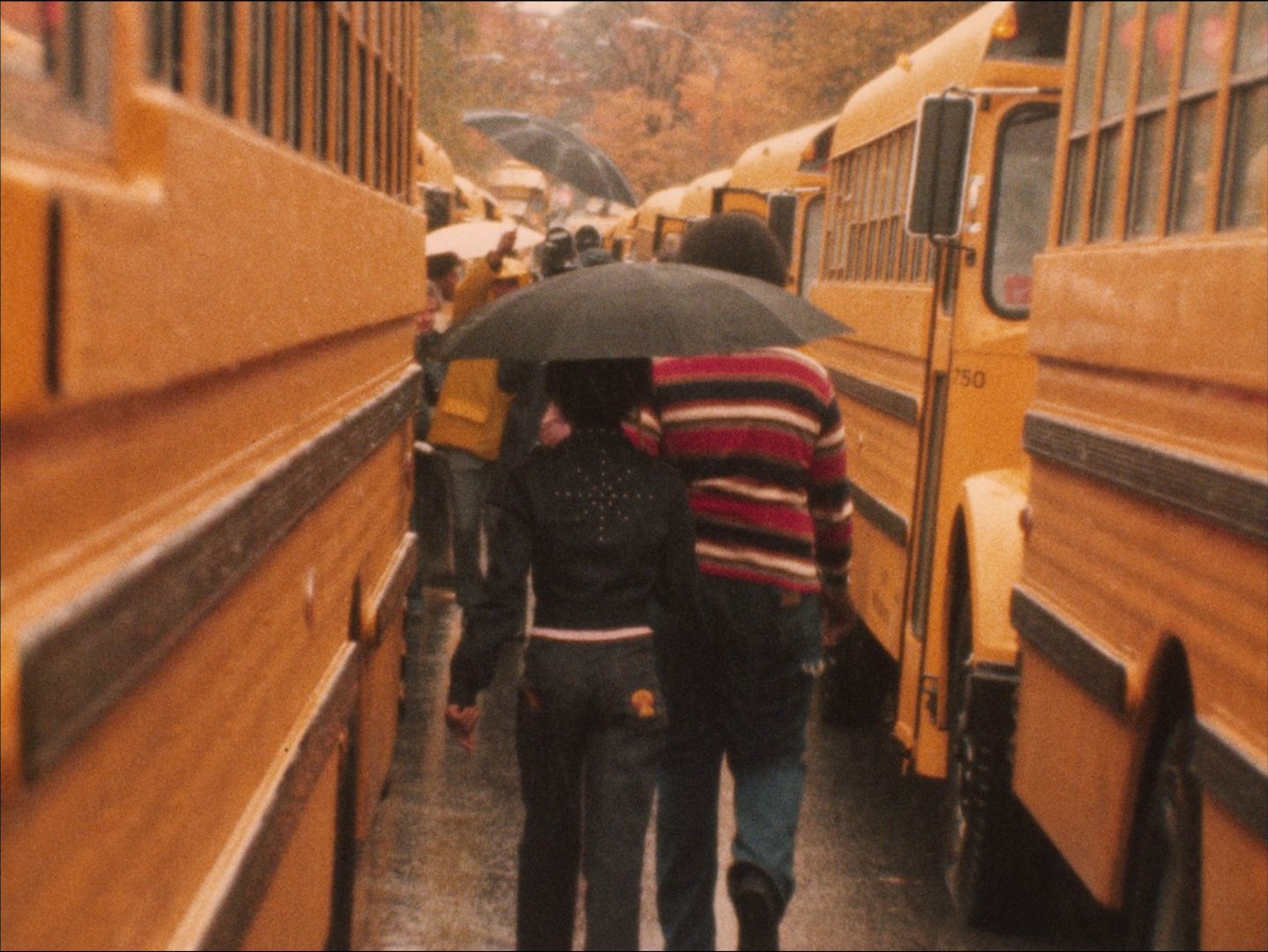
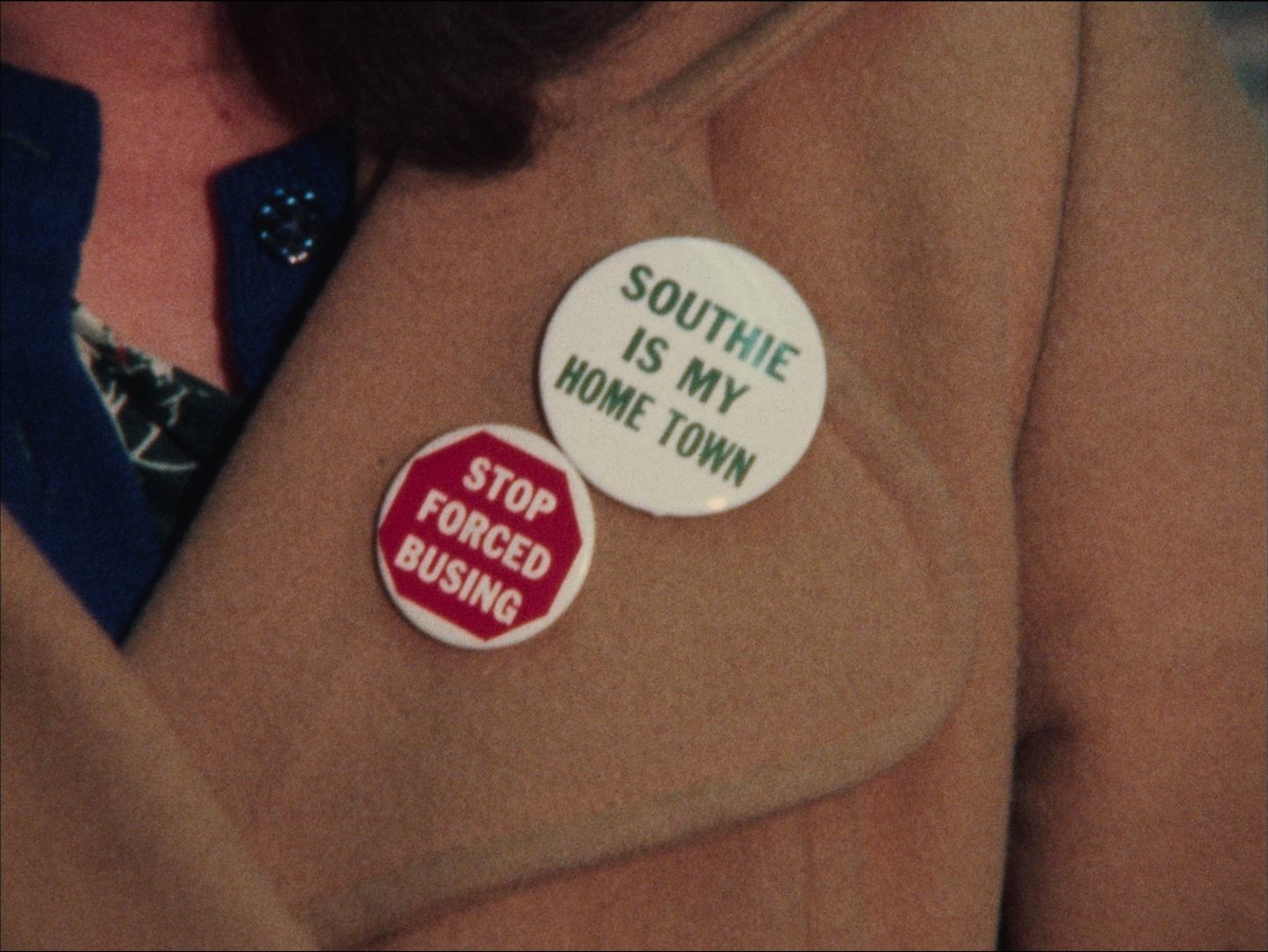
Description: Evening Compass special. Press conference at Boston City Hall during the second week of Phase I desegregation of Boston schools. Frank Tivnan (Director of Communications for Mayor Kevin White) introduces the speakers at the press conference. John Coakley (Boston School Department) gives school attendance figures and analyzes trends in attendance. Robert Kiley (Deputy Mayor, City of Boston) reports that sixteen people were arrested in South Boston and Roslindale today. Kiley voices his concern about the number of young people involved in violent incidents. Joseph Jordan (Superintendent, Boston School Department) and Charles Barry (Deputy Superintendent, Boston Police Department) report that a bus was stoned while passing the Old Colony Housing Project in South Boston. Jordan and Barry report that 200 people were gathered outside of the housing project in the afternoon. Jordan is optimistic that the tension in South Boston will abate. The officials take questions from reporters about school attendance, police tactics in South Boston and the safety of bus routes.
3:02:56: Visual: Ed Baumeister reports live from Boston City Hall, at a briefing by Mayor Kevin White's office and the Boston School Department, after a day of violence and arrests stemming from court-ordered busing in Boston. Reporters include Walt Sanders and John Henning. 3:03:25: V: Frank Tivnan (Director of Communications for Mayor Kevin White) thanks the media for the opportunity to keep the public informed, then outlines the agenda and introduces the speakers: John Coakley (Boston School Department); Robert Kiley (Deputy Mayor, City of Boston); Joseph Jordan (Superintendent, Boston Police Department); Charles Barry (Deputy Superintendent, Boston Police Department). 3:04:24: V: Coakley reports that 54,000 students (67.4% of projected enrollment) attended classes in grades 1 - 12. Shots of reporters looking at handout sheets and taking notes. Coakley notes that attendance decreased in South Boston High School, Roxbury High School, Gavin and McCormack middle schools and South Boston elementary schools but increased at other schools. Coakley gives further analysis of attendance numbers and notes some logistical issues to be resolved in the schools. 3:06:51: V: Kiley gives an overview of the day's events: 16 arrests in South Boston and Roslindale, and 2 injuries requiring hospital treatment. Shots of reporters taking notes. Kiley notes an upswing in calls from parents reporting bruises and minor injuries to their children in the schools. He says that the city is working hard to control and deter incidents of violence and is concerned at the number of young adolescents (aged 12-13) involved in violent incidents. 3:09:45: V: Superintendent Jordan reports on arrests in South Boston; he notes a slight reduction in tension among citizens. He voices the police commitment to the safety of students, calls the violence "deplorable" and is optimistic that the situation will abate. 3:12:00: V: Deputy Superintendent Barry reports that one student was injured by a projectile thrown at a bus in an incident in front of the Old Colony Project in South Boston; that the fine weather attracted many people to the streets, including 200 people outside of the project. Shots of reporters in audience. Jordan takes the microphone and reports that 2 youths were arrested in Roslindale. 3:13:56: V: The panelists take question from reporters. Kiley responds to questions about a possible NAACP motion for US Marshals to come to Boston. Barry responds to questions about the presence of police or US Marshals on buses. Coakley responds to questions about the accuracy of the school attendance figures. Kiley and Tivnan respond to questions about a communication lag between the site of the incidents in South Boston and the communications center at City Hall. Jordan responds to questions about the reaction of South Boston residents to a police rule banning assembly of large groups of people; about the incident outside the Old Colony Project; about security along bus routes; about new police tactics in the coming weeks; about maintaining personnel on the streets and the possibility of changing the bus routes. 3:22:35: V: The panelists take more questions from reporters. Coakley responds to questions about changes in school enrollment percentages from the day before. Kiley responds to questions about whether African American students are really safe in South Boston; about communication between the city government and community leaders in the Old Colony Project; about whether authorities learned about the incident at the Old Colony Project from MDC police. Barry responds to questions about a possible increased police presence at the Old Colony Project. Jordan responds to questions about whether the increased police presence in South Boston will keep South Boston parents from sending their children to school. Coakley responds to questions about the accuracy of attendance figures at South Boston High School; about whether it is possible to educate students in the environment at South Boston High School. 3:31:30: V: Tivnan closes by asking, "any other questions, gentlemen?" Reporters rise to leave. Kiley comments to Tivnan that there is a woman in the audience. Recording ends.
Collection: Evening Compass, The
Date Created: 09/13/1974
Description: Charles Ray, the Headmaster of Roxbury High School, talking to students, parents and faculty members in the offices of Roxbury High School. Pam Bullard interviews Ray in the administrative offices of the school. Ray talks about how the school has changed since the beginning of school desegregation in 1974. He notes that white attendance is still low, but that it is improving. Ray describes the school's bilingual program, and the academic programs set up at the school in conjunction with Harvard University. He says that many students from Roxbury High School received college scholarships last year, and discusses their college opportunities. Ray talks about the atmosphere at the school, and the close relationships between the students and the faculty. He notes that very few students transfer out of the school. He adds that most students feel comfortable at Roxbury High School. Ray says that he tries to learn the names of every student in the school. Ray talks about the challenges of urban education. He says that he encourages pregnant students to remain in school as long as possible. Ray says that he would like to see a program set up to allow students to bring their children to school with them. Ray describes the school's building and facilities. Ray tells Bullard that it is important to treat each student with respect.
1:00:05: Visual: Charles Ray (Headmaster, Roxbury High School) speaks to an African American female student in the office of Roxbury High School. He tells the student what she needs to do in order to change school assignments. 1:01:37: V: Pam Bullard sets up an interview with Ray. Ray talks about some of the photographs in the school office. He notes that the photos were taken by students from the school. Ray talks to a student who has entered the office. The student asks Ray about the television crew in the school office. Bullard notes that the Boston Public Schools are beginning their fifth year of desegregation. Bullard asks Ray how things have changed in five years. Ray notes that Roxbury High School was paired with South Boston High School during the first year of desegregation. Ray notes that only a small percentage of students from South Boston attended Roxbury High School during the first year of school desegregation. Ray says that Roxbury High School was placed in the same district as Charlestown High School during the second year of school desegregation; that Roxbury High School has remained in that district. Bullard asks Ray about white attendance at Roxbury High School. Ray says that the school has more white students now than it had during the first year of school desegregation. He notes that sixty-three white students have been assigned to the school this year; that twenty-five white students are in attendance. Ray says that he would like the Boston School Department to assign more white students to the school. Ray says that Roxbury High School has a bilingual program for Asian and Spanish-speaking students. Bullard asks Ray about Roxbury High School's programs in conjuction with Harvard University. Ray explains that Roxbury High School has been paired with Harvard University by the federal court order governing school desegregation in Boston. Ray talks about a tutoring program in which Harvard students tutor Roxbury High School students. Ray talks about the Harvard Upward Bound Program. He adds that Harvard and Roxbury High School have set up programs for students in advanced math and sciences, reading, and art. Ray explains that teachers and advanced students can take courses at Harvard University. 1:06:46: V: Bullard notes that students who attend Roxbury High School tend to stay at the school and do not transfer out. Ray agrees that not many students transfer out of the school. He adds that most students like the school and the faculty. Bullard asks Ray if many students from Roxbury High School attend college. Ray says that 74 students graduated from Roxbury High School in 1978; that 37 of those students went on to college. He adds that many of the students received scholarships last year. Ray adds that the Girls High Alumni Association has contributed to a scholarship fund for the students. Ray notes that many Roxbury High School students have done well in their college careers. Bullard asks why Roxbury High School has been a successful school. Ray says that the teachers get to know the students and their families very well. Ray notes that the faculty know most of the students by name; that the students feel comfortable at the school. Ray adds that these close relationships are the key to the school's success. Bullard asks Ray if he knows the name of every student at the school. Ray says that he is learning the names of all of the incoming freshmen; that he makes an effort to talk to the students in the hallways. Ray adds that he knows the names of all of the returning students. Bullard notes that all of the students like Ray and speak highly of him. Ray talks about the importance of knowing the name of each student. He adds that the students know that the teachers and other faculty members care about them. 1:11:43: V: Bullard asks how urban education has changed in the past decade. Ray says that programs for special needs students have changed; that pregnant students now stay in school. Ray says that he encourages pregnant students to stay in school for as long as they can. He says that he encourages them to return to school as soon as possible. Ray adds that he would like to start a program that would allow students to bring their children to school with them. He says that it might be difficult for Roxbury High School to meet the safety requirements for such a program. Bullard asks Ray if he would have chosen to be assigned to Roxbury High School. Ray says that he likes Roxbury High School. He adds that the school is structurally sound and has good facilities; that he likes the layout of the building. Ray says that the faculty at the school have a good relationship with the community and with the parents. Ray adds that he likes the atmosphere at small high schools. He says that each student gets personal attention at Roxbury High School. Bullard asks Ray what he has learned over the course of his career. Ray says that he has learned the importance of treating each student with respect. He says that the students treat him respectfully in return. Bullard closes the interview. 1:16:38: V: Ray stands behind the counter of the office at Roxbury High School. He answers questions from a student about her school schedule. Ray confers with a teacher about two problem students. Ray tells the teacher that he will speak to the students. Ray talks to two more students about their school schedules. Ray confers with another teacher in the office.
Collection: Ten O'Clock News
Date Created: 09/13/1978
Description: Press conference at the Boston Schools Information Center on day two of Phase II desegregation of Boston schools. Footage is silent until 00:01:37. Robert DiGrazia (Police Commissioner, City of Boston) takes questions about the arrests of 74 members of the Committee Against Racism, and how the police and judiciary process mass arrests in South Boston. DiGrazia also answers questions about police restraint and police response to violence in the streets. Ed Baumeister (WGBH reporter) notes that there are many arrests for minor infractions and few arrests for major incidents. Greg Pilkington (WGBH reporter) questions the police policy of restraint. DiGrazia says that there is a difference between low visibility and restraint; that police are making arrests. J. Stanley Pottinger (Assistant US Attorney General) discusses the presence of federal marshals in Boston and the ongoing federal investigations into violations of the federal court order. Pottinger says that antibusing activity at night can be considered a violation of the court order. DiGrazia says that police are making great efforts to crack down on violence and vandalism during the evening hours. Peter Meade (Mayor's Office) reports on public safety teams in Charlestown. Marion Fahey (Superintendent, Boston Public Schools) reports on school attendance and atmosphere. She gives information on registration for students without school assignments. Reporters ask Pottinger questions about the federal investigations of antibusing activity. Reporters ask Fahey questions about school attendance and low attendance among white students. Fahey says that attendance will improve as parents and students realize that the schools are running smoothly. This tape has visible time code burned in at the bottom of the screen.
0:01:27: Visual: Press conference at the Boston Schools Information Center. Panelists assemble at a table with microphones. Reporters include Ed Baumeister (WGBH), John Henning, Greg Pilkington (WGBH), and Walt Sanders. Ron Brinn (Information Coordinator for Mayor Kevin White) begins to speak. Audio cuts in and out. 0:03:04: V: A reporter asks about the arrests of 74 members of the Committee Against Racism in South Boston, and a related confrontation with a hostile crowd at the South Boston courthouse. Robert DiGrazia (Police Commissioner, City of Boston) says he has spoken to the parties involved and that the problems at the South Boston courthouse were due to a lack of communication; that Chief Justice Flaschner will work with police and local courts to expedite the booking of arrestees; that he had previously met with Flaschner and others to discuss the expeditious booking of mass arrests; that there was confusion in South Boston on the day in question. A reporter asks if there was a firm agreement with all involved in the meeting to hold court in a venue other than the courthouse if necessary. DiGrazia says there was discussion and plans to implement action if necessary. 0:06:34: V: Baumeister points out that many arrests are made for minor infractions and few arrests are made for more serious acts of violence. DiGrazia responds that there have been quite a few arrests for acts of violence; that members of the Committee Against Racism needed to be moved in order to avoid a major confrontation along a bus route; that the police are trying to neutralize a dangerous situation; that police are showing great restraint. Pilkington points out that restraint by police was not effective during the previous year. DiGrazia interrupts him by saying that there is a difference between low visibility and restraint; that police are actively making arrests this year, but are showing restraint. Reporter asks if there is discussion of calling in the National Guard to aid police at night. DiGrazia says that police are working long hours but performing well; that there are no plans at present to call in the National Guard. 0:09:38: V: A reporter asks about the possibility of federal charges being brought against some arrestees. J. Stanley Pottinger (Assistant U.S. Attorney General) responds that charges are being investigated; that federal and state charges may be lodged; that he is personally involved with five investigations. A reporter asks how federal marshals can aid police in the evening if their mandate is to enforce the federal court order. Pottinger says that certain actions outside of school hours could be handled by the federal marshals as violations of the federal court order; that federal marshals are there to assist police; that federal marshals are working long hours. Pottinger confirms that the Justice Department is investigating an incident at the JFK Home and a Molotov cocktail incident; that they are investigating reports of direct intimidation of individuals trying to comply with the court order; that they are investigating some arrests for the assault of police officers. 0:12:38: V: Pilkington asks if the violence committed by youth gangs in Charlestown constitutes a violation of federal law. Pottinger says that the violence may be a violation, especially if the violence involves an assault on a police officer or a fire official. Reporter asks what will be done about nighttime violence and vandalism. DiGrazia says that he will increase police numbers in Charlestown and South Boston; that police will be assisted by federal marshals; that federal marshals will investigate assaults on police officers. A reporter asks Peter Meade (Mayor's Office) to clarify a statement indicating that he has complaints against the media. Meade says that it was a humorous statement directed at a reporter whom he knows well; that he would like to clarify a his answer to a question from yesterday about police presence in Charlestown. 0:15:31: V: A reporter asks Meade what public safety teams are doing to prevent violence and vandalism in Charlestown. Meade says that several people are on the streets trying to calm the situation; that Roberta Delaney (Manager, Charlestown Little City Hall) will hold a meeting that afternoon with a public safety team; that antibusing leaders in Charlestown have made it clear that they do not support violence. A reporter asks DiGrazia to compare today's violence in Charlestown to that of the previous day. DiGrazia says that police did a good job in defusing a difficult situation today. A reporter asks if federal marshals will be on duty for the evening. Pottinger says that the federal marshals will not be on patrol; that they will be available upon request from police. 0:18:09: V: Brinn introduces Marion Fahey (Superintendent, Boston Public Schools). Fahey thanks the public safety officials. Fahey says that attendance is up for both African Americans and whites; that there has been one suspension and no arrests; that the climate in the schools is good; that extracurricular activities are proceeding. Commissioner DiGrazia excuses himself and leaves. A reporter asks Fahey about low white attendance in West Roxbury. Fahey responds that they are watching the situation and will contact students who are absent. Reporter comments that attendance in elementary schools is primarily African American. Fahey says that some white parents may be waiting to assess the climate at the schools before sending their children; that she is confident that white attendance will go up. 0:21:37: V: A reporter asks Pottinger if there are some individuals under investigation who have not been arrested. Pottinger says yes, but that he will not give details. A reporter asks Fahey about students who have not yet been assigned to school. Fahey gives information on two sites where student registration will be held on the following day. Fahey asks the media to disseminate the information. Fahey says that 800 students were processed in last week's preregistration; that 400 students were processed today; that she has no way of knowing how many students still need school assignments. Fahey tells a reporter that she has no information on the suspension of an African American male student today. A reporter asks Fahey about plans to assess student achievement in the desegregated schools. Fahey says that she is working with consultants on assessing math and reading; that attendance is another indication of school performance. 0:25:21: V: Brinn interrupts to clarify Pottinger's title as he prepares to make a statement. Pottinger explains that he will be absent for a few days for personal reasons; that Robert Murphy (Civil Rights Division, US Justice Department) will be in charge in his absence. Brinn checks with Meade to see if he has a statement, then invites more questions. A reporter asks Pottinger for more detail on investigations of people who have not been arrested. Pottinger says that the investigations are centered on intimidations and threats to those trying to comply with the court order; that the FBI is investigating allegations; that it is possible to move quickly toward indictment if the evidence is sufficient; that he cannot predict when or if an indictment will occur. A reporter asks Pottinger about the five investigations he is involved with personally, and whether they concern people who have not been arrested. Pottinger says that he is familiar with five investigations concerning threats and intimidation as well as arrests made by the state; that there may be other investigations; that there are sitting grand juries available to hear these cases; that he does not think it will be necessary to empanel a grand jury. 0:28:49: V: A reporter asks Fahey where the 25,000 absentee students are. Fahey responds that she does not know. A reporter asks for a summary of the attendance figures. Robert Donahue (Boston School Department) says that the attendance has increased; that some parents have kept children out of school; that attendance will increase as it becomes clear to parents that schools are functioning normally. Fahey gives a rundown of attendance figures for the first and second days of school: that attendance was 60.3% and 64.1% at the high schools; that attendance was 60.1% and 65.8% at the middle schools; that attendance was 58.1% and 64.9% at the elementary schools. 0:30:44: V: Brinn thanks the panelists and closes the press conference. Baumeister gives a summary of the conference. Reporters mill around the room.
Collection: Evening Compass, The
Date Created: 09/09/1975
Description: Press conference at Boston Schools Information Center to sum up week one of Phase II desegregation of Boston schools. Ed Baumeister introduces the Boston School Report with a summary of the day's events. Ron Brinn (Information Coordinator, Mayor's Office) introduces the participants. Peter Meade (Mayor's Office) comments on a successful opening of schools. Marion Fahey (Superintendent, Boston Public Schools) gives a report on school suspensions and comments that the atmosphere in the schools is good. William Reid (Headmaster, South Boston High School) comments on the opening week at South Boston High School. Pat Brady (Detective, Boston Police Department) reads a police report detailing arrests and injuries. Brady reports that there were no major incidents today and that extra police will continue to be deployed. Dr. Louis Perullo (Boston School Department) analyzes school attendance statistics. Perullo compares attendance statistics from the 1975-76 school year to attendance statistics from the 1974-1975 school year. Reporters ask Reid about an altercation at South Boston High School and the effect of community demonstrations on the atmosphere in the schools. Reid says that outside disturbances have a negative effect on the atmosphere inside the schools. Fahey says that she has no control over demonstrations outside of the school. Fahey reports on increased attendance at the city's magnet schools. Reporters ask Fahey and Perullo about school attendance and the possibility of a non-white majority in the Boston school population. Fahey says that she is not yet ready to predict a non-white majority. Robert Murphy (Civil Rights Division, US Justice Department) reports on the activity of federal marshals in Boston and the ongoing federal investigations into violations of the federal court order. Ann Foley (administrative assistant to Fahey) announces a change in operating hours for the Boston Schools Information Center. This tape has audible time code on track 2 and visible time code burned in at the top of the picture.
17:00:00: Visual: Opening credits read Boston School Report. Press conference at Boston Schools Information Center sums up events during week one of Phase II desegregation of Boston schools. Ed Baumeister gives a summary of the day's events: school attendance dropped to 68.4% from 69.1% on the previous day; six African American students were sent home after a scuffle with white students at South Boston High School; no suspensions at South Boston High School; three peaceful protest marches were held. Reporters at the press conference include Baumeister and Walt Sanders. 17:00:51: V: Ron Brinn (Information Coordinator, Mayor's Office) opens the press conference, reminding all that it is day five of Phase II desegregation of Boston schools. He introduces the panel: Marion Fahey (Superintendent, Boston Public Schools), William Reid (Headmaster, South Boston High School), Ann Foley (administrative assistant to Fahey), Robert Murphy (Civil Rights Division, US Justice Department), Peter Meade (Mayor's Office). 17:01:52: V: Meade says that the school personnel deserve a lot of credit for their efforts; that students and parents deserve credit for behaving responsibly during the first week of Phase II desegregation. Meade says that the opening of schools was a success; that many doubted it would go as well as it did; that the city's problems are not over. 17:03:08: V: Fahey says that she is pleased with the progress made in the schools; that she would like to thank the staff of the school system; that ten African American males, 16 white males, five African American females and three white females were suspended over the past week. She introduces Dr. Louis Perullo (Boston School Department), who analyzes attendance statistics for the school system. She says that there were no arrests in the schools all week; that the atmosphere in the schools is good. 17:05:13: V: Brinn introduces Reid. Reid says that he prefers not to compare Phase I desegregation to Phase II; that they are more prepared this year; that he would like to see higher attendance figures; that the past week at South Boston High School was adequate. 17:06:38: V: Brinn stalls as he waits for Pat Brady (Detective, Boston Police Department). Brady reads a statement from Robert DiGrazia (Police Commissioner, City of Boston). The statement reads that there were no major incidents today; that no students were injured in incidents related to school desegregation during the week; that the peaceful opening of schools was due to increased police presence and effective leadership by community leaders; that 112 arrests were made during the week; that 16 police officers were injured; that DiGrazia is pleased with the events of the past week; that extra police will continue to be deployed. 17:09:00: V: Perullo talks about statistics he has compiled. He compares attendance statistics from a Thursday and Friday during the first week of Phase I busing with statistics from a Thursday and Friday during the first week of Phase II. Attendance was down significantly on Friday at all levels during Phase I. Attendance was down slightly on Friday at the high schools and middle schools during Phase II; the elementary schools experienced a slight increase. Perullo says that school attendance usually drops on Fridays. Perullo introduces a table with total attendance by area and level of schooling. He finds that attendance did not change significantly from yesterday to today in any of the areas except high schools; that attendance at Jamaica Plain High School decreased 5.5%; that attendance at Hyde Park High School decreased 6.9%; that attendance at Dorchester High School decreased 5.0%; that attendance at South Boston High School and East Boston High School decreased 4.4% and 5.3% respectively; that attendance at the magnet high schools declined only slightly; that elementary schools in Roslindale saw an increase in attendance of 3.5%. Perullo says that high school attendance increased from 60.3% on Monday to 68% on Thursday; that high school attendance today was down 2.6% from Thursday; that middle schools increased from 60% on Monday to 70.3% on Wednesday; that middle school attendance was down ).7% from Wednesday; that elementary school attendance increased from 58.1% on Monday to 69.8% today. Perullo says that white attendance increased from 56.9% on Monday to 64% on Wednesday; that white attendance was down 1.8% from Wednesday; that African American attendance increased from 62.5% to a high of 75% on Thursday; that today's African American attendance was down 0.6%; that the attendance of other minorities increased from 55% on Monday to 75.9% on Friday. 17:14:52: V: Brinn invites questions from the media. Reporter asks Perullo if he can verify that white students comprise 46% of the school system while African Americans and other minorities comprise 54%. Perullo says he has not yet analyzed those numbers and cannot verify the statistic. Baumeister asks Fahey if she has investigated claims by Frank Power (Headmaster, Charlestown High School), that the projected enrollment numbers are high. Fahey says that she has no answer. Reid says that it is normal to plan for the attendance of every student who might attend, even those whose attendance is doubtful; that students drop out or move away over the summer; that it is difficult to compare actual enrollment to projected enrollment during the first week of school; that actual enrollment is usually less than projected enrollment. 17:17:41: V: A reporter asks Reid about the atmosphere at South Boston High School, as compared to the previous year. Reid says that he does not remember the climate last year; that he has had a good first week of school; that the students were restless today due to a prayer march and rumors of a walkout. A reporter asks Reid about a disturbance resulting in a request for state troopers at South Boston High School today. Reid says that he works closely with Major Gilligan (Massachusetts State Police Department); that Gilligan places troopers where he thinks they will be effective; that decisions concerning the number of troopers are made by him, Gilligan, and the officer in charge of the building; that an altercation at South Boston High School began with an African American student who said he was punched; that three African American students were brought to the office to file reports; that another altercation involving one of these three students occurred after lunch; that he is investigating the situation. 17:20:39: V: A reporter asks Reid if he finds prayer marches and demonstrations outside of the building disruptive. Reid says that any actions taken by the outside community create tension in the school. A reporter reminds Fahey that she had told him that demonstrations outside Charlestown High School had no negative effects on the African American students inside the building. Fahey says that she does not dispute Reid's analysis of the atmosphere in his school; that normal school activity is taking place despite marches in South Boston, Charlestown and Hyde Park; that it is not up to her to restrict parade permits for these marches. A reporter says that Headmaster Power had complained that the number of non-school personnel present at Charlestown High School made it difficult to operate the school. Reid says that he shares Power's concern; that the court order allows 12 community persons to be in the school; that two persons are sufficient to monitor activity and report on the atmosphere. 17:22:54: V: A reporter asks Fahey for observations on the performance of the magnet schools so far. Fahey says that attendance has increased at the magnet schools; that programs in conjunction with area universities will be implemented; that programs are currently under review include a program between English High School and University of Massachusetts as well as an open education program involving the Martin Luther King School and Antioch University. Baumeister asks Murphy if any charges have been filed in cases involving Molotov cocktails. Murphy says that no charges have been filed; that charges may be filed at the end of next week. Baumeister reminds Murphy that the local US attorney has already filed civil charges in one case. Murphy says his office is working together with the local US attorney. Baumeister asks if federal marshals have made any arrests on their own in the past week. Murphy says that they have made no arrests. Baumeister asks if they have been instructed to use restraint. Murphy says that they have been instructed to be professional. 17:24:38: V: A reporter asks Meade if he can share any Police Department intelligence. Meade replies that he does not attend the police intelligence briefings and if he did, he would not share the information. A reporter asks Meade if the mayor will continue to request that two battalions of the National Guard be on call for the city at the expense of $37,000 per day. Meade responds that the decision will be made jointly by the mayor and the governor; that the expense had not been discussed; that a reduction of troops in the public safety plan must be submitted to the court. A reporter asks Fahey if she knows the racial breakdown of the kindergarten population. Fahey says that the school department is making efforts to gather that data. A reporter asks Fahey about the possibility of white students becoming the minority in Boston schools. Fahey says that she is not yet ready to predict a non-white majority; that the school system is engaged in a recruitment program for students of all races; that white attendance has gone up in Roslindale elementary schools; that recruitment is going on in West Roxbury, Jamaica Plain and Brighton; that it is too soon to make predictions. 17:29:26: V: A reporter comments on the fact that white students are staying away from schools in African American communities. Fahey says that this is true; that white parents may be keeping children out until they are sure the schools are safe; that the safety of the schools has been demonstrated over the past week. A reporter asks Fahey how long she thinks parents will wait before sending their children. Fahey says that the decision is up to individual parents. Baumeister asks if Fahey has seen results from the campaign to attract students back to the schools. Fahey says she has not had feedback from teachers; that over the past week teachers have been calling the parents of absentee students; that over the next two weeks teachers will write letters to the parents; that teachers will make personal visits to parents if they get no response from the letters or phone calls. A reporter comments that many classes will be racially imbalanced if white students do not return to schools in the next few weeks. Fahey says that she will refer the matter to the court. A reporter asks if it will be easier for parents to transfer students to a new school if classes are deemed to be racially imbalanced. Fahey reviews the transfer procedure and says that a transfer might be accepted if it does not upset the racial balance in either school. 17:35:01: V: Brinn invites other questions. Brady says that two arrests have been reported since his last report. An African American juvenile male was arrested at the Barton Rogers School for disorderly conduct and an African American juvenile female was arrested for assault and battery with a dangerous weapon relating to an incident on September 9th at the temporary Madison Park High School. Brady confirms 112 arrests for the week. Reporter asks if the Tactical Patrol Force (TPF) will be pulled out of South Boston. Brady responds that the TPF is stationed where it is needed. 17:36:46: V: Brinn invites Murphy to make a statement about the past week's events. Murphy says that he is happy that the federal marshals have made no arrests; that few arrests indicate that the situation is not so bad; that the marshals will continue to be stationed at the schools; that his office is investigating a dozen cases; that he does not expect a dozen indictments; that he is working on these cases with the state district attorney's office, the US attorney's office, the FBI, and the Bureau of Tobacco and Firearms. 17:38:28: V: Foley announces a change in operating hours for the Boston Schools Information Center. Foley says that the phone lines will be open until 5:30pm; that the center has received very few calls during the evenings. Fahey thanks the media and mentions that she will no longer attend press conferences on a regular basis; that she will be working hard to improve programs in the schools; that Boston is dealing with the same problems that many urban schools are facing. Fahey excuses herself. Brinn thanks the participants and the media, then closes the press conference. Baumeister gives a summary of the press conference.
Collection: Evening Compass, The
Date Created: 09/12/1975
Description: Meg Vaillancourt reports on controversy over a new student assignment plan for the Boston Public Schools, which minority members of the Boston School Committee spoke out against at a breakfast commemorating the birthday of Martin Luther King, Jr.. School Committee members John O'Bryant, Juanita Wade, Jean McGuire, and Gerald Anderson speak to the media. They do not believe that the plan will provide equitable education for all. The plan was proposed by mayor Ray Flynn. It will allow parents to choose which schools their children will attend. Interview with Flynn, who defends the proposal, saying that it's supported by parents. He adds that School Committee members have been asked for input on the plan. Vaillancourt also reports that Flynn has proposed the decentralization of the Boston School Department and selling off the headquarters of the Boston School Department. Vaillancourt reports that minority members of the School Committee may rescind their support for superintendent Laval Wilson if he supports Flynn's school choice proposal. This edition of the Ten O'Clock News also included the following items: Elma Lewis in Marsh Chapel at Boston University on Martin Luther King Day and Carmen Fields interviews Robert Nemiroff about the playwright Lorraine Hansberry
1:00:26: Visual: Footage of city and state leaders including Michael Dukakis (Governor of Massachusetts), Charles Stith (Union United Methodist Church), Bernard Cardinal Law (Archidiocese of Boston), and Ray Flynn (Mayor of Boston) singing together at celebration in honor of the birthday of Martin Luther King, Jr. (civil rights leader). Meg Vaillancourt reports that local leaders gathered over breakfast today to celebrate Martin Luther King's birthday. Vaillancourt notes that there was controversy at the breakfast over a new assignment plan for students in Boston Public Schools. V: Footage of Juanita Wade (Boston School Committee) speaking to the media. School Committee members John O'Bryant and Jean McGuire sit beside Wade. Wade calls the new plan "segregation redux." Wade says that the Boston Public Schools need to provide choice, equity, and a quality education right now. Footage of Flynn speaking to the media. Flynn says that the plan has the support of the citizens of Boston; that parents are looking for this kind of reform. Vaillancourt reports that the new plan would allow parents to choose which schools their children will attend; that parents have not been able to choose schools since school desegregation began in 1974. V: Shots of buses pulling up to the front of South Boston High School in 1974; of South Boston residents jeering at the buses. Shots of buses parked in front of South Boston High School; of African American students walking among the buses. Vaillancourt notes that the population of white students in Boston Public Schools has declined since 1974; that non-white students make up 70% of the student population in Boston Public Schools. Vaillancourt adds that the School System has been criticized for not providing students with a quality education. V: Shots of non-white students in a classroom; of an African American male student sitting in a classroom. Shot of Flynn. Vaillancourt reports that Flynn and two consultants have proposed a plan to improve the schools and to increase parental choice. V: Footage of School Committee members O'Bryant, Wade, McGuire, and Gerald Anderson sitting on a couch. African American community leaders, including Charles Yancey (Boston City Council), Eugene Rivers (African Peoples Pentecostal Church) and Louis Elisa (Boston chapter of the NAACP), stand behind them. Anderson addresses the media. Anderson says that the Boston School System needs to provide a quality education to all before it can claim to be equitable. Anderson says that the mayor needs to provide more funding to the schools. Shots of O'Bryant and other community leaders. Footage of Flynn being interviewed by Vaillancourt. Vaillancourt asks Flynn if he is surprised by the attitude of the African American community leaders. Flynn says that he has been working on the proposal for several months; that community leaders have had many opportunities to review and give input on the proposal. Footage of Anderson saying that he is offended by Flynn's attitude. Anderson notes that Flynn has said that the statements of the African American leaders are "bogus." Anderson says that the community leaders are standing up for their constituents; that Flynn's statements are "bogus." Footage of Flynn saying that the members of the School Committee have had input on the proposal; that the members of the School Committee voted twelve-to-one in favor of the plan. Flynn says that the School Committee members were told that they would have further opportunities to give input on the proposal. Footage of McGuire saying that Flynn's proposal will cost more money. McGuire says that the School Committee has not been given additional money to fund Flynn's proposal. Vaillancourt reports that the Boston Public School System spends more money per student than any other public school system in the nation. V: Shot of an African American teacher and student at the front of a classroom; of a white male student seated in a classroom; of an African American female student seated in a classroom. Vaillancourt notes that Flynn has come up with another controversial proposal to fund neighborhood schools; that Flynn has suggested the decentralization of the Boston School Department. Vaillancourt adds that the proposal would sell off the downtown headquarters of the Boston School Department on Court Street. V: Shots of the exterior of the Boston School Department headquarters. Footage of Flynn saying that the downtown headquarters of the School Department should be sold; that the money should be put into neighborhood schools. Footage of O'Bryant saying that the School System is going to end up back in court if it does not receive support from the city. Vaillancourt reports that Dr. Laval Wilson (Superintendent, Boston Public Schools) has supported Flynn's school choice plan; that Wilson's contract ends in June. V: Shots of a meeting in the chambers of the Boston School Committee; of Wilson speaking at a School Committee meeting. Vaillancourt reports that the African American members have voted to extend Wilson's contract in the past. Vaillancourt notes that Wilson's future support among the Committee's African American members may depend on his position on Flynn's school choice plan.
Collection: Ten O'Clock News
Date Created: 01/16/1989
Description: Man addresses Massachusetts state government arguing against the Racial Imbalance Law. He notes that it will be impossible to adhere to that law without compulsory busing, and therefore the law should be amended or abolished.
Collection: WHDH
Date Created: 12/08/1970
Description: Interview with Boston School Committee Chairman John Kerrigan. He speaks about the failings of the current busing system, especially concerning elementary school children. He talks about busing on a voluntary basis, but says that he would rather fund other School Committe projects things over any form of busing. He mentions a current bill which proposes amending the racial imbalance law where it concerns elementary school children.
Collection: WHDH
Date Created: 03/1969
Description: Outside South Boston High School. Buses arrive. Mostly black students exit school and board buses. Police cruisers and motorcycles stationed in front of school. Interview with headmaster Jerome Wynegar who says despite some trouble and a severe lack of students, classes will go on, and faculty will try to keep up morale. He says “…kids come here to learn, believe it or not.” Several takes of reporter standup.
Collection: Ten O'Clock News
Date Created: 10/18/1979
Description: Anti-busing rally at St. Margaret's School. Interview with clergyman on his objections to busing, which are based on the dangers of transporting the children, not the schools they are assigned to. Louise Day Hicks attends the rally.
Collection: WHDH
Date Created: 09/12/1971
Description: Evening Compass late edition newscast covering day 3 of Phase II desegregation in Boston Schools. Ed Baumeister summarizes events and report on school attendance figures. Pam Bullard reports that attendance figures show white students to be in the minority: Peter Meade (Mayor's Office) comments on racial makeup of the school system; Cardinal Medeiros (Archdiocese of Boston) comments on influx of Boston students to parochial schools to avoid busing. School officials comment on the opening of schools: Charles Leftwich (Associate Superintendent of Schools) reports a missing bus and problems with buses arriving late; Robert Donahue (Boston School Department) reports on registration for unassigned students; Frances Condon (Boston School Department) reports on kindergarten registration. Bullard interviews Thayer Fremont-Smith (Lawyer, Boston Home and School Association) about the court action to overturn forced busing. Fremont-Smith says that the court-ordered busing plan is too broad and will result in racially imbalanced schools as a result of declining white enrollment. Edwin Diamond (media critic) analyzes Boston Globe coverage of busing crisis with guests Mike McNamee (MIT student) and Robert Healy (Executive Editor, Boston Globe). Healy says that a local newspaper has to deal with the crisis differently than a national newspaper.
Collection: Evening Compass, The
Date Created: 09/10/1975