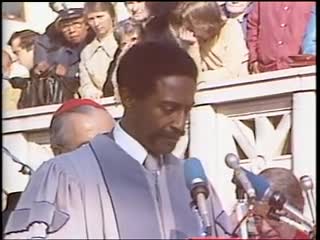
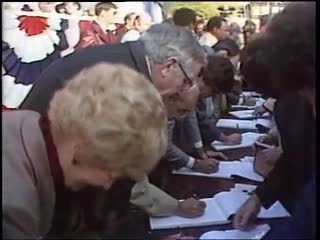
Description: Reporter Christopher Lydon interviews attendees of the inauguration of Ray Flynn as Mayor of Boston, in the Wang Center. The crowd cheers as Flynn and former mayor Kevin White pass by. Lydon interviews attendees of the inauguration in the lobby of the Wang Center. Interviewees express concerns about unemployment, crime, the restoration of city services and the city budget. Cynthia Silveira (Dorchester resident) says that she appreciates Flynn's commitment to diversity and unity but is suspicious of his past voting record on racial issues. Lydon interviews people outside of the Wang Center. Harry Spence (Boston Housing Authority) says that Flynn delivered a "solid" speech, but will face difficulties in delivering city services and achieving racial harmony. George Keverian (State Representative) says that Flynn is the right person to unite the city. Louise Day Hicks (former member of the Boston City Council) says that Flynn must strike a balance between downtown concerns and neighborhood interests. Hicks says that South Boston is the "center of the city." Hicks speaks to Dapper O'Neil outside of the Wang Center. Felix Arroyo (Latino activist) hopes that Flynn will deliver on his promises; Arroyo believes that it will be difficult for Flynn to integrate the city's neighborhoods. Elma Lewis (African American activist) says that she and others will work with Flynn to improve the city. Lewis adds that she is "always looking for diversity." Claire Crawford (Boston resident) says that Flynn is a "people's mayor." Flynn exits the Wang Center and gets in his station wagon; crowd cheers. Lydon interviews James Kelly (South Boston Information Center). Kelly expresses reservations about Flynn's proposal for District Advisory Councils. Thomas Menino (Boston City Council) compliments Flynn's inaugural speech.
1:00:00: Visual: Christopher Lydon interviews a white male about the inaugural speech of Ray Flynn (Mayor, City of Boston) at the Wang Center for the Performing Arts. The man says that Flynn gave a strong speech; that he is optimistic about Flynn's administration. The man says that Flynn will face challenges in improving the schools. Lydon speaks informally to the man. 1:00:45: V: Uniformed officers march up the stairs in the lobby of the Wang Center. People are gathered in the lobby. The audience cheers as Flynn exits a room and proceeds up the stairs. Flynn's young daughter holds his hand as he walks up the stairs. Flynn stops to greet bystanders as he passes. Kevin White (former Mayor of Boston) and Kathryn White (wife of Kevin White) proceed up the stairs after Flynn. 1:02:12: V: Lydon interviews a white man who is a Dorchester resident. The man says that Flynn is the first mayor since Josiah Quincy to have a "sense of the city"; that Flynn is familiar with the neighborhoods and the downtown. Lydon interviews a white middle-aged man about Flynn's speech. The man says that Flynn's speech was very good; that Flynn understands that the government exists to serve the people. The man says that Flynn will face a challenge in restoring city services during an economic crisis. An older white woman says that Flynn's speech was "wonderful." The woman says that Flynn will face a challenge in reducing unemployment; that Flynn's emphasis on unity was important. Cynthia Silveira (Dorchester resident) says that Flynn's speech was good; that she hesitates to trust Flynn because of his past voting record on racial issues. Silveira says that it will be difficult for Flynn to give his full attention to Boston neighborhoods; that she appreciates his commitment to diversity and unity. An older Irish woman recognizes Lydon from television. Her companions explains that they are from the region of Ireland where Flynn's family is from. The second Irish woman says that the speech was "wonderful." An older white woman says that Flynn will be a good mayor if he delivers what he promised in the speech; that it will be difficult for Flynn to reduce the crime rate. An older white man says that Flynn has the right idea; that Flynn will "economize." 1:06:59: V: A crowd streams out of the doors of the Wang Center. Lydon interviews Harry Spence (Boston Housing Authority). Spence says that Flynn delivered a "solid" speech; that it will be difficult for Flynn to deliver services and to achieve racial harmony. Spence says that Flynn's speech expressed his decency and commitment to the people. The crowd continues to exit the building. Groups of people are gathered outside of the doors. Members of the crowd greet Lydon. George Keverian (Massachusetts House of Representatives) greets Lydon and his two daughters. Keverian says that Flynn delivered a good speech; that Flynn's humanity was in evidence. Keverian says that Flynn is the right person to unite the people of Boston. Keverian continues to speak informally to Lydon and his daughters. 1:12:07: V: Louise Day Hicks greets Lydon. Hicks says that Flynn's speech covered many "interesting" and important topics; that South Boston is the "center" of the city. Hicks says that Flynn will need to strike a balance between the neighborhoods and the downtown interests; that Flynn needs to concentrate on affordable housing and crime reduction. Hicks confers with Dapper O'Neil (Boston City Council) on the street outside of the Wang Center. Lydon interviews Felix Arroyo (Latino activist). Arroyo says that the city will be a better place if Flynn can deliver on his promises. Arroyo says that Flynn will face challenges in integrating the neighborhoods; that he appreciates Flynn's commitment to education. Shot of a black car pulled up to the curb in front of the Wang Center. Lydon asks Elma Lewis (African American activist) about Flynn's speech. Lewis say that Flynn put on a good "show"; that inaugural speeches do not mean much; that she and others will work with Flynn to improve the city. Lewis says that she has attended inaugurals for many years; that she would like to have seen "more diversity"; that she is "always looking for more diversity." 1:17:04: V: Claire Crawford (Boston resident) says that Flynn is a "people's mayor." Crawford says that Flynn will face challenges in eliminating racial discrimination. Flynn exits the Wang Center. He greets several groups of bystanders. Photographers crowd around Flynn's station wagon. Flynn clears snow from his windshield. Flynn gets in the car and drives away. The crowd cheers briefly. 1:20:37: V: Lydon interviews Jim Kelly (South Boston Information Center). Kelly says that Flynn gave a good speech; that parts of the speech "concerned" him. Kelly expresses reservations about the District Advisory Councils. Kelly says that Flynn face difficulties in providing services to the city during an economic crisis. Kelly says that the people of South Boston are happy to "have a say" in how the city is run. Lydon begins to interview Thomas Menino (Boston City Council). Menino says that Flynn made an excellent speech.
Collection: Ten O'Clock News
Date Created: 01/02/1984
Description: Judy Stoia interviews Elvira "Pixie" Palladino about her reaction to the Supreme Court's refusal to hear arguments against court-ordered busing in Boston. She is angry about the decision and calls the members of the court a "pack of flaming liberals." Palladino urges the anti-busing movement to continue their protest through legitimate means, like demonstrations and picketing, without resorting to violence. Palladino says that the anti-busing movement will pressure elected officials to redress the grievances of the anti-busing movement. Palladino notes that she is more concerned with a politician's stance on busing than with his or her political party; that she would switch to the Republican Party if the party came out against busing. Palladino says that she is opposed to all forms of busing, including a metropolitian busing plan. Palladino accuses the courts of dictating to parents how they should raise their children; she says that forced busing in Boston represents "reverse discrimination."
0:34:47: Visual: Elvira "Pixie" Palladino is interviewed as she sits behind a table. She says that she is disappointed in the Supreme Court's refusal to hear arguments against court-ordered busing in Boston; that the Supreme Court is a "pack of flaming liberals" and "out of touch with reality"; that she would expect to hear about this kind of "judicial oppression" in the USSR, Cuba or China; that the "shocking" decision will result in increased "white flight" from Boston schools; that the Supreme Court is more interested in redressing the grievances of criminals than law-abiding citizens. Pam Bullard asks Palladino if this is the end of anti-busing action in the courts. Palladino says that they are waiting for an appeal to be heard on the receivership of South Boston High School; that she hopes the court will void the receivership of South Boston High School. Palladino says that the Supreme Court decision will probably result in further resistance to busing; that the anti-busing movement needs to unite in demonstrating against busing through whatever means are left open to them; that the anti-busing movement must concentrate on furthering anti-busing legislation and on electing officials who take an anti-busing position. 0:38:49: V: Bullard asks Palladino about being elected to public office through an anti-busing campaign. Palladino says that government is no longer "of, for and by" the people; that government is now "to" the people; that citizens must be vigilant in protecting their rights; that citizens must elect officials who represent their position on the issues. Bullard asks what recourse anti-busers have if the courts can strike down anti-busing legislation. Palladino says a grass-roots movement could unite the people and put pressure on elected officials. Bullard asks Palladino about the court case concerning Wilmington, Delaware (Evans v. Buchanan), in which suburbs could be forced to integrate their schools. Palladino says that she is opposed to metropolitanization; that she is opposed to forced busing in any form; that forced busing is a failed social experiment. Bullard quotes Palladino as saying that she would not be surprised if anti-busers reacted to the decision in a disruptive manner. Palladino says that she is opposed to violence in any form; that she has received sympathetic calls from anti-busers in Akron, Ohio and Tulsa, Oklahoma; that she is interested in organizing a "constructive" anti-busing reaction. Palladino says again that she would not be surprised if anti-busers react negatively to the decision; that anti-busers may be called on to act as "patriots" to save democracy; that she would like anti-busers to demonstrate their feelings through all legitimate means available. Palladino says that she has never committed an act of violence in her life; that the people of South Boston and Charlestown have been pushed to their limit; that no relief is in sight for the people. 0:43:51: V: Bullard asks Palladino if she feels conflicted as a public official, who must ask her constituents to obey a law she believes is wrong. Palladino says that she is not asking her constituents to do anything illegal; that demonstrating through legitimate means is a legal right; that anti-busers must demonstrate legally, work to further legislation and vote their consciences at the ballot box; that some parents have kept their children out of school for two years; that she fears for the safety of her own children. Palladino says that the government is denying people the basic right to raise their children as they see fit; that the Supreme Court should not dictate where parents send their children to school; that the situation in Boston is a blatant case of "reverse discrimination". Bullard asks Palladino if the anti-busing movement will lobby Tip O'Neill to their cause. Reporter notes that O'Neill will be the new Speaker of the US House of Representatives. Palladino says that O'Neill has not been receptive to the anti-busing movement in the past; that pressure will be brought to bear upon him to represent the anti-busing majority in Boston. Palladino says that voters are crucial to the careers of politicians. Bullard asks Palladino about her voting preferences. Palladino says that she has always voted for the Democratic party; that she would switch to the Republican party if they were to come out against forced busing; that a candidate's position on busing is more important than his or her party affiliation. Palladino says that she is committed to demonstrating against busing through legal means; that she would urge the anti-busing movement to demonstrate non-violently.
Collection: Ten O'Clock News
Date Created: 06/14/1976
Description: Marcus Jones reports on the public's interest in the Pamela Smart trial. Includes interviews with "groupies" that wait overnight for public seating inside the courtroom, or to watch the trial on television in an adjoining room. The trial is being broadcast live throughout New Hampshire (shots of residents watching in bars, nursing homes, etc.) and has gained national media attention. Reporter Bill Spencer says that the live courtroom coverage will help people understand the legal system and make them more willing to serve as jurors, but Marcus Jones wonders whether the "circus atmosphere" surrounding the trial is about "justice, or just entertainment." B-roll follows edited story, including courthouse exterior, metal detector, waiting for a place in courtroom, Court Room One signs, bags being searched before entry, people entering courtroom directly, Pamela Smart entering courtroom, onlookers watching on television in overflow room, shots of Smart testimony on television.
Collection: Ten O'Clock News
Date Created: 03/18/1991
Description: Leader: P2 Pan Am Airline #10078 10/1/74; Mike Taibbi reporter voice over about an open letter in the newspaper from Pan Am employees lobbying for government support to help save the airline. Footage of airplanes and an empty terminal in Logan airport. Reporter standup about the negative impact that the energy crisis had on the airline's financials. Demonstration of Pan Am employees in front of the Massachusetts State House with signs and people chanting. Interviews with Pan Am employees about why they are protesting and legislation that they are supporting. More footage of the employees marching with signs and chanting Hey, hey what do you say, the government needs Pan Am!; Empty Pan Am terminal in Logan Airport; reporter outtakes; interview with a man from the Pan Am management; airport b-roll including air planes taxiing; close up of the ad in the newspaper. [image unstable in sections]
Collection: WCVB Collection
Date Created: 10/01/1974
Description: Rudolph Pierce, Mickey Roache and others hold forum with students at Humphrey Center on "stop and search" tactics by Boston police. Rebecca Rollins reports that Boston lawyers and police officials participated in a forum with students at Madison Park High School. Rollins notes that the topic of the forum was gang activity and the Boston Police Department's stop-and-search procedures. Rollins notes that students and community members have complained about unreasonable stop-and-search procedures by police offiicers. Rollins' report includes footage from the forum. Panelists include Rudolph Pierce (Boston Bar Association), Joan Stanley (Colette Manoil Law Offices) and Francis "Mickey" Roache (Police Commissioner, City of Boston). Pierce says that police have the right to stop a person if there is reasonable suspicion of guilt. Dennis Jean (senior, Madison Park High School) talks about his experiences with police officers who have stopped him. Candido Brown (junior, Madison Park High School) asks why police should be able to search him if he is innocent. Roache tells students that the police department is obliged to protect the rights of citizens. Rollins reports that the forum will help to improve communication between youth and police. Rollins' report includes footage of police officers arresting an African American man. This tape includes additional footage of the forum at Madison Park High School.
1:00:10: Visual: Footage of Rudolph Pierce (Boston Bar Association) speaking at a Madison Park High School. Pierce talks about gang members in Boston. Footage of Joan Stanley (Colette Manoil Law Offices) speaking at the press conference. Stanley says that neighborhood residents are fed up with the activities of some gang members. Rebecca Rollins reports that Boston lawyers and police officials talked about gang activity with students at Madison Park High School. Rollins notes that the lawyers and police officials read fictional scenarios about confrontations between gangs and police. Rollins reports that lawyers and police officials met with students to discuss their differences over the Boston Police Department's stop-and search procedures. V: Shots of the students in the audience at Madison Park High School; of an African American female student addressing the panel of lawyers and police officials. Shot of Francis "Mickey" Roache (Police Commissioner, City of Boston) addressing the students. Footage of a white police officer arresting an African American man. The police officer puts handcuffs on the man, who stands next to a red sports car. Footage of Pierce addressing the students. Pierce says that a police officer has the right to stop and frisk someone if they have reasonable suspicions about the person. Pierce says that the "reasonable suspicion" must be based on facts. Footage of Dennis Jean (senior, Madison Park High School) saying that he and his friends would be stopped and searched almost every day by police. Pierce says that police officers once forced him to drop his pants in public. Pierce says that police officers force people to remove their sneakers; that his friends have had their money stolen by police officers. Pierce says that police officers harass people when they stop to search them. Footage of Roache addressing the students. Roache says that the police often want to act on information that they receive. Roache says that police officers are obliged to protect the rights of citizens. Shots of students in the audience; of the lawyers and police officials at the front of the room. Rollins reports that Roache told students that he investigates every complaint about the improper treatment of citizens at the hands of police officers. Rollins notes that students and police officials cannot agree on what constitutes "improper treatment." V: Shot of two white police officers searching a young African American male on the street. Shot of the lawyers and police officials on the panel at Madison Park High School. Footage of Candido Brown (junior, Madison Park High School) addressing the panel. Brown asks the panel why police officers should be allowed to bother him when he is not doing anything. The students applaud. Shot of a white official addressing the students. Rollins reports that the forum may not resolve the stop-and-search controversy; that the forum will improve communication between youth and police. V: Shots of students at the forum. Footage of Jean saying that the police should be investigating "gang territory." Jean says that police know where the gangs are and what the gangs wear. Jean says that he is not wearing any gang insignia.
Collection: Ten O'Clock News
Date Created: 05/08/1990
Description: Overview of Pope John Paul's recent tour in Canada. Footage of the Pope in parades, surrounded by people, speaking in churches and outside, during ceremonies, on a boat, and in a stadium. Reporter voice over about the tour and the subjects that the Pope addressed throughout reel. Sound.
Collection: WCVB Collection
Date Created: 09/1984
Description: Leader: P1 Parade #9482 7/28/74; Puerto Rico Day parade in Boston.
Collection: WCVB Collection
Date Created: 07/28/1974
Description: Leader: P1 Parade #10198 10/13/74; Silent footage of marching bands, floats, the crowd, and politicians in a Columbus Day Parade.
Collection: WCVB Collection
Date Created: 10/13/1974
Description: Footage of a kids marching in the Memorial Day Parade and a couple floats. Followed by footage of people in a graveyard. Wild sound.
Collection: WCVB Collection
Date Created: 05/30/1976
Description: "Leader: "P1 Parade - McKay #7614 #7616 3/17/74"; St. Patrick's Day parade in Boston. Includes a banner about POWs, no forced busing, and local politicians. Mary Mckay reporter standup. Outtakes include empty street, more parade footage, and reporter outtakes."
Collection: WCVB Collection
Date Created: 03/17/1974